
Podcasts
Mohammed Rustom: A Sourcebook in Global Philosophy
The distinguished scholar talks about the need to extend our definition of philosophy to include works from non-Western traditions and from writers usually classified as religious or mystical. ‘If we’re really teaching the humanities to people, there’s not just one version of humanity that we’re talking about. Why not expose students to all of them?
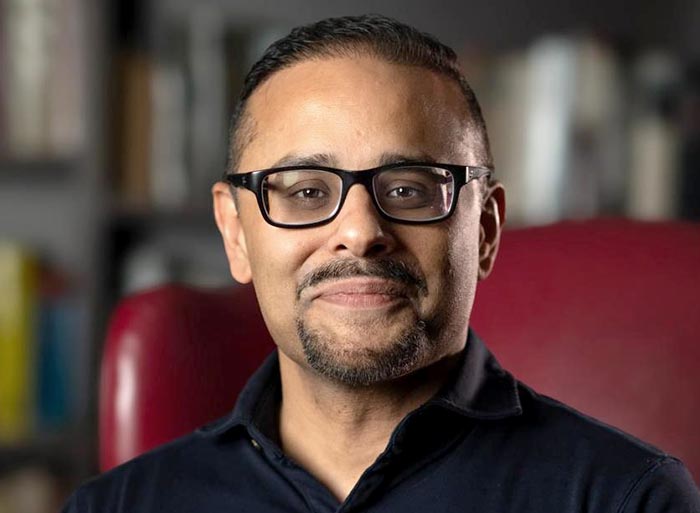
An Interview with Mohammed Rustom
Transcript
Nick: Hello and welcome to the Beshara magazine podcast. I’m Nikos Yiangou, podcast editor for the magazine. And today we are very pleased to interview Mohammed Rustom, who is professor of Islamic thought and global philosophy at Carleton University, an internationally recognised scholar and philosopher whose writings have been translated into over ten languages. He has published over 15 books and 100 articles in the fields of Islamic philosophy, Sufism, Koranic studies, translation theory and cross-cultural philosophy, and has recently edited an enormous compendium of writings, poems and teachings from the non-Western canon called A Sourcebook in Global Philosophy, published in 2025. It’s a sampler drawing from Chinese, Indian, Islamic, African and indigenous sources that brings dozens of these philosophies and spiritual traditions into contemporary English in a way that, if not challenges, then certainly supplements the familiar canon of Western philosophy. Welcome, Mohammed.
Mohammed: Thank you for having me, Nick.
Nick: I’m also joined by my co-host Jane Clark, calling from Oxford in the UK. Hi, Jane.
Jane: Hi, Nick and hello, Mohammed. Can I just say how much I’ve enjoyed reading this new sourcebook. I think it’s fantastic.
Mohammed: Thank you.
Nick: So can we begin by talking about what we mean when we call something philosophy?
Mohammed: Yes.
Nick: The history of philosophy as taught in many Western universities very much focuses on the Western tradition. It tends to run from the ancient Greeks through European thinkers and into modern Anglo–American philosophy. But other civilisations have developed sophisticated traditions of reasoning, metaphysics, ethics and the investigation of reality. Yet these are often classified as religion, wisdom, literature or spirituality rather than philosophy. So could you tell us a little bit about how this hierarchy came about and what assumptions we must reconsider if we are to take global philosophy seriously? Have we unconsciously privileged Western philosophy?
Mohammed: Oh, yes. Absolutely. Thank you. That’s a that’s a wonderful question. And I would say just to be a bit provocative from the get go, I would say it hasn’t been an unconscious privileging. I’d say it’s been very conscious and very conscientiously done. Now a lot of people today, when they write about the need for a more global understanding of philosophy, they begin with the project of colonialism per se, and then how that ended up manufacturing to the rest of the world – that is the colonised peoples in different lands, geographically speaking – various versions of the ‘isms’ that were in vogue in Europe at that time. And of course the philosophical currents that were kind of privileged by the 18th/19th century in Europe were the ones that were then manufactured as philosofia, the love of wisdom. When anyone has a view like that, they have to be willing to probe the multilevel nature of the colonial enterprise and get into all of the institutional dimensions of the academisation of philosophy.
But there’s a much easier route to all of that. That’s one discourse, and I am very much interested in that and involved with it on one level, but I think that if we just look at the general way in which certain notions are mediated by Anglo–American–European traditions, namely the university in particular, outside of colonial and postcolonial contexts, we can see that it’s a very straightforward kind of picture. [It’s] a depiction of philosophy that is that philosophy begins with the Greeks, of course. It’s a Greek word – philosophy. And Nick’s not indifferent to that. Philosofia – the love of wisdom. And it’s recognised by the Anglo–American–European traditions, I would say, as not only being the origins of philosophy or the origins of what is considered the mainstream of philosophy, but really, it’s the place where Western civilisation began. It began in its philosophical institutions. It began through those kinds of major questions and inquiries. And then, of course, it passed down in this genealogy to none other than the Arabs and the Persians. They were the heirs of that tradition of late antiquity. They had nothing original to offer, of course, being, you know, ignorant and people who live in deserts and these kinds of things. But they did enough to at least preserve the material so that it wasn’t lost. And then it went right back to the rightful heirs, through the medieval Latin church, the Church Fathers, and then right back into the bosom of Europe [which is] now conceived as Europe.
And then, thanks to academic scholarship that has kind of bolstered that kind of a picture in a worldview, that’s more or less the genealogy of the history of philosophy that everybody receives, even though today we’re in a very different situation. We have many, many excellent endeavours that seek to globalise philosophy, especially the history of philosophy, beginning with Peter Adamson’s, of course, famous podcast and book series History of Philosophy Without Any Gaps [/]. And he obviously does the exact opposite, being trained in late antique Greek philosophy and Islamic philosophy and being extremely curious and open minded. He’s been able to produce volumes on Hindu philosophy with Jonardon Ganari and other colleagues in different traditions, as well as working on Chinese. He’s done Africana, he’s done Islamic, so on and so forth.
So if we look at the scene, the contemporary scene of philosophy, the way it has more or less been manifested in different institutions of learning [is] that not only does it come out of that genealogy of the history of philosophy and the passing down of philosophical traditions, and ending up rightfully at the right times in the hands of people who could help. So that’s the unique contribution of the people who are not Western peoples. They were preservers. So we thank them for that, and now we know what to do with it. The Arabs and Persians did not know what to do with all of this stuff.
So we need to say a few things about this. So that genealogy – obviously it’s fraught completely; it’s a lie. It’s not true. Just given what we know just about the Islamic intellectual tradition and of course Christian and Jewish traditions in the Islamic world as well – that was a period of robust intellectual, philosophical activity that continues until today. But then look at other traditions. Let’s go further to what they call the Far East. The Far East is not the Far East unless there’s a West. So even then it’s so interesting, but look how far it is from our standpoint. And it’s cool because it kind of tied to Kung Fu and martial arts, so I can kind of see how a philosophy developed there [that] we could use for life, not for thought per se.
So that view of the genealogy of the history of philosophy, it’s taken for granted by the so-called inheritors of the Western philosophical tradition who occupy the philosophical mainstream at universities. In America, for example, and in Canada, North America in general (USA and Canada), there are hundreds of philosophy departments but only a handful of them actually teach traditions of philosophy as standard curricula outside of the Western canon. When they do, it’s just a nod. Just that one little diversity course that they have to offer kind of thing. And even then it’s usually an elective.
So there’s the academisation of the problem of philosophy. But then of course, because the academy, as much as it may like to think that it doesn’t influence the world around it and people think that they’re working in ivory towers and this kind of thing, it really does influence the discourse on the ground. You see it all the way from popular films and how they integrate philosophical concepts like existentialist notions and even phenomenological ideas, all the way right down to popular art and culture and social media. The general proliferation of the idea that wisdom belongs to the West, even though it’s challenged in many quarters, really is normative. It’s quite normative still.
So the question that comes up, of course, is: Does wisdom exist in other traditions outside of the West? And of course it does. But why is it that that is called wisdom or spirituality and this is called philosophy? There, I think, there are two problems that we have to contend with. One, assuming the absolute best of people who want to investigate traditions that are not Western, they do so with the definition of philosophy, love of wisdom, when today a lot of academic philosophy is far from that – it’s almost like mathematics, in symbolic logic and that kind of thing. But they will seek to look at other philosophical traditions and try to see their own traditions in them, and they will fail miserably when they do so. So then the declaration is that there are no philosophical traditions outside of the Western canon. Or they’ll say: Wow, look at that, that sounds pretty cool. Chuang Tzu says this and Hume says that. And then they try to do a comparative thing. But again, the Western tradition is always the arbiter. It’s the arbiter of what makes philosophy philosophy. It’s the arbiter what makes wisdom wisdom.
Now what that volume [The Source Book] has tried to do is decentre that, but not by criticising Western philosophy. I mean, I’m a Westerner myself. I grew up studying the Western philosophical canon and understanding very early what the benefits were to that personally and intellectually, but also what the severe limitations were, having been immersed in the Islamic philosophical tradition for several decades. So that’s kind of where I think we should perhaps [begin], I’ll leave it back to you and we can begin to probe things from that angle. I hope that that was helpful to you to frame things.
Jane: An excellent summary. So on this question of the Western tradition, kind of defining what philosophy is and by extension excluding other traditions from that category: What would you say is radically different in other traditions from the way that we think of philosophy in the West? I mean, we could say, as you’ve already mentioned, that modern intellectual culture very much privileges analytical reasoning and empirical evidence and the separation of the observer from the observed and such like. What do we find in these other traditions which extends those ideas?
Mohammed: Excellent. Thank you for that question, Jane. So the distinctions here are: one is that there is a certain definition of philosophy that comes from the Western tradition, and then that is then seen as the arbiter of those traditions. So that is to say it sets the standard for what is going to be philosophical or it’s willing to acknowledge that there are traditions outside of it that could be philosophical. But again, it has to be measured in reference to what we think is philosophical. It’s kind of a funny problem when you frame it that way. But then there’s a third dimension here, which is that it would of course be extremely not correct to speak of the Western philosophical tradition as one unanimous kind of worldview. There are so many different contending perspectives. For example, in the continental tradition, they are so radically opposed to that analytic approach, and [so it is] no wonder [that] some of some of this global stuff, it’s been of interest to my continental colleagues more than perhaps my analytic philosophy colleagues.
But that is to say also that the Western intellectual tradition didn’t just arrive at its conceptions of philosophy with respect to that genealogy that I mentioned, but it also kind of moved away from its own heritage. If you look at the fundamentally important philosophical contributions of so many authors from not just Plato and Aristotle and Plotinus all the way down to Meister Eckhart, the authors of The Philokalia, Jacob Boehme, even Blake – those are all major philosophical figures, spiritual figures sometimes, who played a humongous role in the development of Western thought. But at some point they were also bracketed out of the equation. So the Western intellectual tradition was looking at other traditions and bracketing them out, and it was looking at its own tradition and saying, well this is more like spirituality. This is more like mysticism and [only] this [other more analytic approach] counts as philosophy.
So keeping that picture in mind, there are many common features in philosophical traditions when you look at them globally. So what unites them under the umbrella of the general term philosophy and the Greek philosofia of the love of wisdom is that they all – that is the Western tradition and the so-called Eastern traditions, if we can use that kind of a fraught dichotomy – is that they all believe that wisdom is worthy of pursuit on one level. Now, what that is, is really the question right here? If you look at many of the investigations, even in contemporary philosophy of mind, they’re concerned with consciousness, with self, with a self, with selfhood, with self-awareness. That’s a common feature you’ll find in Hindu philosophy, Islamic philosophy, Buddhist philosophy, so on and so forth. So there are some general kind of parameters where they all fall into certain categories that could be philosophical and that would be anyone who’s concerned with questions like that. They’re not necessarily asking questions, let’s say, about the biology of the human body. So you can divide them up properly in that way.
But the real question is what are the means and methods by which they then seek to answer these questions. These ancient traditions, which are still very much alive – the Buddhist, the Hindu, the Taoist, the Islamic, the Jewish, the Christian, medieval Christian which are often bracketed out of that equation – they have sought to answer these questions vis a vis their own traditions. Now, again, that’s a feature that Western philosophies also shares in common because they [also] answer those questions within their own traditions; you won’t see an analytic philosopher using Nietzsche to answer the question of the problem of mind–body dualism, because that’s not the tradition that that that person works in.
So it’s kind of funny because the view is that there’s an insistence on a version of philosophy and a certain tradition that understands what that philosophy is as the arbiter of all things. That’s the problem: they’re not willing to look outside of the box, so to speak. And then when they do, they’re very quick to want to reject it. But if you look closely at some of the things that these traditions do speak about, which the Western intellectual tradition has either had as part of its past, or has right now in some way or another, or is desperately grasping for, there are all kinds of interesting relationships between these Eastern traditions (non-Western traditions) and let’s say, the practice, the actual practice, of the human being. So meditation, prayer, so on and so forth, and the way in which that impinges upon the soul and the becoming of the human being in different kinds of worlds, not just this world, but other possible worlds and so on and so forth. So that’s one feature that is largely missing from the contemporary Western philosophical scene. And then when that’s brought in, it’s usually, you know, yoga; you can bring in yoga and some kind of truncated version of some Eastern philosophy and then it’s matched up. But again, it’s always done by academics who are not necessarily invested in the entire picture of that worldview. They’re just taking bits and parts.
And of course there’s an afterlife in a lot of these pre-modern and non-Western philosophical traditions. That is to say, there is an understanding that the human being is accountable at some level of a posthumous state, whatever that might look like. And that perspective doesn’t only colour their metaphysics and their cosmology, but also their ethics. Again, that’s a feature that’s largely missing from, let’s say, Kant onward, where now ethics is not necessarily a question of things that you need to do because of other posthumous states in which there would be a karmic effect of those actions. But they become political kinds of decisions and decisions for activity in the world and setting up the possibilities of the conditions for why you ought to do something. So there the categories often are the same – there’s ethics, there’s metaphysics, there’s cosmology across the board – but you’ll see that depending on the resources of the traditions in question, their approaches and their answers to those questions are radically different. And that’s what I was trying to highlight in the source book, was to show that radical difference there, in all of its diversity.
Nick: A source book of this breadth in inevitably involves choices about which thinkers, texts and traditions best represent the world’s philosophical heritage. Those choices are especially consequential when many of the sources are unfamiliar to Western readers.
Mohammed: Yes.
Nick: So what principles guided your selection?
Mohammed: That’s a beautiful question.
Nick: Can we ask that? Were there particular thinkers or texts that challenged your own assumptions? Or that you especially wanted to bring into wider circulation?
Mohammed: Yes, absolutely. You know, this is really like… So it’s funny because since the book has come out this question in different versions has appeared and… like on the one hand, you know, I’m coming from a particular tradition too. So I have to be very aware, you know, entering into this problem… I had to be very aware of what my own assumptions were about. Otherwise I’d fall into the same trap that I was criticising moments ago. And if I truly believed that the world philosophical tradition has something to offer human beings, then I really need to do two things. 1) I have to try to understand them on their own terms. And 2), I have to recognise that, well, I don’t have any of the resources basically to do that.
So the idea of… originally, the original idea was to write a book on global philosophical traditions. And I learned very quickly, I need at least 17 languages to do that, at least 17. And I’m not Toshihiko Izutsu. So I could never even begin to do something like this. And then not only just the languages, but you need the immersion in the… I’ve studied the Islamic philosophical tradition for maybe about 30 years, and in two particular languages, Arabic and Persian, and a little, very little bit of Urdu. And I feel like I’m just scratching the surface – really genuinely just scratching the surface. And that’s not to sound like trying to be humble. It really is the truth. I just often feel: Wow, there’s so much there, there are so many people we know [about] and there are all these traditions within my own field that I just don’t know anything about or we’re learning about. So the idea that the idea that a single source book is going to do all of it is something that I had to immediately come to terms with and recognise that this was not going to happen.
I had originally been in talks with a certain very big publisher and they wanted this source book quite badly. And I recognised why: it’s because there isn’t such a book like this in existence. There isn’t a source book that’s as comprehensive as this one for now. And my hope, as I say in the preface of the book, is that there are many more like this, and I hope that there are thousands like this, because this is what we need. We don’t need one or two; we need hundreds of these. So with that publisher, I found it very interesting because they were insisting on using the non-Western traditions, whatever you want to call them, but framing them with the Western thinkers. If you have three passages from the Patanjali Yoga, well, you got to throw in a little bit of, let’s say, Bishop Berkeley. If you have a passage from Muhammad Iqbal, you’ve got to bring in Plato.
And I said, no. I said: That’s the problem; what I’m arguing against is this. So the idea had to be – it had to be [that] we had to be comprehensive. There had not to be a predefined understanding of what philosophy is. If we just go on wisdom alone, that would be like the general category that we’re working with, so let’s just go see whichever direction it takes us in. And I was guided by a famous prophetic saying of the Prophet Muhammad. He says that the wisdom is a stray camel of the believer. They grab a hold of it wherever they find it. So I thought: Okay, that will work. Wisdom (ḥikmah, the love of wisdom) surely wisdom is everywhere, so let’s see how it looks in these traditions and in these languages. Then I had to bring together the resources that I had, having taught different philosophical traditions over the years, and make a list, a very preliminary list, of what texts I have found beneficial in the classroom – the things that I had read in translation or in the originals that I thought, hey, this would work; that might not work.
And then to focus on, as much as possible, the big names in each of the traditions as entry points at minimum, and then to focus on lesser figures – or lesser known figures, I should say. So in each of the traditions, the so-called heavy hitters or the superstars, they’re there to the extent that … but as we got into this, we realised there are so many other people who are actually equally as momentous in philosophical depth but about whom we have nothing actually in English. So the other principle was to not use, translation – materials that were translated already. So 75 to 80% of the volume is brand new translations done just for the volume. And that I insisted on, because number one, you want fresh translations, you want stuff that’s not been published before. But I wanted it to be very much a contemporary kind of thing with people who have the same problem that I have in my own tradition and who see Islamic philosophy as a part of a greater part of a philosophical heritage but who are bracketed off for the reasons we were mentioning – [people] who also work in their own respective traditions and who are contending with the same issues.
So thankfully there were about 66 contemporary philosophers and colleagues and really good translators who came forward. And it was the best experience for me because, number one, I learned so much about each of these traditions and these texts. There were things – and I’ll get back to the assumptions being challenged in a moment – that I thought I knew, which I absolutely realised I know nothing about. And three, the way philosophy started looking, depending on the traditions that were coming through, it started to look much more not just diverse but much more profound than one could have ever have imagined. Before coming to this material you would just say, oh, yeah, it’s just wisdom traditions and how interesting. But then you see the level, the depth, the intricacy, the level of argumentation, the philosophical argumentation that’s involved in these traditions and the method, and it’s mind blowing. And then of course, there weren’t just philosophical prose texts that emerged from all of these, but often there were texts, there were poems, there were dialogues, there were artistic texts, literary texts. So again, in doing this, I realised that it’s not just the category of philosophy that’s being challenged, but even the genres that account for what makes philosophy philosophy. I always wondered, why, when I teach Islamic philosophy, do I use storytelling? Because it’s so much easier to use storytelling. But then I realised, oh, this is a feature you find in all of these other traditions too. They also have texts that are intricately detailed and arcane, almost, but they also have versions of those texts and ideas that are accessible to wider audiences.
Now, when it comes to assumptions, I think the biggest assumption of mine that was challenged and that I learned something about and really was very, very surprised about – and it was because of my own ignorance. I had, like so many other people, dabbled with Buddhism for years. I studied it as an undergrad and I teach a global mysticism course, so I teach Buddhist texts: I teach Honan and authors like this. But one of the texts came in – it was an early Theravadan text by Vasubandhu. I think it was one of the first entries in the volume [to come in]. It’s at the end of the volume and it’s [translated] by Charles Goodman [1] and the text directly is arguing against reincarnation; It’s a philosophical defence against why it’s not a tenable position. And I always thought, wait a second, so within Buddhist thought, there are these intra-communal debates. And that was just mind boggling to me, just to see, because I’ve seen the arguments from other traditions, let’s say, but never within the tradition as an internal dialogue.
And what then is a self? All those questions start coming up. And then the other Buddhist texts that started coming, and I started noticing that they really would complement this Vasubandhu text, especially some of these texts that Jay Garfield, who’s a very famous scholar of Buddhist philosophy, had shared with me, including some Tibetan works, which really highlight just how wild it can get and how interesting it can get.
So, in terms of who to include – one of my regrets in the volume is that I was unable to do two things that I tried to do, but I just … it really had to do with what was available, who was willing to do what, and in the time frame that I had given them. I wish I had included more female philosophers because out of the texts, the dozens and dozens and dozens of texts we have, we only have a handful of female philosophers. And I wanted to be able to highlight so many more female voices – that would have been great. So we have a lot of our translators and philosophers working on these texts who were female, but we had very few philosophical texts that were done by females. The few that we do have in the volume are phenomenal. They’re great and I use them both in my global philosophy course. So that’s one regret that I have. And I’m hoping that one day there can be a female global philosophy volume, just with female philosophers, which can easily be done. It can easily be done.
And then I had to also be very careful that my own assumptions and the tradition that I work in, Islamic philosophy, that that doesn’t dominate in terms of the framing. And so not only did I not have, other than the general concept of wisdom as my guiding principle, I tried as best as I could to not put things into Islamic categories, which would have been the easiest thing for me to do. And that’s generally the fault of anyone who’s going to approach an anthology of this nature. It’s always their categories. And I was like: no, no, no, I cannot have that. Like, reincarnation, for example, doesn’t have a place in Islamic philosophy, every philosopher writes against it. So I couldn’t have a section against it, because that would privilege Islamic texts. And then you have one Vasubandhu text. It’s uneven.
So when it came to organising the materials, we came up with five general broad categories. And they could only be determined after all the material came in. So it was quite … when people would ask me: Oh, can I see your table of contents? For the first three years I didn’t really have a table of contents. It was just, well, I’ve got a bunch of texts here and we’ve got to figure this out. And there were some amazing colleagues, of course, who helped. I’d send them stuff [and say]: I have this category here of selfhood and liberation, but, does that really work for, let’s say, this Japanese text that I have? Like, does that really fit here? So some colleagues, they came through. And one of the things that happened was [that] I had originally called the volume, I think it was called Non-Western Philosophy or A Sourcebook of Non-Western [Philosophy]. And one of my colleagues at the University of Toronto, Elisa Freschi, who works in South Asian philosophy, she really pushed against that and said to me: you know, this is the problem. Actually, this itself is going to lead to other problems. And she gave me a very good argument for why. So we ended up coming with this title, Global Philosophical Traditions.
Another thing that I had to bracket out – and again, it’s not because I’m anti-Western, it’s just because I wanted to amplify voices that have not traditionally been represented – I left out your Platos, your Aristotles, and many other authors who I love and am familiar with in the Western tradition, because they’re just covered everywhere. Saint Thomas Aquinas – there are so many texts. Saint Augustine, I would have loved to have brought them in. Dostoyevsky, for example. I really would have wanted a little bit of Dostoyevsky in there too. And the person who was doing it, I think it just didn’t work out in the end, they were unable to get it through. But there were many authors like that: Henry Corbin, for example, he would have been a natural fit; the aforementioned Toshihiko [Izutsu]. Ananda Coomaraswamy would have been perfect for a volume like this. But they’re so widely available and known in English that we also had to bracket out them. And what emerged also from this was that speaking of those lesser-known figures, many of them, not only are they not widely known outside of let’s say their own, philosophical traditions, but even within their own philosophical traditions, there is very little that’s been done on them.
So I remember one of my colleagues, James Robinson, who works on Jewish philosophy, he had given me several texts. Some of them were things like commentaries on Maimonides Guide for the Perplexed. And they were all from manuscripts – Hebrew and Judeo–Arabic manuscripts. He translated them directly from texts that aren’t even in print. So I in the end, I ended up becoming very happy with the wide selection of Chinese, Arabic, Persian, all these texts that we have. I think 16 different languages that are represented in the end. And I would say with all truth and with no sugar coating that that’s like a thousandth of what’s really out there. This is just a snapshot. That’s all that it is. It’s just a snapshot.
Jane: You’ve mentioned that you’ve arranged the book according to these categories and how you came up with these categories. But you could have organised the book just simply by tradition.
Mohammed: Yes, yes. I could have. Absolutely.
Jane: So why did you take this thematic approach? I mean, what do we learn by looking, say, at a section on ‘Ultimate Reality’ with all these traditions presented side by side that we wouldn’t learn if we just had Indian philosophy in one place, Chinese in another, etc.
Mohammed: Beautiful. These are such great questions. This was something, of course, that when it came to organising the text, we contended with for sure. Another way that we had was to categorise it by tradition, as you mentioned. One was just to do it according to the timeline of philosophers. So not to look at categories or traditions, but just to start with Confucius all the way down to the contemporary philosophers. Each of them have benefits. It’s kind of like a trade off. Each of them, they highlight and inflect one or two dimensions, but then they kind of leave out others.
The reason I didn’t want to do it just tradition by tradition was because there was … and I had, an earlier version of that when some of the texts had come in, I started to see if that would work – is that you fail to see the remarkable similarities between the traditions when you just look at all of the texts from one tradition in one category and all the texts from another tradition in another category. And then also the remarkable differences. So they’re actually highlighted very well when they’re brought side by side under a general category.And within the general categories, what I did was, I had to list them historically. So, each of the sections will usually have a Confucian text at the beginning because those are the earliest philosophical texts that we were working with.
So that [thematic ordering} spoke louder and it seemed more meaningful for comparative work and for cross-cultural dialogue than if we were just to look at all these traditions as this is the Buddhist, this is the Hindu, this is the Confucian, this is the Daoist, so on and so forth. And there’s also a practical consideration too, which was that again, depending on the kind of text that came in and the availability of peoples I would have ideally loved to have, [there were] let’s say maybe 15 to 20 texts per tradition. But some of the traditions texts I have 12 or 8 or 6 or 15, so it would also look quite uneven if it was done that way.
And then the other thing that I had to contend with was that these different traditions, most of them do philosophical activity in their own tradition, in usually three or four languages at most. Like the Buddhist texts we have: we have a Korean text; we have a Tibetan text, we have Sanskrit texts, and maybe another tradition, a couple of other languages. But when we get to the Islamic tradition, because of its geographical positioning and its historical development and so on and so forth, Islamic philosophy is done in at least seven languages and really ten, but could get texts from seven different languages. So how do you convey the variety of this when you have an Islamic text that’s in Chinese, that belongs in the Islamic category, but it’s actually in conversation with Neo-Confucian texts. So if you put them in separate categories, they look like they’re not doing the same thing. But when you put them in in a broader category where they’re shared, all of a sudden you’re like: Oh, wow, you mean this literally is an Islamic Chinese text that has the Neo-Confucian context in mind and these thinkers were all trained in that tradition. And you really see that when they’re put together in that way. it was considerations like that, that really guided the organisation.
Jane: So just to move on from that, when you mentioned that you can see how much they have in common and how much they’re different. You’ve mentioned some of the things that they all have common. Can you say very briefly what would be the main commonalities that you see across all these traditions? And again, the main differences?
Mohammed: Yes. Great. So the, the main commonality is they are all concerned with on one level or another, whether it’s an Aztec text or whether it’s a Taoist philosophical text or an Islamic text or whatever the case may be, they’re all concerned with origins. They’re all concerned with: how did all of this come about? How do we account for the multiplicity around us? So the problem of the one and the many. And they’re dealing with it in philosophical ways from multiple vantage points. So the origins, and of course, if you’re going to ask about origins, you’re going to ask about the nature of the cosmos. And then if you’re going to ask about that, then you have to also talk about existence and being. So there’s a lot of commonality and overlap in that general category.
Now their answers and their approaches, in the places where they’re the most similar is often where the difference comes about. Of course there’s different points of emphasis too, but you’ll see a Taoist text will be speaking about the origins of things in the Tao. And then you’ll be reading a Buddhist text that speaks about, let’s say, suffering as the fundamental problem that human beings have to deal with. And they’re both actually grappling with questions of existence, but from very different vantage points. So the category of existence they’re working with and through, but clearly they’re coming up with very different approaches and answers to how to solve that problem.
Another thing that stood out as very common – and surprisingly so to me – was the manner in which they had all emphasised the relationship between language and logic. I never would have thought and known that, that this was the fundamental preoccupation of traditions outside of, let’s say, Western philosophy and Islamic and Jewish philosophy. I just never would have, because those are the traditions that I was most familiar with, I did not realise that many of these traditions had dealt with the nature of linguistic finesse and the relationship between language and naming and what that all means for meaning at the level that they do, especially the Hindu philosophical texts and also some Jain texts too, which did that at a phenomenally even alarming [degree] to me, how it happened, I thought, because they’re dealing with what they would call philosophy of language. But we refused to use categories like that because again, that’ll throw us into our frameworks. These are definitely philosophies of language, but they’re dealing with Scripture. They’re dealing with statements of various religious figures, deities, whatever the case may be in Scripture, and giving examples from them all to come up with some understanding of the relationship between logic and language and so on and so forth.
So epistemology, in general, also was a kind of shared, general perspective. But in the realm of epistemology, again, you have so many different understandings of what it means to know, for example – what it means to be a knower and what is known. Is knowledge something outside of you? Is it something internal to you? And then, here you have many different approaches because you have some authors who are explicitly like materialists, who have a materialist conception of the world and who think that it doesn’t really matter, you know, how much you can know the world because when you do know it, you know it and all of its discrete parts, and then after that, who cares? And then that very much does not take you back to a knowing self. It just takes you back to a material conception of the cosmos. So you find texts like that, for example, which was very surprising. Whereas others come along and say, well, the whole purpose of this life is to really understand that thing that is doing the inquiring – the self. How does it relate to other selves? How does it relate to the supreme self? So on and so forth. One of my favourite texts is the Patanjali Yoga translation by Christopher Key Chapple, because it deals with the nature of self, but also the practice that is required to really turn back on self. And it’s done very beautifully. It’s a very nice translation.
The other area where I found a lot of commonality was in the notion of liberation. So the self is a problem confined, or as we find it, in some kind of world, a cosmos, some kind of existing existential realm. But then, if it’s like that, we also have to understand that in order to know it – to know the self – entails a kind of freeing of the limitations of selfhood. The texts on liberation that we put under in the last category – those were also very interesting because it was very clear that it wasn’t just spiritual liberation we were talking about. Some of the texts that we were looking at, they had to do with existential liberation. For example, we have our last text – it’s a text in Mexican philosophy which is concerned very much with liberation, but not otherworldly liberation at all. It actually comes from a very particular context, like the liberation theology ways of looking at things, and so there’s also a kind of political emancipation. One author talks about liberation and he was from the Catholic tradition. He speaks of liberation as a kind of freeing of yourself from ignorance and the social structures that circumscribe the human project. And then, there are other robust, full out discussions about what liberation means literally: psychologically, philosophically, spiritually, so on and so forth.
So within all the similarities is precisely where the difference came about. But the one place, and I alluded to this earlier, where the most interesting similarities came about – and again, I kind of had a sense of that before I began the project, but seeing the details blow by blow, so to speak, it really surprised me – was in the way philosophy is being done. Like one of the best texts in the volume, in my opinion, is by a Taoist female and it is a poem about basically letting go of the world and attachment and living a simple life and cultivating inwardness and cultivating an awareness of Tao. But it’s done so simply and so beautifully that I thought to myself: Wow, if people lose their faith in philosophy, let’s say, if you just read that one text – it takes you about ten minutes to read it – there’s no way you can be indifferent to the pursuit of what it means to be human after reading that text. It’s so lovely.
So the genres of philosophy really stood out because while you have these heavy, argumentative, philosophical texts like al-Farābī and things like this, you also have these really light kinds of works which are philosophically just as profound and intense. And they’re across traditions and they’re just in different formats and they make it really fun to read because you’re like: Oh well, philosophy doesn’t have to be this boring, heavy activity. Actually, it can look like a literary essay. We have one Urdu text by Wasif Ali Wasif, the famous Pakistani author who died in 1993. And I always say he’s like Ibn ʿArabi and Rūmi in the 20th century if they spoke Urdu. He’s just so wonderful. He literally was a literary author, and he has this text. It’s called ‘Separation and Union’. And I’ve read that text probably to ten different audiences over the years, and every time I read it, somebody in the audience, if not me, cries because it’s so beautiful. And the argument he’s making is simple. It’s in the form of a literary essay of three pages. He says: Basically, look, everybody seeks union with God and union with the cosmos and these things. But did you ever consider how valuable separation is, how good it is for you, how it is what creates all the longing? And he makes an argument favouring, like many Persian authors do, favouring separation over union. It’s remarkable. So I love that.
And the other part of it, again, in terms of similarity, was the manner in which detailed philosophical exposition in these traditions happened through commentary. So again, a unique feature of the volume is that you have key texts like the Bhagavad Gita or major scriptural texts or philosophical texts, like the aforementioned Maimonides Guide for the Perplexed, and then along with those texts are usually some translated materials from major commentators within those respective textual traditions. So you can see how authors within those philosophical worldviews were grappling with the key texts of their own civilisation. And so I found it very interesting – the commentarial method, the commentarial procedures you see across the texts. That was phenomenal. And not just similar in approach, but the concerns were similar. Like this is an important text. We need to really unpack this. And it’s also very helpful for teaching because sometimes you read the originals and you think to yourself, really, what does this actually mean? And then thankfully you have this Sanskrit commentator telling you, okay, this is what this word means. This is what this is, how it relates to this and so on and so forth.
Nick: Wonderful. Well, perhaps we could wrap up with a final question for you about why you think it’s important at this time to developing a much broader global philosophy. So beyond correcting the omissions of history, the book raises a more immediate question: whether engaging with other intellectual traditions might change how we live? We have ecological breakdown, social fragmentation, technological disruption, widespread questions about meaning; all invite us to examine our assumptions about human beings and our place in the world.
Mohammed: Excellent, excellent. So in many ways you answered, when you mentioned the climate change and the problem of technology today and all of these things. This is one of the reasons why a volume like this can be so helpful. Not just a volume like this, but the concept of global philosophy, for all the reasons you mentioned, because these insights impinge so much on our lives as human beings. I always tell my students: Look, if we’re studying philosophical texts from any civilisation and it’s just to study cool ideas, then we’re actually wronging ourselves because we are not historical figures. We’re living beings with blood coursing through us. And we look for meaning. We look for these things. And these authors who wrote them were doing the same thing. So they weren’t writing them as armchair philosophers. There’s this saying in the academy that that’s very popular. It says publish or perish. But how do you write, let’s say, on somebody, let’s say Ibn ʿArabi? – a man whose philosophy would be perish, perish and then if you’re called to, maybe you can publish. [This is a] completely different philosophy, a completely different understanding of what it means to be a person and what it means to produce knowledge, to write about knowledge, so on and so forth.
From the purely academic perspective, because I think that this category of global philosophy can help people in different ways for different reasons. So if we just look at the way the modern academy has been going it’s very obvious to a lot of these people who are kind of the movers and shakers, if you like, of the modern university in different places, that they need to contend with diversity on a cultural level. I’ve seen colleagues literally come up to me, and literally say to me: Look, if we want to be relevant to our students, then we’ve to start teaching non-white materials. Literally one colleague said that to me. And I said to her: I think you’re talking to the to the wrong guy; I’ve been doing this all the time, and I never thought of it as white guys versus non-white guys. That’s just never been the way I’ve looked at it. It’s always been about who’s speaking about truth, about knowledge, about understanding. And they come in all shapes and sizes and colours. So there is that.
So it’s kind of hypocritical as an intention amongst a lot of contemporary people who are concerned with these ideas just to be relevant to students. And you can see how the university engine wants this to happen because while students, they affect enrolment, and I know this for a fact: I’ve seen people, I’ve seen curricula, entire curricula, change around the fact that they weren’t getting enough students to take philosophy classes, because the students didn’t see themselves in them. You can only read so much content if you’re an Indian kid growing up in Canada, for God’s sake. After a while you’ll think to yourself: what resources do I have in my own language, in Hindi, for example? So it’s often because of enrolments and this kind of silly thing. Really, it’s unfortunate, but that is the consideration.
But outside of that hypocritical structure, the universities also, in the best possible traditions of the humanities, do understand, I hope widely, that we need to understand this to really better educate ourselves as living beings. If we’re really teaching the humanities to people, that’s not just one version of humanity and not one version of humanism that we’re talking about. There are so many different brands of that, so many different versions of it, if you like. And why not expose students to all of them? Why not talk about the real great books of human civilisation, not just the great books of one civilisation that happened to win the day because of the aforementioned colonial powers in question. So that’s the academic side of things.
But on the more everyday dimension, the thing that I think these traditions have to offer us, more than anything, is I really believe that they tell us about what it means to be happy – about what human happiness is really all about. I sometimes listen to these different podcasts, interviews, people talking about health and science and all kinds of contemporary problems that people are dealing with. And they all have really interesting insights. Usually they’re not using religion or spirituality or philosophy to unravel these problems. Normally, it’s a neuroscientist, who may or may not be interested in spirituality but they’re going to talk about the science of the brain and how understanding it can lead to happiness. And so I note that there’s so much material out there like that, just on YouTube, that clearly people are fundamentally concerned with being happy, and they’re concerned with the science of happiness – the physical brain chemistry of happiness. There’s a lot of that. But what these authors [in The Sourcebook] have to offer us is not insights about the brain chemistry of happiness per se, but about what it means to be happy as a human being, who finds themselves, barren right now in their current state, outside of any reference to modern learning, which is all of us when we wake up in the morning. We’re all confronted with existential questions right now. Ibn ʿAṭā Allah has a beautiful saying, and I love it so much, it’s an Arabic saying:
When the ignorant person wakes up in the morning, they think to themselves, what am I going to do? But the wise person wakes up and says: What is God going to do with me?
So a lot of these texts try to understand the nature of happiness vis a vis the relationship with the divine, the relationship with ultimate reality in the many different ways it is conceived. And so that is to say, happiness and how to cultivate it, which has everything to do with living.
So a book like this or the texts that it enshrines [and] these global approaches can give to us an understanding of how to pursue happiness in our lives, and then how to ultimately live in such a way that we orient ourselves towards happiness until the very end. And one thing that they are adamant on, is that if you’re going to seek to be happy, there’s people around you, so you have to know how to interact with them. It’s not a solo pursuit even for monks. So we have that one aforementioned Taoist, the author was a monk. In that poem that she shares with us in the book – it’s about all of her suffering and how difficult life has been. But she has such an eye on cultivating happiness in herself and sharing it with others and encouraging others to do so.
So it’s about the pursuit of happiness. And if that’s what people are after, then these traditions have something really to offer to us. And if it’s about pursuing happiness vis a vis the individual loves and lives that we have, and all the people that that we come into contact with, then again, these are philosophies that we need so badly and desperately today.
Nick: Well that’s wonderful, Mohammed, thank you so much. We really appreciate your generosity with your time and for meeting with us. And congratulations on the publishing of this monumental book. We hope it does well and we’re happy to be able to publicise it on this podcast.
Mohammed: I appreciate that very much. And I loved both of your questions. And it’s such a joy to see old friends, to spend some time with you both.
Jane: Yes, indeed.
Nick: It really is.
Mohammed: Yes. Absolutely. Inshallah. Thank you.
Nick: Thank you so much. Thank you for listening. Mohammed Rustom’s book is called A Sourcebook in Global Philosophy, published in 2025 by Equinox Publishing.
You can also subscribe to our podcast on Apple, Spotify, or any of your favorite listening platforms. And in addition to podcasts, there are hundreds of articles on our website, www.besharamagazine.org.
Sources (click to open)
[1] VASUBANDHU: The Commentary on the Treasury of Abhidharma, translated Charles Goodman, p. 497.
The text of this article has a Creative Commons Licence BY-NC-ND 4.0 [/]. We are not able to give permission for reproduction of the illustrations; details of their sources are given in the captions.
read more in beshara magazine

More Podcasts
Interview: Christof Koch: The Neuroscience of Consciousness
The eminent physicist talks about his research in the nature of consciousness, its therapeutic applications and his own experience of non-dual states whilst taking psychedelic drugs. ‘I have to try to integrate what I experience with everything else I know about the world, including the scientific method.’
Interview: Cynthia Bourgeault: The Christian Contemplative Tradition
The radical theologian talks about Jesus as a wisdom teacher and a master of the transformation of consciousness, the practice of ‘self-emptying’ and Centering Prayer, her understanding of Mary Magdalene, and the transitional nature of our times: ‘We’re stuck in a very, very difficult birth canal…
Interview: Satish Kumar: Peace Is Possible
The ecologist and activist talks about his commitment to peace and peace-making, and understanding that peace is not just an absence of war but a positive, harmonious way of living with three aspects: peace with one self, peace with society and peace with nature.
Interview: Clare Carlisle on Transcendence for Beginners
The distinguished biographer and professor of philosophy explores what it means to live a ‘good life’ and the idea – as expressed in the lives of Spinoza, George Eliot and the Indian sage Ramana Maharshi – that we are all ‘modes of the infinite’.
Interview: Professor Mark Williams on Mindfulness Meditation
The Oxford psychologist talks about the development of MBCT, how it can help us look upon ourselves with a compassionate gaze and find peace in a chaotic world. ‘If we live in a universe which is, as David Bentley Hart’s book says, All Things are Full of Gods… then we can’t distinguish a secular practice from a sacred practice.’
Interview: Alastair McIntosh: ‘Riders on the Storm’
The Scottish writer, theologian, and environmental activist talks about climate change as fundamentally a spiritual crisis – a wake-up call inviting us to understand the world as a manifestation of the divine. ‘This is where the evolution of conscious life on Earth has brought the planet to.’
FOLLOW AND LIKE US
@Beshara_Mag








——————————————
——————————————
——————————————
FOLLOW AND LIKE US
@Beshara_Mag
If you enjoyed reading this article
Please leave a comment below.
Please also consider making a donation to support the work of Beshara Magazine. The magazine relies entirely on voluntary support. Donations received through this website go towards editorial expenses, eg. image rights, travel expenses, and website maintenance and development costs.
FOLLOW AND LIKE US
@Beshara_Mag
READERS’ COMMENTS
0 Comments