
Podcasts
Riders on the Storm: Climate, Community and the Survival of Being
The Scottish writer, theologian, and environmental activist talks about climate change as fundamentally a spiritual crisis – a wake-up call inviting us to understand the world as a manifestation of the divine. ‘This is where the evolution of conscious life on Earth has brought the planet to’
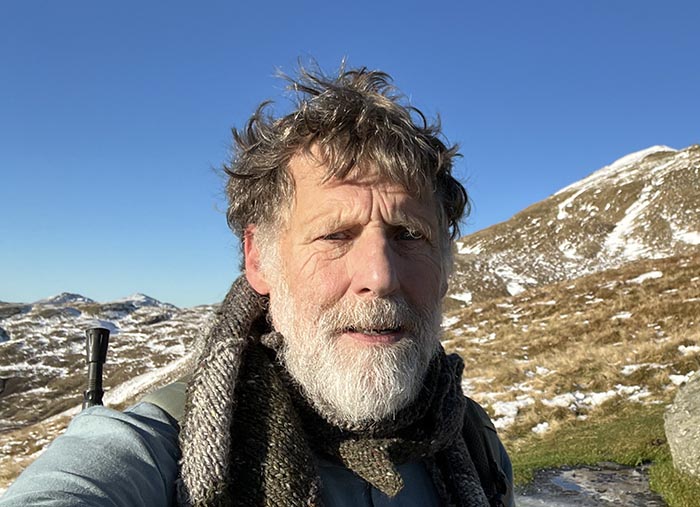
An Interview with Alastair McIntosh
Transcript
Nick: Welcome to the Beshara Magazine Podcast, where we aim to provide a forum for leading-edge thinkers who look at the contemporary world from a perspective of unity. On our website, you will find hundreds of articles by scientists, economists, artists, ecologists and followers of spiritual traditions who are focused on oneness and integration rather than fragmentation and discord. I’m Nikos Yiangou, podcast editor for the magazine, speaking to you from California, and I’m joined today by our executive editor, Jane Clark, who is based in Oxford in the UK. Hello, Jane.
Jane: Hi, Nick.
Nick: Today’s guest is Alastair McIntosh, Scottish writer, theologian, and environmental activist whose work bridges spirituality, ecology, and social change. He is also a Quaker who is deeply committed to nonviolence at every level of life. Raised on the Isle of Lewis, he draws on the deep stories of his Hebridean upbringing to explore belonging, community and the sacredness of place. His latest book is Riders on the Storm (Birlinn, 2020), where he addresses climate science and the debates around it, and the human response required to meet the challenge. Hello, Alastair.
Alastair: Hello, Nick and Jane. It’s lovely to meet you, and to see the human face of your wonderful magazine, Beshara.
Jane: It’s lovely to have you here, Alastair. So… can we begin, by asking you about probably the most basic thing that you say in your work. I know that you regard the environmental crisis as the most important challenge that we face as a human race today, and it is, to paraphrase a line from The Doors’ song, with which you name your latest book, it is ‘the world into which we are thrown’. And you say that it is ‘where the evolution of conscious life on Earth has brought the planet to’. So, as such, you regard it fundamentally as a spiritual crisis, not just a matter of material exploitation or technology. We’d very much agree with this. So could we begin by asking you a little bit about your own spiritual background as a committed Quaker? Were you brought up in the tradition?
Alastair: No, I wasn’t brought up in the Quaker tradition, Jane. I was brought up in the Isle of Lewis. My father was Scottish, my mother was English. I was born in Doncaster in England in 1955, so I’ve just turned 70. When I was 4 years old in 1960, my father, who was desperate to get back to Scotland, went to the island where his uncle had been the first surgeon in the hospital, and where, although we didn’t know it at the time, we actually had very, very distant relatives, and that was the Isle of Lewis in the Outer Hebrides of Scotland, famous for its very strong form of conservative Calvinist religion.
But intriguingly, Jane, you mentioned The Doors, and my line from the songs, or my use of the song Riders on the Storm. And when I saw, you know, a minstrel like Jim Morrison was, who I can’t profess to have known his work well, because it wasn’t exactly what we were raised on when I was growing up in Lewis, but when I saw the name Morrison, I kind of thought, you know, that name is actually an Anglicisation of the Gaelic name, MacGill Vora. Vora is the Gaelic specific name used for Mary as the Virgin Mary. Therefore, the Anglicisation as Mary’s son, because Mac means ‘son of’. Macintosh, Mac an Toisich, son of the chief, is the literal translation of that. So, you’ve got Morrison meaning son of Mary, and I thought, you know, that’s a very Hebridean name. I grew up… amongst many Morrisons, so I dug into it a bit, and sure enough, his Scottish ancestors had roots in the Isle of Lewis, so… I didn’t know that when I was writing Riders on the Storm about climate change.
But, you know, I grew up in this conservative Protestant context, much of which I rejected because of the emphasis at that time – it’s changed a lot now – on hellfire and double predestination. You’re either one of the elect or one of the damned. And then, in the 1980s, I encountered Quakerism, and that spoke very deeply to me because of its mysticism, because of its emphasis on listening for the movement of the spirit, and because of its nonviolence, finding expression in social action.
Nick: So, Alastair, in your latest book, the subtitle for Riders on the Storm is The Climate Crisis and the Survival of Being, and in the introduction, you write that your aim is to go beyond the outward science, policy, and politics of climate change and use it as a springboard to examine deeper questions of being itself. Can you say more about this, please?
Alastair: Well, for that perspective, I have to thank some of my many mentors, and particularly, in the late 1980s and into the early 1990s, I was on the board of a Scottish organisation, the Scottish Church’s Action for World Development, which brought a critical, penetrating, opening-up-the-deeper layers level of critique of what development is, and what it means to be a human being in the world.
Now, it so happened that around 1990, the great Spanish, Indian, Christian, Hindu philosopher and theologian Raimondo Panikkar was giving the Gifford Lectures, which are the very prestigious – in fact, I would say the most prestigious – theological lecture series in Scotland, on the theme of natural religion. And those lectures found publication some 20 years later in the book published by Orbis and Maryknoll, The Rhythm of Being (1989/1990) subtitled The Gifford Lectures.
Now, we in Scottish Churches Action for World Development hijacked Panikkarji while he was here, and we had him come to Glasgow, from where I’m speaking to you just now, and in a hard-pressed area of Glasgow, an area with a lot of poor people, Govan, which is where I live. Not in poverty, I would say, but in sufficiency, but surrounded by a lot of people living hard-pressed lives. So Panikkarji came to Glasgow, to a hall about just a mile down the road from where I’m sitting just now, and he spoke to a conference theme, which was about the meaning of development, called ‘No Life Without Roots’ – [meaning] that unless we have deep spiritual roots we have no life, and therefore there can be no meaningful development in the sense of the original French-Latin etymology of that word, ‘de-envelopper’, to unfold the envelope, you could say. So, Panikkarji came, and he gave a lecture entitled Agriculture, Technoculture, or Human Culture.
That was all part of the backdrop of recognising that the multiple crises of our time that we are facing in the world – of which climate change is one of the most obvious global presenting edges, but you also have poverty, war, prejudice and all the rest of it. At heart, it’s not a question of the science, or the economics, or the politics. It goes much deeper into our spirituality, goes into the nature of being. And I was fascinated that when Panikkarji eventually, just before he died, brought out this book, The Rhythm of Being, to see that there was an epilogue in which he says that 20 years ago – 20 years from 2009 when he wrote this – 20 years ago, he had been trying to publish this book, but had been unable to do so because he had been unable to complete the last chapter which was supposed to be titled, ‘The Survival of Being’. He says: ‘No matter how I reflected on that topic, the results did not satisfy me. On the contrary, what I wrote seemed to be… lucu’… oh, I’m not going to be able to pronounce this word… ‘lucubration’, [meaning] a solemn literary work about something we do not and cannot know anything about. And that he could only move forward when he decided to omit that chapter and replace it with this half-page epilogue. And he concludes:
I must admit that all the ultimate questions cannot have final answers, but that we can at least be aware of the problem we have presented. I’ve touched the limits of my understanding, and must stop here. The Tree of Knowledge, again and again, tempts one at the cost of neglecting the more important tree, the Tree of Life. How can human thinking grasp the destiny of life itself when we are not its owners? That is my humble conclusion. Too much presumptuous research, that is my humble conclusion…too much presumptuous research…It has taken me 20 years to admit this. And I apologise.
Wow. You know, what an ‘out’ from such a great Hindu and Christian, or Vedic and Christian philosopher. What an out, just before he died, to have written that.
Those are the kind of people shaping me, and where the notion of looking at the survival of being, and how ultimately this leads us into the mystery. This leads us beyond what our politics, economics, and science can directly control into the nature of the soul. That’s kind of where I’m coming from.
Jane: So, your point here would be that we review the ecological crisis as a kind of… invitation to assess our position as human beings, or our nature as human beings? Is that what you would mean by it?
Alastair: Absolutely. And, you know, you beautifully used the word invitation there. I see so many activists and people engaged in action on the science and policy and so on of climate change in despair just now, especially given what Trump is doing, and the knock-on effect, so the excuse that that provides to other nations to roll back pledges that had been made on climate change.
And I see people in despair. People have often made very costly commitments in their lives. They see it all rolling back. As they say: we’re all doomed. I don’t think we are, but they say that they’ve lost hope for the future, etc. But I think that if you look at it from a spiritual angle, you can completely turn that around.
And you can see the more challenging situations come on earth, the more the meaning of the prayer, ‘thy community come on earth as is in heaven’ – or as the traditional wording has ‘thy kingdom’, which basically means the community of the realm, that community comes on earth as is in heaven – the more that starts to have traction, and we can treat that as a spiritual wake-up call. We are in this predicament we are in because it is a stage in our and the planet’s evolutionary development. It’s a stage in the evolution of consciousness on earth. Perhaps we had to come to this point. But we need not get stuck here. This is, you know, like Krishna with his conch shell, blowing his conch shell [in the Baghavad Gita], awake, awake. This is the awakening call.
Jane: I mean, I think we would agree with you, and especially as this– particularly the ecological crisis – actually could present itself actually as an existential crisis for humanity. I mean, this is a problem that if we don’t solve it, we may not be. So, leading on to this, in the Riders on the Storm, you undertake a very good, I think, critical analysis of what you see as the two extremes of reaction to climate change. So, you say, on the one hand, there are the deniers who refuse to believe the evidence that science is presenting to us. And on the other hand, there are the alarmists, or the doomsdayers, who you, in your opinion, exaggerate the danger of the situation with essentially good intention of waking people up to the danger. So, but your criticism of both of these as I understand it, is they’re actually both failing to tell the truth about the situation. So, can you say more about what you think would be the right attitude, in the face of what is a very alarming situation?
Alastair: I think the… you say ‘the right attitude’, but what do we mean by that?… And he thereby falls into the trap of presuming to be able to say what is right, having just read from what I read from Panikkaji, ‘20 years, and I apologise.’ …
I think it’s not about the right attitude. I think rather it is about seeking to walk in the way of the Dharma, the unfolding of deep reality. Dharma not just as static law, as it’s sometimes translated, but Dharma as a dynamic force, and the dynamic opening of what Christ called ‘the way, the truth, and the life’.
Jane: So that would imply… I mean, you’re very involved in a lot of activism, and working with a lot of communities and groups on environmental projects, but are you actually saying that in the end, it comes down to what path each individual person walks, the way that they walk?
Alastair: I don’t… I think it’s both… you know, there’s… back in the 1970s, there was an English folk rock band called Steeleye Span, and… I see Nick here nodding…
Nick: I remember them.
Jane: We remember them.
Alastair: Some of us are of a certain vintage! They had an album, and the title of it had a big impact on me at the time. It was called Individually … & Collectively, (1973) or something like that. So it is about doing both our own inner work and also doing the outer political work that we are called to in these times. But, you know, in Hinduism, or the Vedic tradition, however you want to call it, they have this notion of Karma Yoga, the yoga, or the path to union with God, that comes through work. And the interesting thing is that it’s not about what in the Presbyterian tradition would be called ‘justification by works’, i.e., by loading up loads of good karma, you are thereby saved, whatever that means. But rather, and as Mahatma Gandhi very strongly insisted on pointing out, Karma Yoga is about following your calling in life, following your Dharma, following the Tao, following ‘the way, the truth, and life’ to which the inner spirit calls you. That’s where Ibn Arabi is very good. He really understands that sense in which the deep angel of life, calls us. It’s about following that way, truth, and life.
And yet, as the Gita, as the Bhagavad Gita, puts it, renouncing the action… renouncing what follows from that, renouncing in the sense of not being attached to it. In other words, you try to do the right thing as much as is within your means, but you don’t let yourself get caught up in, as Kipling put it, ‘to treat those… to treat success and failure, to treat those two imposters both the same’, or words like that. You know, those words in the poem If, which is a profoundly Bhagavad Gita-type poem. We don’t get caught up in that.
Now, one of the consequences of that is that it allows us not to be… not to be inflated, not to have our egos inflated when our work is successful, but equally, not to be… down-beaten when our work, in an outward sense, is unsuccessful. Because the whole picture, the whole shebang, is so much more than we can comprehend.
If we are truly doing God’s work, our calling is simply to do… to take each next step that is before us. Each next step exposed, no matter how great, no matter how humble, and trust to the greater picture. Anything else is spiritually hubris. Now, I find that very powerful when it comes not just to climate activism, because climate has actually been a small part of my overall work. My overall work is fundamentally about community, about relationship to land and place, about what it means to be a human being.
So, it’s not just about climate change, but it’s about so many other things, so many other things that hit us in life with successes or setbacks. And an attitude to being, that says, you know, ‘Thy will be done’. Or when I translate that in from the Lord’s Prayer, thine ‘opening of the way’ be done, or ‘thine opening of the way be shown to us’. ‘Opening of the way’ is a very favoured Quaker expression. We seek openings of the way when we’re in a stuck place.
Now, you… by the way, the criticism of what I’ve just said to you just now is that… that kicks it into the spiritual long grass. You know, people will say, ‘yes, but what are you going to do about the ever-escalating level of carbon dioxide and the political inaction’? And I say, ‘well, friend, you know’ – and this is where my criticism of alarmism in climate change comes in – I say, ‘well, friend, you know, unless we’re going to do it in ways that move with the democratic process, then the only way we can do this is by persuading our fellow humankind to live differently. And that means doing our own work alongside engaging socially.’
And then my critic will say, ‘Oh, but that’s not going to be fast enough.’ So I say, ‘Well, tell me then, what are you proposing? Are you proposing some kind of green fascism? Are you proposing subverting democracy?’ And that, incidentally, is my criticism of the idea that citizens assemblies should be given sovereign, i.e. legislative, power, because it’s all very well for the hundred people who might have spent a few weekends away being educated about an issue to make wise decisions, but what about the millions who might feel that they are not represented by that process?
‘Are you going to bypass democracy? And if you do… my good friend, have you considered that you might be legitimising approaches to politics that other people who might be less sympathetic on environmental or social issues could equally use to justify bypassing democracy?’ That usually gets them thinking. You know, so easily, we move in bubbles, we don’ think through the unintended consequences of our otherwise seemingly good ideas. So sometimes we just have to roll with it, we have to roll with the suffering, we have to roll with the despair, and yet not let it stick to us. Remember that Karma Yoga principle: do not be bound by your actions, or indeed the actions, the karma, that is, of the world around us, but… live to a higher calling.
Nick, if you’re the same sort of age as me, you might remember the Moody Blues and their wonderful album, In Search of the Lost Chord, (1968) and the final, song, OM, or AUM, as they pronounce the two chords… AUM. And that wonderful line,
Far away, the distant sound
Is with us every day
The rain is on the roof
Hurry high, butterfly.
As clouds go past my head
I know why the skies all cry
OM OM
The world turns slowly round
Can you hear the distant sound?
It’s with us every day
do you know what it says?
OM OM
There you have it. The world turns slowly around. Can you hear the distant sound? Can you hear the divine pulse? What Panikkarji, in his Gifford title, called ‘the rhythm of being’. Can you hear the rhythm of being? It’s with us every day, can you hear what it says? Cosmic horrors. Totality. As Ibn Arabi has it, it brings us into being ‘Alone with the Alone’, [which is the title of a book by Henri Corbin (Princeton University Press, 1998)). And when we are alone with the Alone, we are no longer alone.
There’s this wonderful passage while I’m on that, I’d just like to read it to you. I think it’s my favourite. I found Ibn Arabi very diff… sorry, not Ibn ‘Arabī, I found Henri Corbin who wrote this book about Ibn Arabi and the creative imagination in Sūfism very difficult, as indeed everything else by Corbin I have found difficult. And so it’s one of those books in which I pick out particular passages. But let me just read you here from page 184, Chapter Three on ‘The Creation as Theophany’:
It will first be necessary to recall the acts of the eternal cosmogony as conceived by the genius of Ibn ‘Arabī. To begin with: a divine being, alone, in His unconditioned essence, of which we know only one thing: precisely the sadness of the primordial solitude that makes Him yearn to be revealed in beings who manifest Him to Himself, [insofar] as he manifests Himself to them.
And then it hinges on a hadith, an oral saying from the Islamic tradition – one which, incidentally, the scholars debate as to whether it is a true hadith or not, but I think spiritually, it’s very true. And the hadith is:
I was a hidden treasure, I yearned to be known. That is why I produced creatures, in order to be known in them.
So you’ve got this incredible push of the primordial divine being alone in that primordial nature. And then setting forth, as the Gita so perfectly describes it, you’re unfolding the aims of creation, the multiple cosmoses and all the rest of it, letting forth a whole shebang, Big Bang, and beyond Big Bang, and all the rest of it. And giving it freedom. And that is a critical thing, that love to be loved must be free love. Giving it freedom. And so when people say to me, ‘but how can there be a God when He’ – they always like to call God He – ‘when God Himself allows such suffering in the world, such evil to be carried out?’
The answer that I would have to that is, that unless we have freedom, including freedom not to choose, not to choose the way, the truth, and the life, then it cannot be free love, and so we must be patient through those unfolding aeons of time, in the same way as God in time is patient as the processes of time gradually fulfil themselves into eternity.
That, by the way, is where I’m very grateful to my island Presbyterian tradition, because those people I grew up amongst have a very deep sense of the eternal. They have a very deep sense of time being situated in eternity. Their mysticism, I think, was hidden to me as a youth, because the Calvinist overlay of their religion was so objectionable in certain ways. But as I’ve learned to cut through that, and also as the community itself has evolved to contact the wider world than with the world of the 1960s when I was a boy. As… things have moved on, their spirituality and what I got from them has become more and more clear, Jane and Nick. And I’m more and more grateful for it. And, you know, I therefore often refer to my roots being Presbyterian, Hebridean Presbyterian, as well as my chosen path of Quakerism with a lot of interfaith built into it.
Jane: You wrote about your going back to something of your Hebridean roots in Poacher’s Pilgrimage, which we did a feature on in the magazine in 2017, I think. What was very striking about that was how much you talk about the role of myth and folklore and poetry. Not as we might in the post-Enlightenment world think of them as fantasies, but as real ways of knowing. So, you see the imagination as a real faculty of perception, and in this, you are very much in line with Ibn ‘Arabī and other people, like we’ve covered in the magazine, like William Blake or the Kogi Indians. So, going back to this, how do you see this [when] talking about… the environmental issues or the crises that we’re in? How do you understand the role of the imagination in helping people and communities to find their role in the world?
Alastair: Well, thank you for raising that, because, frankly, I always slightly groan when people ask me to speak about climate change. My first book on climate change was in 2000 and… when was it, 2007 or 2008? Hell and High Water, that had a similar title, Climate Change, Hope, and the Human Condition (Birlinn, 2008). So, you can see where Survival of Being came from that. And that’s because I was asked by the Scottish publisher, Birlinn, to write about the climate crisis, which I was capable of doing, but wasn’t actually what I really wanted to be doing, so I said to Hugh Andrews, the publisher, yes, I will do it, because it’s so important, provided I can meld the spiritual in with it. So in both my climate change books, Hell and High Water and Riders on the Storm, the first half is a matter-of-fact appraisal of the current state of mainstream climate science, the IPCC Intergovernmental Panel on Climate Change, Science for Climate. But the second parts lead us into the spirituality.
However, those two books are not, in my view, my most important books. My most important book, the one I’m best known for, is Soil and Soul, People versus Corporate Power, which came out in 2001, which is about my work on land reform in Scotland, and the successful campaign to protect a mountain in the national scenic area from being turned into a huge roadstone quarry. But I use that – I use those stories – as carriers to get into the deeper aspects of the human condition, and what spiritual life means. So, on the one hand, you’ve got the story, the real… the true story of a community, of which I was a trustee on the land reform committee, so to speak, a community in the 1990s, changing the Scottish attitude to land by showing it was possible to get the land out of the hands of a private owner and run it as a community setup. If you search in Google on the Isle of Eigg, spelled E-I-G-G, you’ll just find loads of videos from all over the world made about what has happened on that island. And then, in parallel, the story with the mountain being saved with the help of a Mi’kmaq First Nations Canadian war chief who came over to help us. And I’m using that to open out applied liberation theology, theology that liberates theology to be doing what theology ought to do, which is to liberate the human condition.
And then, I’ve written 12 books in total, but the… kind of follow through from that is my book you just mentioned, Poacher’s Pilgrimage, (Birlinn, 2016) of which the subtitle in the current version of it, they changed the subtitle, the publisher changed it, the current subtitle is A Journey into Land and Soul. And that is about a 12-day pilgrimage I made through my own island, which is called Harris in the south, and Lewis, the part where I grew up, in the north, divided by a mountain range. And so I’m going 12 days, partly through villages and people well known to me from childhood. And partly four days, entirely alone, across mountains, over rivers, and so on, meeting nobody in extremely… some of the most remote, wildest territory in the British Isles.
And what was I doing on that journey? I was… to simplify, I was bouncing off an expression used by Nora Bateson, the daughter of Gregory Bateson, when I shared a panel with her here in Glasgow quite some years ago. When I pressed her on the question as to how much her father with his books like Steps to an Ecology of Mind, (Chandler Publishing, 1972) was actually pushing forward a spiritual point of view, but very cautiously, as was necessary in those days. She said to me, ‘I think perhaps he was saying that we don’t know, or we may not know, what it is that we are inside of.’ I just thought, what a wonderful expression. We don’t always know what it is that we are inside of. And in what I call the tradition, meaning the Celtic tradition, the tradition or Gaelic tradition in these cultural… Gaelic cultural tradition in these parts, there is a very strong sense of us being inside of something that is far greater than our small individuality.
We have an expression in Scotland – ‘the carrying stream’. And the ‘carrying stream’ is something that I have directly experienced before I ever heard of the expression. I have directly experienced being carried along in a silvery river made up with the voices of the old people in a particularly high-charged situation to do with the Isle of Eigg campaign, and I described that experience in Soil and Soul. And then I discovered, and I’d experienced it one or two other times, a sense of being caught up in a kind of underlying river. I want to say that I’m not talking about something totally fringe here. [There is a] jubilee [publication] of the School of Scottish Studies at Edinburgh University, the Ethnographic Department, if you like, and it’s titled, The Carrying Stream Flows On (The Island Book Trust, 2013) as it celebrates, you can see the ethnographers with some primitive recording equipment at work. So, we have this sense that there is something underlying, and this is why some of our great poets or… cultural writers, people like Hugh McDermott or John Lorne Campbell of the Isle of Canna, had a very soft spot for the writings of Jung, because Jung, of course, speaks of the collective unconscious.
And what they realise is that we already have that deeply embedded in the tradition, but not in ways that would be immediately obvious to the outsider looking in. Because it is what we would call the síth. Now, in Gaelic – and I should say I’m not a Gaelic speaker, I just know a few words – the word sheep S I T H or D H E, means two things. It means the word peace, but it also means fairy. But the fairies in the tradition, like, you know, like the kind of elemental beings that Ibn ‘Arabī was on about in Henri Corbin’s book. Here, the fairies in our tradition are not kind of Tinkerbell with wings and little bells and what have you. Not that kind of approach. Fairy, instead, is… as John… the late John McInnes of the School of Scottish Studies, who was born in the Isle of Lewis and then grew up in Raasay, as John put it, the fairies are a metaphor for the imagination.
And so you see the link there with Corbin, on… Ibn ‘Arabī, because this is all about the creative imagination. And the sìthean, the fairy hill, or fairy knoll, or fairy fort, as they call it in Ireland, the sìthean is a hill, literally and metaphorically, on which you fall asleep. The great bards, the McCrimmons, the great bards and pipers, the McCrimmons, the O’Carillon in Ireland, they fell asleep on the fairy hill, and it said that if you do that, when you wake up, you will either be mad or you will have the gift of the bard, the poetry, the music, the storytelling. There’s probably not much difference between being mad and having the gift of the bard!
And this is why, in… Poacher’s Pilgrimage – so-called because I had a fishing rod for poaching, for illegal fishing in some of the lochs, to try and feed myself for where I went, some of the lochs, the lakes – which I consider to be my most important book, and certainly the spiritually deepest book. I think of it as being an ecology of the imagination. It is an exploration of what it is that we might be inside. And I do quote one line in it from Ibn ‘Arabī. I had not read the book at the time, but I had come across the line quoted elsewhere. He has it here on page 248 of this edition from Princeton Bollingen, that’s a Jungian press at Princeton University, page 248, with this wonderful line here, that… ‘God is a creation of the imagination’, and it’s because God is a creation of the imagination that we pray to Him, and that He exists.’ Quote: ‘Prayer is the highest form, the Supreme Act of the creative imagination.’
So you have this idea that the word creation is to be taken very, very seriously. The creation is not just, you know, in the beginning, God created heaven and earth. It’s that by virtue, at least this is how I would understand Corbin’s interpretation of Ibn Arabi, that it is by virtue of imaginative process that God in God’s self is and has God’s being. The whole shebang is imaginal. Not imaginary, but imaginal reality. That there’s creative quickening. That wonderful word ‘to quicken’. Quicken me, O Lord. That quickening is a quickening of the cosmos itself. Of the divine itself, of being, constantly coming into being, yet always having been being.
Nick: This is actually very interesting because, as you referred earlier, William Blake said something similar, that we don’t have imagination, but the imagination has us. And, similarly, you know, for Ibn ‘Arabī, the imagination is an ontological reality, it’s not a… fictional thing, it’s the nature of being, it’s to do with the nature of being, So we inhabit this, and, with myth and folklore, you very elegantly bring Gaelic folklore and various stories, like you just mentioned, with the fairies, into the character of the land. And you…
Alastair: Well, it’s written in the… I don’t bring it in, it is there. The place, as I show in Poacher’s Pilgrimage, the place is riddled with place names that refer to the mythological, to mythological characters, to – you know, you get direct geological or geomorphological features being most commonly named in place names, but then all over the place, you get the Cnoc Dubhbeg on the Sìthean Mór Beg. The little black hill of… I’m muddling up the Gaelic – the little black hill on the Great Black Fairy Hill. You get place names like that, embedded into the landscape. You only need to look at the old 1850s Ordinance Survey maps, and there they are. It’s just amazing. You’re walking through a mythological landscape. That’s what I unpack in Poacher’s Pilgrimage.
Nick: So you see this as an important part of your activism, so to speak, that bringing out the meaning of the landscape, bringing out the connection to the land is an essential part of community building to bring about…
Alastair: Hugely. It’s like, I mean, you’ll have heard of Loch Neagh in Northern Ireland, which is the largest body of fresh water in the British Isles. I’m on the management advisory group of the Loch Neagh Partnership, and I was just responding to a draft of their future plan, their 10-year plan today. It’s owned by the Earl of Shaftesbury in England, who got it during colonial times, and they’re inching towards a possibility that Nick Ashley Cooper, the Earl, might be willing to gift the bed of the Loch back to the community.
I was just reading a very good management consultancy report about charting this process and taking it forward. And a lot of it is about heritage, and I was saying to them in my response written earlier today, to my mind, the critical thing is to bring out what the loch means to people’s sense of identity and belonging. And that simply having the loch cared for, because it’s very polluted, mainly with agricultural runoff, simply having it cared for by yet another public agency isn’t going to do the trick. Unless the people who live around in the catchment of that loch, which covers half of Northern Ireland and moves… flows partly also from Southern Ireland, unless those people have a sense of biological… bioregional responsibility, the ability to respond, and agency, you’re not going to get long-term traction, or not without it being a huge public… huge and inefficient public expense.
So, you know, what I’m talking about here in terms of mythological connection… is not something pie-in-the-sky, airy-fairy, but it is actually about how we activate very deep motivations within ourselves. And that was why four of the executives from Loch Neagh, four of the board members, came to the Isle of Lewis and Harris to spend a week with me, in October 2024, so they could study how community land trusts, which are followed on from the likes of Eigg and Assynt with community buyouts, and they could see what possibilities there might be for the future management of this body of water. This is a very practical sort of way, Nick, in which the kind of thinking that Ibn ‘Arabī was on about or the kind of thinking that we have in the Celtic tradition can… activate processes in the collective unconscious that give coherence to community and to environmental protection and to human meaning into the future.
It’s good to be able… thank you for these questions, because I find myself replying and thinking to myself that I’m replying, oh, so that’s what it is that we’re doing. You know, I’m already fairly aware of it, but it’s kind of… it’s when somebody asks you in the context of a podcast like this, and I know that you’ll have listeners out there – to whom a warm hello and thank you for being there. It’s in that kind of context that it kind of… draws water from the carrying stream.
Jane: I think this example that you brought about how… about this waterway in Ireland, and also… the project you’ve done on Eigg, do make it very clear what you mean about this thing of survival of being – meaning [that] you’re basically putting into practical action the idea that we kind of – I would say – fully engage with the landscape, or fully engage with the natural world, from this… from this point of view. And in a way, I suppose, going back to ideas of Ibn ‘Arabī, see it not as something external to ourselves, but as something which is reflecting us, or of which we are really and truly part.
Alastair: It’s… I mean, I often think, you know… I’m involved in many different religious groups of different colours. When I say I’m involved, I get asked to speak at them. And so, I’ll go to different churches, Catholic, Protestant, Unitarian, my own Quakerism, and so on. But sometimes I’ll go to one of the Christian churches when they’re having a communion service. And depending on the context, including even in some Catholic context, there may or may not be an invitation to participate in the Eucharist, in the communion service, with the bread and wine. This is my body. Do this in… anamnesis, do this in memory. Not just memory in a shallow sense of remembrance, but I would say, bringing back real presence outside of space and time. This is my body. Do this in memory of me. This is my blood. Do this in memory of me. And what’s, you know, what’s the bread and the wine symbolising there? Now, there’s many different ways that… people of spiritual life have interpreted that. They all have their own ways, but my way is that the bread represents the fabric of the universe. The bread represents material reality. Christ, of Christ Pantocrator. I’m looking at a picture of him on my wall there just now, an icon there. As the Creator, you know, pan-All Creator, the Christ, the All Creator, in the beginning was the Word of John’s Gospel.
Is Christ embodied in the fabric, incarnate, imminent, in the material fabric of the universe, the bread? But that is only possible because that material fabric is quickened, is animated by the blood of Christ, by the spiritual blood. And that’s… A good religion is like a trellis up which the vine grows, so that the grapes can ripen in full sun to sweetness, that makes a strong wine, that brings us to God consciousness, spiritually, metaphorically speaking.
That’s the kind of – to call it a framing is too weak a word. I would say more experience of it that I have. And I don’t mean by that that when I participate in the Eucharist, like most recently in Iona Abbey when I was running a week there, as I do from time to time, and the wine and the bread gets plastered around, I don’t mean, like, a zap out into a mystical experience. In fact, it’s a very ordinary experience, but in a way, that is the point, that the spirituality is not necessarily found only in the far-out states of consciousness (though they’re quite a trip, too!) The spiritual reality is found in the very ordinaryness of it, that the body and blood of Christ are all around and flowing through us. All the time. This is the… nature of the… greater something in which we move and have … and our being, as was, and is, and evermore shall be.
As the Glasgow musician Donovan titled one of his albums, bouncing off an expression in the Hebrew… is it the Hebrew? I forget where I… you can see, I’m a fake theologian, I’ve forgotten where that quote came from, but you know the one that’s about, as was and is, ever more shall be.
Jane: Yes, yes. I think… so, if we could just end up with, a question, going back, drawing on all the… all that you’ve said. You mentioned, earlier that a great many people are in despair at the moment about the state of the world, and also about the way that things are going politically, where it is actually getting worse rather than… rather than better. But you make it very clear that it’s important not to give up hope, and you make this distinction between optimism and hope. So, could we end by asking, what do you see the difference, and how do… how do we sustain hope in this situation?
Alastair: Well, here we are, we’re recording this as Christmas is approaching, though it’ll presumably go out later. But just taking it from where, you know, to dig from where we stand, which is my opening line in Soil and Soul. Right now, we’re in the run-up to Christmas, and I have an app on my phone. It’s actually the, the Catholic Lectionary, the Catholic Daily Readings, which, when I wake up in the morning, I very often just read them over. And just now it’s full of the Christmas story stuff. And you keep on getting, you know, the angel keeps on turning up. It turns up to, Joseph and Zacharias and Mary and the shepherds out on the hill… (makes me… always makes me think of those childhood rhymes as shepherds watched their turnip tops all growing in the field. Oh, a bit of irreverence is good for us!)
But, you know, the angel turns up, and what’s the first thing the angel says? The angel says: ‘Fear not. Do not be afraid. Do not be afraid.’ And as a commentary that I was reading this morning, based on one of the lectionary readings, was pointing out, that is the call to awareness, a call to awakening. Fear not, do not be afraid. It’s at the same time saying, you know, Hark! Wake up! The herald angels sing. And… to me, that is the… message of spiritual activism – that we can only enter into activism, or indeed any kind of an active life, any kind of real embrace of life, if we are not afraid.
But we cannot turn on avoidance of fear just as an act of ego. We cannot do it as an act of personal will. The way in which we become not afraid of what life throws at us is by anchoring into the God Self, anchoring into the Divine Being. Because that… another way which we don’t have time now to talk about, but that is something which can be very experiential, that can be very real, that in times, well, as… I used to lecture regularly to the senior military, and as one officer told me, his job had been to… train the soldiers what to do if they were captured and tortured. And he said, you may find yourself so reduced in everything you think you are that the only thing you will have left is God. Now, we don’t have to wait until we are tortured, but when we see the earth being tortured around us, when we see the poor being tortured, when we see the oppressed being tortured, and when we stand in solidarity with them… fear not, hark the herald angels sing. Wake up. All shall be well. All manner of things shall be well. Because this is about the unfolding of nothing less than Divine Love, of which we are integrally a part.
Nick: I think that’s a wonderful epilogue for the whole question around this crisis of being that we’ve been discussing. Thank you, Alastair.
The text of this article has a Creative Commons Licence BY-NC-ND 4.0 [/]. We are not able to give permission for reproduction of the illustrations; details of their sources are given in the captions.
read more in beshara magazine

More Podcasts
Podcast Interview: Christof Koch: The Neuroscience of Consciousness
The eminent physicist talks about his research in the nature of consciousness, its therapeutic applications and his own experience of non-dual states whilst taking psychedelic drugs. ‘I have to try to integrate what I experience with everything else I know about the world, including the scientific method.’
Podcast Interview: Cynthia Bourgeault: The Christian Contemplative Tradition
The radical theologian talks about Jesus as a wisdom teacher and a master of the transformation of consciousness, the practice of ‘self-emptying’ and Centering Prayer, her understanding of Mary Magdalene, and the transitional nature of our times: ‘We’re stuck in a very, very difficult birth canal…
Interview: Satish Kumar: Peace Is Possible
The ecologist and activist talks about his commitment to peace and peace-making, and understanding that peace is not just an absence of war but a positive, harmonious way of living with three aspects: peace with one self, peace with society and peace with nature.
Interview: Clare Carlisle on Transcendence for Beginners
The distinguished biographer and professor of philosophy explores what it means to live a ‘good life’ and the idea – as expressed in the lives of Spinoza, George Eliot and the Indian sage Ramana Maharshi – that we are all ‘modes of the infinite’.
Interview: Professor Mark Williams on Mindfulness Meditation
The Oxford psychologist talks about the development of MBCT, how it can help us look upon ourselves with a compassionate gaze and find peace in a chaotic world. ‘If we live in a universe which is, as David Bentley Hart’s book says, All Things are Full of Gods… then we can’t distinguish a secular practice from a sacred practice.’
Interview: Lisa Petersen on Somatics and the Wisdom of the Body
The yoga and somatics educator Lisa Peterson talks about her unique form of teaching, which blends together therapeutic practice and spiritual enquiry, guiding students through the lived experience of breath, movement and consciousness.
FOLLOW AND LIKE US
@Beshara_Mag








——————————————
——————————————
——————————————
FOLLOW AND LIKE US
@Beshara_Mag
If you enjoyed reading this article
Please leave a comment below.
Please also consider making a donation to support the work of Beshara Magazine. The magazine relies entirely on voluntary support. Donations received through this website go towards editorial expenses, eg. image rights, travel expenses, and website maintenance and development costs.
READERS’ COMMENTS
2 Comments
Submit a Comment
FOLLOW AND LIKE US
@Beshara_Mag
Thank you for bringing Truth to more people every day,Respect and Love for your communication.
As above “Thank you for bringing Truth to more people every day,Respect and Love for your communication.