
News & Views
Winter Light: On Late Life’s Radiance
by Douglas Penick
Peter Huitson reviews a book which celebrates creativity and deepening perspectives in old age

Claude Monet (1840–1926) in 1923, in his studio with canvases from his Water Lilies series. At 83, he was still painting, although suffering from cataracts and illness. Photograph: Underwood & Underwood/Library of Congress/Corbis/VCG via Getty Images
Winter Light [1] tackles a subject that gets little airtime in a world tilted toward the young. I was drawn to it because, like the author, I am entering old age and seeking inspiration and guidance on how to inhabit this next stage of life as one of growth and renewed possibility. So I welcomed a book with the subtitle On Late Life’s Radiance.
Penick argues persuasively that old age is a time of its own, which is quite distinct from the stages which have gone before. It is a time of losses, both inner and outer and a diminution of capability which pitches us into a state where we feel exiled from our familiar world, estranged from the person we have been accustomed to being. And yet at the same time this process can open us up in a way that allows us to bring to light patterns and qualities of reality that were formerly obscured. I love the idea that the very constraints of old age can, if we allow and accept them, provide fertile ground for new and strange fruits to ripen.
The book is organised into five themed chapters: Body, Linkage, Waiting, Domains of Loss and Domains of Vision. Each provides a slightly different perspective on the potential for a radical blossoming in old age. They all comprise accounts of the author’s personal experience (he was 79 when he wrote it) interspersed with vignettes drawn from the later lives of a wide variety of writers, artists and musicians – both well- and lesser-known, including Titian, Monet, Beethoven, Michelangelo, Turner, Rabindranath Tagore, Andrea Palladio and Stéphane Mallarmé. These illuminate how being curious and open to the unforeseen changes of old age can lead to a new sense of being and meaning, resulting in the expression or articulation of radical subtleties and beauty in people’s artistic creations. Penick’s aim throughout is to offer signposts that might help us discover new pathways and dimensions in our own old age.
He begins with Beethoven. The composer was not particularly old in modern terms, dying at 57, but he had a very distinct ‘late period’ as, in his last 10 years, he not only lost his hearing but also suffered from many other illnesses. Penick quotes Lewis Lockwood:
‘The further decline in Beethoven’s health moved in tandem with his increasing psychological withdrawal and deepening anxiety. Here the emotional and intellectual demands that he made on himself expanded and deepened as he composed the last piano sonatas, the Ninth Symphony, the Missa Solemnis and the last quartets.’ [p. 18]
and comments:
His music drew on […] reserves of inwardness, entering ever deeper currents of grief, frustration, longing and resolution. The music of this late period was […] profoundly mysterious, profoundly challenging and an inexplicable wonder. It […] was not invented or created, but discovered waiting in some deep, uncompromising expanse of spirit. [p. 19–20]
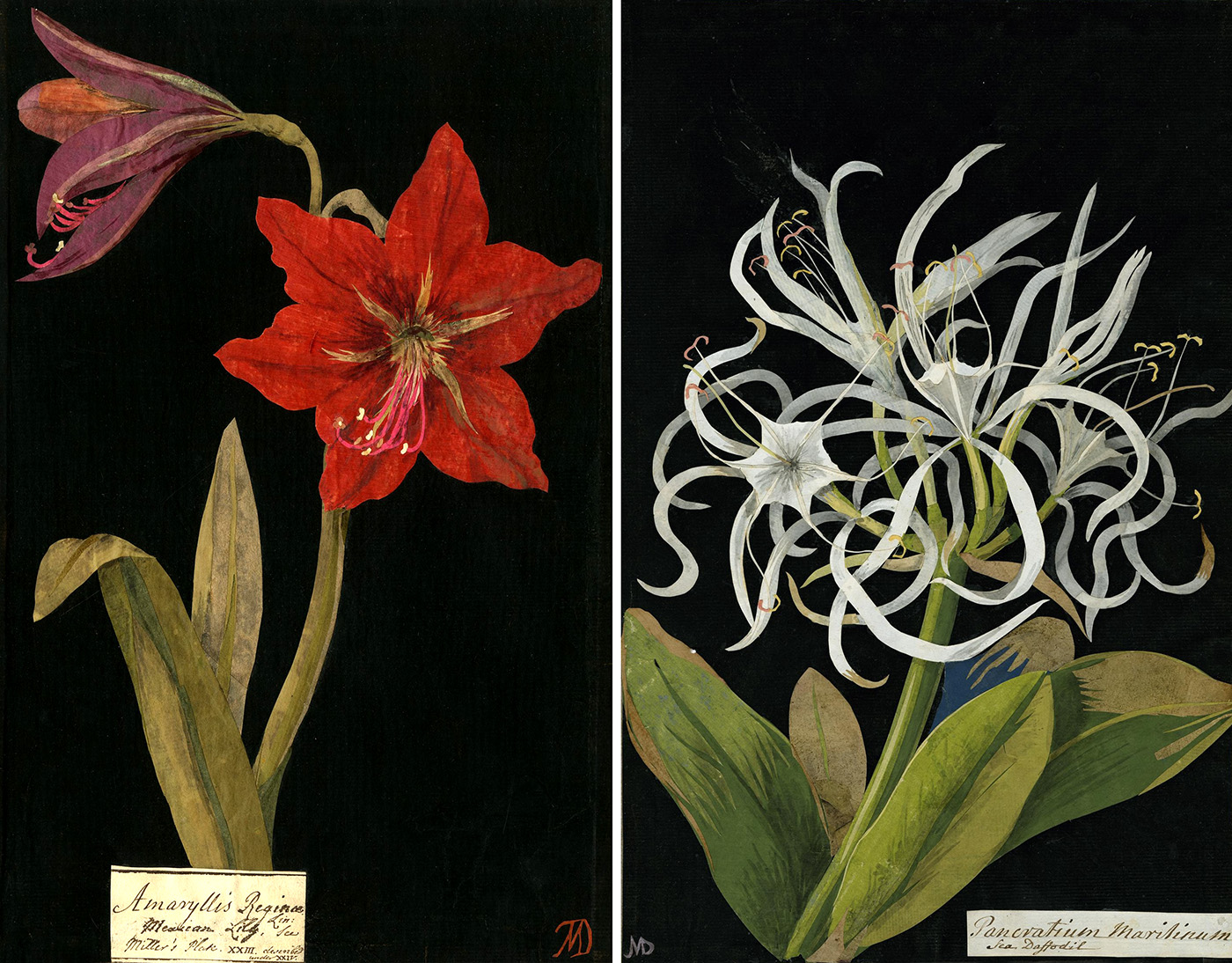
Mary Delany (1700–1788): two of the 985 flower portrait ‘mosaiks’ she created after the age of 72. Left: Mexican Lily (1775). Right: Sea Daffodil (1778). Images © The Trustees of the British Museum (click here [/] for more).
Move your computer mouse over the image to enlarge
Mary Delany: A Flowering in Late Life
.
A major strength of the book is the variety of creative elders Penick chooses to illustrate ‘late life’s radiance’. Each of them comes to find their vocation in their own way, and in many cases, this uncovered identity is not simply a refinement of what has gone before but manifests as a new creative direction.
Take the case of the artist Mary Delany (née Granville) born in 1700. She was brought up for life at court: well-educated, she spoke several languages and was a skilled artist, musician and embroiderer. A change in her family’s fortunes led to a forced and unhappy marriage, but after being left a widow, she cultivated her avid scientific interest in the form and development of plants. In 1743 she married the botanist and gardener Dr Patrick Delany. With his support she developed her shell-work, fine needlework, drawing and painting. But the unifying theme was the flower. As Penick puts it:
Flowers with their infinite, delirious generosity of colours, shapes, smells and transformations, were to this outwardly conventional woman of immense intelligence and sensuous acuity a domain of almost utter freedom. [p. 91]
After 25 years of a happy marriage, she was widowed again and went to live with her long-time close friend, The Duchess of Portland, at her lavish country estate, Bulstrode. This provided her with a huge range of plant life to study, which she discussed in detail with her hostess and with many of the most eminent botanists of the time who came to visit.
When she was 72, Mrs Delany made the discovery for which she is now best remembered:
The petal of a red geranium fell on her black ebony desk and landed accidentally beside a piece of red paper of exactly the same shade and colour. She began cutting the paper to make a replica of the petal. The Duchess happened by … Mrs Delany immediately [understanding] the possibilities of her chance discovery, looked up and remarked: ‘I have invented a new way of imitating flowers.’ [p. 92]
She had discovered a form of collage never seen before. She called her flower portraits ‘paper mosaiks’. But as Penick points out, there was something deeper in her creations that combine the rigour of botany and science with the fluidity and transience of feelings. As he explains:
She used the structural framework of flowers as the pattern on which to explore the subtleties of her inner life, her past and ongoing passions. [Her] subtle art lives in a unique … juncture of the fragile inner structures of flowers, patient skill and the delicate intensity of her vibrant inner life. [p. 93–94]
Delany went on to create 985 paper mosaiks. It is difficult to gain the full effect of seeing them on screen – but looking at her portraits of the Mexican Lilly and the Sea Daffodil, I felt an exquisitely sensitive fragility coupled with a vibrant vulnerability reaching out to embrace me. Yet at the same time, this was grounded in a reassuring exactness of form.
For me, Mary Delany is a striking example of someone who arrived at a sense of self and vocation after a long journey through alien lands. This can be likened to an inner pilgrimage ‘a transformative journey to a sacred centre.’
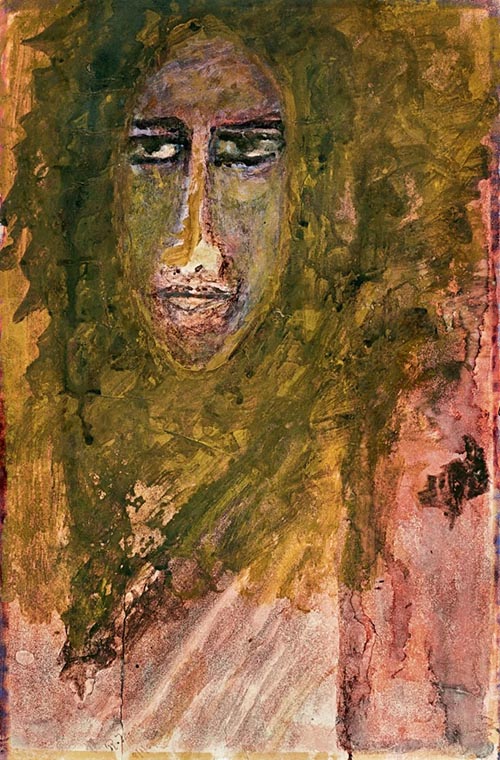
Rabindranath Tagore (1861–1941): Untitled (head of a woman), painted in 1939, when he was 78. Image: Southeby’s [/]
Move your computer mouse over the image to enlarge
A New Perspective on Tagore
.
Winter Light also invites us to look again at people whose life and/or work we might think we already understand and appreciate them in a new way. Take the case of Rabindranath Tagore, the well-known Indian Nobel Prize winning writer and poet. Our article ‘Participating in the Divine Playfulness’ by Hina Khalid focused on Tagore’s notion that each moment the world is being sung into being. In other words, it manifests as a dynamically changing and perpetually enchanting stream of notes, each of which reveals what Tagore called the cosmic harmony (sāmañjasya) of the finite and the infinite.
Penick starts by quoting from his collection of prose poems, Gitanjali, written in 1910 when Tagore was in his early fifties.[2] He sees these as ‘devotional poems that seek to make present the primordial unity within all the world’s disparate aspects. [p. 53] But the poems are also shot through with sadness that results from a feeling of disconnection. Penick quotes:
It is the pang of separation that spreads throughout the world and gives birth to shapes innumerable in the infinite sky.
It is this sorrow of separation that gazes in silence all nights from star to star and becomes lyric among rustling leaves in rainy darkness of July.
It is this overspreading pain that deepens into loves and desires, into sufferings and joy in human homes; and this it is that ever melts and flows in songs through my poet’s heart. [p. 53, Line breaks as I think Tagore intended]
He goes on to tell us that in the following years, as India moved toward independence, Tagore was increasingly affected by the terrible conflicts, fomented by people with unshakeable convictions, that were tearing Indian society apart. He did not feel these tensions could be resolved by words and at the age of 60, turned to painting as his main creative activity. As Penick puts it: ‘it was as if he wanted to listen and connect with the wordless where innate spirituality, undistorted by words and opinions, could still offer an enduring refuge.’ [p. 54]
Tagore said of his own artwork:
My pictures are my versification in lines. If, by chance, they are entitled to claim recognition, it must be primarily for some rhythmic significance of form which is ultimate and not for any interpretation of an idea or representation of a fact. [p. 55]
At another time, he said: ‘What is art? It is the response of man’s creative soul to the call of the Real’.
As Penick explains, the figures in Tagore’s paintings appear in impenetrable stillness, wrapped in a solemn intensity of yearning [p. 55]. I agree. But for me there is something more that Penick fumbles toward but cannot quite grasp. When I look, for example, at the multichromatic portrait of a woman painted in 1939, I see her emerging into the light; longing to bring the unity of reality into the world, but at the same time imbued with sadness and compassion at the seeming impossibility of realising the underlying harmony of the Real in this world of loss and conflict.
It seems that as Tagore got older, his inner vision opened out to explore ever more deeply the apparently discordant qualities that underpin existence. He was guided to his unique style of painting as the only way to express the subtlety of what he perceived in portraits of beautiful and haunting reconciliation.
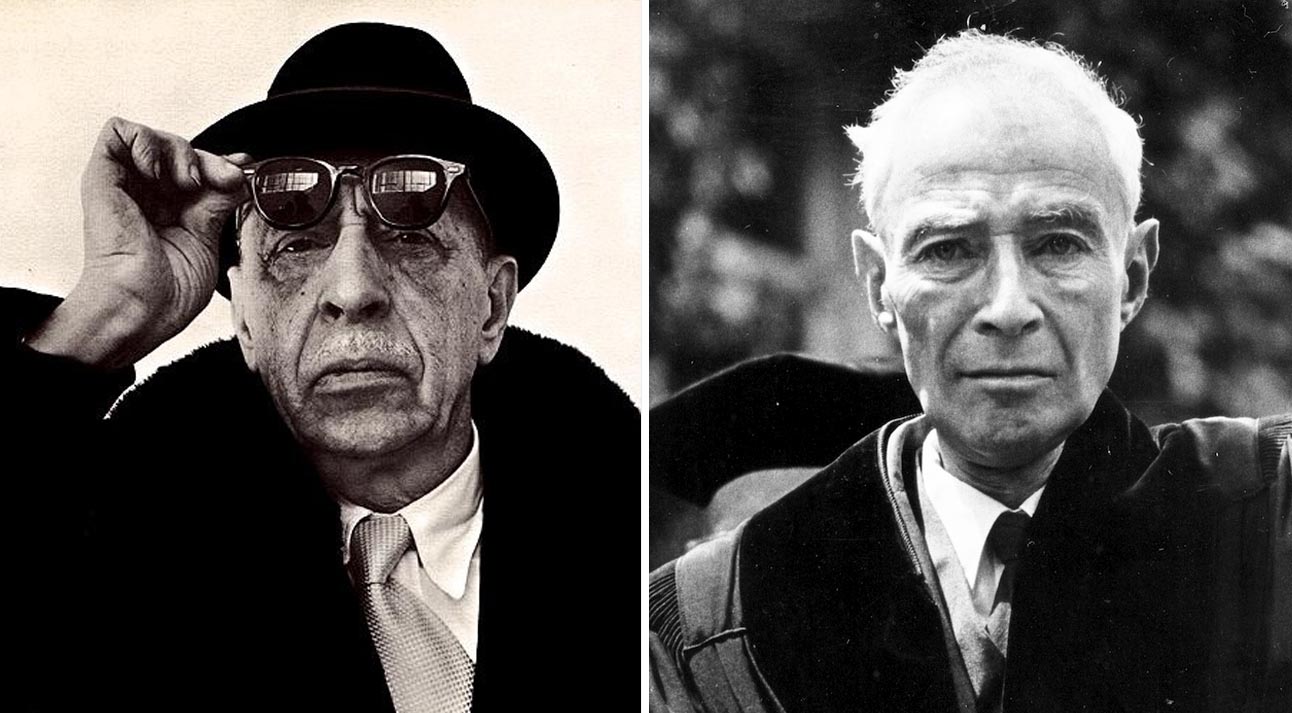
Left: Igor Stravinsky (1882–1971), portrait by Richard Avendon, New York, 1959. Photograph: Corkin Gallery. Right: Robert Oppenheimer (1904–1967). Photograph: AIP Emilio Segrè Visual Archives, Physics Today Collection
An Encounter between Stravinsky and Oppenheimer
.
One of the most moving passages, for me, is in the book’s Afterword, which gives an account of the premiere of Stravinsky’s last major work, Requiem Canticles, which Penick attended as a young man in 1966. At this performance, Penick witnessed a surprising and strangely intimate encounter between an ageing Stravinsky and an ailing Robert Oppenheimer. This mutually vulnerable exchange between two great souls left a deep impression on him – and perhaps sowed the seeds for the book he has written more than 60 years later.
At the time, Stravinsky was 84 and suffering from pain and ill health. He also suffered from feeling isolated musically:
[…] being obliged to live now at a detached and strictly mind level of exchange with younger people who profess to wholly different belief systems. I am also, and for the first time in my life, bothered by a feeling of loneliness for my generation. [p. 165]
He goes on to say that what he regrets most of all is the loss of his ‘background as a whole’. As Penick reminds us, Stravinsky was not only an embodiment of artistic culture at that time, but he also exemplified another facet of 20th century life – ‘he was always an exile’. [p. 166] He had been exiled first from Russia to live in many parts of Europe before having to leave Paris in 1939 to seek shelter, first in Los Angeles and then in New York. He continually had to make a new place for himself and ‘did not have the security of home ground.’
In his later years, Stravinsky made a radical change in his compositional methods which brought fresh life to his music. Penick suggests that he was creating a vital link ‘between his vanished world and the one in which he found himself’, underpinned by ‘deep devotion and unceasing love’. [p. 167]
In the subdued silence of the concert hall, as Stravinsky was waiting for the performance to begin:
[He was sitting] swathed in white scarf and tan overcoat, tiny, bald and pale, frail like a newly hatched bird. [p. 166]
The physicist Robert Oppenheimer was also in the audience, just a few months before his death from cancer. He too had been exiled – in his case from the scientific community – and was scarred by his pivotal role in creating the most devastating weapon the world had ever seen.
He wore a tuxedo, was gaunt, his face very flushed and frozen in a terrible kind of anguish. He seemed so deeply pained that those who did not know and greet him, looked away. […] He […] looked like a man burned to the core. [p. 168]
Penick encapsulates his experience of the Requiem Canticles:
Deeply, moving… expansive and vast. [The work] seemed to rise out of a distant darkness and carry us on the subliminal pulse of a hidden stream … [that] progresses with a kind of natural-seeming logic and vitality. … the essential feeling of the whole requiem, even with its many complex and subtle effects, was simplicity, as if at the centre of every note, chord and phrase, was a muted cry of loss. [p. 168]
When the performance was over the audience remained silent as had been requested in the programme … ‘but suddenly Oppenheimer leapt to his feet applauding. The audience quickly followed in a prolonged standing ovation.’ [p. 168] Later, Penick discovered that Oppenheimer had the Requiem Canticles played at his funeral, which took place just a few months later.
Video: Requiem Canticles; duration: 15:07

John White Abbbot: Prospero Commands Ariel (1839) depicting Act I, Scene 2 of William Shakespeare’s The Tempest. Image: Wikimedia Commons
Journey into Simplicity
.
As I was reading Winter Light, I remembered that a few years ago I had read another book that also dealt with the renewed possibilities of later life: Old Age, Journey into Simplicity by the Jungian Analyst Helen Luke.[3] I was moved to go back to this to see how the two books compared. Luke takes a complementary tack from Penick in that she takes her examples from profound imaginative literature rather than from biography, looking at figures such as Odysseus, Lear and Prospero. The central focus is an exploration of Prospero’s journey in The Tempest, written by Shakespeare just five years before his own death in 1616. Luke suggests that the key to realising the enchantment of old age is letting go – in Prospero’s case, of his creative spirit, Ariel.
[Every man and woman must like Prospero come at last to the point of recognising that] they are able to set free the Ariel who has served [them] so faithfully over the years, [giving them a sense of meaning and achievement] […] When this moment comes all too often it may itself be refused unrecognised. Ariel is held on to – the ‘winged life’ is destroyed and the possibility of growth into death recedes. [p. 50]
At the same time Prospero must accept the dark and unacceptable sides of himself, represented in The Tempest by Caliban. She writes:
[This] is the final test – the realisation of the Caliban in ourselves […] and the clearly spoken, ‘This too is I’. There can be no true forgiving of another without this taking up of responsibility for the darkness and ugliness that is ours. [p. 57]
Luke then quotes a passage from Laurens van der Post’s autobiography, where he is musing about Rembrandt’s last self-portrait, to make explicit what she is saying:
To me it remains an almost unbearably moving testament, wherein the painter bequeaths the totality of himself impartially to all who have eyes to see. […] Gone at last are all the special pleadings, evasions and excuses that men use to blind them to the truth of themselves […] there is […] an intimation that through total surrender to the truth of himself he has been emancipated from error and discovered something greater even than his art to carry him on. [pp. 57, 58]
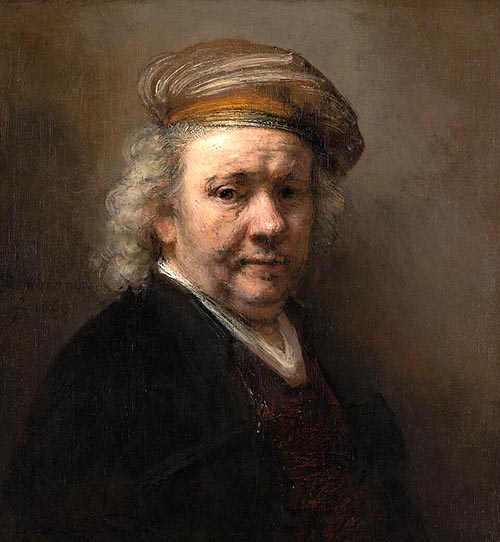
Rembrandt (1606–69), self-portrait, painted in the last year of his life. Image: Wikimedia Commons
For me, Luke’s reflections add depth and clarity to the vignettes in Penick’s book. It helps us understand the depths which Beethoven had to explore and accept in order to find a deeper reservoir of inspiration. It shows Tagore’s acceptance of ‘the tears of the world’ in order to explore with clarity the depths of longing. And van der Post’s description of Rembrandt ‘surrendering to the truth of himself’ chimes with Mary Delany’s uncovering of her vocation.
This brings me to what I feel are the limitations of Penick’s book. On one hand, he brings centre stage a fascinating and neglected subject which he illuminates through vivid pen-portraits of people drawn from a wide spectrum of backgrounds. Yet at the same time, despite all his evident reading and learning, and his Buddhist background, I feel that occasionally, particularly in his reflections, he does not quite embrace, at a profound, heartfelt level, the experiences he is talking about. For example, he quotes Yeats’ famous lines written in later life:
I must lie down where all the ladders start
In the foul rag and bone shop of the heart. [p. 61]
To me, this provides a clear example of letting go of our creative Ariel and accepting our inner Caliban so that we can embrace the ground and depths of our heart, which is so relevant to many of the lives he looks at. But he does not build on the implications of this quote, and I find his reflections that follow it obscure.
Two other niggles. Firstly, the book is divided into five chapters, but I find it difficult to see how the titles of each are fleshed out as themes. Secondly, it needed a little more love and care in its production. I found the way he introduced line breaks into Tagore’s prose poem clumsy. My Italian partner was put off by the two typos in the three-word dedication. He appears to replicate Elliot’s use of ‘Il miglior fabbro’ the Waste Land but unfortunately it reads ‘Il miglor fabro.’
Notwithstanding the above, Winter Light is a fascinating and readable book that offers an optimistic perspective on later life. Among all the transformative stories, there will surely be one at least that calls you toward your own unlived life.
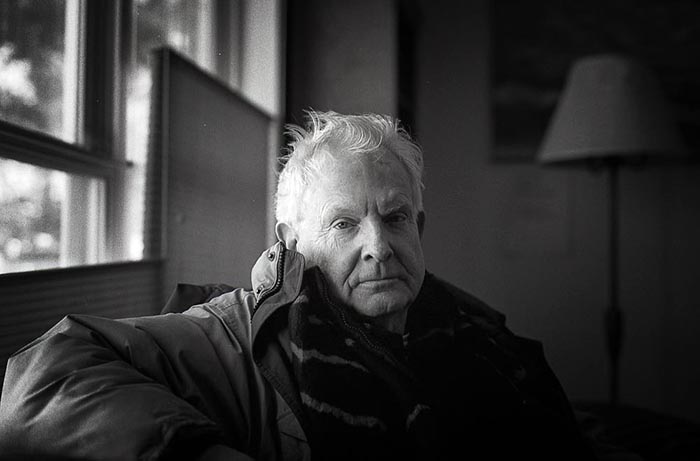
Douglas Penick. Photograph: punctumbooks.com
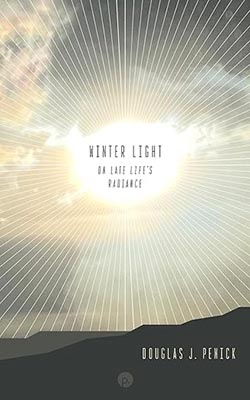 Winter Lightwas published by Punctum Books in 2025. It is available as a book or a free download (click here)
Sources (click to open)
[1] DOUGLAS PENICK, Winter Light, On late Life’s Radiance, (Punctum Books, 2025).
[2] RABINDRANATH TAGORE, Gitanjali, (1910: English translation, with a foreword by W. B. Yeats, The India Society, London, 1912) Available on Project Gutenberg [/].
[3] HELEN LUKE, Old Age. A journey into Simplicity, (Lindisfarne Books, 2010).
More News & Views
Book Review: ‘The Anxious Generation’
Fatima Chaudhry reviews a recent book which explores the effect of smartphones on the younger generation and proposes spiritual elevation as a solution
Book Review: ‘An Island to Myself’
Robert Hirshfield talks to the author of a new book by Michael N. McGregor which explores the place of solitude in an active life
Reflection: Dad’s Transition
Helen Carolan remembers the death of her father, Sean, aged 80, in County Mayo, Ireland, and the traditional wake which followed
In Memory of Gabriel Rosenstock
Peter Huitson remembers the Irish writer and haikuist who contributed several pieces to Beshara Magazine
April 2026
Gabriel Rosenstock
Don Quixote in Search of the Holy Land
All You Need is Love: The Lasting Legacy of the Beatles
Jane Clark reflects on a recent book and two documentaries about the Fab Four which argue that they were seminal in making us the people we are today
FOLLOW AND LIKE US
@Beshara_Mag








——————————————
——————————————
——————————————
If you enjoyed reading this article
Please leave a comment below.
Please also consider making a donation to support the work of Beshara Magazine. The magazine relies entirely on voluntary support. Donations received through this website go towards editorial expenses, eg. image rights, travel expenses, and website maintenance and development costs.
READERS’ COMMENTS
2 Comments
Submit a Comment
FOLLOW AND LIKE US
@Beshara_Mag
What’s there to say? A compelling review. I’ve ordered the book. Two copies.
Congratulations. I enjoyed the review of your new Book, “Winter Light,” certainly a theme that is, for so many, more important than the chaos that seems to be happening daily around us. Chaos has a way of changing from day to day. The inner calm and the creativity one discovers make the latter part of life a satisfactory one for those who feel it or who are introduced to it, “Winter Light” a grand horizon.