
News & Views
All You Need is Love: The Lasting Legacy of the Beatles
Jane Clark reflects on a recent book and two documentaries about the Fab Four
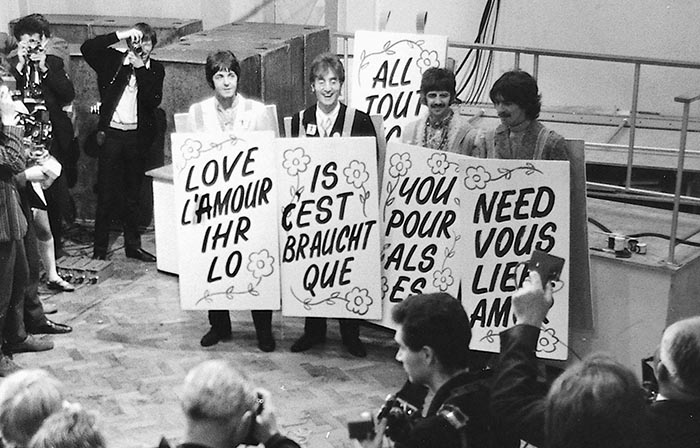
The Beatles promote the Our World campaign holding ‘Love is All You Need’ placards at Abbey Road Recording Studios, London, in June 1967. Photograph: Trinity Mirror / Mirrorpix /Alamy Stock Photo
The Beatles have come back into our lives recently. In late 2025, a new book by Ian Leslie entitled John and Paul: A Love Story in Song [1] hit the bookshops with a refreshingly new perspective on the song-writing partnership of John Lennon and Paul McCartney, garnering a wealth of praise from the critics and the public alike. At the same time, Disney released a re-edited and extended version of the 1995 documentary The Beatles: An Anthology, [2] which in nine episodes presents their extraordinary story from the point of view of the three Beatles still surviving at that time – John Lennon having died of course in 1980. Then in January 2026, Sam Mendes kept our interest alive by releasing the first images from his forthcoming four-film cinematic tribute to the band – one movie for each Beatle – which is due to be released early in 2028 starring a glittering line-up of young British talent.
Much of this rekindling of interest can be attributed to Peter Jackson’s revealing documentary, Get Back, [3] which appeared in 2021. A three-part marathon lasting eight hours, this draws upon extensive footage (60 hours of film, 150 hours of recording) shot in 1969 during the band’s rehearsals for an intended album and live show, culminating in the famous ‘rooftop’ performance that was, it turned out, the last public appearance of the group.
When it was released, Get Back sparked a radical reassessment of the Beatles’ story which had been standard fare for fifty years – in particular showing them to be far more harmonious and creatively engaged with each other in their final months than was depicted by the press at the time. It also gives us a privileged close-up of the group in action, showing us how great songs such as ‘Don’t Let Me Down’, ‘Let It Be’, ‘Something’, as well as the eponymous ‘Get Back’, developed from inception to fully realised performances. We get to see genius at work. But we also see the four of them squabbling, laughing, dancing with each other, exchanging banter. Leslie comments on all this:
When Peter Jackson’s documentary Get Back was released in 2021, many viewers commented on how strangely modern the Beatles seemed, as people. The footage showed us London streets populated by gents in pinstripe suits and hippies in Afghan coats, everyone timestamped by the historical moment. But when John, Paul, George and Ringo were in frame, we felt as if they could walk out of our screens, into our living rooms, without missing a beat. It wasn’t so much how they dressed as their demeanour: how they talked to each other, the way they sat, the jokes they made.
That isn’t a coincidence. The critic Harold Bloom argued that we recognise ourselves in Shakespeare not just because he captured something eternal in human nature but because he wrought our very idea of what a person is – an introspective, self-fashioning individual. Similarly, the Beatles were crucial to the creation of a post-1960s personality: curious, tolerant, self-ironising, unaffected, both feminine and masculine. Timothy Leary declared, ‘The Beatles are mutants. Prototypes of evolutionary agents sent by God, endowed with a mysterious power to create a new human species.’ [4]
Of course, those of us in the ‘baby boomer’ generation who were teenagers and students in the 60s always believed that we were part of a cultural revolution which would change the world. But as time has gone by, the decade has come to be seen by many as a brief moment of utopian optimism which was superseded by the materialism and cynicism of the 80s and 90s – and indeed, the backlash we are witnessing in our present time. It is therefore interesting to see this new acknowledgement that something of lasting significance happened. This short reflection is an attempt to gather together a few thoughts on what light this new Beatles material sheds on whatever that was.
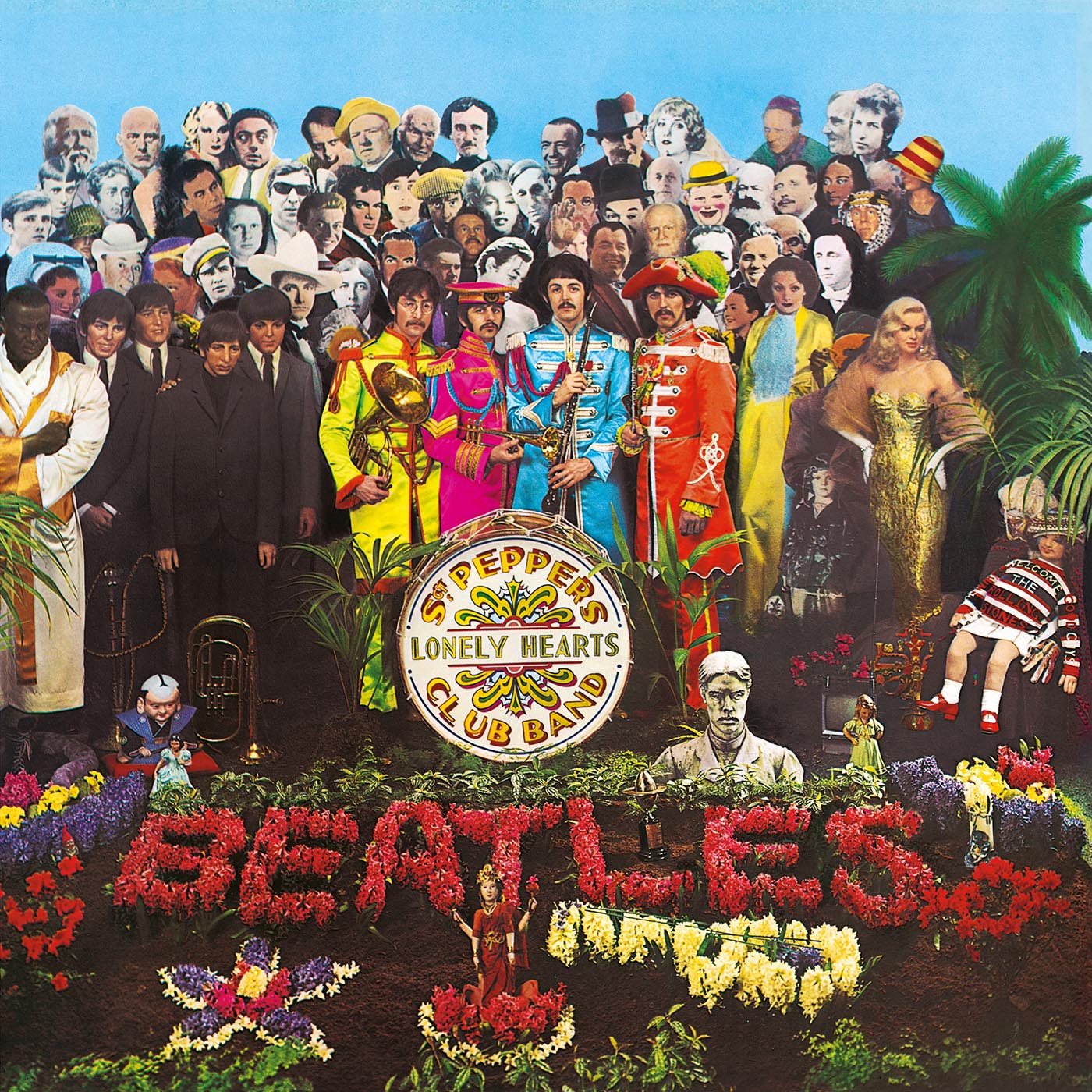
Cover of the Beatles’ most ground-breaking album, Sgt Peppers Lonely Heats Club Band, released in 1967. It had huge cultural impact, and specifically inspired Leary’s: ‘The Beatles are mutants’ quote. Image: Wikimedia Commons
Move your computer mouse over the image to enlarge
From Black and White to Technicolour
.
Leslie is not the only commentator to see the Beatles as presaging a new kind of humanity. The popular historian Tom Holland also considers them to be seminal, but he sees them not so much as individual agents but as exemplars, or representatives – avatars, even – of the wider cultural and ethical changes which were happening at the time. In a podcast in The Rest of History series aired in December, he refers to them as ‘lightning rods for so much which makes the 60s a revolutionary decade’. [5]
He goes on to liken the scale of the transformation to the protestant revolution of the 16th century when Martin Luther produced his Ninety-five Theses and challenged the authority of the Catholic Church. We are now, Holland believes, living in the aftermath of what happened in the 1960s, ‘rather as people in the 16th century were living in the aftermath of what happened in the 1520s’. [6] In other words, whatever happened then is still unfolding, just as the ramifications of Luther’s actions continued to play out in the centuries that followed, even down to the present day.
‘Lightning rod’ is an excellent image, as perhaps the most immediately obvious characteristic of the ‘Beatle effect’ was its energy and aliveness. This manifested in the Beatles themselves – not only in their music but also in their extraordinary productivity and appetite for work. It is estimated that they wrote around 200 songs between 1962 and 1970, many of them masterpieces, and produced 12 albums and 22 singles. It also showed itself in the astonishing number of ‘firsts’ they introduced into the music world; they were the first band to truly work as a team, not as a lead singer with a backing group; the first to write their own songs; the first to acknowledge the influence of black – and black female – music; the first to refuse to play to segregated audiences in America; the first to produce a ‘concept album’; the first to introduce Eastern music into their arrangements; the first to take over their own management; the first to set up their own production company… The list could go on.
This life and energy was equally evident in the effect they had upon their audience. One only has to look at the images of screaming teenage girls at concerts and the mobs that greeted the Fab Four wherever they went to see that some powerful force was being unleashed in the soul of a generation. This was most overtly female sexual energy, but, while not underestimating the importance of this, it went far beyond that. The whole culture was galvanised.
For instance, commentators report that within a week of the arrival of the Beatles in America in 1964, you could hear the sound of garage bands – groups of four or five with a drum kit and guitars – starting up all over the country. By 1967, America was hosting the summer of love, for which, as Conan O’Brien, Holland’s partner on The Rest of History podcast, says: ‘the Beatles were the soundtrack’. [7] The 60s also saw a creative renaissance in art, fashion and design which was to make London the style capital of the world, and new forms of political activism and awareness of human potential in movements such as black power and second-wave feminism. Of special interest to us in Beshara was the emergence of new forms of spirituality and spiritual education, with groups springing up everywhere, reading Eastern philosophy and following gurus from India and the Middle East.
O’Brien puts it like this: ‘The Beatles single-handedly brought us from black and white to colour.’ [8] Anyone who lived through that era will testify to the experiential truth of this statement. I was 12 years old when ‘Please Please Me’ hit the radio waves, and it felt exactly like that – as if some new dimension had suddenly opened up and everything was richer, brighter, full of promise. Technicolour rather than monochrome.
Video: All You Need is Love performed on ‘Our World’, BBC, 1969. Duration 3:48
A Message of Love
.
What then was the message which was being conveyed through this remarkable channelling of energy? Going back to Holland’s comparison with the protestant revolution, one could say that what emerged then was the idea that God is present in the interior of each individual, and the pre-eminence of conscience over authority. Holland believes that the central message of the 1960s revolution is the primacy of love as the guiding force in life. In his book Dominion, he expounds upon this principle within a Christian context, as bringing out a strand which has always been present in the faith, going back to St Augustine in the fourth century, who wrote:
Love God and do whatever you please: for the soul trained in love to God will do nothing to offend the One who is Beloved. [9]
This correlation arises because it is Holland’s thesis that Western civilisation is deeply and irrevocably influenced by Christian understandings even when it thinks it is rejecting the religion as such. And it is indeed difficult to argue against the idea that the Beatles drew inspiration from the culture in which they were brought up. In the 1950s, Christianity was still taught in school, and most people, particularly within working class areas, went to church. George and Paul were baptised Catholics.
Nor can one question that love was the essence of the Beatles’ message. It is clearly the case; it is the first word in the first record they released, ‘Love Me Do’, (1962) and almost the last on their final album, Abbey Road, (1970) where they sing in unison: ‘And in the end, the love you take is equal to the love you make’. [10] When asked by the BBC to participate in the first global television event, Our World, in June 1967, the song they chose to perform was entitled ‘All You Need is Love’.
This programme marked the launch of the first communication satellite and was watched by an audience of over 400 million people in 25 countries. It was an historic moment, and the Beatles used it to create a universal anthem to love and peace, complete with a flower-power extravaganza of balloons and beads and a full backing orchestra. John had recently become interested in mass communication and the use of slogans to get ideas over, so he set out to write a message that was unambiguous and that anyone could remember and sing. George later explains in An Anthology:
Everyone else was showing people knitting in Canada or Irish clog dancing in Venezuela, but we just sang ‘All You Need is Love’ because it’s a kind of subtle piece of PR for… well, God.[11]
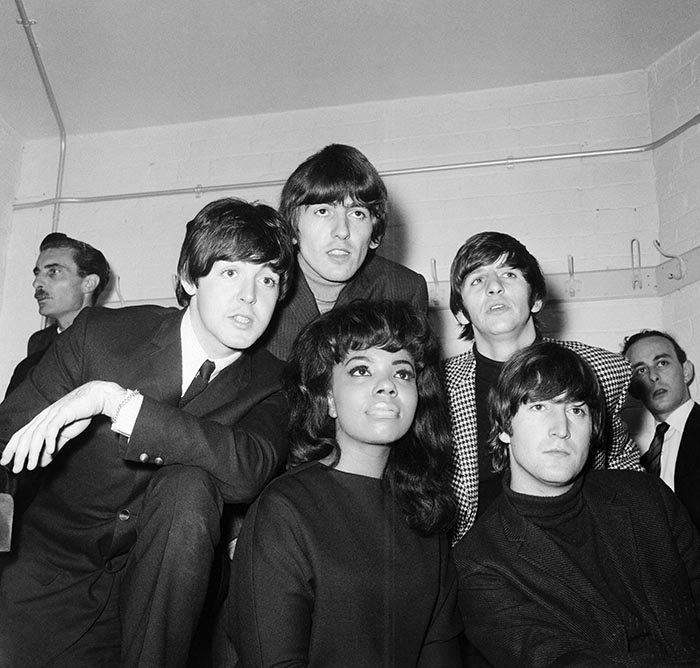
The Beatles in Bradford, UK, October 1964, with Mary Wells, whom they described as their favourite American singer. They invited her to open their 1964 tour. Her hit single ‘My Guy’ reached Number One, and she was first African American Motown artist to tour in the UK. Photograph: Trinity Mirror / Mirrorpix /Alamy Stock Photo
But one can question Holland’s implication that love is a specifically Christian principle. It is at the heart of all the religious traditions of the world, and it can be argued that it was actually the Beatles’ particular task to bring out its universality. They themselves were deeply influenced by Black American music, whose roots lie as much in Africana spirituality as in Christianity; they spent their teenage years totally immersed in it and learning its language. And their songs were, without exception, couched in purely secular terms, which meant that they had global reach, as the BBC broadcast demonstrates, transcending religious and cultural boundaries – even linguistic differences – as well as finding acceptance with people who had no religious background at all.
George’s use of the ‘God’ word in 1995 reflects his own personal bent which only became manifest in his songs after he left the band, and his use of it was in any case in the context of his embrace of Indian spirituality. This began during his time with the Beatles, when the whole group famously experimented with transcendental meditation and visited the retreat centre of the Maharishi Yogi in Rishikesh in 1968. This was another ‘first’ which had the effect of putting Eastern mystical traditions on the global stage – and Eastern music; George himself went on to learn the sitar from the famous master Ravi Shankar.
This combination of secular modes of expression with an interest in personal and spiritual development – also expressed in their use of mind-enhancing drugs such as LSD – made the Beatles early exponents of the distinction between ‘spirituality’ and ‘religion’ which has become commonplace today – another instance of the way they were a template for the people we have become.
The Beatles rehearsing ‘Don’t Let Me Down’ during the Get Back rehearsals in the basement of the Apple building in London, January 1969. With the soul musician Billy Preston, who was given joint credit on the single of this song and ‘Get Back’. Video: Official Clip from Get Back (Peter Jackson, 2019). Duration 1:58
Love in Action
.
This message of love – and its correlatives, peace and justice – was not only an abstract concept but was embodied in the Beatles’ relationship with one another. They each say this about themselves in An Anthology. ‘In the end, we were just four guys who loved each other’, says Ringo. ‘Nothing can ever break the love we have for each other’, says John. [12] This is another first, as far as I know; what other group of famous men have spoken about their feelings for each other like this in public?
The ‘fly on the wall’ footage presented in Get Back provides us with fertile ground in which to explore the question of what this love looked like in action. The group were on the brink of breaking up by the time the film was shot; they were tired, ready to move on from being Beatles and in the midst of a financial crisis as Apple Corps began to unwind. It was, from all accounts, a time which they themselves found extremely difficult. But there are still many moments when one can see how they once were and when they are evidently enjoying both the music and each other’s company. There is a lot of fun and laughter. And creatively, they are still working well. In fact, at one point, Paul comments that they are playing better together than ever before, and I would myself agree; the arrangements we see them developing in Get Back, later released on the albums Let It Be and Abbey Road, are wonderful.
The main thing that emerges from the film is that it really was a collective effort. Some commentators, such as Philip Norman in his rather cynical biography Shout, [13] have tried to portray the Beatles as having a two-tier hierarchy in which John and Paul were the main act and George and Ringo merely bit players. But this is not what comes over in Get Back, where we see them working together with a palpable generosity of spirit to bring every song, whoever it originated with, to its best form. Their aim is to write and record 14 new songs during a three-week period, and at some point each of them – including Ringo – arrives in the morning with an ‘overnight song’ which they present in a very rudimentary form, often with only a snatch of a lyric or melody. This is immediately picked up by the whole group and, if it is a goer, developed further.
The most famous example is ‘Get Back’, which starts as a vague strumming on the guitar played by Paul to George and Ringo one morning before John even arrives. Over the next weeks they work together endlessly on the transitions and rhythms, Paul and John work on the lyrics, until finally the song emerges in its full glory, sounding, as Leslie puts it, ‘as effortless as breathing’. [14] In other scenes, we see them helping each other with words, trying out ideas, playing one another’s instruments, giving advice. They are all superb musicians in their own right, but the sum is even greater than its parts. We watch hours and hours of rehearsal, but when they do their final performance on the roof of the Apple building in Savile Row, it is electrifying. Pure joy.
Video: ‘Get Back’ performance on the roof of the Apple building in London on 30 January 1969. Duration 3:20
Working Together
.
The same principle of collectivity and non-hierarchy applied to their decision-making. From the very start they adopted a policy of unanimity, meaning that they all had to agree on any major matter. This applied both to artistic decisions – which songs to include on an album, which ones to release as singles, whether or not to tour – and business matters such as the setting up of Apple Corps. They were also famously self-determining; George Martin describes in An Anthology how even on their first single, they insisted on recording their own material rather than a cover, which was an unprecedented demand, especially for an unknown group.
At the same time, it has to be said that this ideal of consensus and equality was not always perfectly realised. There were, as George Harrison was to later say in An Anthology, ‘some big egos in the group’, and there is a truth in Norman’s view that John and Paul tended to be over-dominant. This was especially so in the early days when they were the principal songwriters. By the time of Get Back, there was tension around the matter of leadership and at one point, George walks out because he feels over-ridden by the Lennon–McCartney duo. He has begun to produce great songs himself (in fact, ‘Here Comes the Sun’ is currently the most-listened-to Beatles’ song, with over nearly two billion hits on Spotify) and has also just been playing with Bob Dylan and The Band in the USA, finding there a far greater degree both of consensual working and personal acknowledgement.
In the film, we hear John and Paul discussing this situation through a hidden microphone concealed in a plant pot in the canteen. (Yes, really!) There is no recrimination directed at George. On the contrary, Paul apologises for having taken on too much of a leadership role and being too controlling. John acknowledges that George’s feeling of exclusion is long-standing – it is ‘a festering sore, and the problem is that yesterday we didn’t give him any bandages’. Their conversation sounds quite normal, even perhaps a bit inarticulate and fumbling, to us today, familiar as we are with the language of therapy and psychoanalysis. But in the 1960s it is remarkable in the degree of critical self-awareness it displays. This scene is therefore another prime example of Leslie’s insight about the way that the Beatles anticipated the people that we are today.
It also shows that while putting love in practice turns out to be not so ‘easy’ as their 1967 anthem maintained, there is an underlying intention towards equality and fairness and an openness to personal change. There is a marked difference in group dynamics when George rejoins a few days later, and in Paul’s behaviour in particular. They move studios, to the new Apple building in Soho, and the songs start to come together.
The Beatles rehearsing ‘Something’ during the Get Back rehearsals in the basement of the Apple building in London January 1969. Video: Official Clip from Get Back (Peter Jackson, 2019). Duration 1:27
John and Paul: A Love Story in Song
.
As for the relationship between John and Paul themselves, Leslie has no doubts about describing it as a love affair. In fact, he calls it a ‘quasi-marriage’ – a term which John himself would seem to corroborate when, introducing his performance of ‘I Saw Her Standing There’ at Madison Square Garden in 1974 [/], he refers to Paul as ‘an old estranged fiancé of mine’. [15] They were at the centre of each other’s lives for more than 15 years, being 16 and 15 respectively when they first met in the working-class area of Liverpool in the late 50s. They would skive off school to write songs in their bedrooms.
They did not divide the tasks of words and music, as previous great song-writing duos (Gilbert and Sullivan; Rogers and Hammerstein) had; they both did both, presenting ideas to each other at an early stage and working them up together. Everything they produced was attributed to Lennon–McCartney, even though, by the time of Get Back, they were mostly writing separately. Leslie sees them as being deeply entangled in each other’s minds, to the extent that at times they even had the same dreams.
His book presents a moving portrayal of their unique relationship through an examination of 43 of their songs. His great insight is that they communicated through their music in a very particular way – or maybe better to say that it was through songs that they communicated whatever was going on inside them. He explains in his conversation with Kate Mossman at the end of the paperback edition of the book:
There’s an emotional, as well as musical and aural attack in those early songs, rooted in the fact that they wrote themselves: that sounds obvious, but it wasn’t common. It’s authentic. It’s coming from within. [16]
One can argue that it was not just in the early songs that this holds true; it is also the case, and perhaps more consciously, in the later songs. Leslie’s analysis allows us to understand better what we are watching in Get Back, and I myself totally concur with his take on ‘Two of Us’ and ‘Oh Darling’ as messages from Paul to John concerning their impending separation. In fact, John himself acknowledges this at one point when they talk about overlapping lines in ‘Oh Darling’ (McCartney) and ‘Don’t Let Me Down’ (Lennon); ‘It’s as if me and you were lovers’. The question of break-up is explicitly framed in terms of divorce; ‘But what about the children?’ asks John. ‘Dick James’ replies Paul, referring to their song publisher.
Leslie also decodes some touching moments of tenderness between the two friends, noting, for example, Paul’s great attention to the bass part on ‘Don’t Let Me Down’, making an effort to support John in a song which clearly expresses anxiety about his potentially life-changing commitment to Yoko Ono. We also see John launching into ‘I’ve Lost my Little Girl’ – the first song they ever wrote together – after Paul’s hopes that the Get Back sessions will culminate in a live concert are finally crushed. ‘He is hurting. John can tell: he feels it too… It’s a balm’, comments Leslie. [17]
Leslie, rather generously perhaps, sees the pushes and pulls of jealousy and rivalry, which are also evident in Get Back, as manifestations of the depth and intensity of their relationship, and even suggests that they were an intrinsic part of their creative process. Just because a relationship is based on love does not mean that it is all sweetness and light, he points out; on the contrary, real love engages the whole of our being, touching the bad as well as the good.
When the divorce finally came, it was messy and acrimonious, and very much conducted in the public eye. So it is a nice feature of John and Paul that Leslie extends his study beyond the break-up, showing that the relationship continued in some way. It seems that by 1980 they were in regular phone contact and Leslie believes that one of John’s final songs, ‘Starting Over’, was addressed to Paul as much as to Yoko. In fact, all the Beatles remained friends, both professionally – playing on each other’s solo albums– and personally. George spent his last days in Paul’s house in Los Angeles and died there.
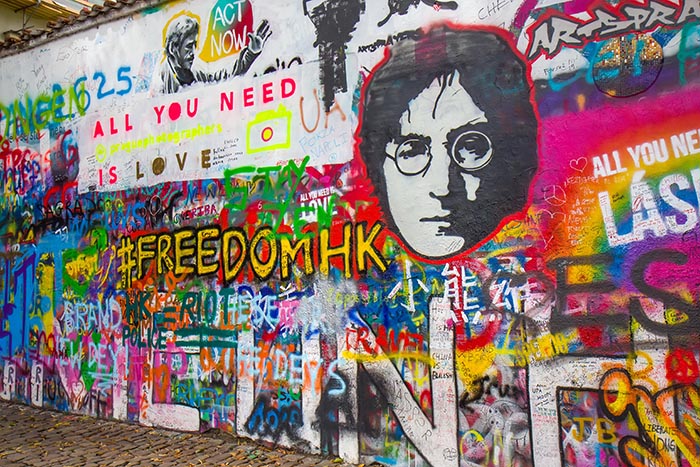
Street Mural in Prague, 2019. Photograph: Vladislav Gajic/Alamy Stock Photo
Legacy
.
If, as Holland says, The Beatles were like ‘lightning rods’ for whatever was happening in the 1960s, then the vehicle of transmission was music. And the music they created together is still going strong: 60 years on, they remain the best-selling band of all time, with between 600 million and a billion records sold, and they currently have more than 34 million monthly followers on Spotify. This is only about a third of Taylor Swift’s, but not bad for a group that broke up 55 years ago. At the end of their podcast, Holland asks O’Brien whether he thinks that we shall be listening to the Beatles in 200 years’ time like we still listen to Bach and Beethoven, and he replies: ‘Yes, I do’ – with the proviso that we will not have perished through nuclear holocaust or alien invasion.
Listening to this musical legacy while researching for this piece, I have been struck anew by its sheer excellence and energy. And this reminds me of an interview we did for Beshara Magazine with the distinguished academic Joy Bostik, who talks about the power of Black American music. She explains that this has its roots in the animistic traditions of Africa and the concept of ‘vitality’ which is central to it. She explains:
By vitality, what I’m talking about is really a kind of mysticism if we understand that as being broadly defined as direct experience of divinity. These embodied rituals which involve movement, gestures, and verbal affirmations, call and response, etc. – all these are strategies that enable us to have an experience, or open the way for the possibility of experiencing, spirit.[19]
Leslie’s analysis implies that the power of their music also came from the chemistry between the Beatles themselves – that the message was embodied in their persons and their way of being as much as in their output. On the evidence of Get Back, one has to agree with him. There are many aspects of this that could be drawn out, but the thought that has predominated for me is that it must be significant that the revolutionary impulse of the 1960s was transmitted not through an individual but a group. And that the relationships within that group were based upon love – love between the participants but also love for a shared aim. The commitment of the Beatles to the music, and the care that they devote to producing each song – going over performances time and time again until they get it right – is one of the most moving aspects of the film for me.
What we see is neither the suppression of individuality in service to the whole, nor the assertion of rampant individualism. Rather, we witness a different way of working – a collection of individuals coming together freely in a non-hierarchical modus operandi in order to express, or to achieve, a common aim. I am not the only one to see this as a paradigm for our times. The Vietnamese teacher Thich Nhat Hanh has famously said that the next Buddha may come as a sangha (spiritual community) and the Dalai Lama has repeatedly told us that we should no longer be looking for leaders to follow, but that change will only happen from the ground up, with individuals working together.
Not everyone embraces this vision, of course, and it seems that at the moment we are witnessing a massive backlash from those who wish to retain the old power structures based on patriarchy, racial superiority and such like. It is therefore very helpful, in these dark times, to be reminded of the extraordinary phenomenon of the Beatles and the message of love and peace which they brought. May it prove to be, in the words of John Lennon, ‘a love which lasts forever’.[19]
Sources (click to open)
[1] IAN LESLIE, John and Paul: A Love Story in Song (Faber, 2026).
[2] The Beatles: An Anthology, Episodes 1–9 (1995, re-issued by Disney in November 2025).
[3] The Beatles: Get Back 1, 2 & 3, a documentary directed by Peter Jackson (2021), available on Disney.
[4] IAN LESLIE, John and Paul, pp. 2–3.
[5] ‘The Beatles: The Band that Changed the World’: The Rest is History podcast with Tom Holland and Conan O’Brien, December 2025.
[6] Ibid
[7] Ibid.
[8] Ibid.
[9] TOM HOLLAND, Dominion, (Little Brown, 2019), p. 473/p. 553, n.1: Augustin 7th Homily on the first epistle of John 7.
[10] ‘The End’, on the album Abbey Road, 1969.
[11] The Beatles: An Anthology
[12] Ibid.
[13] PHILIP NORMAN, Shout (Hamish Hamilton, 1993).
[14] IAN LESLIE, John and Paul, p. 274.
[15] See video of concert [/].
[16] IAN LESLIE, John and Paul, p. 417.
[17] Ibid, p. 35
[18] Ibid, p. 369
[19] Beshara Magazine, Issue 26, 2024.
[20] LENNON & McCARTNEY, ‘Don’t Let Me Down’ on Let It Be (1970).
read more in beshara magazine



The text of this article has a Creative Commons Licence BY-NC-ND 4.0 [/]. We are not able to give permission for reproduction of the illustrations; details of their sources are given in the captions.
More News & Views
Book Review: ‘The Anxious Generation’
Fatima Chaudhry reviews a recent book which explores the effect of smartphones on the younger generation and proposes spiritual elevation as a solution
Book Review: ‘An Island to Myself’
Robert Hirshfield talks to the author of a new book by Michael N. McGregor which explores the place of solitude in an active life
Reflection: Dad’s Transition
Helen Carolan remembers the death of her father, Sean, aged 80, in County Mayo, Ireland, and the traditional wake which followed
In Memory of Gabriel Rosenstock
Peter Huitson remembers the Irish writer and haikuist who contributed several pieces to Beshara Magazine
April 2026
Gabriel Rosenstock
Don Quixote in Search of the Holy Land
Book Review: ‘spinning pinwheels’
Gabriel Rosenstock rediscovers kokoro (heart) in a new book by the distinguished Indian poet K. Ramesh
FOLLOW AND LIKE US
@Beshara_Mag








——————————————
——————————————
——————————————
If you enjoyed reading this article
Please leave a comment below.
Please also consider making a donation to support the work of Beshara Magazine. The magazine relies entirely on voluntary support. Donations received through this website go towards editorial expenses, eg. image rights, travel expenses, and website maintenance and development costs.
READERS’ COMMENTS
3 Comments
Submit a Comment
FOLLOW AND LIKE US
@Beshara_Mag
What a wonderful piece. It confirms all my deepest intuitions about these times. The spirit of the Beatles was my salvation in the 1960s and the salvation of our generation. Definitely imbued with this announcement of joy that is Beshara. May it continue. Hopefully this article will get the wide circulation it deserves.
Thanks Christopher. So glad you enjoyed the article. Certainly it was a lot of fun to immerse myself in all this wonderful new material.
This is a fantastic article on The Beatles. I am posting it and Fatima’s article on mobile phones and their antidote in the divine on both X-Twitter and BS. Maybe you or someone could consider doing one also on the spirituality of The Moody Blues, another late-60s-70s band whose eastern-influenced music (especially Lost Chord) and lyrics served as simple but profound spiritual teaching to a generation. Is there anything of such likes around with so much impact today? I suspect not, though happy to be told otherwise. All the more need to have in-depth writing on what I think of as “transcendental music”.