
News & Views
The Anxious Generation by Jonathan Haidt
Fatima Chaudhry reviews a recent book which explores the effect of smartphones on the younger generation and proposes spiritual elevation as a solution

Cover image of the original edition of The Anxious Generation. Image: calnewport.com/blog/page/7
From the ages of eleven to nineteen, I was magnetised by my smartphone and laptop, and when those were not available, by the next closest screen in my orbit. I had a more committed relationship with my smartphone by the age of 15 than I had had with anyone else. She completely understood my interests, showing me what I wanted, just enough of the time. Through multiple profiles on multiple social media sites, I, just like my peers, had curated a virtual version of myself. My doubts and insecurities were masked with courageous posing and posting. I became engulfed by a fabricated idea of myself, and who I believed I was, rather than dealing with the real me occupying space in the real world. I was at the mercy of others’ beliefs about who I was and who I could be and became a willing/un-willing recipient of internet culture, picking up a second-hand belief system about myself and our world that resulted in a real-life impact on my feelings, habits, behaviours and actions.
Over the last two years, through a journey of rebuilding connection to the real world, I have been on a steady journey of sobering up. I was held accountable for my actions when I lost sleep to endless scrolling, took an extra 25 minutes in the shared bathroom, got stuck on my phone or was caught logging back into profiles that I had claimed to have deactivated during a digital detox. This process slowly helped me realise the extent to which smartphones are a real-life experience blocker. I am grateful for all these ways in which I was held accountable because they ultimately led me to wander down to the local library and bring home a copy of The Anxious Generation.[1] Upon first reading, it was as though a fresh wave of clarity hit me. I was stunned to see such brazen truths spoken, addressing how virtual socialisation is affecting humanity and our ability to connect with the real, living world.
A university professor of ‘Ethical Leadership’ in New York, Jonathan Haidt (pronounced ‘height’), has brought together a collection of data, hypotheses and case studies documenting the harm that a ‘phone-based childhood’ has caused for Generation Z (that is, born between the years 1997–2012), including but also going beyond the rapid increases in mental health disorders expressed by the group. Reading it for me was listening to a gripping horror based on a true story.
He explores a wide range of themes: the shifts in mental health in adolescence; the nature of childhood and what children have historically benefitted from in order to fully develop into conscious adults; the harms that come from a phone-based childhood, which are different for boys, girls and those who identify otherwise. He concludes by laying out the collective actions we can take towards creating a healthier childhood for future generations, putting at the centre those which produce what he calls ‘spiritual elevation’ and bring us back to a sense of our interconnectedness with each other and the world.
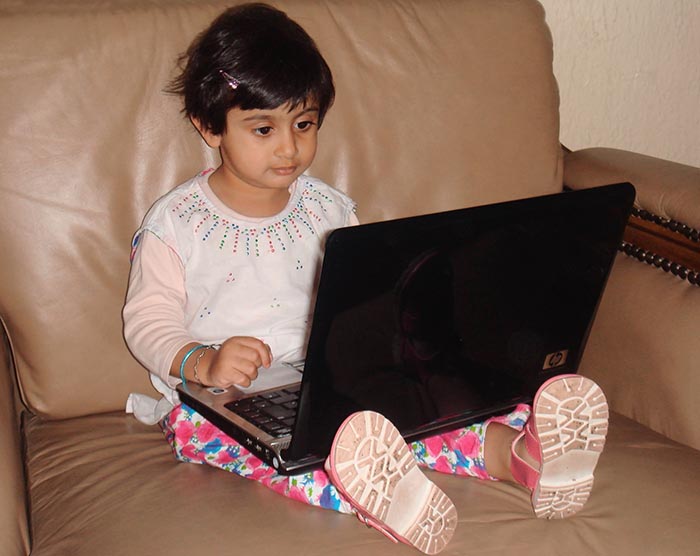
Fatima, aged 2, taken in her childhood home in Bury, England. Photograph: Uzma Chaudhry
Inside the Pages
.
In the Introduction, entitled ‘Growing up on Mars’, Haidt introduces the phrase ‘the Great Rewiring of Childhood’, explicitly naming the intergenerational shift that began in the late 1980s from a ‘play-based childhood’ to a ‘phone-based childhood’. He explains that the early developments of personal technology and social media meant that time alone became incentivised, while at the same time a rise in fearful parenting across the Anglosphere affected the numbers of children playing outside unsupervised. What resulted was a rapid increase in technology dependence amongst children who were ‘overprotected in the real world, and underprotected in the virtual world’ (p. 9).
This transition spanned decades of advancements, culminating in the cataclysmic introduction of the iPhone, shortly followed by the rollout of the front-facing camera and then, not long after that in 2010, a new app for photo-sharing, Instagram. These developments increasingly took away real-world consciousness from many of its users, deliberately diverting attention to the management of personal ‘online brands’ and keeping up appearances in the now ‘global village’.
Haidt specifies four features of communication in the ‘real world’, within which children have been brought up for hundreds of thousands of years, and then contrasts them with those found in the ‘virtual world’.
| Real World | Virtual World |
| Embodied: using our bodies to communicate, being aware of the bodies of others, and responding to the bodies of others, consciously and subconsciously. | Disembodied: no body is needed, just language and information. Partners can be Artificial Intelligences. |
| Synchronous: happening at the same time, with subtle cues about turn-taking and timing. | Asynchronous: not occurring at the same time, happening via separate text-based posts and comments. |
| One-to-one/one-to-several communication: one interaction is taking place at one time. | One-to-many communication: engagement can potentially be with a vast audience, and multiple interactions can be happening in parallel. |
| High bar for entry and exit: there is a cost to join or leave, so communities are strongly motivated to invest in relationships, learning how to manage themselves and their emotions in order to keep meaningful companionship going. | Low bar for entry and exit: people can easily block others and leave spaces instantly if they are not pleased. Relationships are often disposable. |
Table contrasting relationships in the digital and real world (see pp. 9–10). Created by Fatima Chaudhry
The final item, which comments on the foundations on which relationships are being formed, stood out to me as an especially true and heartbreaking reality in which many of us, often unknowingly, are both the enablers and victims. The effects of being socialised virtually into disposable, shallow relationships inform the behavioural standards of interactions in the ‘real world’. This unfamiliarity with developing deep, meaningful relationships with anyone, including ourselves, inhibits self-development and places clear barriers in the transition from childhood to adulthood. Furthermore, with so many asynchronous networks and groups in the virtual world, it is difficult to enforce a collective regulatory system. Therefore, it is up to individual users to uphold and apply moral standards where they see (or don’t see) fit.
In Part 2, Haidt goes on to give ‘The Backstory’ to the decline of the ‘play-based childhood’ – by which he means one where children are able to play freely, unsupervised by adults, in order to develop essential social and physical skills. As technology has become more portable, research tells us that young people have tended to meet up with their friends in person less, and are more likely to engage with one another virtually, resulting in a situation where personal technology is the main avenue for communication rather than merely a tool to set up face-to-face interactions. The author goes on to describe the smartphone as ‘an experience blocker’, as it reduces interest in all non-screen-based forms of experience.
Throughout this section, the reader is offered advice on what children need in order to make a well-guided transition to adulthood, taking into account the full rights and responsibilities of the child. Haidt points out that traditional rites of passage – by which he means the kind of rituals and challenges that are found in indigenous societies – no longer take the same form in modern, industrial societies. He maintains that the role these rites play in the cultural development of a young person is crucial, as they are ways of communally celebrating entry into their adult personhood through periods of separation and challenge, creating a space to self-transcend and to become aware of collective responsibility.
But since the early 20th century, these communally-marked rituals have been disappearing, ‘downgraded’ for more superficial functions. Modern birthday celebrations do not usually mark age with any tangible feeling of difference in responsibility or freedom, nor does the child experience the sacredness of receiving a higher rank in the community following the chance to develop their capability. Haidt writes: ‘A human child doesn’t morph into a culturally functional adult solely through biological maturation’ (p. 109), reminding us that the commitment required to undertake care for children goes beyond serving their physical needs.
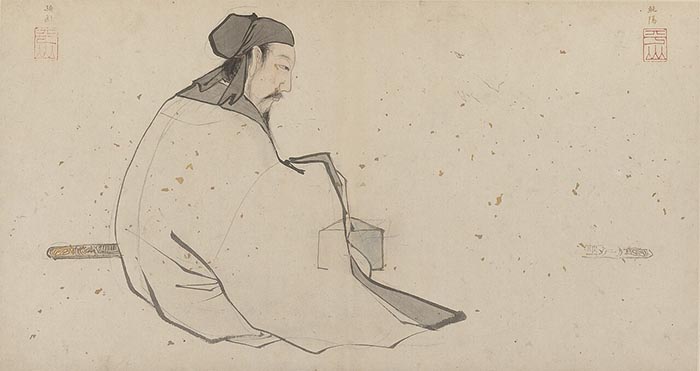
Zhang Lu’s painting of early 16th century, Taoist scholar and poet, Lü Dongbin (Ancestor Lu). He is one of the Eight Immortals whose lifetime supposedly spanned two hundred and twenty years. Image: Wikimedia Commons
Cultivating Spiritual Elevation
.
In Part 3: ‘A Great Rewiring’ and Part 4: ‘Collective Action’, Haidt offers more comprehensive advice on changes that we can all make towards healing. He focuses particularly on practices that ‘spiritually elevate’ people rather than ‘degrade’ them, and on actions that raise the level from which we are usually operating to one that considers a reality greater than ourselves, recognising the sacredness of each part of our interconnected life system. He puts forward solutions to bringing change at a personal, educational and governmental level.
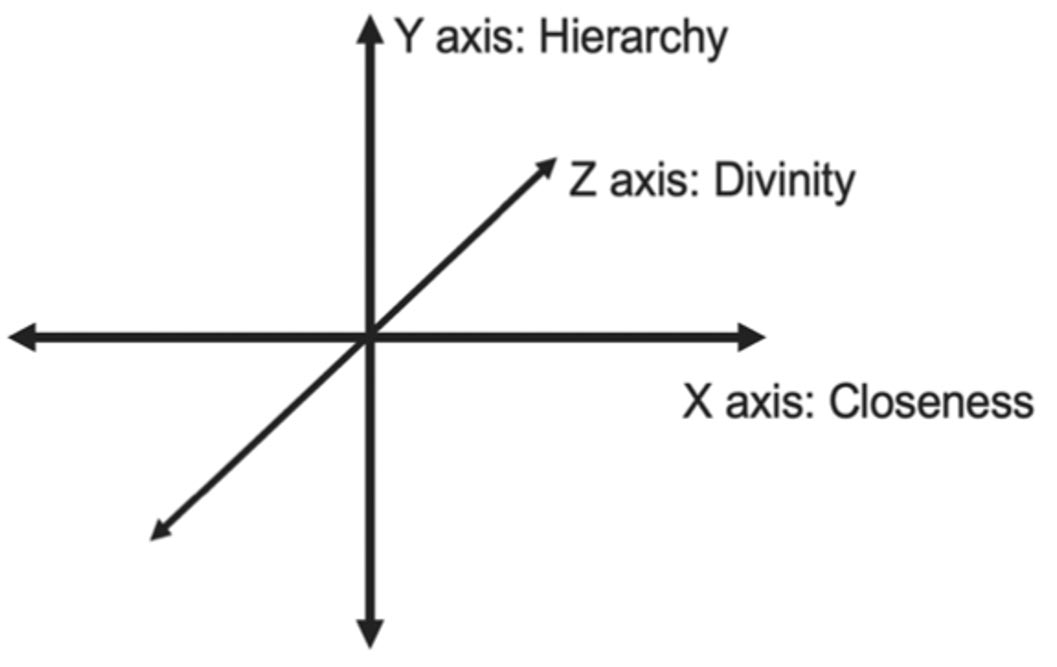
Three Dimensions of Social Space (p. 215)
Haidt himself, in a previous book The Happiness Hypothesis,[2] has developed a model of how people perceive social space, as shown in the figure above. On the vertical axis is the perception of social hierarchy; on the horizontal, our distinguishing between people who are near to us and those who are far. But he introduces a third axis which he calls ‘Divinity’, which expresses the way in which we perceive people and places as bringing us closer or more distant to some sense of sacredness, purity or elevation. Many traditional cultures, he points out, speak of virtuous actions that bring us ‘upward, closer to God’ while selfish actions bring us downward, away from God, as well as the ways in which ‘closeness’ or healthy attachment can affect this. He emphasises the role of ‘older, wiser’ persons in creating secure attachment to facilitate young people’s spiritual experiences of Divinity in the real world.
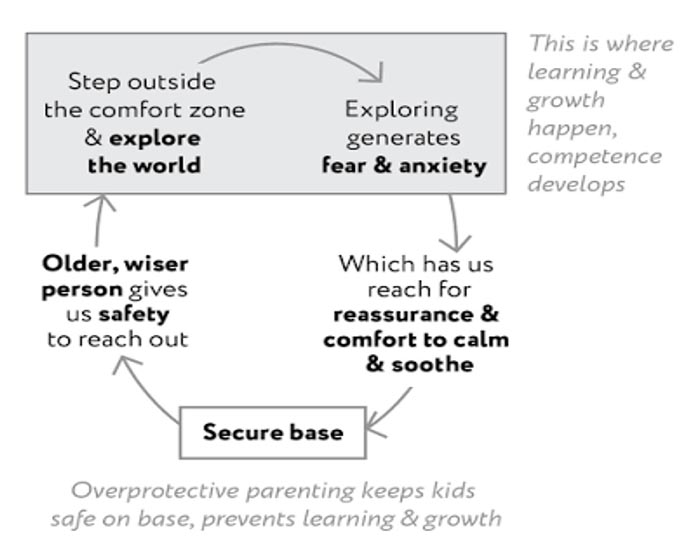
The Mammalian Attachment System (p. 99)
In Chapter 8, Haidt lays out a set of six spiritual practices which he feels can help this process of elevation. For instance, he addresses a feeling of a lack of sacred spaces, time and objects within modern secular society and explains why it matters to experience moments of uplifted sacredness with one another, defined by Durkheim as ‘collective effervescence’. (p. 218) This does not just pertain to faith-related activities, but also to experiences of feeling and enjoying live music, theatre and synchronous sport chants and rituals. In contrast, the virtual world and social media carry no embodied movement, and offer no marked sacredness that is tangible to the humans using the platforms. Anything and everything is available all of the time, and as a result, we lose the ability to sense quality connection with other users or with the content itself.
He goes on to explore the importance of embodiment, stillness, silence and focus, and forgiveness. Finally, in sections on ‘Transcending the Self’ and ‘Finding Awe in Nature’, he discusses the neuroscience of operating from our Default Mode Network (DMN), which is preoccupied with our individual needs and processes events from an egocentric point of view. Research has found that the DMN is less active during times of spiritual practice, such as meditation and prayer, but also during moments of awe when we are perceiving something unfathomable and bigger than ourselves in a profoundly pleasurable way. Dacher Keltner, a social psychologist who has studied ‘awe’ in depth, writes that it helps:
… shift us from a confrontational, dog-eat-dog mindset to perceive that we are part of networks of more interdependent, collaborating individuals. We sense that we are part of a chapter in the history of a family, a community, a culture. An ecosystem. (p. 224)
Alarmingly, this default mode of being is exactly what social media has been set up to indulge. By appealing to our DMN and our ego, we are brainwashed into fixating on ourselves in a way that produces long-term harm. Haidt tells us that it is a common misconception that only young people are susceptible to being ‘spiritually degraded’ through their use of social media. However, by virtue of attention-engineered algorithms and normless interactions, all users are vulnerable to absorbing negative behavioural habits, however ‘managed’ the usage is. The culture of social media relies on users to share opinions and judgements on others, which undermines the essence of peaceful belief systems and ways to co-exist in a shared world. Thousands of years before social media was created, Taoist wisdom tells us:
Bedevilments arising in the mind are ideas of self and others, ideas of glory and ignominy, ideas of gain and loss, ideas of right and wrong, ideas of profit and honour, ideas of superiority. These are dust on the pedestal of the spirit, preventing freedom. [3]
I could list the multitude of ways in which social media has evolved to become a hotspot of ‘bedevilments’, one of the most glaring examples being the practise of ignominy – meaning a severe loss of reputation, or a profoundly dishonourable situation that results in a person becoming an object of general contempt – through the internet’s ‘cancel culture’ and the encouragement of quick judgements on the actions of others with no opportunity for resolving conflict.
In my experience, establishing spiritual practices involves adopting exercises that challenge our ‘DMN’ or ‘egocentric points of view’ through acts of service. For instance, while attending a (pilot) course for young people on finding happiness and purpose in today’s world, I was introduced to a student of The Bhagavad Gita, who affirmed that when our actions are not aligned with intention and a greater purpose, we find that our energy dissipates into lower activities –which for me was endless scrolling on my phone. However, when we are oriented towards service, our energy is sustained, longer-lasting and further reaching. I was reminded, and have since been re-reminded through books and otherwise, that spiritual activism:
… approaches demanding issues in ways that invite an ever-deepening perception of reality and of our positioning – individually and collectively – within it.[4]
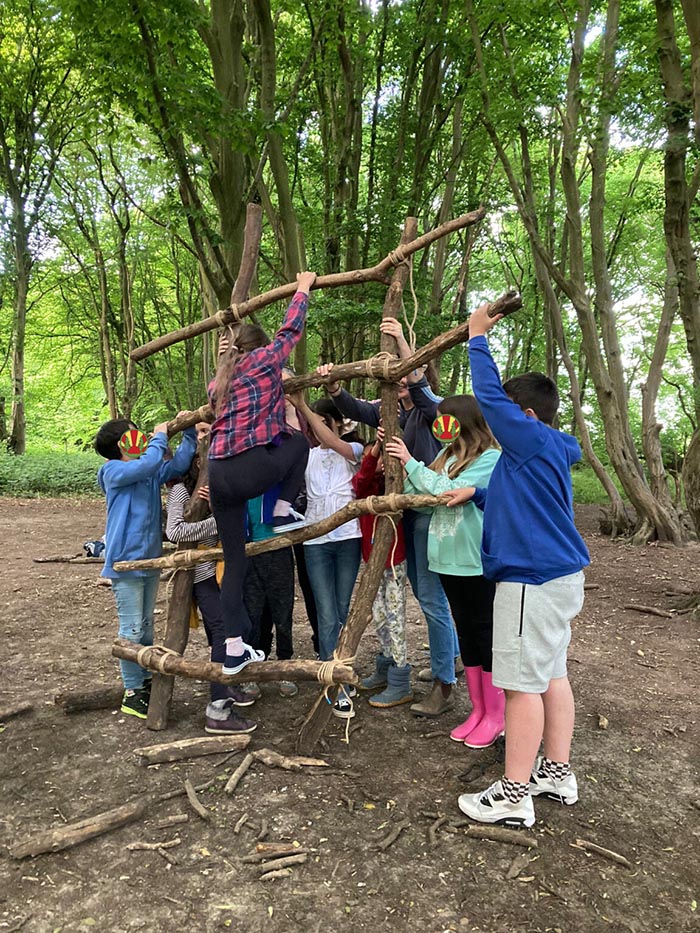
Woodcraft Folk were established in 1925, as an ‘Education for Social Change’, and continue to help ‘folk’ from birth to adult in developing critical thinking skills and becoming active in their community and the wider world with values rooted in the ‘co-operative movement.’ Image credit: woodcraft-stalbans.org
Solutions
.
As part of the final section, ‘Collective Action’, Haidt breaks down solutions to what parents, schools and governments can do differently. Starting by addressing the big picture, he describes how policies introduced by both big tech companies and governments have the potential to exert a significant influence on our everyday behaviour. He advocates for tech companies to rectify the negligence towards the duty of care they have always owed to the minors using their platforms. As for governments, he advocates an age limit for smartphone access, and would without doubt welcome the recent announcement of a social media ban for under 16s which has sent waves crashing into the homes of many families in Britain. Haidt himself, though, writes from the perspective of a resident of the USA, where the age of internet ‘adulthood’ is just 13.
Alongside this, he calls on people in positions of power, as well as decision-makers in schools, to invest in making real-life experiences more accessible and desirable for children and young people. He believes that every person – adult or child – should have close access to open green spaces, which is not currently the reality for many of us who live in cities or densely populated areas. We should push local councils to invest in our children’s access to inner-city nature spots and community-built playgrounds within walking/cycling distance from schools and homes.
Haidt goes on to say that schools should be responding to the changing needs of young people through normalising phone-free educational environments while introducing agency and rebuilding trust through more play-full activities. He recognises that while it is not easy for schools to replace technology completely, there are ways of delaying pupils’ gratification and nurturing their real-life encounters while around other peers who are being encouraged to act in the same way. We are all very much in this boat together, and Haidt really reinforces how beneficial it is to not act as isolated individuals, but as part of a coordinated, active community effort toward creating a healthier childhood.
This same call for desirable real-life opportunities also goes out to parents and families, as most of us are re-engaging differently in the physical and natural world after the COVID pandemic. For most parents, allowing space for their children’s intrinsic desire for risky, adventurous free play to be satisfied is much easier said than done, but it does have immense rewards in the long-term, as it produces children who are more competent and confident in their ability to play and stay safe in the real world when they are faced with difficulties. Haidt strongly encourages parents to introduce responsibilities to children from a young age and to rely on them as capable members of a household in order to raise awareness of their (big and small) roles, and to avoid the feelings of uselessness and a lack of purpose that so many teenagers are weighed down by these days.
A hopeful sign which Haidt mentions is that there is an increasing awareness among young people themselves regarding the harms derived from smartphone usage. This has been supported by the release of a subsequent book by himself and Catherine Price entitled The Amazing Generation.[5] This is an adaptation of The Anxious Generation illustrated and written for adolescents so that they feel empowered by this knowledge to take action in their own lives, and in a way that is not as likely to happen if it is just their parents yelling at them to get off their phones.

The Amazing Generation, written specifically for nine to twelve year olds, including graphic novels and interactive challenges. Image credit: theamazinggenerationbook.com
Conclusion
.
This current epidemic of mental health is not just an imminent cause for concern for the youngest generations. The effects of their state of being ripple out to everyone. Young people are the future custodians of the Earth, and it is our clear collective duty to the coming generations to ensure that the children around us are growing up with resilience, compassion and resolve, not with anxiety, depression or chronic loneliness. Haidt suggests that we cannot distinguish the start of the generation that will follow Gen Z until the culture shifts and there is a noticeable change in the technological, socio-economic and environmental state of affairs.
The Anxious Generation is a brilliant resource for inter-generational dialogue. The book is well written and organised in such a way that readers can bookmark to retain information thanks to the images, visual data and bullet-point summaries which conclude each chapter. Coupled with The Amazing Generation it offers a set of resources as a means for young people to manage their way out of a mental health epidemic. I can personally attest to its effectiveness; in the months after I finished reading it, I noticed a louder voice inside myself calling out when I was slipping into habitual modes of phone-dependent behaviour.
Haidt makes a strong causal link between technology and social media use and deteriorating teenage mental health. But it is of course important to recognise that the advent of digital media has brought benefits as well as harm. A lot of knowledge in the modern world is spread through digital channels, and the virtual world can, for many, offer a fruitful initial space for inquiry. The internet has also, in some places and for some people, provided hospitable sub-cultures for souls seeking virtual connection in the absence of physical connection or safety. However, Haidt’s analysis makes it very clear that it is essential that while making relationships in the virtual world, we must also be grounded in the real world. One of the big messages of the book is that for us young people, developing a taste for a spiritual perspective, even in its most elementary forms, might be the only real chance we have at reconnecting with ourselves, each other and our environments.
There is perhaps a degree of irony in a Beshara reader finding this book review on a digital platform within the virtual world, but through any medium possible, I would recommend The Anxious Generation to parents, youth workers, educators, aunties, uncles, neighbours, carers, and anyone with an interest in strengthening unity and being brave enough to reach through the virtual world to make real connection with our anxious generation.
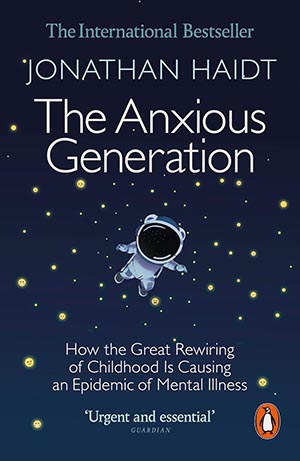 The Anxious Generation was published in the USA by Penguin Press and in the UK by Alan Lane in 2024. The paperback UK edition appeared in 2025.
The Anxious Generation was published by the USA by Penguin Press and in the UK by Alan Lane in 2024. The paperback UK edition appeared in 2025.
Fatima Chaudhry is a twenty-one-year-old living in Glasgow. She is a founder and director of a community interest company (inpotential.org), as well as a student of permaculture, youth worker and community organiser. She is a mother to two cats and resident expert on issues pertaining to youth, for her family.
Sources (click to open)
[1] Jonathan Haidt, The Anxious Generation (Penguin Random House, 2024)
[2] Jonathan Haidt, The Happiness Hypothesis (Cornerstone Digital, 2015)
[3] Thomas Cleary, Vitality, Energy, Spirit: A Taoist Sourcebook (Shambhala Publications, Inc., 1991) p.91
[4] Alaistair McIntosh & Matt Carmichael, Spiritual Activism (Green Books, 2016) p. 11
[5] Jonathan Haidt and Catherine Price, The Amazing Generation (Puffin, 2026)
read more in beshara magazine



More News & Views
Book Review: ‘An Island to Myself’
Robert Hirshfield talks to the author of a new book by Michael N. McGregor which explores the place of solitude in an active life
Reflection: Dad’s Transition
Helen Carolan remembers the death of her father, Sean, aged 80, in County Mayo, Ireland, and the traditional wake which followed
In Memory of Gabriel Rosenstock
Peter Huitson remembers the Irish writer and haikuist who contributed several pieces to Beshara Magazine
April 2026
Gabriel Rosenstock
Don Quixote in Search of the Holy Land
All You Need is Love: The Lasting Legacy of the Beatles
Jane Clark reflects on a recent book and two documentaries about the Fab Four which argue that they were seminal in making us the people we are today
Book Review: ‘spinning pinwheels’
Gabriel Rosenstock rediscovers kokoro (heart) in a new book by the distinguished Indian poet K. Ramesh
FOLLOW AND LIKE US
@Beshara_Mag








——————————————
——————————————
——————————————
If you enjoyed reading this article
Please leave a comment below.
Please also consider making a donation to support the work of Beshara Magazine. The magazine relies entirely on voluntary support. Donations received through this website go towards editorial expenses, eg. image rights, travel expenses, and website maintenance and development costs.
READERS’ COMMENTS
1 Comment
Submit a Comment
FOLLOW AND LIKE US
@Beshara_Mag
A good introduction from Fatima which should be on the notice board of every school and home in the country.
Sadly, al this is vicariously know by schools, parents and governments. parents in particular, being ‘responsible’ for their children’s smartphone addiction, deny it. Educators tier up in supposedly seeing technology as an educational leap of learning fail to recognise the dependence they place screen time on learning. Government as they cannot see how to bring about change and enforce it in a sympathetic and meaningful way.
Hence we seemed screwed to enter more mundanety, more mental health and more lack of interest in life other than that of me.
But thank you for raising the book to my attention. I intend to weave it somehow into my university courses this coming year.
John