
Arts & Literature _|_ Issue 31, 2026
Pointing Towards the Void
Farah Ahamed explores the concept of sunn kaall (the primordial void) in the music and poetry of Islam, Hinduism and Christianity
Pointing Towards the Void
Farah Ahamed explores the concept of the primordial void (sunn kaall, kháos, hū) in the music and poetry of Islam, Hinduism and Christianity
Farah Ahamed is a human rights lawyer and a writer/editor whose many published stories explore how people’s lives are affected by culture and religion. Born in Kenya to Ismaili Muslim parents with origins in Gujarat, India, she first came across the concept of sunn kaall – the primordial void – in the Ismaili devotional hymns taught to her by her mother. In this article she explores how the same reality has been expressed in many different ways in both the East and West – within the Islamic Sufi tradition; the ancient Orphic hymns of Greece; the poetry of Rabindranath Tagore and the Ismail teacher Pir Shams Sabzwari; the writings of John Donne and St Francis of Assisi, and the vachs of the Kashmiri female mystic Lal Dei (Lalla). Music, she maintains, is a way of searching for the divine – ‘an entry point into the underlying mysticism of nature and universal sound’.

In 2009, when I moved back to Nairobi after ten years abroad, I decided to learn to sing Indian classical music. I had been circling questions about voice, silence and spirituality, and felt that music might open a way in. A friend led me to a guru. He spoke of riyaz – relentless, daily practice – and of voice culture, disciplined breath, and the need to ‘purify the ears.’ For two years, at 5:30 every morning, I sat with the harmonium, sounding Aum across the Indian classical scale – sa, re, ga – for hours. And even then, my teacher was not happy. ‘No. You’re not singing with your true voice.’ My true voice. What did that even mean? ‘Learn to listen,’ he said. ‘Not just to the note, sa, but to what follows it – the fading echoes, the after-vibration, the emptiness. Become aware of your breath, instinctively. Only then will you begin to tune your voice.’
My teacher gifted me yellowing photocopied pages of The Sound of Indian Music: A Journey into Raga,[1] which gave me an insight into the foundational principles of Indian classical music as a route to spirituality, and I began to understand what my teacher had been asking of me. I came to understand raags as the foundational melodic framework of Indian classical music, and as a sound vibration which aimed at the transcendence of the self toward divinity. The book explores the essence, emotional resonance and philosophical significance of raags, mapping their impact on the human spirit. Each raag is designed to evoke a specific rasa, or emotional mood, that elevates the listener from worldly feeling toward a state of calm and devotion. Raags are traditionally linked to specific times of day or seasons, so as to align the listener’s internal state with the rhythms of nature.
In 2009, when I moved back to Nairobi after ten years abroad, I decided to learn to sing Indian classical music. I had been circling questions about voice, silence and spirituality, and felt that music might open a way in. A friend led me to a guru. He spoke of riyaz – relentless, daily practice – and of voice culture, disciplined breath, and the need to ‘purify the ears.’ For two years, at 5:30 every morning, I sat with the harmonium, sounding Aum across the Indian classical scale – sa, re, ga – for hours. And even then, my teacher was not happy. ‘No. You’re not singing with your true voice.’ My true voice. What did that even mean? ‘Learn to listen,’ he said. ‘Not just to the note, sa, but to what follows it – the fading echoes, the after-vibration, the emptiness. Become aware of your breath, instinctively. Only then will you begin to tune your voice.’
My teacher gifted me yellowing photocopied pages of The Sound of Indian Music: A Journey into Raga,[1] which gave me an insight into the foundational principles of Indian classical music as a route to spirituality, and I began to understand what he had been asking of me. I came to understand raags as the foundational melodic framework of Indian classical music, and as a sound vibration which aimed at the transcendence of the self toward divinity. The book explores the essence, emotional resonance and philosophical significance of raags, mapping their impact on the human spirit. Each raag is designed to evoke a specific rasa, or emotional mood, that elevates the listener from worldly feeling toward a state of calm and devotion. Raags are traditionally linked to specific times of day or seasons, so as to align the listener’s internal state with the rhythms of nature.
Most of all, I learnt to appreciate how, through singing raags, the human voice becomes a spiritual pathway – an entry point into the underlying mysticism of nature and universal sound. Music as a way of searching for the divine.
Singing devotional songs has always been part of my family’s culture. I am a fourth-generation Kenyan, and my family arrived in Nairobi in the early 20th century from Gujarat, India, during the colonial era. I was born to Ismaili Muslim parents, attended an Irish Catholic all-girls convent and had friends who were Christian, Hindu, Sikh, Muslim, Buddhist, Jew and Bahai. Depending on the religious festival, at our home we received from our many friends, sweetmeats on Diwali, Vaisakhi and Idd, and Christmas presents. My parents went to weddings and funerals at the synagogue, temple, church, mosque and gurudwara, while I attended mass every Friday.
I grew up learning Swahili hymns at school, listening to my father singing the raag to bhajans (Hindu hymns) [/] when they were aired on the radio, and my mother humming ginans [/], while often remembering her own mother – my grandmother – who was known for her powerful, soothing voice. Derived from the Sanskrit word jnan – an abstract noun which may be rendered as ‘knowledge’, ‘wisdom’ or ‘cognition’ – Ismaili ginans are hymns, religious lyrics, sung in everyday prayer rituals in mosques and homes as part of ordinary, joyful and supplicatory devotional practice. In our home, we learnt to recite and sing ginans in Gujrati, Sindhi, Saraiki and Punjabi even before we understood what the words meant or knew how to read or write.
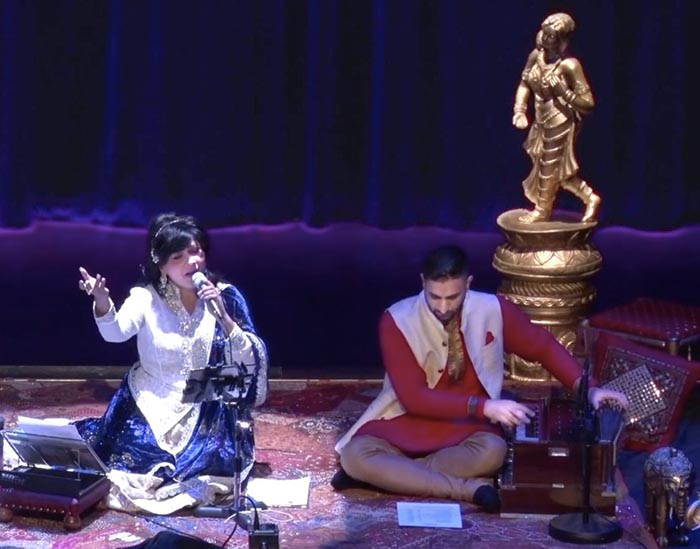
Ginan singer Navinjaan performing Mere Mowla (My Lord). Image: Navinjaan NJ Sounds YouTube [/]
Sunn Kaall in Ismaili Ginans
.
My mother usually sang ginans from her heart and memory, but when she could not recall the words, a ginan book was passed around at prayer time, and we would read the words and sing together. She would also explain the meanings of specific words or phrases, drawing out their sacred imagery and symbolism. Later, on my own, I studied the book of raags from my music teacher, underlining Sanskrit words and trying to make sense of their translations. I also returned to the ginan book from my childhood and attempted to become a better listener and reader of other works of poetry and musical texts. I was looking for answers to questions which were not properly formulated in my mind, and still reflecting on sound and silence.
A Gujarati ginan which my mother often recited was Anant Akhado, sometimes called a ginan granth or long-form devotional hymn. It was composed in the 15th century by the Ismaili Pir Hasan Kabirdin [/], who wrote it over six months and six days on a piece of cloth. It comprises 500 verses written in Khojki script, and is known for its poetic and spiritual depth. (To hear a rendering of a few verses, see video right or below.) It was in some of its verses that I first came across the words sunn kaall.
Video: Anant Akhado sung by Navinjaan. Duration: 15:10
Ashaji, Sunn-kaall maanhe tap-naa kaheeyen…
Oh Lord, in the primordial void when there was only contemplation
… The Lord of light was alone at that time…
Ashaji, Sunn-kaall maanhe thee rachanaa keedhee…
Oh Lord, From the primordial void the Lord created the universe [2]
According to Pir Hasan Kabirdin, sunn kaall is a deep, contemplative, limitless space of creative energy and consciousness. Drawing from Hindu Vedantic and Tantric traditions, sunn kaall is not conceptualised as nothingness, but understood as a space of infinite possibility and unmanifested consciousness. It is the substratum from which existence emerges. In sunn kaall, consciousness and energy are one. It is primordial vastness. In deeper meditative paths, sunn kaall is synonymous with shun yata, a form of silence or emptiness which is not an abyss but encompasses full, non-dual consciousness. Devoid of object-subject duality, sunn kaall is the cosmic void that precedes all thought and creation.
Other gnanic texts describe the initial stirrings within this space as the awakening of spanda or divine vibration, an original force which gave rise to primordial light and the cosmic sound of Aum. For instance, there is an ancient hymn, considered to be the earliest recorded example of a song explicitly mentioning the phenomena of the primordial void, called the ‘Nasadiya Sukta’, or ‘Hymn of Creation,’ found in the 10th Mandala of the Rig Veda. The concept of spanda corresponds to the philosophical understanding presented in the Rig Veda, where the void is the ultimate, indefinable and timeless substrate – a state before creation that was ‘neither non-existence nor existence, neither realm of space nor the sky beyond.’ It describes a ‘darkness’, ‘void’ and ‘emptiness’ where ‘That One’, the ultimate reality, was covered. The hymn notes that this One ‘breathed’ windlessly, and through the power of heat ‘came into being.’ [3]
Early Orphic hymns, such as ‘Hymn 6 to Protogonos’ [/] [4] similarly mention a primordial creative deity, Phanes, hovering over the ‘void of day’, representing the chaos and darkness before the cosmos was created. Orphic Hymns are a collection of 87 short religious poems composed in the 2nd or 3rd century BC based on the beliefs of Orphism, a philosophy claiming descent from the mythical hero and musician Orpheus.
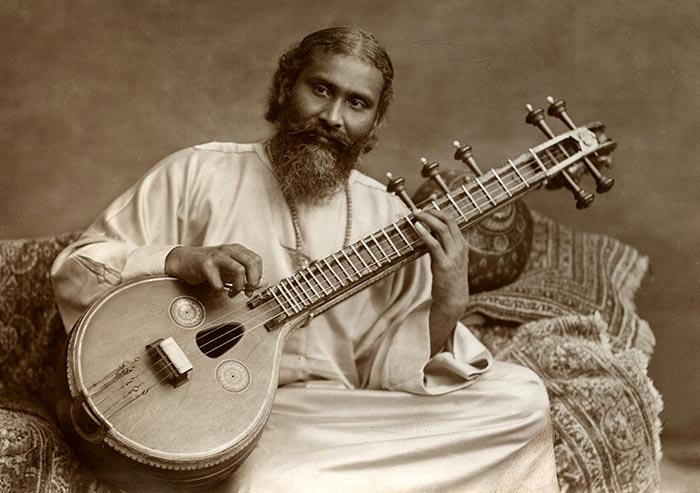
Hazrat Inayat Khan, who in the 19th century brought Sufism and its musical traditions from India to the West. Image: ramdass.org/hazrat-inayat-khan [/]
The Primordial Void as Allah Hu in Sufism
.
In modern Sufi traditions, poems and qawwalis often refer to the notion of a primordial void, similar to sunn kaall, positing that the sound originating from this vastness was Hu. In his poem ‘Lashareeka Lahoo’ (‘Ruler of the World, Soul of My Blood’) (see video right or below), the poet Malik-ul-Mulk, articulates it this way: before the creation of the world, earth, moon, sky, or indeed any known truth, when there was nothing at all, in this pre-creation state, there existed only Hu, or Allah Hu, which signified a sole divine presence.
Video: ‘Allah Hu’ performed by Faiz Ali Faiz, Chicuela, Miguel Poved. Duration: 13:23
Yeh zameen jab na thaa, Yeh jahaan jab na thaa
When this earth did not exist, when this world did not exist
Chaand suraj na tha, Aasman jab na tha
When there was no moon, sun, or sky,
Raaz e haq bhi kisi per ayaan jab na thaa
When the secrets of truths were still unknown,
Tab na that kuch yahan Tha Magar tu Hi Tu, Allah Hu, Allah Hu
When there was nothing here, there was You and only You, Allah Hu, Allah Hu
In Sufi practices, Hu is described as allowing access to higher consciousness in the same way that Aum is believed to in Hinduism. Aside from conceptual similarity, the sound ‘u’ in Aum is often likened to the ‘u’ in Hu. Both Hu and Aum are considered to have an innate, ancient sacred vibration. The words are believed to represent the ultimate sound energy of the divine and are often sung or repeated as mantras in meditative spiritual practices.
According to the Sufi scholar, Reshad Feild, in his book The Last Barrier,[5] Hu is the primordial sound of divine essence and existence, while Allah Hu is an acoustic and an inner, ‘unstruck’ melody that is sensed when the heart is in a state of devotion. Allah Hu is also the divine breath uniting all creation. It is not merely a chant but the sound of existence itself which emerges from a void. For Feild, the sound represents the essence of ultimate divinity that resonates within the human heart. Hu is the vibration of the heart, and the chant Allah Hu is a dhikr or remembrance that enhances the connection to the divine. Through alignment with this inner sound that emanates from the original source, a person, through their breath, can experience ultimate reality.
Hazrat Inayat Khan [/] in The Mysticism of Sound and Music,[6] also explores the essence of sound, particularly in relation to its primordial and spiritual aspects. He suggests that there exists a ‘unique sound reality’ – a spiritual dimension that reveals the beauty and infinity of the universe. This sound from the core, original void or sunn kaall, is unique because it represents the divine unconstrained by form or thought. It is a direct and pure manifestation of the divine essence, and the knower of the mystery of it understands the entire universe. For Khan, ‘inner sound’ is the core of all existence and represents the harmony of the soul. Inner sound is also a bridge between the human soul and the essence of ‘all that is.’ In fact, everything in the universe, including the movement of stars and planets, possesses a musicality and rhythm that produces a magnificent sound which originates from the primordial void in order to glorify the divine.
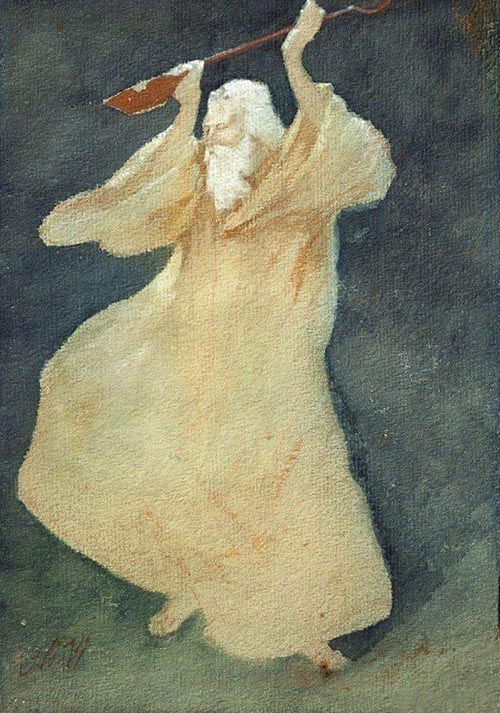
Rabindranath Tagore portrayed as a blind musician that he enacted as part of one of his plays, Falguni. Painting by Abanindranath Tagore (1871–1951). Image: Museums of India
The Void as Spiritual Experience in Tagore and John Donne
.
I found similar references to the concept of sunn kaall in other poetic works. After my mother died, I began reading Rabindranath Tagore. One afternoon, while in my father’s library, browsing through Gitanjali [/] (Song Offerings) translated from Bengali, I found an old shopping receipt which my mother had placed, bookmarking ‘Poem 67’ where the poet had written about his experience of ultimate reality. According to Tagore, in the presence of the divine, likened to an ‘infinite sky for the soul to take her flight in,’ there is a void with the absence of earthly concepts.
But there, where spreads the infinite sky for the soul to take her flight in, reigns the stainless white radiance. There is no day nor night, nor form nor colour, and never, never a word.[7]
Tagore’s experience of divine connection or ultimate reality is a vacuum. Nonetheless, at the same time, in the first line of ‘Poem 1’, he also says:
Thou hast made me endless, such is thy pleasure. This frail vessel thou emptiest again and again, and fillest it ever with fresh life.[8]
On the one hand, Tagore explains, the limitless emptiness is devoid of all ideas and forms. On the other, it is a consciousness with potentiality. His poems illustrate his rapturous realisation that he is ultimately a spiritual being; his essence is of sunn kaall, constantly being ‘emptied’ and renewed. Echoing Hazrat Inayat Khan, he says: ‘All things are created by the Aum… without form, without quality, without decay…’ and are from that which is ‘formless,’ ‘colourless,’ ‘infinite’ and ‘fathomless,’ to manifest a ‘thousand forms…’ [9]
The English poet John Donne had a comparable experience. Writing in the 16th century, his engagement with the concept of a primordial void, chaos or non-existence was a recurring, profound theme. He frequently juxtaposes the intense, intimate world of his personal experience against the backdrop of formless, chaotic nothingness, which he sees as a state of pre-creation. Donne offers his deepest exploration of this in his poem ‘A Nocturnal upon St. Lucy’s Day’ [/] [10] where the poet/narrator claims to be the ‘epitaph’ of ‘every dead thing.’ He describes himself as a ‘quintessence even from nothingness’, effectively identifying with the void. He goes on to define himself as ‘… by Love’s limbec, am the grave/Of all that’s nothing,’ a state where he feels ‘dead’ and reduced to ‘nothingness,’ representing a personal cosmos that has reverted to a state of void or chaos, ‘Of the first nothing.’
According to Greek mythology, chaos is the origin of everything, and the first thing that came into existence. It is the primordial void, the source from which everything has been created, including the universe and the gods. The first deities that emerged out of Chaos were Gaea (earth), Tartarus (underworld), Eros (love), Erebus (darkness) and Nyx (night). The etymology of ‘chaos’ is from Ancient Greek, and the word χάος (kháos) is defined as an abyss, or yawning gap. Derived from the verbs ‘to gape’ or ‘open wide’, chaos is not disorder but represents the initial, empty space before creation.
However, for Donne, the ‘absence of all’, was both a theological concept of what existed before God and an emotional and spiritual reality. It was what the human soul confronts in moments of loss, love or repentance until it is recreated by ‘Love’ in a ‘wrought new alchemy.’ In ‘Nocturnal’, the idea of sunn kaall is presented as a paradox where Donne claims, ‘I am re-begot/Of absence, darkness, death: things which are not,’ which may be understood as a form of nothingness, making him a living embodiment of the primordial void which bonds him eternally to the essence of all things.
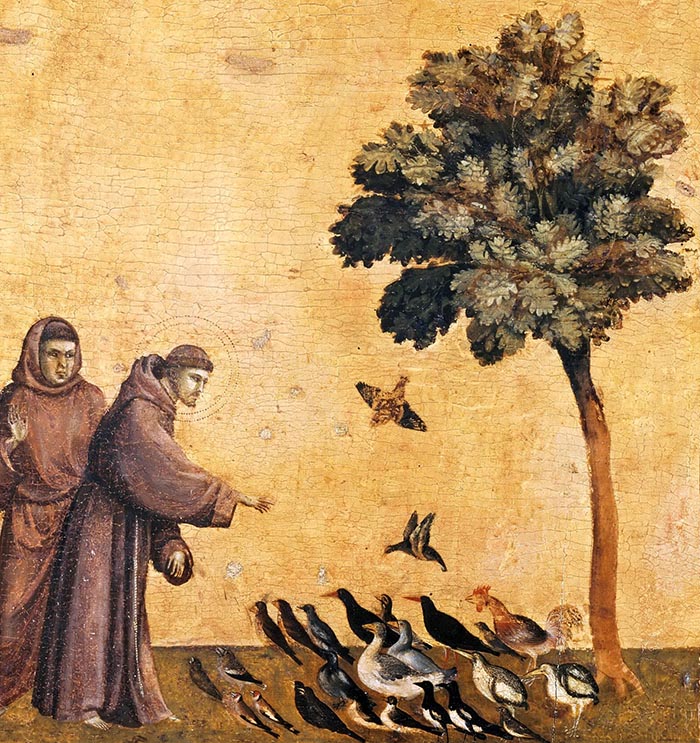
St Francis Preaching to the Birds by Giotto di Bondone, a fresco created c.1299 for the Basilica of St Francis in Assisi, Italy. Image: Wikimedia Commons
The Void as Unending Love in Pir Sabzwari and St Francis of Assisi
.
Donne’s understanding is similarly depicted in ginanic references. One of my mother’s favourite ginans was Brahm Prakash. Composed in the 13th century by Pir Shams Sabzwari [/], the 150 verse Punjabi granth, Braham Prakaash or Divine Illumination [/] [11] expresses an ecstatic understanding of spiritual reality. According to Pir Sabzwari, one graced with divine light feels mystical love and connection permeating through everything. Every atom of creation, corner and space is filled with a sense of divinity which is both dynamic and static, and arguably, like sunn kaall.
However, the Pir also notes that one cannot capture in words the final stages of maarifah (the epitome and utter ineffability of spiritual knowledge) because ‘the glory (or majesty) of the divine cannot be expressed further’ (maheema adhik kahi na jai). By this he means that when it comes to describing sublime magnificence and glory, language and mental concepts have their limits. He explains with vivid imagery what happens when one’s heart is illuminated. It is as if one hears a flute when there is no flutist in sight and music pervades without the presence of any musicians (nahee tur jahaa(n) hay bee turaa, nahee(n) sur jahaa(n) hay bee sura…).[12] One feels the flowing of a river even though the river Ganges is not near (nahee ga(n)g jahaa(n) haybee ga(n)gaa) and the fullness of companionship without the presence of people, (nahee(n) sa(n)g tahaa(n) haybee sa(n)gaa…). It is a condition of bliss and a sensation of being in union with all – even though one is entirely alone.
In two further verses, Pir Shams illuminates what occurs when one experiences further stages of marifaah. He says:
Nij aapaa so vyaapak hi dharyaa, Pi(n)dd bharama(n)dd charaachar bharyaa…’ [13]
A phrase by phrase translation shows the pointed clarity of his message:
Nij aapaa – one’s own true self, the divine essence, or the absolute soul.
so vyaapak hi dharyaa – has expanded, diffused, and manifested everywhere.
Pind – the individual physical body or the microcosm.
bharama – the entire universe, cosmos, or the macrocosm.
charaachar – all things animate (moving) and inanimate (still/living and non-living).
bharyaa – completely filled, saturated, or infused.
For Pir Shams, a transcendent experience entails a recognition that the limitless divine has manifested its essence everywhere, filling the individual body, the cosmos, and all living and non-living creation. It highlights a philosophy of divine immanence, where the universe is a reflection of divine light and the human body is considered a miniature cosmos containing the same energetic vibration as the universe.
I was intrigued to find that Saint Bonaventure, when writing in the 13th century about Saint Francis of Assisi, noted a similar omnipresence. He explains in Legenda Major S. Francisci (The Major Legend of St. Francis):
When he considered the primordial source of all things, he was filled with even more abundant piety, calling creatures, no matter how small, by the name of ‘brother’ or ‘sister’, because he knew that they had the same source as himself.[14]
St Francis himself in Fratello sole, sorella luna, (Canticle of Brother Sun and Sister Moon), translated from Italian, says:
Praised be You my Lord with all Your creatures, especially Sir Brother Sun…’ and ‘through Sister Moon and the stars…’ ‘…Brothers Wind and Air’, ‘…Sister Water’, ‘…Brother Fire’, ‘…our Sister Mother Earth’.[15]
For Saint Francis and Saint Bonaventure, the primordial void was God, the source or ‘Fontal Principle,’ of all being.
Similarly, in his poem ‘Unending Love’ [/], Tagore wrote about his spiritual journey, describing how he felt that he had loved the spirit of the divine which he had discovered in ‘numberless forms, numberless times’:
I seem to have loved you in numberless forms, numberless times…
In life after life, in age after age, forever.
My spellbound heart has made and remade the necklace of songs,
That you take as a gift, wear round your neck in your many forms,
In life after life, in age after age, forever.[16]
While some have interpreted this as referring to Tagore’s reincarnation, the line, ‘in your many forms’ suggests that Tagore was directly addressing the divine and recognising the continual, dynamic manifestation in all living things. ‘Unending Love’ is a joyful ode, a ‘necklace of songs,’ to the discovery of abundant, divine pervasiveness.
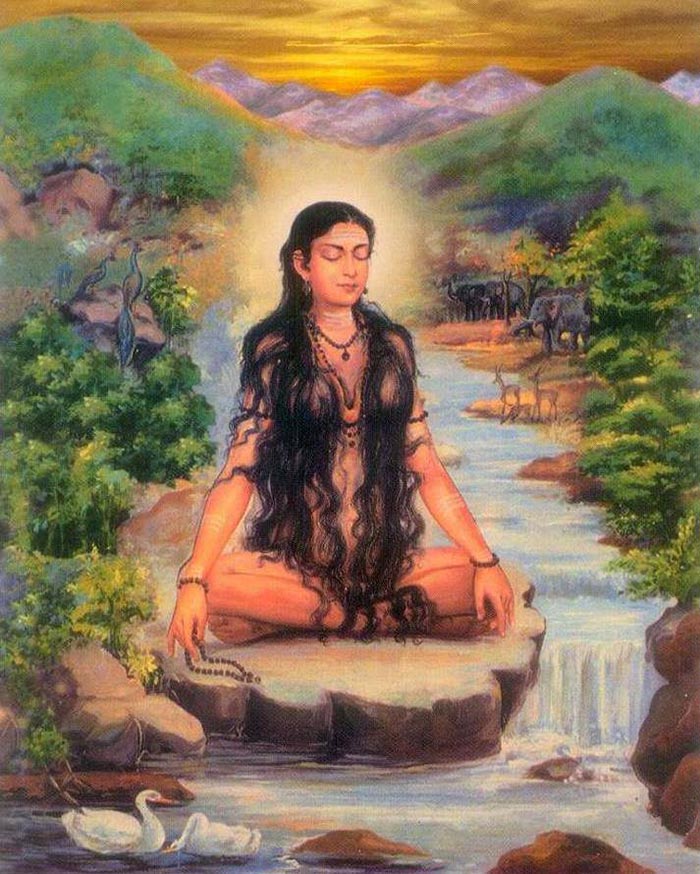
The 14th century Kashmiri mystic Lal Ded.Image: Kashmir Online
The Void as ‘Beyond’ in the poetry of Lal Ded
.
Female mystics, too, have written about their experiences with resonating ideas of sunn kaall. The 14th century Kashmiri mystic Lal Ded, popularly known as Lalla, penned 258 poems or utterances known as vakhs, where she described her spiritual journey. (For more on Lalla, see video right or below.) In ‘Poem 115’, recording her epiphany of expanded awareness, she wrote:
Video: Let’s Talk Religion: Lal Ded. Duration: 20:12
Word or thought, normal or Absolute, they mean nothing,
Even the mudras of silence won’t get you entry.
We’re beyond even Shiva and Shakti here.
This Beyond that’s beyond all we can name, here.[17]
In another vakh [/], echoing Tagore, she refers to an ‘unstruck sound,’ and an emptiness, where there is:
… neither name nor colour nor family nor form, and where one who, meditating on herself, is both Source and Sound, is the goddess who shall mount and ride this horse.[18]
Reading her takes me back, again, to memories of my childhood. My mother spoke often of the relationship between spirituality and music. At dusk, for an hour, every activity stopped, and a solemn hush filled the house. We sat together in a circle on the living room carpet, listening to my mother as she gently corrected the mistakes in our prayers, taught us the melodies to different ginans, and pointed out the symbolic significance and meanings of certain words. A moment of calm and stillness. Through the open window, sounds filtered into the room: the call to prayer from a nearby mosque and crickets rubbing their wings in the garden.

Farah Ahamed’s writing has been published in Ploughshares, Wasafiri, White Review, LA Review of Books, Massachusetts Review, World Literature Today, Asymptote and Markaz Review among others. She is the editor of Period Matters: Menstruation in South Asia (Pan Macmillan India, 2022, www.periodmattersbook.com) described as ‘an essential book about the female body that dispels misconceptions,’ by Book Riot. You can read more of her work at: farahahamed.com
Image Sources (click to open)
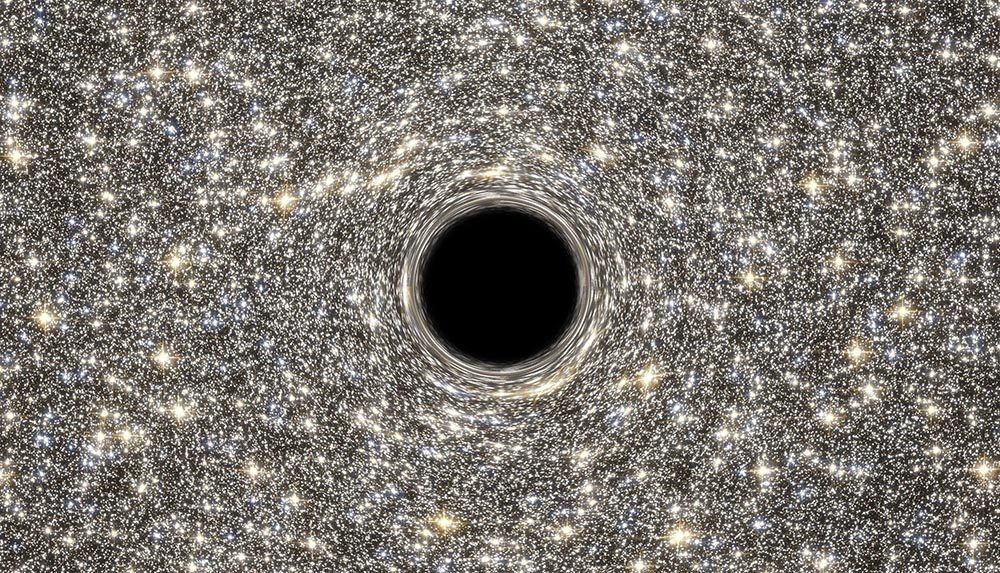
Banner: Artist impression of a ‘supermassive’ blackhole in a very dense galaxy, based on the combined observations by the NASA and Hubble Space Telescope. Image: Wikimedia Commons.
Inset: Farah Ahamed. Photograph: courtesy Farah Ahamad.
Other Sources (click to open)
[1] RAGHAVA R. MENON, The sound of Indian music: A journey into Raga (Indian Book Company, 1976).
[2] Pir Hasan Kabirdin, in A. ESMAIL, A scent of sandalwood: Indo-Ismaili religious lyrics. (Curzon Press in association with The Institute of Ismaili Studies, 2002), verses 355–566.
[3] Rig Veda 10.129, in Wendy Doniger O’Flaherty (trans.), The Rig Veda: An Anthology (Penguin Books, 1981), pp. 25–26.
[4] Orphic Hymns 1–20, translated by Thomas Taylor: see https://www.theoi.com/Text/OrphicHymns1.html.
[5] RESHAD FEILD, The Last Barrier (Harper & Row, 1976).
[6] HAZRAT INAYAT KHAN, The Mysticism of Sound and Music (Shambhala Publications, 1996).
[7] RABINDRANATH TAGORE, Collected Poems and Plays of Rabindranath Tagore (The Macmillan Company, 1967), p. 32.
[8] Ibid, p. 3.
[9] RABINDANATH TAGORE, The Tagore Omnibus IV (Macmillan India, 2005), p. 465.
[10] JOHN DONNE: see https://www.poetryfoundation.org/poems/44122/a-nocturnal-upon-st-lucys-day.
[11] Pir Shams Sabzwari [/], in ZARINA KAMALUDDIN and KAMALUDDIN ALI MUHAMMAD (comps), Braham Prakash of Pir Shams: English Translation and Glossary. (ITREB Pakistan, 1997).
[12] Selected verses of Brahm Prakash: see https://www.scribd.com/document/238927551/Brahm-Prakaash-Pir-Shams, verses 71–2.
[13] Ibid, verses 121–122.
[14] BONAVENTURE OF BAGNOREGIO, translated by E. G. Salter, ‘Legenda Maior Sancti Francisci (The Major Legend of St. Francis)’, in The Life of St. Francis, (Sheed and Ward, 1960).
[15] ST FRANCIS OF ASSISI, The Canticle of Brother Sun and Sister Sun: see https://ignatiansolidarity.net/blog/2015/06/04/canticle-of-brother-sun-and-sister-moon-of-st-francis-of-assisi/.
[16] Rabindranath Tagore, see https://allpoetry.com/Unending-Love.
[17] LAI DED, I Lalla, translated from the Kashmiri by Ranjit Hoskote (Penguin Books India, 2013), Poem 115.
[18] Ibid, Poem 79.
The text of this article has a Creative Commons Licence BY-NC-ND 4.0 [/]. We are not able to give permission for reproduction of the illustrations; details of their sources are given in the captions.
FOLLOW AND LIKE US
@Beshara_Mag








——————————————
——————————————
——————————————
Video: Anant Akhado sung by Navinjaan. Duration: 15:10
Video: ‘Allah Hu’ performed by Faiz Ali Faiz, Chicuela, Miguel Poved. Duration: 13:23
Video: Let’s Talk Religion: Lal Ded. Duration: 20:12
FOLLOW AND LIKE US
@Beshara_Mag
If you enjoyed reading this article
Please leave a comment below.
Please also consider making a donation to support the work of Beshara Magazine. The magazine relies entirely on voluntary support. Donations received through this website go towards editorial expenses, eg. image rights, travel expenses, and website maintenance and development costs.
READ MORE IN BESHARA MAGAZINE
The Philosophy of Prayer
Distinguished Anglican theologian George Pattison talks about the meaning and practice of prayer in the modern world
Participating in the Divine Playfulness
Hina Khalid explores the Theological Aesthetics of Rabindranath Tagore
A Thing of Beauty…
Robin Thomson appreciates the music of Bach and an inspiring new performance of his St John Passion

This Little Light of Mine
Joy Bostic talks about Africana spirituality and its expression in popular music and dance
READERS’ COMMENTS
This essay brings me back from a lot of chaos, monkey chatter and helps me now focus on what is truly important and not the mundane things that life is made up of! It has brought me back from the living dead to a living soul that must recognize its source every single nano second of every single day ! Farah you have opened my eyes again today. I was lost and now I am found and hopefully I will not be lost again. Thank you !
Thank you for reading and sharing your thoughts, Jane.
“Deep calleth unto Deep”
Beauty unto Beauty
Truth unto Truth
Goodness unto Goodness
Unity unto Unity
Thank you for this reminder of Psalms. It speaks of the same mirrored nothingness.
Dear Farah (and Jane)
Thanks for posting this excellent article. On the spirituality of Sound.
It’s a strange coincidence, and I mention it here as a way of getting over the strangeness of the timing of this event.
I was listening to Raag Yaman, Kishori Amonkar’s incomparable rendition, this morning, as if I had been prompted by some unseen, unheard (ghaibi?) presence to listen to this particular piece of music….i was feeling a particular kind of melancholy that had no reason or name….and very soon after I finished listening to Kishori ji, while checking my mail, I couldn’t believe….there it was—-your article. On the primordial Void! The very thing I had been struggling to explain to myself in words.
Thanks so much! I feel amazed and filled with gratitude.
Minor correction: (suggestion)
Tab na that kuch yahan Tha Magar tu Hi Tu
…..when there was nothing here, there was You and only You….
Tu hi tu….means You and only You
Also, the word for You is tu…..not Tun….
Sincerely,
Nighat
Dear Nighat,
Thank you very much for reading and sharing your thoughts. I must listen to Kishori Amonkar’s Raag Yaman now that you have suggested it. My favourite is Raag Miyan ki Malhar- I wrote a poem on the monsoon season which is also published here, in Beshara- in case you’d like to take a look!
Also, thank you for the suggestion- I will speak to Jane and correct it.
Farah’s article touched me deeply, and brought back memories of the wealth of Ginan corpus that my mother, not unlike Farah’s mother, shared with me in my childhood: an endless source of wisdom, spirituality and mystery. I too became a student of illuminating poetry of Donne, Tagore, William Blake, Rumi, Shabistari as well as T.S.Eliot. I ask myself: ‘Is it the never-ending search that is an end in itself or is it the arriving? How does one reach the point of annihilation and total union? ‘Fana-fi Allah”? Farah’s article made me reflect on the journey into the Void. A brilliant article. Thank you.
Thank you Gulzar. I too love Shabistari’s Gulshan-i-Raz. I had forgotten that text. You have reminded me to revisit it.