
News & Views
Reflection: Dad’s Transition
Helen Carolan remembers the death of her father, Sean, aged 80, in County Mayo, Ireland, and the traditional wake which followed
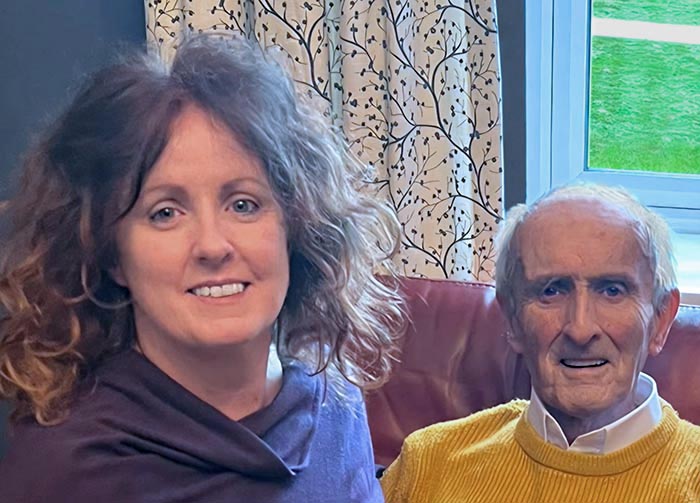
Helen Carolan with her father, Sean. Photograph: Helen Carolan
On 2 September 2025, Dad had a serious fall outside the house. It happened just at the opening of the eclipse portal – an astrological concept referring to the two-week period between a solar and lunar eclipse. It is considered a sandhi point in Vedic astrology – a transition point between the worldly and the spiritual, such as birth and death. Having been getting progressively weaker after three years of kidney dialysis, the fall proved too much for him, and he died three weeks later. He had one night at home before passing over.
On the day before he died, Dad was in hospital, waiting and waiting for his discharge after three long weeks. By now he had completely deteriorated and had given up on living. He did not even ask for a cigarette. He was pitifully thin and delirious at times. It was perhaps the hardest day of my life to date, and I have had a few tough ones. By the time the ambulance came to take him home, it was four hours behind schedule and 8 pm. The ambulance driver chose to follow me to the house as she was unfamiliar with the area.
Initially, I felt such relief and joy that Dad was finally coming home, after at least a week of pushing for it to happen. However, as I drove along the Castlebar Road through the darkness, the loneliness, listening to Dad’s favourite songs, my feelings changed, as though under the spell of the environment. I was leading Dad home to die, and I began to cry.
On arrival at the house, it took some time to get Dad safely from the ambulance to his bedroom and his prescribed hospital bed. Friends and family gathered to welcome him home to where his heart had been waiting. He seemed happy. He smiled when he came into the house and faintly spoke names when asked: ‘Do you know me, Sean?’
Around midnight, when the people dispersed, we settled him in for the night. Death was with us, but we did not realise how close. We administered the prescribed medication to keep him comfortable, and he seemed to drift off into a sleep of sorts – a sleep from which he never actually awoke. His breathing could be heard through the house, relentless all night into morning. Loud heavy sighs, rattling at times. His only movement was to intermittently lift his hand to his mouth – something he had been doing in the hospital, too. Perhaps he was dreaming of smoking … but who knows?
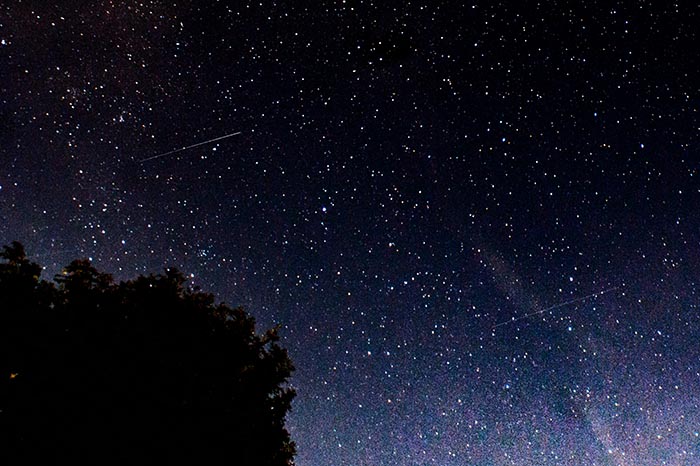
Night sky over Ireland. Photograph: Sean Harkin / Alamy Stock Photo
A Quiet Passing
.
The night turned intimately magical and lonesome. The most beautiful blanket of stars was visible – a rare sight, particularly in the West of Ireland, where it is usually cloudy or rainy. I used to often talk to Dad about the stars or the moon, or a particular celestial event taking place. Recently, I had mentioned to him a solar eclipse due to take place when he was heading to dialysis. He asked me later: ‘Did you see the eclipse?’ ‘No’. ‘Did you see it from the hospital?’ ‘No, it was too cloudy.’
Dad’s heavy breaths continued, each one bringing him closer to death. ‘Dad, do you see the stars? They’re amazing, they’re here for you’.
3.30 am and I knelt by his bed and prayed. Dad loved the Rosary. I prayed some of it –
‘Please God, let Dad go quickly…’ Soon after this I recited the Hanuman Chalisa [/] – a Hindu devotional hymn – and played a version Dad liked by Krishan Das (to listen, click here [/]). He was a Catholic, but he liked Bhakti music, particularly Krishna Das. In the same way, he had an interest in astronomy and astrology, also Shamanism. This made all the different happenings on the night before he died more notable for me.
I asked Hanuman: ‘Please take what fear lingers in Dad’s mind and in mine.’ The distressing noise continued – the breathing – but it no longer felt like Dad was breathing. He was being breathed, further and further out of his body. The night started to give way, a night of pacing from room to room, window to window: ‘Dad, are you ok? Can you hear me? It’s Helen.’
6 am: I went out the back to turn on the heating. Friday morning, 26 September. The dawn sky was colourful and tranquil – and there was Venus, the morning star. The planet of love and transformation. A planet with mythological associations with death and rebirth. Orbiting close to the sun, there are times when it rises as the morning star; other times it sets as the evening star, sinking into the underworld, into the world of the dead. Then, moving to the East, it reemerges – having conquered death – as the morning star.
On this morning, I wondered, was its visibility and its beauty an omen? I think so. Omens, like any other sign, only exist if you choose to see them. As Carl Jung said, man ‘ought to have a myth about death, for reason shows him nothing but the dark pit into which he is descending’. A robin came to the window; it briefly stood and looked in at me, then flew off. Was it just a bird, or an angel telling me that the spirit world was opening? Seems that is up to me. Peter Kingsley, a renowned philosopher and mystic, talks about the language of the birds and how they speak of eternity. He says that they want to be heard and need us to listen. Giving them our conscious attention, these angels bring us messages from other realms.
7 am: Mom got up. I went to bed for a couple of hours. Neighbours, friends and family passed through for the morning to see Dad. ‘We will be back later to see you, Sean.’ One of our neighbours, who is a nurse, along with Dad’s carer, turned him and changed his pyjamas, making him appear more comfortable and at home. A deeply practical expression of respect and love.
Dad was shrinking before our eyes. Around 1.15 pm, a neighbour said to him: ‘Sean, I will see you later.’ My sister Lorraine stood close by, looking out the window. She noticed and wondered at a white ‘thing’ in the field floating towards the house. She turned and said goodbye to our neighbour, then sat beside Dad’s bed. His face changed, his lip dropped, he gasped. Once. Twice. No more breaths. Lorraine shook him, imploring that he wake up. He had died. Following a Shamanic tradition, she leapt and opened the window wide so that his spirit could leave with ease. She then sat and whispered in his ear: ‘Go to your mother,’ and told him how much we all love him.
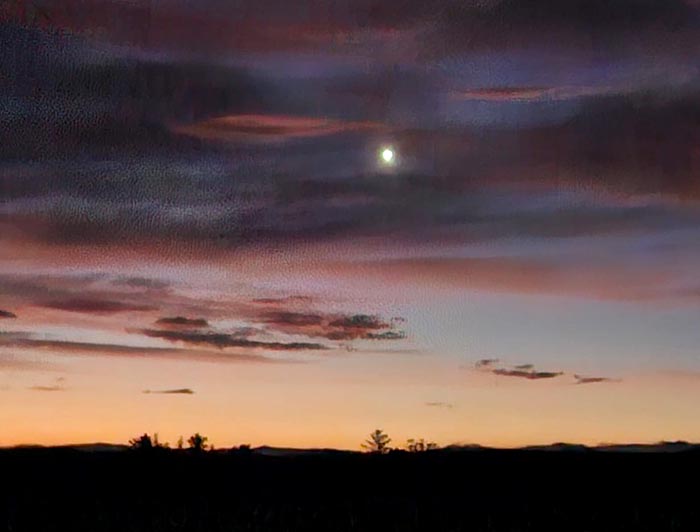
Venus rising as the morning star. Photograph: Helen Carolan
A Traditional Wake
.
Sadness and grief took over. We had decided that we would not have Dad’s remains embalmed, and that we would wash and dress him ourselves. But now that he had in fact died, we were numb. No idea what to do next. One is so susceptible to suggestions and authority at times like this. A temporary lapse in processing and a haze of confusion fell. Our neighbour, the nurse, had returned, as had Dad’s carer. ‘Get me a basin of water, and I’ll shave him.’ This was what I needed to hear. Slowly, the haze lifted and we proceeded with the necessary ablutions.
When ready, his body was transferred from the hospital bed to his wicker one. Taken to the sitting room, Dad was waked for 24 hours until his mass on Sunday morning. The previous night’s silent attendees – the robin, planets and stars – were followed by the bustle of preparations and the visitation of sympathisers. A warm and steady stream started to flow.
In keeping with tradition, Dad’s remains were in company throughout their repose, with local men and family keeping vigil throughout the night. The more traditional Irish wake is less common now. It is being replaced by a private affair with a two-hour slot either in the house or funeral home for the community to come and pay their respects. There are many practical and personal reasons for this, which pertain in part to modern life and our growing secular mindset.
But tradition worked for us. So many people brought food, so much food. People voluntarily took on responsibilities which allowed the wake to run smoothly – making tea, offering food or a drink to people (and to us), organising traffic and even coaxing our dogs out of the way of the sympathisers! There was alcohol, tea, coffee and cigarettes for whoever wanted them. Without all the help, it would have been a dry and chaotic affair. When you have a wake, you really feel like you are not alone. People you have not seen for years drop in, people you were not expecting call, and people keep you from falling into yourself.
By the time of closing the coffin, we had spent so much time with the remains, so much time talking about Dad, praying for him and touching or kissing his face, that it was OK. The time had come to leave the house, and we were ready. We had been propped up by the knowledge that we are not alone; grief comes to everyone, and this is hard to forget when you have a wake.
Dad’s remains were carried into the church by his friends, ‘The Men of The West’ [/] playing – one of his favourite old Irish songs. It made me cry. My sister and I did the readings, readings I chose from Isaiah and the letters of St. Paul. My oldest sister gave a touching, and at times comical, eulogy and the mass finished with the recitation of an old Gaelic poem ‘Bean tSleibhe ag Caoineadh a Mic’ [/] – which Dad had learned at school and had recited to us not long before he died (click here for an English translation).
The coffin was carried to the graveyard, where it was lowered into its plot. The morbid sound of the clay hitting against the coffin was contrasted by the uplifting praying of the Rosary, all five decades ringing out to heaven. The seeming contradiction of the situation brought to mind a quote from the yogi B.K.S. Iyengar:
As animals we walk the earth, as bearers of divine essence we are among the stars, as human beings we are caught in the middle, seeking to reconcile the paradox of how to make our way upon earth while striving for something more permanent and more profound.
The wake is a ritual steeped in the spiritual from start to finish. It is as intense as it is tiring as it is loving. There is nowhere to hide, but strangely, you do not want to hide. It is full of magic and love. One becomes possessed by curiosity and interest in ‘the other world’, on which, according to St. Paul, we should keep our minds fixed. A mysterious fixation until I myself gasp my last.
Rest In Peace, Dad.
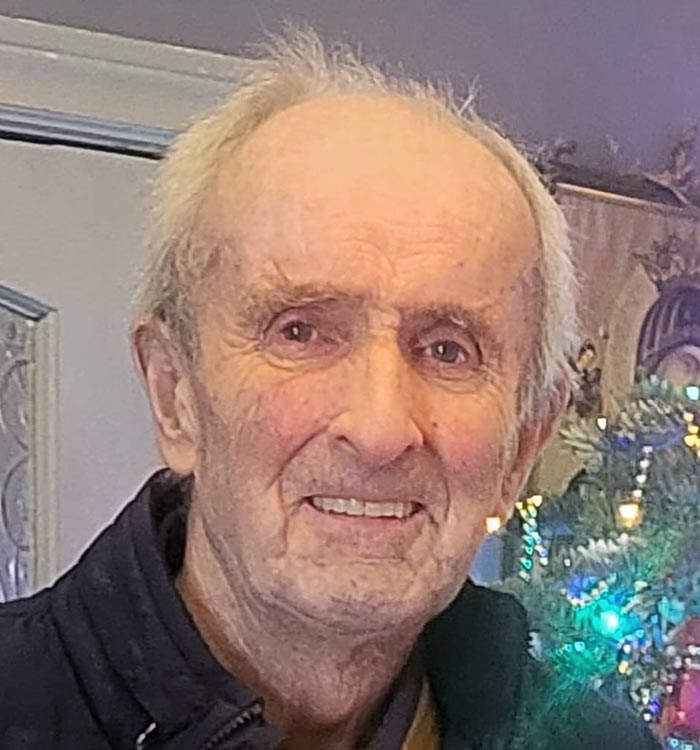
Sean Carolan (1945–2025)
Helen Carolan
works as a Rehabilitation Assistant with Acquired Brain Injury Ireland in Dublin. Her background is in Psychology and ABA. She enjoys reading and writing about religious and spiritual figures and topics, with a particular interest in dying and the cultivation of renunciation as a way to assist with this transition in her own life.
The text of this article has a Creative Commons Licence BY-NC-ND 4.0 [/]. We are not able to give permission for reproduction of the illustrations; details of their sources are given in the captions.
More News & Views
Book Review: ‘The Anxious Generation’
Fatima Chaudhry reviews a recent book which explores the effect of smartphones on the younger generation and proposes spiritual elevation as a solution
Book Review: ‘An Island to Myself’
Robert Hirshfield talks to the author of a new book by Michael N. McGregor which explores the place of solitude in an active life
In Memory of Gabriel Rosenstock
Peter Huitson remembers the Irish writer and haikuist who contributed several pieces to Beshara Magazine
April 2026
Gabriel Rosenstock
Don Quixote in Search of the Holy Land
All You Need is Love: The Lasting Legacy of the Beatles
Jane Clark reflects on a recent book and two documentaries about the Fab Four which argue that they were seminal in making us the people we are today
Book Review: ‘spinning pinwheels’
Gabriel Rosenstock rediscovers kokoro (heart) in a new book by the distinguished Indian poet K. Ramesh
FOLLOW AND LIKE US
@Beshara_Mag








——————————————
——————————————
——————————————
If you enjoyed reading this article
Please leave a comment below.
Please also consider making a donation to support the work of Beshara Magazine. The magazine relies entirely on voluntary support. Donations received through this website go towards editorial expenses, eg. image rights, travel expenses, and website maintenance and development costs.
READERS’ COMMENTS
1 Comment
Submit a Comment
FOLLOW AND LIKE US
@Beshara_Mag
This is a deeply moving tribute. The way you’ve woven together Catholic traditions, Vedic astrology, and Hindu hymns like the Hanuman Chalisa creates a beautiful, universal picture of a soul’s transition. Your father sounds like a truly open-hearted man.