
Podcasts
Professor Mark Williams: Mindfulness Meditation – Finding Peace in a Chaotic World
The Oxford psychologist talks about the development of MBCT and how it can help us look upon ourselves with a compassionate gaze
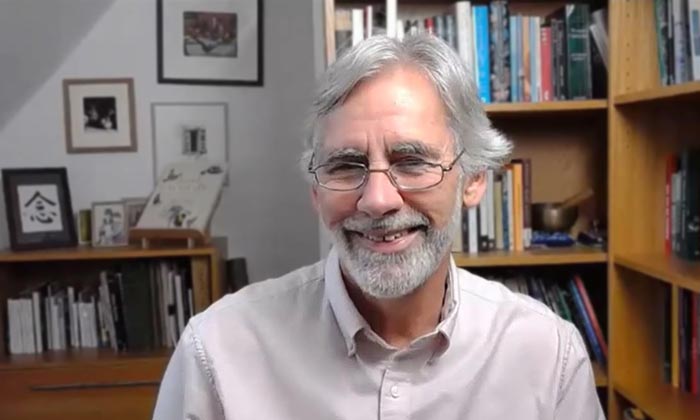
An Interview with Mark Williams
Transcript
Nick: Hello and welcome to the Beshara Magazine Podcast, a forum for leading-edge thinkers viewing the contemporary world from a perspective of unity. On our website, you will find hundreds of articles and interviews with scientists, economists, artists, ecologists, and followers of spiritual traditions whose narratives integrate and elevate our understanding of ourselves and our world. I’m Nikos Yiangou, podcast editor for the magazine, speaking to you from California, and I’m joined today by our executive editor, Jane Clark, who is based in Oxford in the UK.
Today, our guest is Professor Mark Williams, clinical psychologist and Emeritus Professor of Clinical Psychology at the University of Oxford, and the co-developer of Mindfulness-Based Cognitive Therapy (MBCT). Originally designed to help with chronic depression, this has found wide acceptance among the general public interested in understanding the workings of the mind to bring about a greater sense of well-being and relief from the triggers that cause mental distress. Mark has also played a leading role in bringing mindfulness into mainstream clinical practice and public health, including its adoption within the UK’s National Health Service. One of his more recent books that he co-authored is Deeper Mindfulness: The New Way to Rediscover Calm in a Chaotic World.
Nick: So, Mark, welcome. Thank you for coming.
Mark: It’s my pleasure.
Nick: Tell us a bit about your background and training, and how you came across mindfulness. I understand that it was your work on cognitive behaviour therapy for depression which led you to start looking at meditation as a therapeutic practice.
Mark: Indeed. So, I was a clinical psychologist, trained in the National Health Service to be a clinical psychologist, and then my doctorate was on depression. I then specialised in depression for all of my career, particularly the emphasis on when depression leads to suicidal feelings and suicidal behaviour and suicide. I had been brought up in the world of cognitive science and cognitive psychology. And so it was natural, when Aaron Beck started to advocate for cognitive therapy for depression, to learn about that and to study it, its evidence, and its mechanisms. And that’s where I came from. I trained with John Teasdale, who was already interested in cognitive mechanisms underlying depression, and, in the 1970s, and then in the 1980s and 90s, had specialised in cognitive therapy for depression.
The way we got into mindfulness was through the awareness that depression almost never… oh, sorry, that’s exaggerating… depression often is recurrent. I was going to say it almost never exists alone, and that’s true in one sense, so it brings other things with it, like anxiety and fear and irritation. About half of people who get depressed, seriously clinically depressed, may never get depressed again, and that’s good news. But for the half who do get depressed again, it can become recurrent.
And that’s the thing that had started to bother a lot of people in the field, particularly, actually the psychiatric world that would offer antidepressants to people. Antidepressants are good for many people, and they’re a lifesaver for some, and as psychologists, we weren’t against people taking antidepressants when they needed them. But the psychiatrists themselves were worried that many people gave up taking their antidepressants. When they felt better they would stop taking them, as most of us do with with pills. Just keep them in their bag or pocket for a rainy day. And the trouble with that is that when you stop taking them, the risk of recurrence of depression, of depression coming back, goes back to the risk you had originally. So that it’s not taking them and using them to get over your depression, which they’re good for. It doesn’t mean that they are a permanent cure. And they had started to worry about that, and wonder whether cognitive therapy might do a better job. And indeed, there was some evidence that if you’d had cognitive therapy and then stopped, your rates of recurrence, your rates of getting depressed again, were significantly lower than those who had done antidepressants and come off their antidepressants.
Jane: I gather that you got into mindfulness because you found that the early results from using cognitive behaviour therapy were good, but when they looked in detail at it, they found that it wasn’t quite working as they thought. Because they thought that they were going to replace negative thoughts with positive ones. But what they actually found was that it was changing people’s attitude to thought itself– that they were beginning to see that their thoughts were not the reality. And that led you into meditation as a practice.
Mark: Yeah, that’s precisely right, Jane. What happened was that when we looked carefully at the data on cognitive therapy it had been assumed that people would change their degree of belief in their thoughts, so that if somebody said, ‘my friends are sick of me, I’m a useless failure’, then, gradually, throughout therapy, you’d get to work with a therapist to look at those thoughts as a hypothesis. Okay, so how can we test the theory? It might be right, it might not be. You might be a useless failure, you might have no friends. How can we test that idea? This might be the depression speaking rather than reality. How could we test that?
And cognitive therapy is very good at reducing people’s belief in their negative thoughts. But we knew that that couldn’t be the reason it worked, because antidepressants are also good at changing your belief in your negative thoughts. When people get better with antidepressants, when their mood recovers, and you say to them, do you believe you’re a useless failure? They say, no, no, no, no, no. So both cognitive therapy and antidepressants do the same thing. But if you stop taking your antidepressants, depression can come back, whereas if you stop doing cognitive therapy, it is less likely to come back. And so we thought, well, it can’t just be that.
And then, when you look more deeply, you see that cognitive therapy had a notion already, actually, [of] what they called de-centring. They said, people, by treating their thoughts as hypotheses, are de-centring; they’re seeing their thoughts as just mental events. But interestingly, cognitive therapists who had discovered that and referred to it, [nevertheless] believed that that was all in the service of changing beliefs.
Whereas it was rather the other way around, that in the business of doing therapy we’re actually changing people’s attitude to their own thoughts, and exactly as you say, that’s when it opened the door to the idea of training people in something that would also help them see their thoughts as mental events. Mindfulness was the obvious candidate for that.
Jane: So you started looking by what Jon Kabat-Zinn had done with mindfulness-based stress reduction (MBSR), which, according to Nick, is still the main form of practice in the States. But then you developed this into MBCT, which is the most widely available form of mindfulness in the UK now. So, what’s the relationship between those two forms of meditation?
Mark: They’re very similar in the sense that they’re both an eight-week program for a couple of hours a week. MBSR tends to be two and a half or three hours a week, MBCT about two hours a week, done in a group or a class, mostly now online, but back in the day they were in person, with up to 30 people in MBSR, maybe in a class, maybe fewer in MBCT, partly because MBCT was specific, originally for people who’d been depressed. We wanted smaller groups of people who’d been depressed.
But we offered MBCT to people who were between episodes of depression, because the idea was to prevent a future episode, and to offer something to people when they felt well. and able to do the training, as it were. We imagined then that – and we were wrong about this, actually – that people when, in the middle of depression, wouldn’t be able to meditate very easily.
But the advantage of mindfulness meditation, and by the way, I was a mindfulness sceptic when I started, I didn’t know or even believe that it would work, but my colleague John Teasdale was very sure it would work, and we took his word for it, and he was proven right. The reason why Zindol Segal and I went along with it was because the theory said it should work. But I wasn’t at all familiar with mindfulness, and to me it seemed like a sort of form of relaxation. I’d been brought up in a Christian tradition that insisted you pray. And I didn’t much like that sort of thing. So I thought, I’m not going to suddenly start doing a version of prayer or relaxation in my own life. There’s already too much seepage between my professional life and my personal life, I didn’t want that at all. So I was a little bit sceptical, so was Zindol Segal, but John was sure about it, so we went ahead with it.
In the end we learned our mindfulness from Jon Kabat-Zinn and his colleagues Ferris Urbanowsky and Saki Santorelli. We went to UMass to sit in with their classes, we brought back his tapes and his CDs, started meditating. That was hard for Zindol and me. And then we went back. We tentatively started teaching to small groups of people, and then went back to show our tapes to Jon Kabat-Zinn and his colleagues, and in that way gradually bootstrapped our way into becoming mindfulness teachers. Nowadays, you’d never do it as badly as that – there’s now proper trainings around, thank goodness.
MBCT is like MBSR for depression. So, if you see MBSR as the stem cell, MBCT is one of its first flowerings as a fully-fledged programme. The first session is almost identical with MBSR, then every other session out of the 8 weeks makes small but important differences to how it’s taught, to the psychoeducation used. There’s lots of education about depression, to how it’s adapted for people who have had a history of depression. So at the first sight, it looks very similar, but when you dig deep, the intentions of the practices are different, the sort of inquiry you have will be different, and so we end up now with MBSR and MBCT as two sisters or cousins of mindfulness in the mainstream.
Nick: This makes sense. So, one of the features of your work at Oxford has been research into the neurological basis of meditation. So what have the studies of MBCT, in particular, revealed about mechanisms of change in the human brain? What does it say about not only depressive relapse, but how does it also inform healthy ways of being In people in general. Because it’s not only people with clinical problems who do mindfulness meditation.
Mark: No, indeed. So, the work we did with the neuroscience was to look at something that Professor Richard Davidson at Wisconsin had worked on, which is the balance of the activity of both sides of the brain in the alpha rhythms. ‘Alpha asymmetry’ is what he called it, which is the tendency for the brain to go into a different configuration when it’s approaching something that it wants or likes versus when it’s trying to prevent something that it doesn’t like. And so you get a sort of imbalance. Davidson had done a lot of work on that, and indeed, when we entered the field and went to see Jon Kabat-Zinn for the first time, he was engaged with Richie Davidson on a trial of biotech workers, in which they’d shown that mindfulness changed this balance. So that it changed, you might say, from a more preventative mind space, or brain space, as you like, to a more approach-brain space even when giving people negative things to think about a negative mood.
There’s something called a negative mood induction, which we tend to use in our research, to produce bits of negative mood in ordinary people off the street who haven’t been depressed, and simulate depression for 10 minutes. You see all sorts of changes in their thoughts and beliefs for those 10 minutes. If they’ve been depressed in the past, you get a different pattern, but that’s another story, which we can come back to if you want to. But what Davidson and Davidson and Kabat-Zinn and his colleagues found was that even when you gave people negative things to think about, they were able to maintain this approach-oriented attitude to what was going on in their minds, and in their bodies, and in their moods.
Not only that, but the extent to which they could maintain that approach-oriented brain state, if you like, then correlated with immune system function. If you gave a flu jab to people and then looked at the antibody titer, you’d find a difference between those that had learnt to maintain this open stance. So, there was a lot of talk then about trying to find and replicate these sort of data, and so in our lab, Torsten Bonhoeffer, my colleague, did some work using EEG to put this cap on with lots of electrodes so you could begin to measure the difference in the frontal and central parts of the brain between the activity on the left and the right. He found that after MBCT, people changed from an avoidance, the balance changed and shifted towards approach. In our work, it more stayed in the middle rather than swung right over to positivity. But that might not be surprising with people with a history of depression. But it certainly shifted, and in the control group, it didn’t shift at all.
And I think the relevance for the rest of us who might not have been depressed is that there’s lots of stuff goes on in our lives that we don’t want to happen. All sorts of major and minor traumas, all sorts of hassles during our day, people we have arguments with, disappointments, failures, things we’re ashamed of, which come back to haunt us even when we think we’ve got over them. And each of them can be virtually guaranteed to shift our brain into this avoidance mode in which the whole brain sort of begins to respond in this avoidance mode. What happens then is that even after the thing that stimulated it has disappeared from our minds, we may still then be in this constricted, narrow avoidance mode. So we end up living much of our lives with our shoulders hunched up and our stomach constricted and our fists slightly tight, and a slight frown on our face. And then we wonder why our friends treat us a little warily, or why we treat ourselves a little warily.
So, mindfulness is really, really helpful, because it’s an embodied practice at enabling people to recognise the signature, the personal signature, of avoidance. We sometimes call it the ‘relapse signature ‘as well for people with depression. But the personal signature: Is it tight fists for you? Is it a frown for you? Is it tight shoulders for you? To learn the signature and respond to it with compassion and an openness, which allows you to relax in the face of this. Not to force relaxation, but to open up to what’s happening, accept it as it is. And then, funnily enough, often these things go on their way without having to chase them away.
Jane: I haven’t heard anyone put it quite like that again before. I think it’s extremely interesting. One of the things I noticed from a recent podcast that you did is that it’s been shown that mindfulness meditation can be very helpful in the case of what’s called ‘effective polarisation’ which must be related to this. This is when people like political opponents actually start to really, really hate each other, rather than simply differing in terms of points of view. So this must come from this same root of this avoidance strategy.
Mark: Indeed. With the avoidance strategy, of course, if you’re constricted, then it’s really easy to find other people to blame for what’s going on. It’s a hunkering down, yeah? It’s a ‘my tribe’ thing – my tribe of other people, but my tribe in here as well. I gather everything in and then try to protect the self. We know this doesn’t work very well, but you could see how the brain and mind is doing the best it can.
There’s a psychologist called David Treleaven who does work on trauma-sensitive mindfulness, and part of what he encourages people to do is, when they feel really gripped up, he has this way of encouraging people to make a fist with one hand and then to try to open the fist with the other hand. And how well does that go? Not very well. And then he says, okay, make a fist with that hand. Now, put the other hand underneath. And say to this hand that’s gripped up: Good job. Good job. And guess what? You actually feel the fist unravelling, un-bending.
So there’s a sense that if we can learn to treat our minds and bodies with kindness, when we notice it all gripped up, with saying: Oh, good job, your mind’s doing the best it can to protect you, but actually, it’s backfiring. The guy who did this work on affective polarization, Otto Simmonson, who is at Oxford now back in Stockholm, he did three studies, both on Remainers and Brexiteers in Britain. and two with Democrats and Republicans in the states. And, in one study, he used the full eight-week programme. He actually used the programme Finding Peace in a Frantic World, which myself and Danny Penman wrote in 2011, which is a book which has an eight-week program in it for the general public. He used that program for Brexiteers and Remainers, and found that affective polarisation was shifted by that.
But then he wondered whether even one small 10-minute meditation might do it, and so he took one 10-minute meditation from that programme, which is called the Kindness, or Befriending Meditation, which involves the meta-meditation from Buddhism. And it involves, first of all, bringing kindness to yourself. May I be safe and protected. May I be happy and healthy. May I have ease of being. But then you extend that love and kindness to a loved one, and then to somebody you don’t know very well. Maybe you see them on the bus, on the subway, you don’t know their name, but you assume they have fears and hopes like every other member of humanity. So you say, may they be safe and protected. Then lastly, if you choose, you extend that to somebody you don’t like very much. Not the most difficult person in the world, but somebody you find somewhat difficult. And then you assume that they also want to be happy. And you say, may they be happy and healthy, may they be safe and protected, may they have ease and being. So, all that happens in 10 minutes, and Otto Simmonson took this, compared it with another meditation, the10-minute meditation that didn’t mention kindness but just breath and body, I think, and then with 10 minutes of speaking about meditation. And found, in this study, the kindness meditation had the same effect as the full program in reducing affective polarisation.
It was a remarkable series of studies, I think, and given that they were so small, I was very surprised to read them, and yeah. Otto Simmonson.
Nick: Actually, this leads us into, a question, about the sacred. Mindfulness is presented as a secular practice which requires no prior beliefs in a religion or a wisdom tradition. So, does this enhanced experience of witnessing the arising of thought, and paying attention to what is in the current moment, open the practitioner to a new appreciation of what might be called the sacred? In fact, could it be that the practice helps redefine what we mean by the sacred?
Mark: Okay, I mean, those are very big questions, and let me try to break them down one by one. So, the first part of the question was about these practices being presented outside …
Nick: As a secular
Mark: Or a secular practice, okay. Then the question then is, well, even so, can they lead people to that?
Nick: Yeah.
Mark: So…
Nick: I mention this question now because of what you were just saying about loving-kindness.
Mark: Yes, yes.
Nick: You know, about this sort of overarching sense that there’s more to this than just paying attention to one’s thoughts.
Mark: Certainly, that’s true, and I think there is a sense in which that mindfulness has these different layers. One is just paying attention to thoughts and learning to gather your attention, and how to pay attention. But yes, mindfulness is also layered in the Buddhist tradition with a second layer, which is about compassion and loving-kindness. And also with a third layer, which is about wisdom. And insight.
You tend to find that the original MBSR/MBCT, would focus mainly, I think, on the attentional practice. Partly because, certainly in our way of understanding mindfulness, we were absolutely sure that we didn’t want something that seemed to be a religious practice. And for Jon Kabat-Zinn himself, as well, it was a deliberate intention. Because his first thought was, people are not going to go to a monastery in Asia to learn this stuff, nor are they going to go to a retreat centre in the States. Many lovely retreat centres there are now, of course, but still, the number of people who can afford the time or the money to go there is miniscule. So, where could you teach this to make it available? He said, well. where are the places people really need it? In a hospital, in a general hospital. And so he went to UMass Medical Center in Worcester, Massachusetts, and taught right in the heart of the hospital, in their conference room that they had there. On the ground floor of their conference room, so people didn’t have to – well, they could get there with their wheelchairs and so on. And he asked the doctors just to refer anybody that they couldn’t help anymore with medical or surgical procedures. Those are the people who were referred to Jon Kabat-Zinn.
So it was very firmly premised on the idea that this is not a religious, or a faith-based, or a meditation. Now, of course, Jon himself, calls himself a student of Buddhist practices. I’ve heard him say that of himself, rather than a Buddhist. But he says himself, ‘I hang out with many Buddhists’, and many Buddhist monks and nuns have visited his centre. When we go and train, as he does, we often find monks and nuns in the audience, learning which bits of their tradition actually have an evidence base. Because often they’re asked to comment because of the popularity of mindfulness, and they say, well, we don’t know. We have all these different traditions and all these different meditations, but which of these would actually work? The same with MBCT. MBCT for depression; it needs to be evidence-based. Why? Because if you’re going to offer it in a health service, the health service itself has ethics. And one of its ethics is that you should only offer people something which has an evidence base.
So, if you’re going to offer this in a health system, you’ve got to obey the ethics of the health system. Not that we’d have wanted to do anything else anyway. But we’ve got to be mindful of of that. Therefore, we didn’t publish the book until we had the evidence that it worked, and then you don’t even get into health guidelines unless you’ve got two, three, more, evidence-based trials, randomised controlled trials. So all of that are the ethics of science and the ethics of healthcare.
But we’ve never made a secret of the fact that this comes from a very rich tradition of practice within the Buddhist tradition. It’s also represented in the contemplative traditions in virtually every faith that you look at. It’s obviously part, as well, of the Global South, of Native American culture, of Native Aboriginal culture – this sense of, connection with something bigger, than our materialist self. But that’s not part of MBSR and NBCT. This is a much bigger philosophy.
But the second half of your question is really intriguing. What we notice is that if people come and they have no faith, often they’ll refer to this. Especially people that we started to teach in the 90s, who, when they’d been brought up in the 50s, the 40s and 50s, had often been to school assemblies in their youth. Had often been, say, in a Christian family, or a conventional Christian family. And I remember one person saying to me, oh, this is like prayer without a priest, it’s great. And so you get this sense of, people voluntarily taking quiet time every day to be by themselves. To focus on breath, which is a very traditional, faith-based as well as Buddhist-based, training. We’ve had Muslim people saying to us, now, when I pray five times a day, I really take the time, there’s nothing repetitious about it anymore. So what we notice is – and I find this in my own life as well – that it nourishes the roots of your faith. They’re taking the quiet time each day.
In the embodied practice, even before you get to loving-kindness meditations, there’s a sense of gathering in your attention. We even call it ‘shepherding’ your attention, which has resonance with the Hebrew Scriptures, the Christian scriptures, the Islamic scriptures – the sense of the Good Shepherd. Can you be a good shepherd for yourself?
This is a heck of a challenge, you know. But then we teach people: you don’t have to worry about mind wandering. Mind-wandering will happen. The mind will go all over the place. In fact, the whole reason why we came into mindfulness is to train people to deal with mind-wandering, and if there was no mind wandering, there’d be no training. If you had a blank mind, where would the training be? That would be like going to the gymnasium and seeing no equipment. You’ve wasted your money. Empty room. When you meditate, the gym equipment is already in your mind. Your mind goes this way, your mind goes that way, so you get lots of practice in cultivating compassionate gathering. Shepherding.
Jane: I’m interested, talking about it in terms of the kindness and compassion, the difference that this makes. You’ve said already that if you’re looking at affective polarisation, just 10 minutes of a kindness meditation makes such a difference. And I noticed that you have a chapter in your recent book on taking a pause in your thinking, which is a very, very, that’s a very common spiritual practice to do that, to just sort of distance yourself a little from your thoughts for a moment. But you add into this practice thanking the mind for being as it is. I was very interested as that’s something that I haven’t seen before, and I just wondered, what effect does this have – this sense of gratitude towards the mind?
Mark: What people say is that it transforms their relationship with their own mind in ways they find very surprising. The reason why we introduced it is because there’s virtually no mindfulness teacher on the planet that doesn’t say to people, don’t worry when your mind wanders, it’s not a mistake. I mean, I say this myself in the meditations: ‘it’s not a mistake’. You need your mind to wander, because you practiced da da da You can say that a million times, but when your mind wanders in meditation there’s always a sense of slight – you know, what we talked about; Richie Davidson’s preventive brain starts, this avoidant brain ‘oh, it’s happening again’, yes? What was going wrong? When I started this new work on the deeper mindfulness ‘feeling tone’ work that eventually came out with that book, one of the first things that motivated me was people saying to me, oh, I can’t meditate. My mind wanders all the time. And I thought, we have to take that really seriously, because obviously saying don’t worry, don’t worry, isn’t enough.
Now I had a colleague many years ago who was a great creative innovator in the field of borderline personality disorder. She was at the University of Washington in Seattle, her name was Marsha Linehan. She was an extraordinary researcher and clinical developer, and developed something called ‘dialectical behaviour therapy’ for very seriously upset women particularly with a diagnosis of borderline personality disorder. And she developed what she called ‘opposite action’ which is that whatever you feel like doing, impulsively, do the opposite. So, if you feel like, you know, cutting your wrists, do something which is completely incompatible with it. If you feel like sitting down and having a drink in front of the television, do something the opposite. So, in this way she was teaching people not just to try to deal with the problem but to actually do an opposite action. So, what’s the opposite action of being disgruntled when your mind wanders? The opposite action is to say: Oh, thank you.
And when you then drill down, you actually notice that the mind is never doing anything wrong, in this sense. For example, let’s say it brings a traumatic memory to mind. Well… that feels like the mind has somehow gone wrong, and yet, if we understand that the mind is highly sensitive to uncomplete business, or incomplete business. That’s how we remembered that we had a podcast to do today. That’s how we remember to take our pills. That’s how we remember our appointments when we’ve lost our Google diary. We have a pretty good mind that reminds us of things that we’ve forgotten to do, and in the middle of the night, you know how you wake up sometimes, and you suddenly remember you haven’t sent the email from four weeks ago that you’d meant to send. What an earth is going on? Well, the mind has had that information, and it’s just said, -oh, oh reminder – this little tickler system.
So, we have a mind that’s really sensitive to incompleteness. And, of course, when we’ve got trauma in our past, difficulties in relationships, generally speaking, they’re incomplete. The file hasn’t been closed, if you like. And therefore, the mind’s process that is delivering this in the middle of your meditation, or in the middle of the night, the mind itself, the processes are not at fault. The content may be very unwelcome, but the processes of memory, of planning, of sorting out your life, that’s the intention. So if one can just say to the mind, when it wanders: Oh, thank you. Or at least develop an appreciation of what it’s trying to do. The mind is trying to do its best to keep you safe, to keep you from harm. So if you can say thank you and develop this gratitude to the mind, you’ve done something opposite to what you feel like doing and you’re more likely to remember it, it has a bigger impact. And I think that enables us to cultivate a totally different relationship. Then, when the mind wanders again, if we just get into a habit of saying, thank you, then to take a pause, notice where the mind has gone then thank the mind, it helps the compassionate gathering that we’ve been speaking of – the compassionate shepherding. It’s no longer such a struggle, because it’s done in an atmosphere of appreciation, kindness, and gratitude.
Nick: One further point we could look into is the idea, that you, I think more recently, Mark, brought up about feeling tone. From what I understand, this is based on some newer neurological research. And it sounds like, when it comes to, issues of recursive thinking, trigger points that cause one’s thoughts to spiral out of control – that feeling tone and how you have integrated it now into MBCT seems to be a way to arrest this before it even starts. And I’m just curious to hear more about this, because it sounds like it’s helpful for everyone, not just people who suffer from depression. Clearly, as human beings, we all get into these headspaces where one thing triggers another thing, and before you know it, you’re down a rabbit hole. So I’d be curious to hear a little bit more about what you have to say about that.
Mark: I think it’s a very good description, Nick, that one thing leads to another, and before you know it, you’re down a rabbit hole. I think we can all relate to that experience, where once you’re down the rabbit hole, there’s not a lot of room to move and turn around and so on. So yes, feeling tone in the Buddhist tradition is the second foundation, or the second way of establishing mindfulness, after the body. In the Buddhist tradition, it’s called Vedana. Sometimes translated as sensation, sometimes translated as feeling, but it’s somewhere in between sensation and feeling. It’s neither a body sensation, nor is it a feeling in the sense of emotion. But what it refers to is the sheer and very simple sense of something being pleasant or unpleasant or neither one nor the other.
So, as you look around the room – you can look around your study, or where you’re sitting, wherever you’re listening, and just look around the room – as your eye moves around the room, you’ll tend to find that some things are discovered to be pleasant and some things are perhaps discovered to be less pleasant. There might be a pile of books that you’d meant to put away. There might be three dirty teacups there with the coffee stains on that you’d meant to wash up. There might be a photograph that you really like of a family member or a friend. And you realise that, actually, everything has a feeling tone – everything we take with our eyes, everything we hear, all our body sensations. Neuroscience shows that to be the case. Interestingly, so does the Buddhist tradition talk about this, that everything has a feeling tone.
So it’s another case where the modern psychological science and these ancient two and a half thousand year-old teachings converge. The interesting thing about the traditions is this that they argue that feeling tone comes at the moment of consciousness where something makes contact with mind or body. So, you might have a sensation, for example, or you might have a thought. So, thought occurs, and they see thinking as being like a sense door, so [just] like you hear, a sound, so the mind receives a thought. Where hearing comes into the ears and has an immediate feeling tone, so when a thought or a feeling occurs in the mind, it has an immediate feeling tone too. And there’s nothing we can do about that. All our past conditioning with that body sensation, or that thought, is wrapped up in that very moment, all the past conditioning we’ve had. But it meets our current context of how we are now in a unique feeling tone that you can’t prejudge. Showing that is relatively easy. For example, if somebody offered you a piece of chocolate now, you might think it was pleasant. But what if you’ve just eaten a seven-course meal and somebody offered you the same chocolate? Just a wafer-thin mint? No, no, no, thank you, no thank you, no thank you. Just the very thought of it would be unpleasant. So, you’ve got a past conditioning with chocolate, but you also got the current context, and between them, they’re going to determine the feeling tone.
So the feeling tone is freshly minted, moment by moment by moment. But if we’re not aware of it, then it’s going to affect the next moment. And feeling tone turns out to be the glue that holds [together] an elaborative series of mental models. In other words, the story in the head, right? What is it that means that you can’t let go of a story? This is a rabbit hole you talked about. Why can’t we, despite all our efforts, let go of a story that’s going round and round and round in our heads? We think it’s because we’ve got a problem to solve, and we haven’t solved it yet. Well, that’s part of it, but here’s another hypothesis. That, as we start to solve the problem, and the problem is not yet resolved, that unresolved problem has itself a negative feeling tone. And because of the negative feeling tone, we now want to get rid of it, so we’re slightly avoidant. It’s back to Richie Davidson, slightly avoidant.
And then we get stuck in, oh, well, in that case, I must go round the circuit again. But it’s not just the content that makes us go around the circuit, it’s not just the unresolved problem. It’s actually the feeling tone that came with that initial contact. That’s the glue that sticks together all these series of moments that make up the story in our head. If we become aware of the feeling tone – and people report this, during this, deeper mindfulness course – if you can become aware of feeling tones: unpleasant. And then if they can go even further and bring kindness to it, say, it’s okay not to like it. Then they notice – and it’s quite striking – Oh! It dissolved. Where did it go to? I was in the middle of being really angry about that relative that sent this card, or that told them… And I suddenly realised, oh, this is unpleasant. It’s okay not to like it. And I suddenly started thinking, oh, where did I put my glasses? Or, suddenly, I thought, oh, my life had moved on. Even before I realised it, my life moved on, and my brain stopped doing this to itself.
Now that’s happened often enough when I’ve been teaching this to think that these ancient Buddhists had a real insight. That if we can bring awareness to this tipping point, we can collapse the fabrication. We can make the house of cards just collapse back on itself. It doesn’t always happen, but sometimes with small pains and aches, and mental pains and aches, this is a powerful procedure for people.
So, we deal with the feeling tone in this programme by, first of all, setting up just how to gather the mind, not just on the breath, but other parts of the body too, then to do the training that Jane alluded to, which is to notice the wandering mind and bring kindness to it and say thank you to the mind. And then we embark on the, first of all, making people aware of offering meditations that people can become aware of feeling tone. Then, having done that for a week, training people up in saying, it’s okay to like this, or it’s okay not to like this, so we can savour something without getting attached to it and deal with the negative without trying to push it away. We’ve already trained people, if it gets too difficult, then don’t, don’t, don’t worry, just give up for a while. Don’t think you’ve got to grit your teeth and try to make something happen. These are just suggestions. You can always go back to your basic meditation, or just open your eyes, look around the room. You don’t have to sit there in solemn stillness.
And then when they’ve learned all that, we teach them one further phrase when their mind is very, very busy, and that’s to say, no action needed right now. And that little phrase, for many people, seems to really allow them to take space for themselves. Not that it’s teaching people to be passive, because there’s all sorts of things we have to do in life, and mindfulness sometimes helps us to do them. But saying, no action needed right now often helps to get rid of those entangled action which are just queuing up and most of which you’ll never take anyway. So, these are the ways in which we try to help people. To apply this feeling tone wisdom in their own life.
Jane: So, in a way, you would say that it’s fundamentally a practice of acceptance of what’s happening, complete acceptance. And acknowledging how you feel about it, and then just being able to then let it go.
Mark: Absolutely. And one of the things that I really value about this teaching that I was taught by some Buddhist teachers is that the word ‘acceptance’ and the phrase ‘letting go’, when you’ve experienced it, you know sort of what that feels like.But if you haven’t experienced it, it’s just a word or a phrase and it can actually torture us? Why can’t I accept this? Why can’t I let it go?
And what I love about these ancient wisdom traditions is they don’t just stay with words, but teach a practice. They teach a specific practice without actually using the words. We don’t promise, this will help you let go, or this will help you accept, or learn acceptance. We hardly use those words at all. But actually, when people come back to us, they say exactly what you just said, Jane. Oh! I can now accept what my mind’s doing. Oh, I can now let go. And when people say it, as it were, when it bubbles up in them, we can celebrate it, but that’s very different from saying, this is what we’re going to teach you.
Jane: I think it’s a really fine example of a beneficent aspect of science, about how science is really helping us to understand things now.
Mark: I believe it is, and one of the lovely things is that many people in the neuroscience field who work on mindfulness are also mindfulness practitioners, so they know about the first person as well as the third person perspective. So Richie Davidson knows and has friends with and has worked with Matthieu Ricard, who’s the French Buddhist monk in the Tibetan tradition, and who would encourage his other fellow monks to go and have their EEGs recorded, and to go into fMRI machines. There are lots of lovely photographs of Matthieu Ricard climbing into the fMRI with Richie Davidson looking on, in order that the scientists and the people who are long-term skilled practitioners could meditate under the scientific eye of the fMRI machine, and really collaborate together in what became known as contemplative science. Not to deny or be reductionist about what was happening, but in order to enable people to see that truth is never incompatible with truth.
And so, truth from this direction, truth from that direction, we don’t have to expect that they will clash if we do the work in the right way.
Nick: So the results of all of this work, Mark, that you’ve been doing over the last 40 years is that, it’s been quite widely accepted. Mindfulness-based cognitive therapy has been adopted or recommended by quite a number of governmental and international bodies, including the National Health Service and the United Nations. These are very impressive inroads into the broader culture and the broader acceptance of mindfulness practice. So, in your view, what factors have driven this institutional uptake? Is it scientific evidence, cost-effectiveness, the cultural shifts in mental health policy, or something else? And where is it going from here?
Mark: I think all of the above. I think it’s very difficult to know exactly why it should have [caught on] over the last 40 years. Jon Kabat-Zinn himself is a very skilful advocate for mindfulness. He’s very good, intelligent, wise and charismatic and that always helps. But he himself would say, it’s not just down to me, it’s the people he’s trained, and then been trained on. Maybe the time was right. Mindfulness entered the world, the Western world, in a much quieter way than Zen in the 50s, or TM in the 70s. There weren’t pop stars saying, I’m now doing mindfulness, or people driving Rolls Royces around saying, I’m making money from mindfulness, or this sort of thing. It was teachers coming back from Myanmar, from India, from Thailand, and quietly beginning to do what you might call the westernised Insight Meditation Tradition which had been a flourishing in Burma and Myanmar for the last couple of hundred years, where there’d been a move away from just seeing mindfulness or meditation as something that the priests do in the temple to what the people should be doing. [This was] partly I think as a response to the missionary element and the way in which their colonial element, and so on … I think part of the people seeking independence from all of the colonialists was to recapture their Buddhist traditions as a people rather than just as temples. And that had been the reinvention and the rediscovery of what became known as Vipassana, Insight Meditation, which is one major stream.
But it came quietly to the west. And I think that perhaps its USP is the sense that it didn’t have a big splash. And also that Kabot-Zinn taught it in hospital. All the people that came to him to learn how to do it, they went out into hospitals, they worked in hospitals, there were doctors, nurses, other people working in hospitals. His original published work was on chronic pain. And then he did this work that I told you about with Richard Davidson, he did some work on psoriasis. These were complex physical problems that it looked like mindfulness would work with.
When we went, it was pretty early on, about 10 or 11 years after he’d opened that clinic, and then did the research on recurrent depression and found it cut the rates of recurrent depression. [So] the evidence base started to grow in the clinic, and I think it’s because it grew in the clinic, then that it had neuroscience elements to… because fMRI had not been available [before]. It wasn’t cheap enough to be able to use it for science until the late 80s and 90s. So things converged. The clinical imperative, if it works clinically, most people think, oh, maybe it’ll work for me, too. I might not have been clinically depressed, but I do get low from time to time.
And then, of course, you say that it’s been accepted, but I think it has, as many workplaces use it, and it’s got a lot of evidence in the workplace. But a lot of people are suspicious that it’s been denatured – that it’s taken away from its ethical roots and its roots as a path, as a spiritual path. But I think there’s all sorts of pros and cons about that. First of all, it was intentional to take it away from the spiritual path. I think it wasn’t a mistake. Secondly, by making it widely available, it becomes a bit like a public health thing. People say, oh, people only meditate for two minutes now. Well the amount of fluoride you need in your toothpaste is very small. But actually, if you brush often enough, it means you don’t have so many cavities in your teeth. We don’t know yet how small an amount of mindfulness you need each day.
But as Jane said earlier on, this sense of taking a pause is a very, very long-standing tradition in many faith traditions, and in many psychological traditions, as it were. Taking a pause: you know, probably our parents told us, one or the other of them, count to 10 before you say a cross word. And I think that’s pretty good counsel. Pretty good counsel. If the whole world did what our mothers told us, we’d be better for it. But that’s not to demean important spiritual practices. We’ve got to start somewhere.
I think that the most experienced and wisest teachers I’ve heard are the most relaxed about the modern mindfulness movement. They’re not frowny about it at all. They celebrate it, because which of us who was, for example, big on exercise would demean yoga classes, or pilates classes, or Zumba classes, or walks or walks in forest? I mean, it would make no sense at all for those of us who are really into exercise ( I don’t include myself in that, by the way!) to actually demean people that were doing two or three minutes of stretches a day, or 20 minutes of stretches a day. Nor do I think with mindfulness that it’s wise to put on a frowny face. and discard or demean people who do small amounts of practice. I think they’re doing heroic work.
Jane:. Is there anything that we haven’t asked you that you’d like to say?
Mark: Well… Mindfulness is such a rich tradition, there’s so much. It really depends whether there are domains that we haven’t talked about. You mentioned earlier the sense of the sacred. I have some interest in that. But since we’ve been talking mostly about mindfulness, I’ve been very happy to emphasise, as it were, its secular and mainstream elements, because there are some times when I think it’s really helpful to imagine that if we live in a universe which is, as David Bentley Hart’s book says, All Things are Full of Gods – this is [the title of] his book – if we live in that sort of universe, then we can’t distinguish a secular practice from a sacred practice. It’s about practice, not about whether we’re doing it in this domain or that domain, in this temple, in the forest, at home, in our studies, whatever. It’ll happen anyway, and it won’t be anything to do with us.
There’s an interesting aspect of mindfulness that the very word itself was translated from the Pāli by Thomas Rhys Davids and his wife Caroline. They were in Sri Lanka at the turn of the century, 1800s to the 1900s. He was a JP there – and a Sanscript scholar. In fact, she’d met him when he was a lecturer, and they’d got married, and they’d ended up in in Sri Lanka. And they were the original translators into English, and they founded the Pali Text Society, which I think is still in existence. And he was partly responsible for collaborating with us to set up the British Academy in 1901.
But interestingly, they came across this word in the Buddhist text sati. And it was clear that it was related to the Sanskrit word smriti, which means to remember. But the way it was used in the Buddhist, in the Pāli texts, seemed to be different. It seemed to be more about non-forgetfulness rather than remembering. And by non-forgetfulness, I mean sort of awareness. remaining aware. And they were casting around, well, could they just translate it as to… to remember? That didn’t seem to do it. Should it be aware? To stay aware? Attentiveness?
Attentiveness might have been good enough, and that’s how we translate the Greek word prosochē that the Stoics have as a daily practice. But they were both brought up in a Christian church. He was a congregationalist, son of a congregationalist minister, and she was daughter, granddaughter, and great-granddaughter of Church of England priests. Both knew their Bible well. And they thought, what we need is that word that’s used in Psalm 8, which is: ‘What is man that thou art mindful of him? or the son of man that thou visitest him’, in the St. James Version. And actually, the interesting thing is it isn’t ‘What is man?’ in the original Hebrew. The word is enosh, which is frail mortal. So the thing is not ‘What is man?’; but ‘What is frail mortal, that you, God, who created the heavens and earth, should, keep him in mind?’ ‘Keep man, this frail mortal, in mind.’
And then, of course, the second half of the Psalm, usually, of each verse, usually repeats, in other words, what the first half has said, or the son of man, then it does use the word, ben-adam in the Hebrew, a son of man, that you visited him, which is visiting in the caring way, and often translated now, that you care for him, or her. So it’s all about care, it’s all about compassion. And so they used the word ‘mindful’ to translate the Pāli because of Psalm 8. The interesting thing about that is that in the Psalm the word mindful is an attribute of God. not something that actually it was enjoining humans to cultivate.
So it’s a sort of the sense that God includes us in a compassionate gaze, holds us in mind, as it were, doesn’t forget us and visits us, in the sense, visitare, which comes from the same root as video and visits. It’s about seeing. Sees us. You’re held in a compassionate gaze. And that is an attribute of God. When we then come to the Buddhist and the translation there, it’s really ironic that what we’re cultivating in this secular practice is the same quality, of holding ourselves in a compassionate gaze, and holding others in a compassionate gaze. And for me, that’s an extremely rich seam to mine in terms of meaning and depth, whether you’re a person of faith or not. If there’s love at the heart of the universe, in some way, as many people call it God, some people prefer not to. But if this material world is not all there is, then the sense of actually being held is, I think, a very good place to start, and it’s probably a good place to finish.
Nick: Thank you so much for your time and, and your, and your insights. We really appreciate it.
Mark: Thank you, Nick, thank you, Jane, and thank you for inviting me to participate.
The text of this article has a Creative Commons Licence BY-NC-ND 4.0 [/]. We are not able to give permission for reproduction of the illustrations; details of their sources are given in the captions.
read more in beshara magazine



More Podcasts
Interview: Satish Kumar: Peace Is Possible
The ecologist and activist talks about his commitment to peace and peace-making, and understanding that peace is not just an absence of war but a positive, harmonious way of living with three aspects: peace with one self, peace with society and peace with nature.
Interview: Clare Carlisle on Transcendence for Beginners
The distinguished biographer and professor of philosophy explores what it means to live a ‘good life’ and the idea – as expressed in the lives of Spinoza, George Eliot and the Indian sage Ramana Maharshi – that we are all ‘modes of the infinite’.
Interview: Alastair McIntosh: ‘Riders on the Storm’
The Scottish writer, theologian, and environmental activist talks about climate change as fundamentally a spiritual crisis – a wake-up call inviting us to understand the world as a manifestation of the divine. ‘This is where the evolution of conscious life on Earth has brought the planet to.’
Interview: Lisa Petersen on Somatics and the Wisdom of the Body
The yoga and somatics educator Lisa Peterson talks about her unique form of teaching, which blends together therapeutic practice and spiritual enquiry, guiding students through the lived experience of breath, movement and consciousness.
Interview: LD Deutsch on Time, Myth and Matter
The Los Angeles based writer talks about her recent book Time, Myth and Matter: Essays on the Natures and Narratives of Reality, in which she weaves myth and science into a coherent narrative and looks at the intertwining of the inner or psychic dimension with the outer world of physics.
Interview: Colin Tudge on Enlightened Agriculture
The well-known scientist and author talks about the need to rethink our agriculture so that it is more sustainable and equitable, and to base our economic system on the perennial values of compassion, humility and oneness
FOLLOW AND LIKE US
@Beshara_Mag








——————————————
——————————————
——————————————
FOLLOW AND LIKE US
@Beshara_Mag
If you enjoyed reading this article
Please leave a comment below.
Please also consider making a donation to support the work of Beshara Magazine. The magazine relies entirely on voluntary support. Donations received through this website go towards editorial expenses, eg. image rights, travel expenses, and website maintenance and development costs.
FOLLOW AND LIKE US
@Beshara_Mag
READERS’ COMMENTS
0 Comments