
News & Views
spinning pinwheels: new and selected haiku and haibun by K. Ramesh
Gabriel Rosenstock rediscovers kokoro (heart) in a new book by the distinguished Indian poet
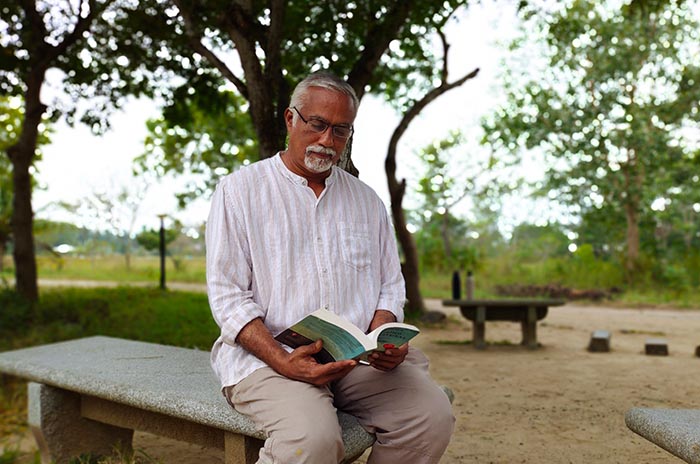
K. Ramesh in Tamil Nadu. Photograph: Aryan Kamboj
Haiku have lost kokoro (feeling, heart, spirit). From the time of the Man’yoshu, Japan’s earliest poetry anthology, the Japanese literary arts have invested mono (things) with kokoro. (Quoted in Simply Haiku Archives)
It’s true. The heart has largely gone out of haiku. Most haiku today aim at cleverness, a so-called ‘Aha moment’. Such haiku are, in fact, senryu [/] – not haiku at all. K. Ramesh puts the heart right back into haiku. That’s why he is one of the greatest of all living haijin (master haikuists).
————daybreak
————waves keep touching
————the dead turtle———(p. 58)
——the glide of herons
——I remove a word
——from the haiku———(p. 135)
first summer rain
my hand outside
the train’s window———(p. 13)
Let’s briefly examine haiku, senryu and haibun. Haiku is more – much more – than a short poem. Up to Bashō’s time (17th century) it scarcely deserved mention, being a popular form of squib in 17 syllables, 5-7-5. Then, Bashō gave it depth and sonorousness: listen to the haiku with which I begin the first part of my short video course (see below), which reads:
on a bare branch
a crow alights…
autumn evening
This has all the elements of flawless haiku. It has the kigo, or season word: bare branch. We know we’re in autumn. It has the kireji, or cut, indicated by the ellipsis. It has the return to the sublime, briefly disturbed by the crow’s movement. It is utterly perfect.
By contrast, senryu has the shape and sound of a haiku, but usually lacks depth; it is human-centred, as opposed to being nature-centred. As for haibun: this tells a story, in prose, with one or more haiku to give it focus. The relationship between the prose and the haiku is meant to be tenuous and ill-defined and yet complementary. Many people get it at first reading; for others, it takes longer. It’s non-linear. K. Ramesh is a master of haibun and haiku as can be seen in the following haibun.
Strands
The puppeteer is old now. Age has gnarled his fingers which once gently handled strings tied to expressions. There was a time when he entertained everyone in the village, young and old. It is long since the television snapped the threads from his hands. But, even now, when he is sleeping on the porch, he dreams of a mythical story, and his fingers become alive and make subtle movements.
full moon…
overnight the spider makes
a complete web———(p. 213)
His haiku do not inspire an ‘Aha moment’ but silence. Reverence. The spirit and heart of haiku may not be obvious in the above samples. But they are there, pulsing sweetly. The best haiku are about nothing, really: just seeing and feeling. They never say too much. But here is mystery too!
jasmine scent…
morning sun warms
the bellies of storks———(p. 22)
The art of haiku is primarily the subtle art of juxtaposition. This comes naturally to a gifted haiku poet. It cannot be forced.
power failure —
closing the book
I listen to the rain———(p. 73)
An old favourite! The thing about haiku is that you need to be alert – it’s an experience that’s easy to miss.
abandoned dog…
looking at the face
of every pedestrian———(p. 87)
winter evening
the newborn calf
eyes everybody———(p. 101)
Ramesh’s haiku are beautifully life-affirming and meditative. It’s as if they are saying, things may not look great but really, everything is as it should be:
full moon —
everything in its place
in the kitchen———(p. 102)
dinner time —
a grain of rice
for the praying mantis———(p. 107)
They have that deep sincerity without which great haiku are impossible.
firefly…
between two
glows———(p. 23)
Haiku are a state of becoming, witnessing the becoming, and getting the experience down on paper. Haiku are a witness to the quotidian miracles ignored or unseen, unfelt, by the untrained eye:
summer twilight…
ducks cross the road
with the shepherd———(p. 29)
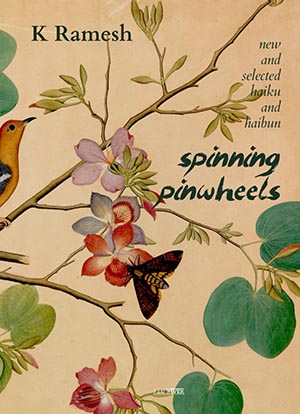 spinning pinwheels: new and selected haiku and haibun
by K. Ramesh was published in India by Red River in 2025 and is available on Amazon.
spinning pinwheels: new and selected haiku and haibun
by K. Ramesh was published in India by Red River in 2025 and is available on Amazon.
To explore further haiku and haibun and the work of K. Ramesh and Gabriel Rosenstock…
… watch
A three-part introduction to the art of haiku and haibun in Irish (with English subtitles) presented by writer Gabriel Rosenstock:
Video: Haiku as Gaeilge 1. Duration 5:46
Video: Haiku as Gaeilge 2. Duration 8:14
Video: Haiku as Gaeilge 3. Duration 7:07
… read
An essay by Robert Hirshfield on K. Ramesh’s development as a writer of Haikus: K. Ramesh: Haiku Master of South India — Singapore Unbound [/]
Where Light Begins Haiku by Gabriel Rosenstock 2012: Where Light Begins · The Haiku Foundation Digital Library [/]
The Selborne Haibun after Gilbert White’s classic The Natural History of Selborne; free online haibun in Irish and English, 2022: The Selborne Haibun [/]
Gabriel Rosenstock is a poet-translator, tankaist, haikuist, children’s author and novelist and, in the words of Hugh MacDiarmid, ‘a champion of forlorn causes’.
read more in beshara magazine


More News & Views
Book Review: ‘The Anxious Generation’
Fatima Chaudhry reviews a recent book which explores the effect of smartphones on the younger generation and proposes spiritual elevation as a solution
Book Review: ‘An Island to Myself’
Robert Hirshfield talks to the author of a new book by Michael N. McGregor which explores the place of solitude in an active life
Reflection: Dad’s Transition
Helen Carolan remembers the death of her father, Sean, aged 80, in County Mayo, Ireland, and the traditional wake which followed
In Memory of Gabriel Rosenstock
Peter Huitson remembers the Irish writer and haikuist who contributed several pieces to Beshara Magazine
April 2026
Gabriel Rosenstock
Don Quixote in Search of the Holy Land
All You Need is Love: The Lasting Legacy of the Beatles
Jane Clark reflects on a recent book and two documentaries about the Fab Four which argue that they were seminal in making us the people we are today
FOLLOW AND LIKE US
@Beshara_Mag








——————————————
——————————————
——————————————
If you enjoyed reading this article
Please leave a comment below.
Please also consider making a donation to support the work of Beshara Magazine. The magazine relies entirely on voluntary support. Donations received through this website go towards editorial expenses, eg. image rights, travel expenses, and website maintenance and development costs.
READERS’ COMMENTS
3 Comments
Submit a Comment
FOLLOW AND LIKE US
@Beshara_Mag
Readers might also enjoy the following essays which touch on kokoro, both in waka and haiku poetry, and discuss some differences in conception between them. The author was a very distinguished Japanese scholar of mystical Islam, as well as coming from a family of Zen practitioners and calligraphers. The first and last pieces are of the most relevance to poetics.
https://terebess.hu/zen/mesterek/beauty.pdf
Thankyou.
Hi im interested in sending you a copy of “My Hennaed Hand ” a senryū collection for a book review. Could you advise?