
A Thing of Beauty _|_ Issue 31, 2026
The Mystic Ark: Notre-Dame, Sacred Space and the Poetic Imagination
The distinguished poet James Harpur considers what makes places sacred and whether ‘sacredness’ requires an act of poetic imagination

The Mystic Ark: Notre-Dame, Sacred Space and the Poetic Imagination
The distinguished poet James Harpur considers what makes places sacred and whether ‘sacredness’ requires an act of poetic imagination
In December 2024 Notre-Dame Cathedral in Paris was officially reopened after the great fire which nearly destroyed it in 2019, and the world could experience its (renewed) beauty once again. At a conference in Trinity College Dublin on 30 November 2024, organised by the Trinity Centre for Medieval and Renaissance Studies and attended by members of the French Embassy, the poet and author James Harpur spoke of the importance of sacred beauty and questioned whether it is an objective quality or a presence of mind, or a mixture of the two. This essay is based on his presentation.
In his poem ‘Notre-Dame’, the French Romantic poet Gérard de Nerval presents Paris’s great cathedral less as a thing than as an experience that can be preserved for eternity through the imagination.
Our Lady’s so antique – a dowager! –
Who might outlive the Paris of her birth.
Yet come a thousand years Time will fell
Her giant frame – as a wolf brings down a bull –
And chewing silently consume her innards
Till just a meagre skeleton remains.
Sightseers across the world will come
To stare in wonder at her cage of bones:
But dreamers who remember Victor Hugo
Will see in vision the cathedral grow
Before their eyes and rise, rise in glory,
A mirage shimmering, a vast new story. [1]
Nerval refers to dreamers who can reconstruct the fallen carcass of Notre-Dame through Victor Hugo’s dramatic novel Notre-Dame de Paris (translated into English as The Hunchback of Notre-Dame) and make it imperishable by way of their imaginations. Nerval’s poem is a statement not only about the imagination but also its relationship with the material world, from which the poetic imagination proceeds. A candle flame needs a wick; Michelangelo’s Last Judgement needs a wall; Bach’s Sonata in C Major needs two violins. And Nerval’s dreamers need the physical ruins of Notre-Dame as well as the imagination of Hugo and his book.
What is it that makes a place sacred and what is the role of the imagination in experiencing the sacred? Does Notre-Dame, say, have an inherent sacredness that can be felt in the same way that the temperature in a cold-storage warehouse can be felt? Or is it necessary to bring a sense of sacredness into its interior? And is it possible to have a sense of sacredness in any place on earth without first having the imagination of someone like Victor Hugo or Nerval – without the ability to ‘see deep down into the life of things’, to use William Wordsworth’s phrase?
For Wordsworth, as for other poets – and indeed anyone who has the eyes to see – the poetic imagination gives the things of the world a vibrant, symbolic or metaphorical aspect. Ted Hughes, for example, in his poem ‘Gnat Psalm’, sees a swarm of gnats and his imagination transforms them into tiny dancing angels. Baudelaire, in his poem ‘Le Cygne’ (‘The Swan’), describes seeing on a city pavement a swan who had escaped its cage and was dragging its white feathers along the bumpy surface, homesick for its watery home. For Baudelaire, the swan is not just a scruffy bird but a symbol of anything removed from its natural element and placed in a hostile environment.
Ted Hughes and Baudelaire are seeing two things at once: Hughes sees a swarm of gnats and a group of tiny dancing angels. Baudelaire sees a swan and a soul in exile, a living being crying out for redemption. In both cases the writers are displaying what William Blake called ‘double vision’, that is, seeing into the life of an object or creature so deeply that some other quality or image emerges from it and its spiritual essence is discerned. Blake gives his own example of double vision in a poem in which he describes a thistle in terms of a grey-haired old man. It is as if Blake saw through the outward surface of the thistle’s whiskery spikes, its drooping head and thin body, and his imagination re-shaped it into an old man.
For double the vision my Eyes do see
And a Double Vision is always with me
With my inward Eye ‘tis an old Man grey
With my outward a Thistle across my way. [2]
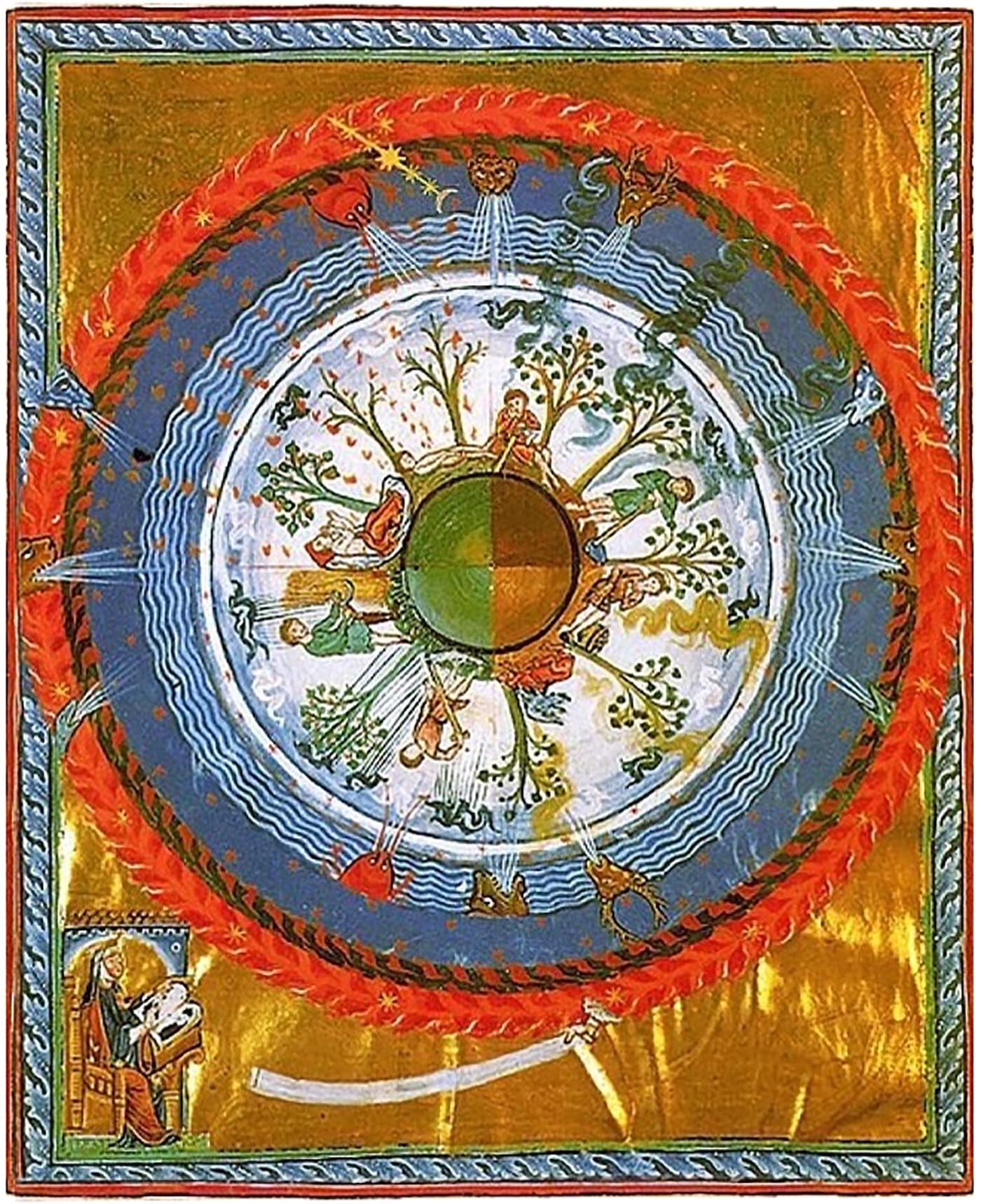
A depiction of ‘veriditas’ – the greening life-force that pervades the world – by Hildegard of Bingen (1098–1179). Image: thewaterchannel.tv [/]
Move computer mouse over image to enlarge
Seeing with Double Vision
.
For Blake, double vision was not just what poets should practise, but everybody. His fear of, and rage against, the ‘single vision’ as he called it, of his bête noire, Sir Isaac Newton and scientific reductionism was a lifelong crusade. To regard something merely as a scientifically measurable object, or to see only surfaces of things and not their inner nature and deeper import, is, for Blake, to violate the principles of creation.
Blake was unusual in the strength of his own double vision, but not unique. Hildegard of Bingen, for example, the 12th-century German nun, also had a visionary gift that penetrated surfaces and reached a deeper reality. For Hildegard, it was the Holy Spirit that made the world numinous. In her song O Ignis Spiritus she describes the elemental motive power of the Spirit:
Clouds stream from you, the ether flies,
The stones conserve their moisture
And water bubbles up in springs;
The earth exudes green vigour. [3]
In Hildegard’s perception, the elements of nature – clouds, ether, stones, water, springs, earth – are supercharged by the Spirit and exude what she calls ‘green vigour’, or viriditas (‘greenness’), a cosmic force that she believed courses through the earth – with the added sense of fertility or a life-giving energy.
It is not necessary to be a poet or mystic to have double vision. To a great extent, the idea that the things of the world naturally have a symbolic, metaphoric, mythic or divine dimension was the normal state of affairs in the West before the
Enlightenment, and it still is for indigenous peoples around the world. In Pinnacles Desert in Western Australia, for example, there is a series of pointed jagged rocks protruding from the ground. There are two creation stories behind them. The local Yued people regard the rocks as the despairing fingers of warriors who have been sucked down into the sandy terrain because they have transgressed into a taboo area. The modern scientific story is that the rocks are simply limestone pillars created 100,000 years ago.[4]
Of the two stories, single vision recognises only the scientific one; double vision recognises the physical reality of the rocks, but also sees another, mythic, story that gives the rocks value. It is, in other words, the poetic imagination that makes Pinnacles Desert sacred. Can we say the same thing about Notre-Dame and other Christian shrines?

Limestone pillars or the fingers of warriors? The Pinnacles Desert in Nambung National Park, Western Australia. Photograph: Jacub Michankow via Wikimedia Commons
The Loss of Vision
.
Double vision has been blurred and sometimes blinded by the laser beams of science. Of course we need science: think no further than dental anaesthetic. But the danger of science is that it strips away the mystery from the universe and renders suspect everything that cannot be measured. C.G. Jung once said: ‘We have stripped all things of their mystery and numinosity; nothing is holy any longer.’[5] His implication is that holiness is a state of mind and not an objective reality. If it were the latter, then no amount of demythologising science would affect our so-called sacred places. Nevertheless, perhaps Jung was not entirely right when he said mystery has been stripped away from all things. The sense of the numinous can still be experienced in science-dominated societies. One obvious example is the Christian Mass, during which, in Roman Catholic and other traditions, a tiny material wafer is transubstantiated into the spiritual reality of the living Christ.
John Betjeman describes the implications of this transformation in a poem called ‘A Lincolnshire Church’. The poet enters the church and sees the ‘tabernacle of God’ on the altar with its wine-dipped wafer; and through the lens of the imagination the wafer expands into:
God who created the Heavens
And the wide green marsh as well
Who sings in the sky with the skylark
Who calls, in the evening bell.
There is a neat and telling contrast between Betjeman’s church experience and that of another English poet, Philip Larkin, who, in his poem ‘Church Going’, also inspects a country church, but unlike Betjeman cannot see beyond surfaces – although the poet’s attitude becomes more ambivalent at the end of the poem. He first of all checks that ‘there’s nothing going on’ before entering and surveys the interior with its pews, hymn books, brownish flowers, and ‘some brass and stuff / Up at the holy end …’. The poet continues his dismissive tour of his church, like a bored shopper idling away the time in a bric-a-brac shop: he mounts the lectern, stares at the open Bible and speaks aloud the words ‘Here endeth’ more loudly than he intended:
The echoes snigger briefly. Back at the door
I sign the book, donate an Irish sixpence,
Reflect the place was not worth stopping for.
Like Philip Larkin, many of us in the West have slid into secular rationalism, letting the mysterious be stripped from us. This trend is reinforced by the type of language we are increasingly subjected to. The grey squirrels of single vision with their dead jargons of science, tech, bureaucracy and business, etc, are discreetly ousting the red squirrels of imagination. In the last couple of years, the Oxford Learner’s Dictionary added the following phrases to its pages. Attention span; brand loyalty; ChatGPT; clickbait; live chat; smart motorway; vape juice. You can add to those lexical arrivistes newish compound words such as: upskill, download, take-out, heads-up, downsize, work-on, buy-in and so on.
Words like these with their flat sounds and monosyllabic drumbeats are conditioning our minds to think in their image. They all spell out literal meanings, but jettison the beauty of verbal rhythm, music and painting – the language of poetry and art. Ovid once said, ‘Si latet, ars prodest: adfert deprensa pudorem.’ (‘If art is concealed, it has a good effect. If it can be seen, it brings shame.’) [6] These new crass words shame our culture. It is one of the functions of art and architecture to reconnect us with the riches of the symbolic world we are being eased away from all the time. We are losing the culture of the imagination and the soul, and soon we will not have the language to protest about it.

Soaring vaults: the interior of Notre-Dame at its reopening on 30 November 2024. Photograph: Xinhua / Alamy Stock Photo
A World of Poetry in a World of Prose
.
That is why Notre-Dame, as the archetype of cathedrals, is so important – because it is the architectural equivalent to poetic language. Indeed, the French poet Theóphile Gautier called Notre-Dame ‘a world of poetry in a world of prose’.[7] Cathedrals are designed to mobilise the imagination, to induce a sense of otherness and mystery into our desiccated souls. The soaring vaults are designed to lead the mind to heaven; and stained-glass windows, column capitals, carved misericords, embroidered vestments, chalices, candles – all cohere to make an assemblage of sacred beauty that is more than the sum of its parts. The care taken over materials and design is in accordance with ancient sacred symbolism; chalices do not resemble tea mugs; vestments do not resemble kitchen aprons.
Craftsmen laboured to make things beautiful, not just to please the mind but to raise the mind to God. Abbot Suger of Saint-Denis in Paris (c. 1081–1151) believed that beautiful objects such as jewels, gold, silver and stained glass could lead you to the divine. Over the great doors of Saint-Denis, Abbot Suger inscribed the words: Mens hebes ad verum per materialia surgit. (The dull mind rises to the truth through material things.) [8] The earthly light reflected from a surface is an echo of, or corresponds with, the divine light.
Of course, this impulse to see one thing in terms of another has an ancient heritage. The early Christian scholar Origen said that visible things contained invisible and divine knowledge that led the mind to spiritual insights. A thousand years later, the French theologian Alain de Lille was saying much the same thing: ‘Omnis mundi creatura / Quasi liber et pictura / Nobis est et speculum’ (‘Every creature of the world is like a book and a picture to us, and a mirror’).[9]
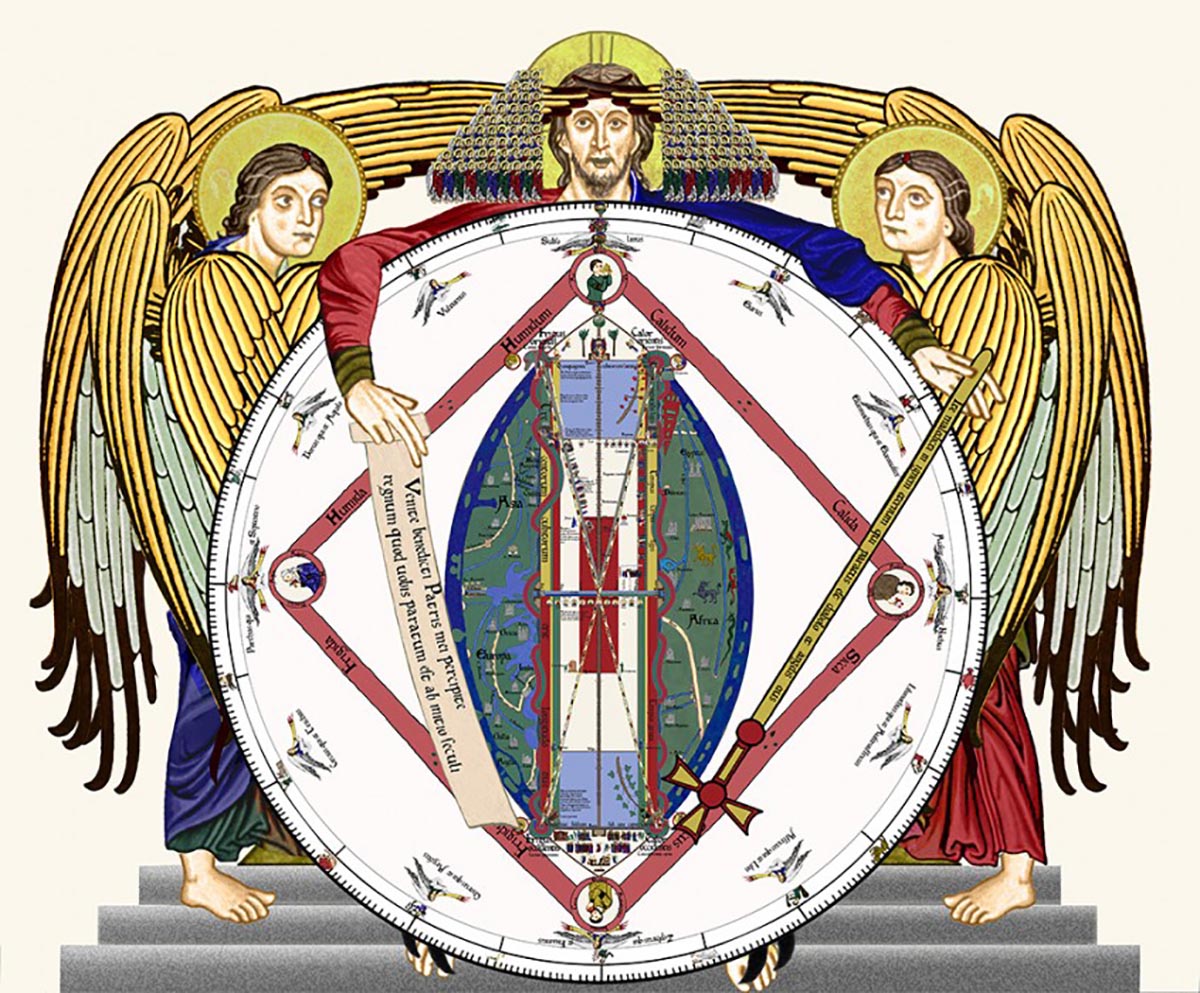
The Mystic Ark, shown as it might have appeared if constructed at the convent of Hohenbourg during the abbacy of Abbess Herrad in the late twelfth century. Image: Dr Conrad Rudolph via Wikimedia Commons
Move computer mouse over image to enlarge
In a similar vein, the theologian Hugh of St-Victor in Paris is thought by many scholars to have created an astonishing painting known as The Mystic Ark, with which he used to illustrate his lectures.[10] The Ark is painted as if from above and represents a three-storied structure loosely based on the Ark of Noah, and illustrates biblical events, Christology and the history of salvation. The painting of the Ark conveys themes through descriptions, imagery, symbols, symbolic colours, number symbolism, cartography, alignments with the cardinal directions, and so on. It is like a Platonic template of double vision, in which one thing points to or symbolises something else. For example, the lamb at the heart of the ark represents Christ, but also, in the words of the art historian Conrad Rudolph, the ‘iconic centre’ of the cosmos and the ‘narrative centre of finite historical time’.[11]
This type of symbolic thinking was also applied to the parts of a church, as William Durand, Bishop of Mende in south-central France, explained in a treatise called Rationale Divinorum Officiorum. In the plan of a church, he says, the chancel represents the head; the transepts, the arms; the nave – the torso, legs and feet.
The four walls represent the four virtues: justice, fortitude, temperance and prudence. The church piers are bishops and theologians because they support the Church. The towers represent the preachers; the windows are the Holy Scriptures, which, William says, ‘transmit the light of the True Sun’. The main door is Christ himself, echoing the verse in John’s Gospel: ‘I am the door: by me if any man enter in, he shall be saved.’[12] Even the cement that binds the stones in the walls, William says, has symbolic value. Cement is made of three things: lime, sand and water. Lime stands for charity; sand represents people in need; and water symbolises the Holy Spirit.[13]
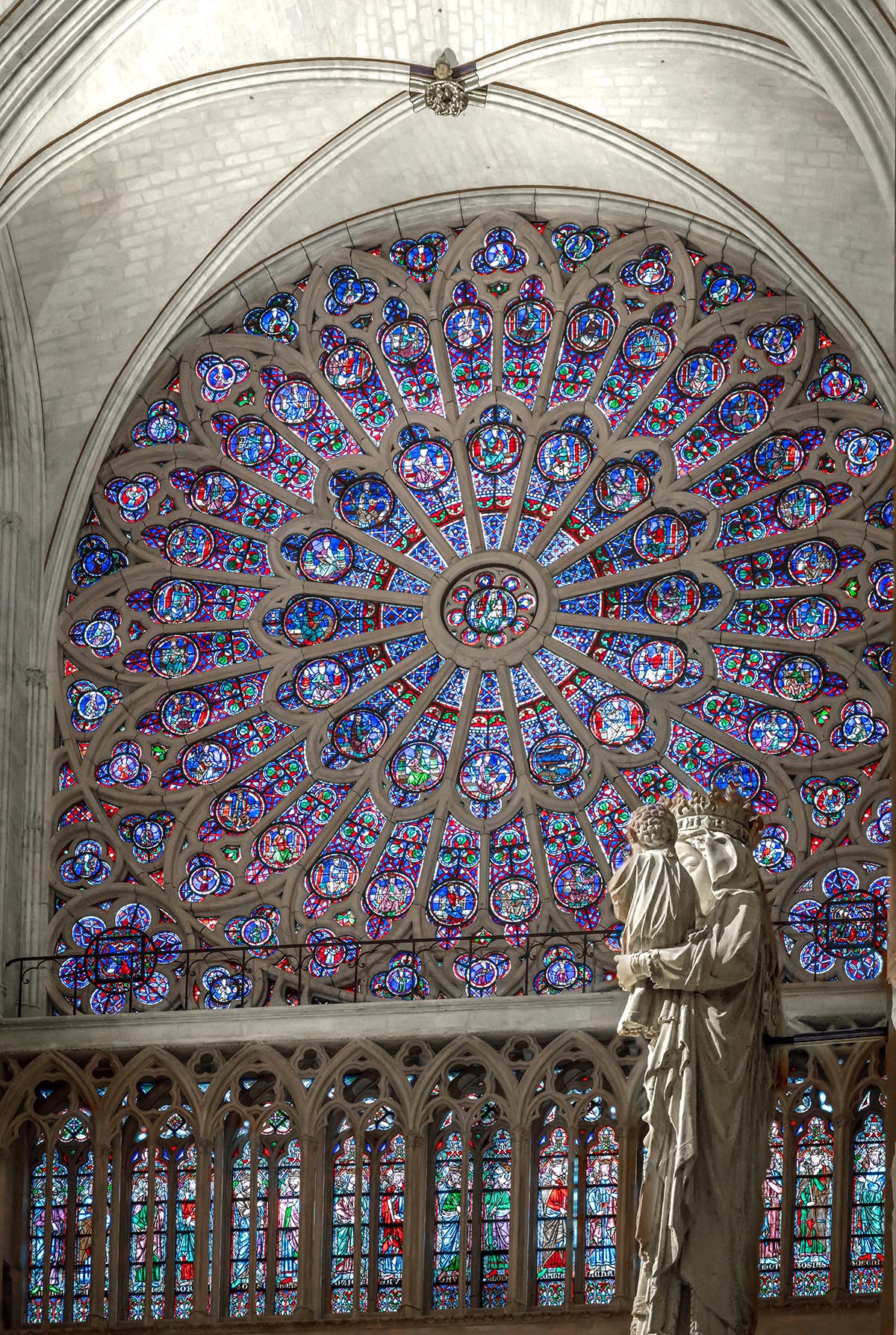
Windows as holy scriptures: the rose stained glass window in the southern ailse of Notre-Dame, with a statue of the Virgin and child in the foreground. Photograph: Franck Legros / Alamy Stock Photo
Move computer mouse over image to enlarge
Leading the Mind to God
.
Imagine walking into Notre-Dame, or any church, with the everyday belief that everything you saw had a symbolic, allegorical or spiritual aspect – the rose windows, the walls, the door, the transepts, even the cement, and so on. The place would be infinitely more rich, and pulse with holiness. Your eyes would slide off material objects and slip into spiritual vision, seeing symbolic connections everywhere. You would get close to the type of perception Victor Hugo himself enjoyed when he rhapsodised over the beauty of Notre-Dame and its…
… immense central rose window, flanked by its two lateral windows like a priest by his deacon and subdeacon… a vast symphony in stone… One sees the imagination of the workman, disciplined by the genius of the artist, jump out in a thousand different ways.[14]
For Victor Hugo, a sacred space was one in which imagination and genius created beautiful structures and objects. The careful fashioning of these was not a case of art for art’s sake. As with Abbot Suger, divinely-inspired beauty was intended to lead the mind to God.
Not everyone has agreed with Hugo and Suger about the nature of sacred space. Christianity has always had an ascetic, puritanical side that has affected church decoration. St Bernard of Clairvaux and the Cistercians, for example, were hostile to, or at least wary of, artistic decoration in holy places. For them, elaborate art was a distraction from God. A Cistercian statute of 1145 states: Vitreae albae fiant, et sine crucibus et picturis (Let the windows be made of white glass without images or crosses.) [15] Behind this strain of Christianity lies the injunction in the Book of Exodus, which states, ‘Thou shalt not make unto thee any graven image …’ [16]
It is easy to see from this fateful verse how a militant puritan might be inspired by it. Take the example of Richard Culmer, a puritan Anglican priest, who, in December 1643, entered Canterbury Cathedral, the pilgrimage shrine of St Thomas Becket, with a 60-foot ladder and a steel-tipped pike in his hand. He methodically smashed the medieval stained glass and, as he says, ‘rattled down proud Becket’s glassy bones’. [17]
Notre-Dame itself was no stranger to Puritan excesses during the French Revolution, when the church and clergy came under attack. In the autumn of 1793 in Paris, there were bonfires of sacred books and vestments. The chalices of the church of Saint-Sulpice were snatched and melted down. On 23 October, sans-culotte militants knocked off the heads of saints on Notre-Dame’s exterior, believing, it was said, they were French kings, and not the kings of Judah. Two weeks later, Notre-Dame itself hosted a Fête de la Raison, complete with an altar dedicated to Liberty, and the statue of the Virgin Mary exchanged for a goddess of Reason, played by an actress. Atheism had replaced faith; a brave new world with a new method of temporal dating had replaced the rich lineage of history. Single vision had replaced double vision. But Notre-Dame survived and eventually, with a little help from Victor Hugo and the architect Viollet-le-Duc, and many others, the cathedral regained its status as one of the great sacred places in Paris, France and Western Europe.
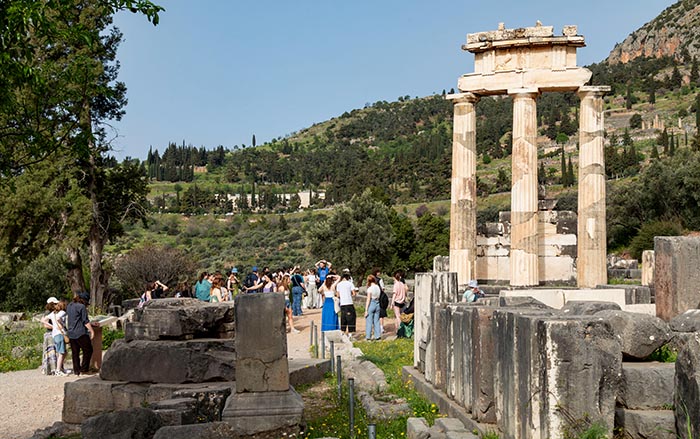
Outliving the place of one’s birth: the circular Tholos at the Temple of Athena Pronaia, Ancient Delphi, Greece, still much visited in 2024. Photograph: E. Westmacott / Alamy Stock Photo
Personal and Private Aspects
.
At the start of this essay I pondered what made a place sacred. My conclusion is that sacred places have a personal and a public aspect. On the personal level a sacred place is any place on earth – a church, temple, mosque, a grove, a field, a house, a mountain, a road to Damascus – which, through its beauty, grandeur, isolation or some other quality, induces in your mind, heart and soul a state of being that makes you more receptive to the presence of the divine. This presence might be barely discernible, or it might arrive as gently as a whisper or as a profound epiphany. But a place can activate a sense of the divine only if you already possess the right spiritual sensitivity, emotional innocence or what I have been referring to as the poetic imagination or ‘double vision’.
At a public level, a sacred place embodies the culture, aspirations and history of the tribe or nation; it has a totemic role. Think of Tara in Ireland, Uluru in Australia, the Ganges in India, Delphi in Greece, and so on. Notre-Dame is such a place, recording the scars and the triumphs of French history, while still functioning as a house of prayer and consolation; a place of song and praise; an ark, welcoming visitors and pilgrims not two by two, but in their thousands. Battered by revolutionaries, burned by fire, embossed by beautiful stained glass, wearing its gargoyles like glorious defiant warts on its skin, Notre-Dame floats majestically on the Seine, a giant stone swan that directs our minds and hearts towards the great mystic Christian ark, which welcomes everyone. And now, renewed again, who would bet against Notre-Dame outliving the Paris of its birth, as Nerval predicted.
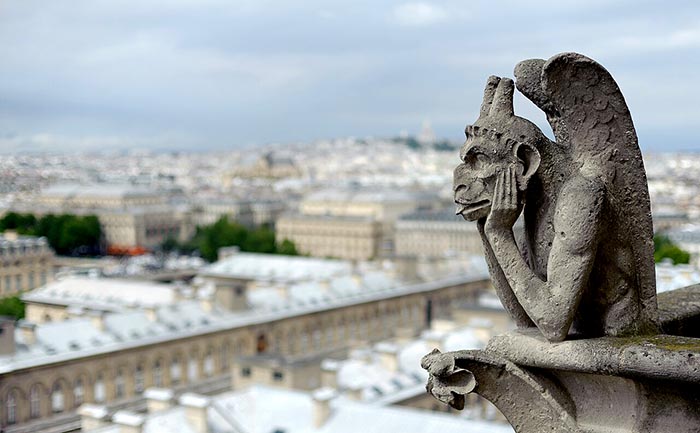
For more on James’ special relationship with Notre-Dame and the writing of his latest book of poetry, The Gospel of Gargoyle, click here [/].

James Harpur has published ten books of poetry, including his latest, The Gospel of Gargoyle (Eblana Press, 2024), a metaphysical dialogue set on the roof of Notre-Dame; and The Magic Theatre (Two Rivers Press, 2025), a verse memoir of his student years at Cambridge. His debut novel, The Pathless Country (Cinnamon, 2021), a historical tale set in Ireland before 1916 and inspired by the work of J. Krishnamurti, was winner of the J.G. Farrell Prize and shortlisted for the John McGahern Prize. He lives in West Cork.
Image Sources (click to open)
Banner: View of Notre-Dame Cathedral in Paris in summer 2025, showing the historic Gothic west façade. Photograph: imageBROKER / Hilke Maunder / Alamy Stock Photo.
Inset: Josselin, a gargoyle on the roof of Notre-Dame. Photograph: Ysaag Valren via Wikimedia Commons.
End image: La Stryge, or The Witch; the gargoyle on the roof of Notre-Dame who inspired James’ poetry. Photograph: Jawed Karim via Wikimedia Commons.
Other Sources (click to open)
[1] My version appears in my poetry book, The Gospel of Gargoyle (The Eblana Press, 2024).
[2] WILLIAM BLAKE, ‘Poem in a letter to Thomas Butts’, 22 November 1802. In The Complete Poetry and Prose of William Blake, edited by David V. Erdman (Anchor Books, 1988), pp. 433-434.
[3] My translation of Hildegard’s Symphonia No. 28, (‘O ignis Spiritus’). For the Latin original, see here [/].
[4] See here [/].
[5] CARL JUNG (ed.), Man and His Symbols (Doubleday, 1964), p. 94.
[6] OVID, Ars Amatoria (II. 313).
[7] THÉOPHILE GAUTIER, from his poem ‘Notre-Dame’ in La Comédie de la Mort, 1838.
[8] See ERWIN PANOFSKY, Abbot Suger on the Abbey Church of Saint-Denis and Its Art Treasures (Princeton University Press, 1946), pp. 46–47.
[9] ALAIN DE LILLE, De Incarnatione Christi Rhythmus Perelegans, PL 210, col. 579A, ‘Omnis mundi creatura/ Quasi liber et pictura/ Nobis est et speculum’ quoted in E. R. Curtius, European Literature and the Latin Middle Ages (Bollingen Series/Princeton, 1953), p. 319.
[10] See CONRAD RUDOLPH’s magnificent reconstruction of Hugh’s painting in his The Mystic Ark: Hugh of Saint Victor, Art, and Thought in the Twelfth Century (Cambridge University Press, 2014), pp. 343-48.
[11] Ibid.
[12] The New Testament, John 10.9.
[13] WILLIAM DURAND’s thesis can be found in The Symbolism Of Churches and Church Ornaments translated from the Latin by John Mason Neale and Benjamin Webb (No publisher cited, 1843), pp. 17-30.
[14] VICTOR HUGO, The Hunchback of Notre-Dame, trans. Isabel F. Hapgood, (G. Bell & Sons, 1888), chapter 1.
[15] See RICHARD MARKS, Stained Glass in England During the Middle Ages (Routledge, 1993), p. 111.
[16] The Old Testament, Exodus 20.4.
[17] RICHARD CULMER, Cathedrall newes from Canterbury (Printed by Rich. Cotes for Fulk Clifton, 1644), p. 22.
The text of this article has a Creative Commons Licence BY-NC-ND 4.0 [/]. We are not able to give permission for reproduction of the illustrations; details of their sources are given in the captions.
FOLLOW AND LIKE US
@Beshara_Mag








——————————————
——————————————
——————————————
FOLLOW AND LIKE US
@Beshara_Mag
If you enjoyed reading this article
Please leave a comment below.
Please also consider making a donation to support the work of Beshara Magazine. The magazine relies entirely on voluntary support. Donations received through this website go towards editorial expenses, eg. image rights, travel expenses, and website maintenance and development costs.
READ MORE IN BESHARA MAGAZINE
Transmission Across Cultures
Writer and art historian Diana Darke brings to light the largely unacknowledged influence of Islamic architecture and craftsmen on the iconic buildings of Europe
A Thing of Beauty… The Book of Kells
The distinguished poet James Harpur ‘takes a line for a walk’ as he remembers the challenges of writing his poem ‘Kells’, based on the great Irish masterpiece
Reflections: Beside Still Waters
James Harpur contemplates St Columba, Covid and the Rainmaker, and asks: how can we make our living conditions less hostile?
READERS’ COMMENTS
0 Comments