
Science & Technology _|_ Issue 32, 2026
Accessing Our Creativity
Innovation consultant Eitan Buchalter talks about the importance of creative thinking and how we can nurture our capacity for it in both childhood and adult life
Accessing Our Creativity
Innovation consultant Eitan Buchalter talks about the importance of creative thinking and how we can nurture our capacity for it in both childhood and adult life
Eitan Buchalter is an innovation consultant with over twenty years experience of working with individuals and companies. After completing a PhD at University of Oxford on creativity in science, he worked at a consultancy which advised organisations like NASA, Proctor and Gambol, the Football Association and the Tate Gallery on how to better develop ideas. He went on design a government-backed programme for applying the findings of evidence-based research to nurturing creativity in UK schools, which had a highly successful pilot. However, its planned roll out to a national study in 2020 was cancelled due to the Covid pandemic. He now works as a freelance consultant with companies all over the world, helping them to look after and enhance their employees’ natural creative thinking abilities, and is also writing a book based upon his PhD research. He talked to Jane Clark and Peter Huitson about creativity as an innate human capability, how we can develop it in ourselves and the impact of AI.
Jane: Eitan, your speciality is helping people to access their capacity for creative thinking and innovation. You’re working with big companies at the moment, but you’ve also looked at the way we can encourage creativity in science and in education. Why do you think this is so important?
Eitan: Well, it might be worth taking a step back and ask first of all: How do we define creativity? I think often people shy away from this because they think of it as an airy-fairy sort of term – that it is just about things like paintings and poems. But actually, it is much more to do with ideas; how we come up with them and how we develop them. There has been an enormous amount of research on the subject over the past sixty years, but it hasn’t yet filtered down into how people think about the matter.
In the field of creativity studies now, there’s a fairly clear consensus about the definition, which is that if an idea is to be considered creative, it needs to be both new and useful. By ‘new’, it can mean that it is new to the universe – to the world – like the Covid vaccine. These things are what are known as ‘Big C’ creativity. Or it can be new to your company or your school or your community. Or of course, it could just be new to you; there could be a billion other versions of this idea, but you may not have known about them and have just, yourself, thought of it. Then there is the matter of whether the new idea is useful and this depends on your social context. Does the idea resolve a challenge in a business context? Did a five-year-old child manage to make their aeroplane out of the limited number of Lego pieces they had available?
So, creativity has a lot of complex ways in which it operates. But thinking about the definition in simple terms as an idea that is both new and useful is probably quite a good way to begin.
As to why it is important now? Well … being creative, coming up with and developing ideas, is the history of human progress. It is innate in us, and this is why when we look around us, we see all sorts of development that we might not see in other species. Of course, innovation is very important socially and economically, and we see many kinds of technological advances around us, particularly in today’s world. But the most important thing from my point of view is that this is part of what it means to be human. In order for us to be ourselves, we need to develop ideas, and we need to have a mechanism for expressing them because that’s who we are.
Jane: So why do so many people think that they are not creative, or feel embarrassed about the level of their creativity?
Eitan: One answer is that it is because we have somehow forgotten to prioritise it in our educational process. Can I tell a story? Have you heard about Dr Land? In the 1960s, he was doing research into creativity, and he was asked by NASA to come up with a test that would help them to recruit the most creative engineers into the space programme. So he and his team developed a test, and it was very successful; NASA was very, very happy about it. They found that about 2% of the people who were taking it would reach what was defined as genius-level creativity.
But it’s actually quite a simple test, so Land and his team thought: well, why don’t we try giving this to children – five-year-olds – and see what happens? And to their huge surprise, they found that an enormous number of the children – about 98% – scored at genius level. This was incredible. I mean, you’ve got 2% of the population going into NASA and 98% of five-year-olds registering at these levels! [1]
So then they thought: let’s see what happens when we come back. So they turned it into a longitudinal study, and a few years later, when the children were ten or so, they retested. And what they found was that the figure for genius level was more like 30%. And then five years later, at 15, it was more like 12%. That was the end of that particular longitudinal study. But then they repeated it with, I think, about a quarter of a million adults in the general population and found that it was back down to 2%. (To see Dr Lands talking about this research, see video right or below.)
Video: Dr George Lands: The Failure of Success. Duration: 13:37
So, what this tells us is that people become less able to express their creative thinking over time. Sometimes we say: This person is more creative than that person, or we say of ourselves: I’m creative or I’m not creative. But what we’re really saying is that some people have found coping mechanisms to retain their innate creative capability despite their experience during education, and other people have been less able to do so, so that capability ends up being a bit more dormant.
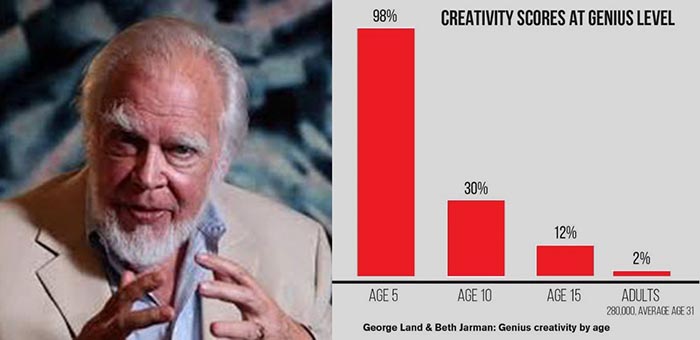
Dr George Lands, whose study of creativity in schoolchildren was a landmark in creativity studies
Losing Our Creativity
.
Jane: But don’t you think that in modern Western economies, we do very much value innovation. We understand that our economic growth depends upon it – developing new drugs, new sorts of engineering, new software, etc. Why do you think that we’re suppressing innovation when actually we desire it so much?
Eitan: Well, I don’t think we do it on purpose. I think it’s inadvertent. But I also think that it’s important to be a little bit pedantic about the word innovation, because we can make it into an object, meaning we think ‘an innovation’. All the things that you’ve mentioned are outcomes of innovation. But it’s also important to think about it as a process – the process of innovation or innovating. The balance of interest always tends to be towards outcomes, whereas actually, if we want to promote these and to have more of them, we need to be happy to support the process, to understand what the process is and know how we can support it.
To explain this a bit more: my PhD was a study of the way that scientific ideas develop. The title was Ideas in Science: An Ethnographic Study, and my ‘natives’, so to speak, were scientists working in research labs. One of the most important things that I learnt was that new ideas develop in extraordinarily idiosyncratic and circuitous ways; there are lots of dead ends; a lot of what we call ‘serendipity’, meaning things coming together seemingly by chance; a lot of deviation from what was originally planned. It’s a complex process. But when they come to do funding applications, scientists are forced to focus on outcomes, meaning that they are constrained by a system which wants definite results for the money which is being spent – a new drug, a new particle, a new photoelectric cell or whatever.
This means that they are often unable to pursue interesting avenues for exploration which might have led to much more significant discoveries, or if they do follow them, they can be accused of not fulfilling their contract and their future funding is affected. So what we need to do is develop systems which not only acknowledge but actively encourage this much more organic, open-ended process.
Jane: Before we go on to talk about how we can do that, can we consider what we are doing at the moment that is not supportive? How come the extraordinary creativity of a five-year-old gets kind of squished out of them as they grow up?
Eitan: I think that the main problem is that at school we are taught that certain things are important and we’re rewarded for certain kinds of activities. There are many factors in this; there are family or community expectations, but there is also the matter of qualifications. There might be an entrance exam for the school, and later on for university. So as much as it might be a wonderful ambition for a school to promote creative thinking, it ends up being something that’s just nice to have. We don’t measure it, so it doesn’t feature as a priority.
Peter: Don’t you also think it’s built into the system that the students who do well are the ones who are good at taking input and presenting it back – that what is valued is regurgitating stuff rather than thinking for yourself.
Eitan: Well, yes, I think that that that’s absolutely right. The wonderful late, great Sir Ken Robinson spoke very eloquently about this. He talked about how our education system has developed from the Industrial Revolution. Children are batched by their age and are processed through a factory-like school where they are taught to do certain things and are rewarded for them (see video right or below).
Video: Do Schools Kill Creativity? by Sir Ken Robinson; TED Talk 2007. Duration: 20:03
I will often talk jokingly – maybe only half-jokingly – about ‘winning’ at school. This means that you have to be very compliant and do all the things that you’ve been told to do – remember your vocab; remember your spellings; make sure you get things right. But when you interpret a question differently – when you see that the way that something was phrased means something else to you than was maybe within the framework that the teacher intended – they bring you back and say: Actually, you didn’t quite get that right; you need to think about it like this because that’s what I want you to do.
So there are all these moments, repeated over and over again between, say, the ages of five and 15 as the Land project documented. If you are compliant, you get high grades and lots of praise and awards and prizes, whereas if you’ve come up with something that is a bit different or sounds a bit odd or strange, you get told that you need to work a bit harder to try and achieve the ‘right’ thing.
Jane: I had a very vivid experience myself when I was practising for the 11-plus test which, in the 1960s, you had to take in the UK to qualify for grammar school. There was a question where we were presented with a series of shapes and we had to say which was the odd one out. I put down an answer which seemed perfectly feasible to me but it was marked wrong. I went to the teacher and said: Look, this is my logic: this is what I saw. But she just repeated that it was the wrong answer. I still remember it because I was so cross, and actually quite bewildered at 11 or so about what was going on.
Eitan: That was because you’d categorised it in a different way. You received the same input as everyone else but put it together in an unusual way. We don’t have good enough mechanisms for rewarding and supporting that kind of thinking, and that’s essentially why, I think, creativity diminishes as we go through the education system and beyond. I don’t think anyone is sitting there thinking: right, we need to beat all the creativity out of this lot. I just think that we haven’t done the reverse and said: This is really important. These days we’ve got plenty of tools available to us, but it requires quite a radical transformation that we haven’t quite undertaken yet. We need to be evidence-based about how we support creative thinking right across society – whatever your age.
Peter: Doesn’t this kind of suppressive behaviour also carry on into institutions? There’s a right way of thinking that is acceptable, and if we say something different, our reality is dismissed. So what we’ve learned at school carries on throughout our lives and therefore into our society and culture.
Eitan: Yes, I think that’s right. Because our corpus of understanding has, in a sense, been developed at school and that’s what we draw down on as we get older.
Developing Our Creativity
. Jane: I know that you worked for several years on an educational model which would address some of these issues. Can you tell us a bit about this?
Eitan: Yes. It had actually been a long-term obsession of mine to think about what it would be like to make creativity, or creative thinking, part of the core school curriculum alongside numeracy and literacy. So a few years ago, I decided to put my money – or my energy – where my mouth is and develop a practical programme. The aim was to translate some of the incredible work – the evidence-based research – which has been done in creativity studies into practice. We launched a pilot scheme in 2018, which proved to be incredibly successful, and obtained funding to roll out the programme much more widely, but at that very moment – it was 2020 – the Covid epidemic hit us, and everything changed. It has not yet been resurrected, so more recently I have been applying the same principles to developing creativity in the private sector.
Jane: You have worked as a consultant in quite a variety of organisations: NASA; the Football Association; Procter & Gamble; the Tate Gallery. Why do institutions like this wish to employ someone like yourself?
Eitan: Well, if a company is interested in developing its capacity for innovation, they have a budget for it, which they usually spend on tools – predominantly innovation tools – or on projects aimed at developing a certain kind of market or area or whatever. But alongside that, there is the human capability that they are already paying for that they can support, enhance and develop, and that’s the area I’m focused on.
There are two sides to my kind of innovation consultancy. One asks the question: How do we develop new ideas at an institutional level, from inception to the point where they have outcomes? The other is on the process side, and asks the question: How do we help people themselves to become better at having ideas and developing them?
Developing a product is often about how people evaluate the financial benefit of an innovation. Did it make lots of money, or whatever the objective was? But developing people’s capability is just about making the most out of what you already have – it’s about mindset. So successful innovation is about pairing those two things together and achieving a balance.
Peter: So how do you go about helping people to cultivate their own creativity?
Eitan: There are six characteristics of creative thinking that emerge from the literature. And the point here is that five-year-olds tend to have these quite naturally. They are: motivation, expertise, confidence, resilience, taking sensible risks and openness. These six form the framework, and while there is a lot to be said about each of them, I think most people have a pretty good idea of what they mean.
There’s really not a lot of difference in terms of what I do between students at school and people in the corporate world or scientists working in their labs, because another thing that we know from the evidence is that creative thinking is something that is personal to each individual, and individuals need to figure out their own mechanism, their own process, for what they can do to enhance and encourage it. So we are always working on an individual basis.
My method is to focus not on what people produce but on their experience. What does it feel like when they are being creative? The programme starts with whatever the person is interested in. It doesn’t matter what their age is; everyone’s got something that they’re interested in – a hobby, an idea; it could be absolutely anything from watching TV to gardening to football. We take that as a starting point. And the process is that they try to make something that will communicate their fascination to other people – to express how they feel when they do it. It’s quite a difficult brief really, but it’s supposed to sustain the process over quite a long period of time.
Then my role is to be the guide along this journey and to say: Well, what have you made and how have you made it? Have you done some research? Have you spent some time thinking about what it feels like when you’re doing this thing? What does it feel like before you do it, in anticipation? If I’m talking to someone who loves cycling, I might ask them: What does it feel like when you’re getting your gear together or when you get your bike ready, or when you’re starting and suddenly you get a flat tyre? How does that emotional journey map out? And now, can you communicate that journey to someone who has no idea about cycling? The process of grappling with that challenge allows them to experiment – to try different things out, and also, sometimes, to let everything flop and see what happens. Then they pick themselves up and I ask them: What did you learn from this?
All this can give them the confidence, the expertise, the motivation, the ability to take sensible risks. They can do all of those things within the safe environment of a hobby or interest in a way that is not possible in a school or work environment where they are being assessed, and achievement and outcomes matter in determining individuals’ performance evaluations.
Peter: You give a very nice example in one of the videos about your educational project of a boy whose enthusiasm was football.
Eitan: That was a story from the pilot study where this evidence-based process was brought into schools. This boy was interested in football and so the first thing that he did – the first idea that he had – was to make a football stadium. But the point of this experiential method is to push yourself to ask: How do I communicate what I’m interested in to somebody else? Not to communicate the topic but my interest in it. This is quite a complicated thing for kids, or for anyone really, to grasp, but the point is that you are not really thinking about creating an object; you’re thinking about curating an experience.
So my question got him thinking: What do I feel when I go to the football? A stadium doesn’t communicate that. And then he realised that actually the important thing for him was spending time with his dad. It was nothing to do with football, but he had to go through that process to get there. Saying to him that the football stadium didn’t achieve the objective was a way of pushing him to think more carefully, to go a bit deeper and immerse himself in that feeling so that he could explore where it took him. And that’s how serendipity can work, isn’t it? You notice valuable things in your thoughts and allow yourself to be open to going down avenues that you might not have expected initially.
Creativity and Play
. Jane: So how do you extend this kind of exercise into practice in, say, the workplace? Is the idea that cultivating this process in the special space of your particular interest, when there is nothing at stake, ignites something in people and spills out into the work environment?
Eitan: Yes, and the analogy that I like to use here – and it’s actually quite well used within the literature – is with fitness. If you were thinking about your physical health, you might take up some form of exercise or yoga or go to the gym. You run on a treadmill in order to increase your cardiovascular health, not to arrive at a destination. It’s about improving your capabilities. But then one day, when you find yourself having to run for the bus, you can do it.
So, yes, it’s exactly what you say. If you’ve started to expand and explore and express your creative thinking capabilities, then you have a much more fluid access to this sort of idea development. I work with a lot of lawyers and software engineers, who are all enormously creative. But actually, the first job is just to say: Look, part of being human is being creative; it’s there, it’s in you. I’m not teaching you how to be creative. I’m just going to teach you how to access the creativity that you already have and how to learn about it. What does that feel like? What does that look like for you?
Peter: I’m struck by what you say because I have worked with children in a play environment, and I can see how much this overlaps with the principles behind play therapy.
Eitan: Absolutely. Play is such an important concept, but we’ve been taught not to do it as adults. Even with children at school, it takes place in the time between the lessons. It’s the bit that doesn’t count. So this is a brilliant example of what we were talking about earlier – of how a school may inadvertently prioritise or give a hierarchy of importance to certain kinds of activities over others.
Play is something that many people have cottoned on to, but sometimes not with the full spirit of it. Because there can be a wrong way to play – by creating too much rigidity around it, for instance, or by giving it a theme; you’re going to play, but you’re going to do it on this theme or with this topic. Now that’s not entirely a silly idea, but it’s sort of running before people can walk in many cases. Whereas this programme starts at the very beginning.
Jane: One thing you talk about particularly is the need for reasonable risk, which is one of the six basic qualities required for creativity.
Eitan: Sensible risk. Yes. It’s very important to be able to embrace some level of uncertainty. This comes up especially when you’re trying to consciously imagine the consequences of a set of actions. I can do this and will get that for sure, versus something where the outcome is a bit uncertain. If you’re willing to just give it a go, that sort of spirit allows you to start exploring the opportunities that are latent in your subconscious, because you can try things out that you don’t have a logical justification for but just have a hunch that they might work. Or that what might come from an experiment might be interesting – even if you don’t know how or why before you start.
Jane: As Ken Robinson put it: we need to be willing to be wrong.
Eitan: Absolutely. Nothing would ever have been invented if people were always 100% sure of what the outcome was going to be. And that’s the point. It comes back to the definition of creativity that we made right at the very beginning – that an idea has to be both new and useful. It’s got to be new to you. And in order for it to be new to you, there’s got to be some element of risk.
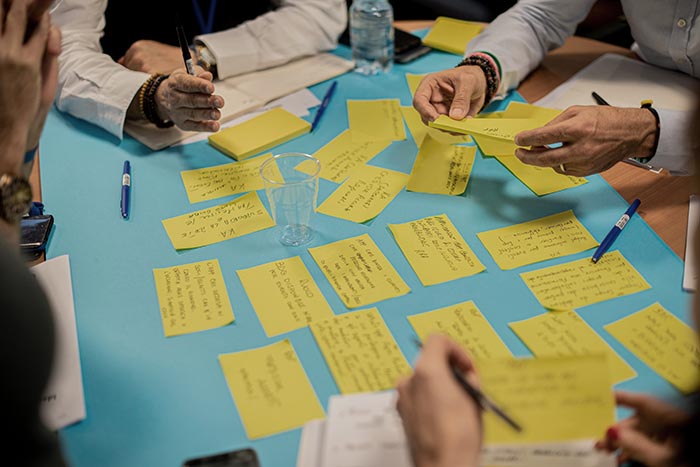
Image: Unsplash
Creativity in the Workplace
.
Peter: So what about the other aspect of your work – encouraging creativity at an institutional level? How do you go about that?
Eitan: Well, it’s important to understand first of all that organisations have very different sets of objectives. They work in different ways. They’ve got different sets of people they’ve recruited. They’ve developed, whether consciously or subconsciously, a certain culture. And all of these things will impact on how people within that organisation feel; whether they feel able to share an idea, develop an idea, even give themselves permission to explore an idea.
Basically, the way I see it is that all ideas start as little seedlings, and when they first germinate, they might all look the same. You have to water them all in order to see which ones will flower. So ideally there needs to be an environment where somebody isn’t going to lose out on a promotion or some kind of status or pay rise or whatever because their idea-seedling germinated but didn’t flower. You need to foster a culture where people feel safe trying things out and failing. Because failing to produce an innovation outcome is, in fact, part of succeeding to perpetuate an innovation process.
But the trouble with that is that it needs to be holistic within the organisation. If an organisation can say: This person has spent all year exploring their curiosity – trying different things out alongside their day-to-day responsibilities – but none of them have worked. And we’re not going to penalise them for it – well, they’ve got quite an extraordinary culture. But as soon as you set outcomes that need to be fulfilled before someone is allowed to try different things out, then you’re back to this idea of hierarchy. It is the same as at school, where you need to get all your spellings right and get your good grades, and then if you want to mess around in the art room later, you can.
Jane: I very much like this metaphor of ideas being like seedlings that all look the same when they first pop out of the ground, and it is only as they are watered and nurtured that we can begin to see which will come to fruition. Do you have any suggestions about how we begin to do this within our own organisations and management structures?
Eitan: Well, one of the really important principles that I work with is that nobody owns ideas. I do workshops with people, and I put this right at the very beginning as one of the rules. Ideas aren’t owned by anyone; we’re working on all of them together. A lot of social deference can occur within groups or meetings, so that somebody with a higher status gets recognition and ideas from other people are ignored. So I give everybody a pack of Post-it notes before the meeting and get them to write down all their ideas about a topic. Everyone has the same coloured Post-it notes, so no-one knows who wrote what, and we put them up on the wall according to different themes. So everyone’s ideas get put up there, and the workshop is about synthesising them and thinking about them further.
This at least helps people to distance themselves from the notion that they own an idea. But you still get the kind of charismatic leader that loves the sound of their own voice, and when they speak, everyone will listen and these are the ideas that miraculously get prioritised. So as a technique it is not perfect, but it does help to cultivate an openness and a humility to think about ideas coming from all sorts of different places rather than just a few special people.
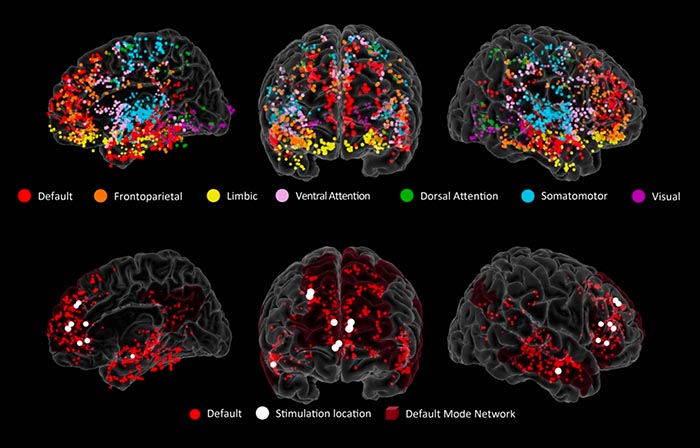
Advanced brain activity imaging depicting moment-to-moment activity, contrasting ‘default mode network’ with creative thought. Image: Bartoli, Devara, et al.
Creativity and AI
.
Jane: So, can we ask you about AI? We are faced with a situation where a lot of jobs which we would think of conventionally as creative, like writing films or poems or translating literature between languages, are being taken over in some way by AI. Whatever we might think about the validity or quality of what it is producing, this is clearly an important issue. And it’s going to be a big issue in companies as well; who will come up with new ideas for products or packaging?
Eitan: Absolutely. This is a huge topic which is right in front of us all. And I think that at the moment it’s advancing and developing so quickly that everything that we’re about to say can become irrelevant in a couple of weeks’ time. But right now, what I would say is that it is best seen as a tool that can synthesise and help us deal with the technical articulation of ideas extremely well. So if you are a software developer, it can write the software really easily and quickly, and that makes the experimental phase of a project much quicker. What might have taken three or four weeks before can maybe take an hour now.
We still have to set up the parameters for AI to work. What problem is it trying to solve? How is it being instructed? What prompts are put in place? But once this is done, AI is very good at doing experiments – writing a contract differently if you’re a lawyer or if you’re an author; maybe you want to experiment with a different story or with different tones of voice to see whether that might spark a different route for you. In the past we might have done some of this with a conversation with a colleague or gone the long way round by actually writing all of that stuff out.
At the same time, I think that there’s something lost because often it’s in the process of making something that we really come up with something new. Say you are an author who wants to see what a chapter would look like in three or four different voices – different dialects, maybe, or character voices. There is something about actually writing it out – deeply immersing yourself in the process of writing it out – that helps in the idea development. It’s the experiential or the visceral side of it, which I think we need to be aware of. AI can turn the volume down on the experience of making something or hand-writing a page of dialogue. And I believe that in this new reality we may find that we lose something in how far we’re able to develop ideas.
For instance, a big part of my doctorate was transcribing interviews, which in 2015 I had to do mostly by hand. I used some form of technology towards the end – some elementary speech-to-text software – but having the very sophisticated programmes we have now would have saved me a lot of effort. But at the same time, I wouldn’t have immersed myself in the content of the discussion as much as I did when working manually. In anthropology, we call this knowing your data – understanding it and seeing the links between what people are saying and so on. So there are advantages and disadvantages. I think this comes back to a sense of humility. Can we find a way to be humble with this technology and not forget the disadvantage of doing things quicker, more seamlessly?
Jane: I agree with you. Some of my students at the university have talked about AI doing things too quickly for them. They can’t keep up, or the speed at which information comes in overwhelms them. Sometimes we need to go a bit slower as human beings and let things sink in.
Eitan: Yes, as we have already said, there is a big difference between focusing on the outcome of an innovation and working with innovation as a process. The process of developing ideas in our head is non-linear and complex, and sometimes it can help to bend bits of cardboard or stick things together with glue or to have a conversation with a friend and see where our mind goes while we do it. The important bit is not the result but being open and noticing how things feel to us. And being open and confident to allow our ideas to develop accordingly because we understand that this is what our creative process looks like.
Creativity and Humanity
.
Peter: I work as a spiritual director, and it strikes me that many of the qualities that you aim to develop in your work – openness, embracing uncertainty, being vulnerable, being humble – are also qualities we work with on the spiritual path. I wonder what your view on this is.
Eitan: Well, I don’t consciously work from a spiritual perspective. But one thing that has emerged from my work, which was a surprise, was how many people report a sort of a renewed motivation for their work and improvements in their mental health. This has been actually much stronger in the corporate world than it was within schools.
Jane: Perhaps this comes back to what you mentioned at the very beginning of our conversation: that being creative is an essential part of our humanity, and so it brings a sense of contentment or happiness when we are able to express ourselves more fully.
Eitan: Yes, being human is about lots of different things, and it’s good news to find that it includes this as well. In many people, this creative capacity lies dormant because they’ve told themselves a story and come to believe they cannot do certain things. But when we start thinking about it, we can see that we are all being creative in all sorts of ways all the time. We just don’t name it like that. We come to cook supper and find out that we only have 70% of the ingredients, so we figure something out. And sometimes the best dishes come about because we are working with limits. It’s the same with poetry when we try to write within a formal structure – like a sonnet has to be 14 lines or a haiku 17 syllables. We have to work out what are the full capabilities of the different materials or structures that we’re presented with.
Peter: In fact, it’s interesting to contemplate how much of human life consists of making the best of limits.
Eitan: Yes, indeed. The other way in which I think this work overlaps with spiritual work is in developing trust in our intuition. Some people might say that this is some form of spiritual guidance. But others might say: Well, it’s just my subconscious telling me to give this a go, so I’m not going to kill this idea before it’s germinated. I’m going to go with it and see what happens.
Peter: But by working with the subconscious, they are still allowing a more complete version of themselves to emerge.
Eitan: Yes, I suppose so. So however we see it, the end result is an increase in our humanity – and our capacity to fully articulate who we are.
Jane: Eitan, thank you very much for talking with us about this fascinating subject. We wish you all the best in your work and look forward to reading the book when it comes out.
Image Sources (click to open)
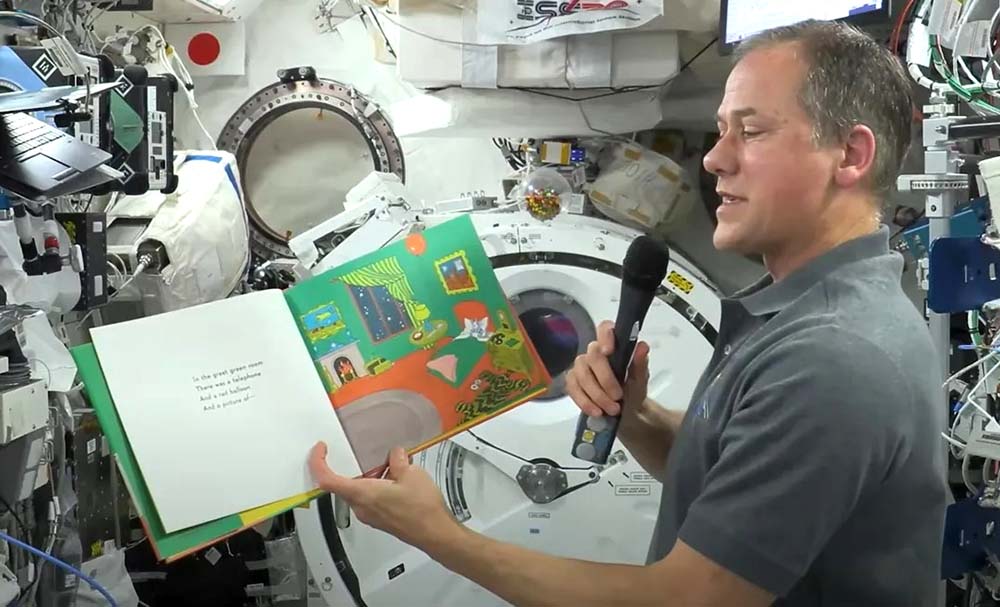
Banner: NASA astronaut Thomas Marshburn reads aloud Goodnight Moon for a recorded event aboard the International Space Station as part of a NASA and Crayola Education collaboration. Image: NASA.
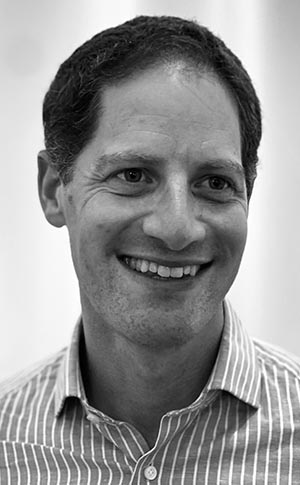
Inset 1: Eitan Buchalter. Photograph: Courtesy Eitan Buchalter.
Insets 2 & 3: Artwork from The Touchstone Centre for Children, New York, which is dedicated to nurturing the creative capability of children. For more, see touchstonecenter.net.
Other Sources (click to open)
[1] XYZ
The text of this article has a Creative Commons Licence BY-NC-ND 4.0 [/]. We are not able to give permission for reproduction of the illustrations; details of their sources are given in the captions.
FOLLOW AND LIKE US
@Beshara_Mag








——————————————
——————————————
——————————————
Video: Dr George Lands: The Failure of Success. Duration: 13:37
Video: Do Schools Kill Creativity? by Sir Ken Robinson; TED Talk 2007. Duration: 20:03
FOLLOW AND LIKE US
@Beshara_Mag
If you enjoyed reading this article
Please leave a comment below.
Please also consider making a donation to support the work of Beshara Magazine. The magazine relies entirely on voluntary support. Donations received through this website go towards editorial expenses, eg. image rights, travel expenses, and website maintenance and development costs.
READ MORE IN BESHARA MAGAZINE

Pilgrim in the Land of Children
Robert Hirschfield appreciates the work of Richard Lewis, a teacher who has devoted his life to inspiring children to write imaginative poetry

Social Ecology: An Alternative Perspective
Professor Jim Morley argues that we need to rediscover ourselves as naturally affiliative, cooperative and empathetic
Participating in the Divine Playfulness
Hina Khalid explores the Theological Aesthetics of Rabindranath Tagore

READERS’ COMMENTS
0 Comments