
Arts & Literature _|_ Issue 32, 2026
Music and the Ineffable Divine
Catherine Coldstream contemplates the sublime nature of music
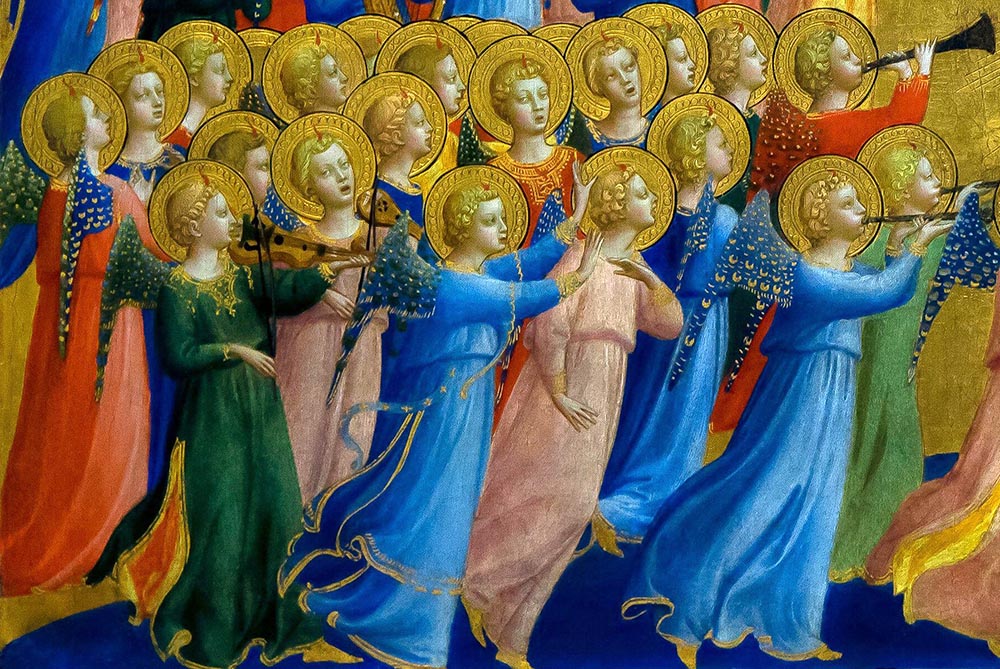
Music and the Ineffable Divine
Catherine Coldstream contemplates the sublime nature of music
Throughout human history, music has been seen as a way of connecting us with the divine. Rabindranath Tagore described it ‘the purest form of art’, while Beethoven saw it as ‘the one incorporeal entrance into the higher world of knowledge which comprehends mankind but which mankind cannot comprehend.’ In this article, the writer, mentor and former Carmelite nun Catherine Coldstream contemplates the relationship between silence, speech and music in our experience of the ineffable; the ‘sublime’ correspondence between music and the harmonies of the universe, and her own love of the late Beethoven string quartets. ‘The gift of music comes down to us like rain or dew or inspiration, as beauty, as gratuity.’
Will there be silence in heaven? Or music of a beauty beyond all human conceiving? On surrendering our finite, mortal state, what, if anything, will we hear? Words in a language we can understand? Sounds that are intelligible? These are the kinds of questions St Paul would have dismissed as foolish, or aphrōn – mindless – because they are based on too low a vision of what to expect ‘on the other side’. Comparisons of the afterlife with states with which we are familiar fail, typically, by virtue of their banality.
Not that there is anything necessarily wrong with the more banal elements of day-to-day existence – the banal (or ‘ordinarily decreed’ realities) are part of the common fabric of human life, one of many essential ligaments that bind us together as embodied beings. But so, too, are shared intimations of something less familiar, the ultimate perfection we dimly intuit and for which we all long. Every heart desires fulfilment, an end to striving, and it is towards this that we attempt to navigate consciously or unconsciously, throughout our lives. It is a feature of the Christian vision that it places this ultimate fulfilment outside of time and space.
Will there be silence in heaven? Or music of a beauty beyond all human conceiving? On surrendering our finite, mortal state, what, if anything, will we hear? Words in a language we can understand? Sounds that are intelligible? These are the kinds of questions St Paul would have dismissed as foolish, or aphrōn – mindless – because they are based on too low a vision of what to expect ‘on the other side’. Comparisons of the afterlife with states with which we are familiar fail, typically, by virtue of their banality.
Not that there is anything necessarily wrong with the more banal elements of day-to-day existence – the banal (or ‘ordinarily decreed’ realities) are part of the common fabric of human life, one of many essential ligaments that bind us together as embodied beings. But so, too, are shared intimations of something less familiar, the ultimate perfection we dimly intuit and for which we all long. Every heart desires fulfilment, an end to striving, and it is towards this that we attempt to navigate consciously or unconsciously, throughout our lives. It is a feature of the Christian vision that it places this ultimate fulfilment outside of time and space.
St Paul, when asked what sort of embodiment our post-resurrection selves are likely to receive, gives his hypothetical interlocutor short shrift. ‘These are stupid questions!’ he retorts, sounding less than tolerant of those seekers who, while sincere, manage to ask the wrong questions.[1] There will be no obvious resemblance between our mortal bodies and whatever form our future selves may take, he says, comparing the difference between pre- and post-resurrected states to the difference between a seed and a fully-formed plant. What is now manifest is not what is to come, he further clarifies, reminding us that potentiality and actuality are mutually exclusive.
There is also an element of grand and untold mystery implied. This is in keeping with Paul’s biblical formation, in terms of which it would be a mistake to try to pin God (and any other sort of transcendence) down. Indeed, it may be better for us not to think we ‘know’ prematurely, or to assume we ‘understand’. Such grasping cannot but fall short of the mark. Images and idolatry fail us not because they are too exciting, but because they are not exciting – or transporting – enough. We get the drift of what Paul is saying, but very much not the specifics, probably because the categories in which we conceive of things like ‘specifics’ will no longer apply in our as-yet-unrevealed future state, that singular unveiling when we come ‘face to face’ with Uncreated Light.

Elijah Fed by the Ravens by Giovanni Girolamo Savoldo [/] (1480–1548). Whilst he was taking refuge in the mountains, Elijah heard the voice of God in ‘the sound of a gentle breeze’.[2] Image: National Gallery of Art, Washington DC, via Wikimedia Commons
Silence, Speech and Music
.
Silence, as a mode, is something we might associate with, if not the divine presence itself, then a form of access, a precondition of the waiting on God that is contemplation. Silence as attentiveness. Silence as a letting go, or even a letting be. Silence of this kind is not a relaxation, but a consciously chosen form of receptivity, a ‘bending of the ear’ to catch harmonies pure enough to take us out of ourselves, expanding the heart, enlarging our capacities, readying us for ever greater glimpses of the God who approaches us in humility, like Elijah’s gentle breeze. Such an active receptivity not only acknowledges that there is something out there to be heard and worth the hearing, but also implies a readiness to apply what is learned in contemplation to the stuff of daily life, in actions that are – in the core sense of the word – obedient.
From the Latin ob audire (to ‘listen to’), the verb that has become associated with a mindless following of orders actually implies something far richer and more humanly demanding – a co-operation with spirit that is part surrender, part active responsibility. To listen for and obey divine promptings is to declare oneself a conscious and active agent of the good, the beautiful and the true, not the lackey of some interim authority. It is to put truth first, and indeed to choose the path of truth which embraces all the other virtues, including love. It is to interact freely with truth as son or daughter, not slave – to borrow another biblically-rooted image from St Paul. A child listens in order to learn from a parent, and in that listening learns to imitate.
The sheep that belong to the Good Shepherd listen for that voice which, once heard, leaves a lasting imprint on the mind and soul, one that, entirely of itself, articulates a kinship and effects an alchemy. But such active and transformative listening requires a measure of openness and passivity, and above all that we be comfortable in silence. Silence is the gateway. Sound is the reward, whether as word or Word, whether as Logos or divine reverberation.
But what of earthly music, and what, for that matter, of human speech, those two forms of communication that depend on a shared grammar and a common physiognomy, forms that allow imperceptible vibration to be translated into meaningful assertion and made intelligible? Are these not also valid vehicles for the divine approach, modes that we recognise as a reaching out, a deep calling to deep, a communication that can flow easily – almost reciprocally – in both directions? Since God’s very word is creative, each utterance an effecting of the holy will, the bending of the human ear to catch the scattered strains of divinity is a well-adjusted response. To say God speaks to us is no exaggeration – it is an understatement. God speaks us. He wills us into being. And, continuing to utter the Word who is Life, He also wills us and continues that willed utterance for as long as it glorifies Him to do so. To paraphrase St Augustine, God is the singer; we are the song. But no song exists in isolation. In harmony with the divine Creator, we are called to listen and to move to His reverberations.
Of all the means we have for picking up on the ineffable divine, music, I would suggest, is the most direct and pure, excepting only that ‘naked faith’ of which true ascetics speak, and – linked to such humble faith – a selfless partaking in the sacraments. How these latter – faith and a sacramental life – relate to music, however, it is difficult to say, unless we settle for an explanation according to which harmony is the purest ‘sensible’ access we can have, or hope for, pure faith lying somewhere beyond the realm of the senses.
According to such a model, faith, like hope and love, are demanding virtues that connect the human will directly to God, being ‘theological’ in character, while the gift of music comes down to us like rain or dew or inspiration, as beauty, as gratuity. It is something that softens the heart and inclines us to listen to and nurture that love that is beyond all loves, and to accord it the highest place in our lives. When music moves us, everything seems possible; so miraculous are its effects. When beauty accosts us, we are sometimes shaken to the core, and, being shaken, roused briefly out of the sleep that so easily can close our eyes and ears to good.
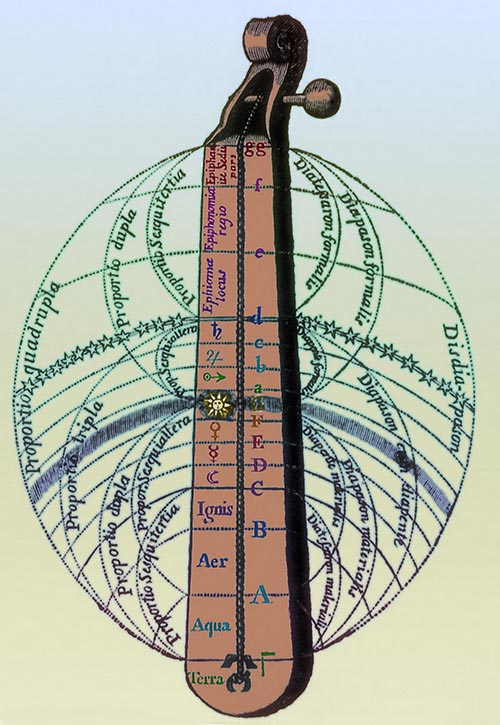
‘Harmony of the Spheres’ by the English hermeticist Robert Fludd (1574-1637), showing man’s soul in harmony with the universe. Image:Science History Images/Alamy Stock Photo
The Sublime in Sound
.
As for heavenly music, as a transcendent category in itself, what do we mean when we speak of the sublime in sound? And can we, at least theoretically, distinguish between the extraordinary beauty and power sometimes conveyed by music this side of heaven, from that longed-for experience ‘no eye has seen, no ear heard, nor the heart of human conceived’? [3] Does the music that causes us to weep, here and now, have any relation to the divine, beyond that of humble messenger, and if so, in what does that relationship consist? Can we know anything at all about it?
The composer and writer Andrew Baker [/] revives Platonic theories about the role of harmony in connecting humankind with God, appealing to the geometry inherent in musical relationships and the way harmonious resonance mirrors so many other natural relationships, proportions, and instances of beauty. [4] According to such a worldview, music has within itself the capacity to order the human soul, encouraging the development of virtues, and enhancing the metaphysical aspirations of the individual. As such, music and the divine are profoundly intertwined.
To respond to the question as to what we might or might not expect to hear in heaven, however, a leap into the great unknown is ultimately required. The only afterlife references to music in the Bible involve dramatic things like trumpets and harps, but most of us read these as poetic and metaphorical. In the end, all we can do is gesture towards a future state that satisfies as a summation, and a culmination, and an end point that makes sense of (and justifies) the way that leads there. Knowing what we do about sound as vibration, a disembodied phenomenon, and God, as pure spirit, it is not fanciful to suppose a correspondence between the two, especially given that spirit suggests movement and the Logos rationality, the thrust of a communicable idea.
In music, what cannot be touched or held or possessed in any way at all (CDs and streaming services notwithstanding) subtly enters into our very being, touches, moves, and changes us at a cellular level, much as the essence of God can do when ingested by the faithful communicant according to a Christian theology of the Eucharist. Either way, transformation somehow happens, and a wonderful exchange whereby what defies the boundaries of our bodies and vibrationally penetrates us also remakes us.
Video: Danish String Quartet plays Beethoven’s Heiliger Dankgesang in The Copenhagen Cycle, 2018. Duration 19:04
The Deaf Beethoven
.
Of all the music that has spoken to me most directly, there are certain works that stand out as particularly mysterious. On discovering Beethoven’s late string quartets (Numbers 12 to 16 [4]) as a teenager, I became fascinated by the pared-back language of these exceptionally taut and distilled works of art. I wondered what was it that not only transported but silenced me, returning me to my own centre in a way that was more akin to prayer than to performance, or to its emotive effects. The relative muscularity and bombast of Beethoven’s earlier and middle period seemed to have evaporated, leaving only the contemplative gaze behind.
I might not have expressed it in that way, as a stormy 17-year-old searching for musical redemption, but I sensed the purity of intention behind the works, the integrity and power that told me something more than what we normally mean by ‘music’ was at work. These sonic constructions were the equivalent of ‘thin places’ – zones where barriers of time and space are dissolved, and a direct line is drawn between inspired source and receptive listener.
One answer to my teenage questioning might be that, by the time these late works were composed, from 1825 onwards, Beethoven was completely deaf, which cannot but have ushered in a new and strangely disembodied relationship with music for him. Beyond sensation, music here is less about the heard experience and more about the underlying architecture, the pure concept, and this, I now feel, is one reason these extraordinary late works have the ethereal and transcendent glow of otherness. They are distillations of something beyond sound and sense, of something that shares in the conceptual perfection of mathematics while, at the same time, acknowledging the neediness of our humanity.
The Heiliger Dankgesang, or ‘Holy Song of Thanksgiving’, which constitutes the Adagio of the 15th string quartet, Opus 132, is one of the most sublime instances of this, a movement in which the composer thanks God for recovery after a time of illness in musical measures that sound like surrender and helplessness and gratitude all at once.
Is this what heaven will sound, or perhaps feel like? It is tempting to be overconfident or to gush, but the truth is we have no idea and must wait to be surprised. That change will happen is certain, and we are offered the image of the ‘twinkling of an eye’ to help us compute how swift, how sure, how instant, our ultimate conversion and enlightenment might be. Whether to the sound of a trumpet, or to the absolute silence we read about in the Book of Revelation – a ‘bated breath’ moment while the mysteries of the universe are uncovered (at the breaking of the seventh seal) – or to a rush of energy such as the one evoked by Beethoven’s ‘Freude!’ the unveiling of the godhead is likely to be far beyond anything of human conceiving.
In his 1928 novel Point Counter Point, Aldous Huxley includes a reference to the crystalline perfection of Beethoven’s Heiliger Dankgesang as an effective demonstration of the existence of God. In his 1931 essay, The Rest Is Silence, he continues his dialogue with music, commenting that:
All the things that are fundamental, and most profoundly significant to the human spirit, can only be experienced, not expressed. The rest is always and everywhere silence … After silence, that which comes nearest to expressing the inexpressible is music.[5]
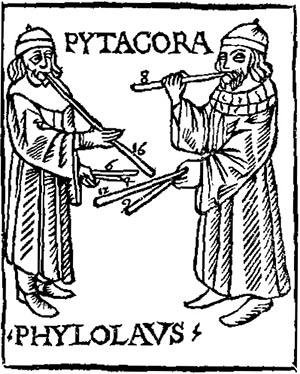
The fact that music varies widely between times and places does not alter the fact of its actual existence as a spiritual language, a wavelength, or spectrum of wavelengths more precisely, and a play on our perception of time itself. That it can draw tears, that it can calm, and bond, and lift us out of our narrow selves into a remembered past or an imagined future, all speak of its powers as something beyond the banality of the everyday, even though it is accessible to most of us at any moment. Our bodies provide the instrument in the gift of singing, which is as primal as the scream of a newborn infant, and as sophisticated as Pythagoras.
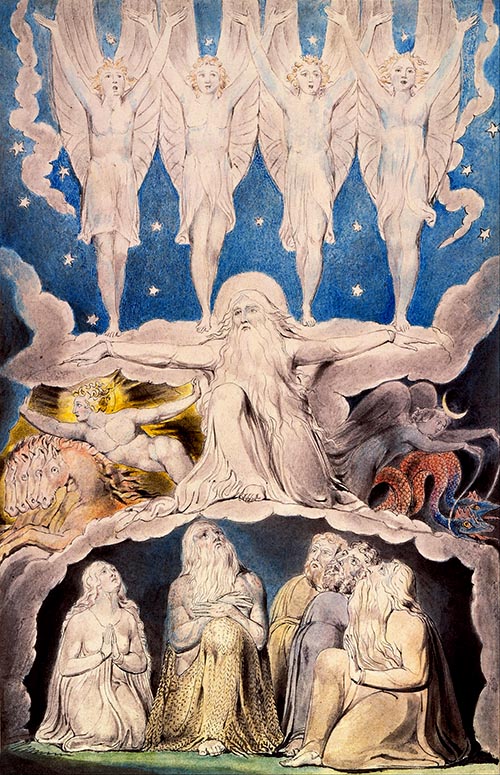
‘When the Morning Stars Sang Together’ by William Blake, an illustration to The Book of Job. Image: Wikimedia Commons
Final Thoughts
.
So will there be silence in heaven, or music of a beauty beyond all human conceiving? Because ‘heaven’ is a word, and no one really knows what it can possibly mean, beyond a vision and an experience of God that is complete and finally and fully satisfying, the question presupposes ways of knowing that are not yet available to us. Paul’s indication that, beyond the material, there will be joys which ‘no eye has seen, no ear heard, nor the heart of human conceived’ [2] gives us the hope that, in some other sphere, beyond our conceptions of time and space, justice will be done and the longing for ultimate goodness rewarded. What that will involve, and with what, on the sensory level, we may compare it, is profoundly mysterious. The fact that both God and music – like angels, who are also pure spirit – share an agile, disembodied and essentially vibrational (ethereal) quality, does suggest a qualitative identity, or at least a relationship that accords with many of our deepest intuitions.
How far beyond our current imaginings the truth resides, we do not know. With Job, I am happy to sing: ‘I know that my Redeemer liveth’ [6] and that ‘these eyes shall look upon’ [7] the one who takes my part, while equally happily acknowledging that the language falls short of the reality. I am more reluctant to suggest that Bach’s Art of Fugue, or Beethoven’s Opus 132 fall short, but even the purest mathematical relationships expressed through music – that is, ethereally and vibrationally – speak to us of things we cannot, in our embodied state, fully understand. I am happy to await the ineluctable transformation, in that promised twinkling of an eye, and the reconfiguring of my nature until its capacity for God is filled and my potential for goodness is realised, and I am ready to discover what the word heaven really means.

Catherine Coldstream is a writer, mentor and former Carmelite nun. Author of Cloistered: My Years as a Nun (Chatto & Windus, 2024), and editor of William Coldstream Remembered: Portraits of a Painter (Sansom & Co, 2025) she has taught Religious Studies in schools and contributed to journals including the Temenos Academy Review and MONK arts magazine. Her writing has been adapted for radio and shortlisted for awards including the TLS Ackerley Prize, the Hatchard’s and Biographers’ Club First Biography Prize.
Image Sources (click to open)
Banner: Detail from Christ Glorified in Court of Heaven, Fra Beato Angelico (1423–4). Image: photosublime / Alamy Stock Photo.
Inset: Pythagoras and Philolaus experimenting with musical pipes. From Theorica Musicae by Franchino Gaffurio, 1492. Image: Wikimedia Commons.
Other Sources (click to open)
[1] See New Testament, 1 Cor 15:36.
[2] See Old Testament, 1 Kings 11–13.
[3] New Testament, 1 Cor 2:9.
[4] See ANDREW BAKER, Hidden Music: a Franciscan Musical Theology (AJB Publications, 2023).
[5] BEETHOVEN Opus 127, 130, 131, 132, and 135.
[6] ALDOUS HUXLEY, ‘The Rest is Silence’ in Music at Night (Chatto and Windus, 1931).
[7] Old Testament, Job 19:25.
[8] Old Testament, Job 19:27.
The text of this article has a Creative Commons Licence BY-NC-ND 4.0 [/]. We are not able to give permission for reproduction of the illustrations; details of their sources are given in the captions.
FOLLOW AND LIKE US
@Beshara_Mag








——————————————
——————————————
——————————————
FOLLOW AND LIKE US
@Beshara_Mag
If you enjoyed reading this article
Please leave a comment below.
Please also consider making a donation to support the work of Beshara Magazine. The magazine relies entirely on voluntary support. Donations received through this website go towards editorial expenses, eg. image rights, travel expenses, and website maintenance and development costs.
READ MORE IN BESHARA MAGAZINE
Participating in the Divine Playfulness
Hina Khalid explores the Theological Aesthetics of Rabindranath Tagore
A Thing of Beauty…
Robin Thomson appreciates the music of Bach and an inspiring new performance of his St John Passion
The Art of Conducting
British conductor James Lowe talks about the nature of music, and the importance of live performance in this digital age

READERS’ COMMENTS
0 Comments