
Arts & Literature _|_ Issue 31, 2026
Edwin Muir: The Return to Eden
Andrew Watson contemplates the life and work of the famous Orkney poet who made a journey from childhood trauma to rediscovery of faith and meaning
Edwin Muir: The Return to Eden
Andrew Watson contemplates the life and work of the famous Orkney poet who made a journey from childhood trauma to rediscovery of faith and meaning
———Was it a vision?
Or did we see that day the unseeable
One glory of the everlasting world
Perpetually at work, though never seen
Since Eden locked the gate that’s everywhere
And nowhere? [1]
These lines were written towards the end of his life by Edwin Muir (1887–1959), one of the most distinctive Scottish poets of the twentieth century. They articulate a vision that slowly emerged through a life marked by loss, exile and spiritual searching. Muir’s work traces a journey from childhood trauma and inner disorientation towards a slow rediscovery of faith and meaning. It speaks to us today both because he lived at a time of similar insecurity and ideological conflict, and because his deeply personal search for healing and reconciliation remains eternally relevant.
At the centre of his poetry stands the myth of Eden: a lost state of harmony and belonging that is longed for and at times regained in altered form. Whether read theologically, psychologically or simply symbolically, Eden represents an integrated world in which meaning is not severed from experience and one’s place is secure. For Muir, this myth was rooted in his own memory of childhood, yet it also echoes a universal story of exile and return.
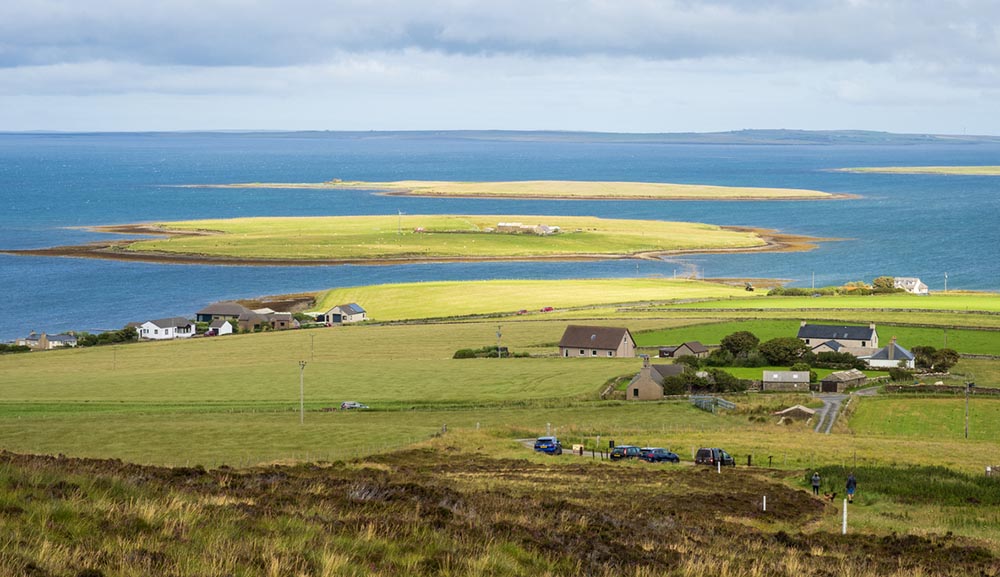
He was born, the youngest of four sons and two daughters, in Deerness, a parish in the eastern part of the main island of the Orkneys. This island home formed the imaginative Eden of his life. Its rhythms of farming, sea and weather seemed part of an ancient and harmonious order. That sense of belonging ended abruptly in 1901 when rising rents forced the family to abandon the island and move to Glasgow. For a sensitive fourteen-year-old boy the change was calamitous, as the pastoral landscape of Orkney gave way to the pollution, noise and poverty of an industrial city in which he was never at home.
It was not only the move to Glasgow that wounded the adolescent Muir. Within five years of their arrival in the city, his father, mother and two brothers had all died, worn out by stress and poverty. These losses during his teenage years created a deep psychological fracture, which he later likened to spiritual paralysis. It was a trauma from which he would take many years to recover.
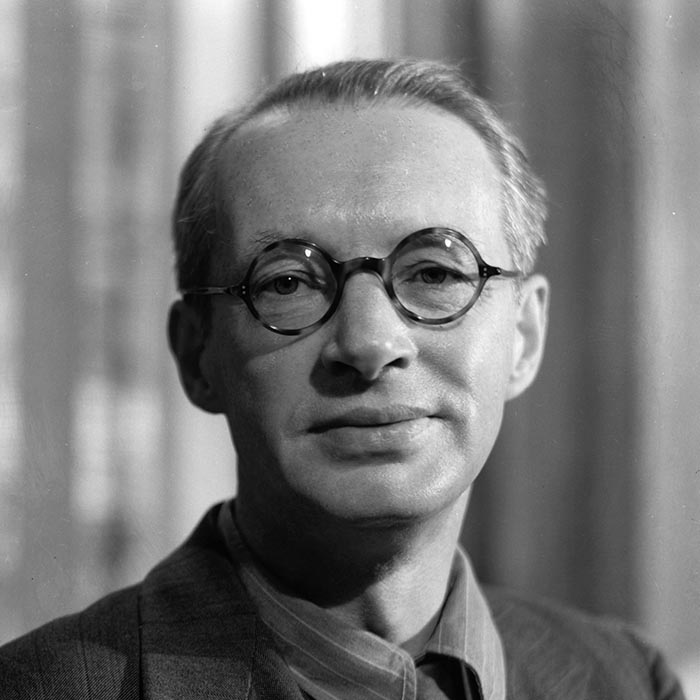
Edwin Muir, photographed by Howard Coster in London in 1945. Photograph © National Portrait Gallery
Memories of Eden
.
In Glasgow, Muir received little formal education and worked at various soulless jobs. One of these was as a clerk in a ‘bone factory’ on the coast, where decaying cattle bones were burned to produce charcoal for sugar refining. He worked here for two years, and his description of the place reads like a scene from Dante’s Inferno: piles of rancid, maggot-infested bones, the stench clinging to clothes and skin, and the incessant angry cries of seagulls feeding on the maggots. It was an experience of profound degradation that deepened his sense of alienation.
Something of this psychological state is found in one of his first poems, ‘The Betrayal’, published in 1925:
———It is told
That Beauty is a prisoner,
And that her gaoler, bleak and bold,
Scores her fine flesh, and murders her.
He slays her with invisible hands,
And inly wastes her flesh away,
And strangles her with stealthy bands;
Melts her as snow day after day.
Within his thicket life decays
And slow is changed by hidden guile;
And nothing now of Beauty stays,
Save her divine and witless smile.[2]
This nightmarish image of Beauty imprisoned and destroyed by a nameless, pitiless force conveys Muir’s sense of helplessness and despair, rooted both in his private trauma and in the generalised trauma left in the wake of the First World War. It stands in stark contrast to the memory of his island birthplace, celebrated in another early poem, ‘Childhood’, which was also published in his first collection:
Long time he lay upon the sunny hill,
To his father’s house below securely bound.
Far off the silent, changing sound was still,
With the black islands lying thick around
Often he wondered what new shores were there.
In thought he saw the still light on the sand,
The shallow water clear in tranquil air;
And walked through it in joy from strand to strand.
Grey tiny rocks slept round him where he lay,
Moveless as they, more still as evening came,
The grasses threw straight shadows far away,
And from the house his mother called his name.[3]
The poem has something of the quality of Blake’s Songs of Innocence: it evokes an illumined and secure world in which the poet had a clear sense of his own place, yet one suffused with hidden significance, where the veil between the visible and the invisible is thin. The islands themselves bore the traces of earlier cultures: prehistoric inhabitants had left behind stone circles, burial chambers and the extensive settlement at Skara Brae. For an imaginative child it was a landscape alive with mysterious presences. As Muir later recalled:
The Orkney I was born into was a place where there was no great distinction between the ordinary and the fabulous; the lives of living men turned into legend… A man I knew once sailed out in a boat to look for a mermaid, and claimed afterwards that he had talked with her. Fairies, or ‘fairicks’, as they were called, were encountered dancing on the sands on moonlight nights.[4]
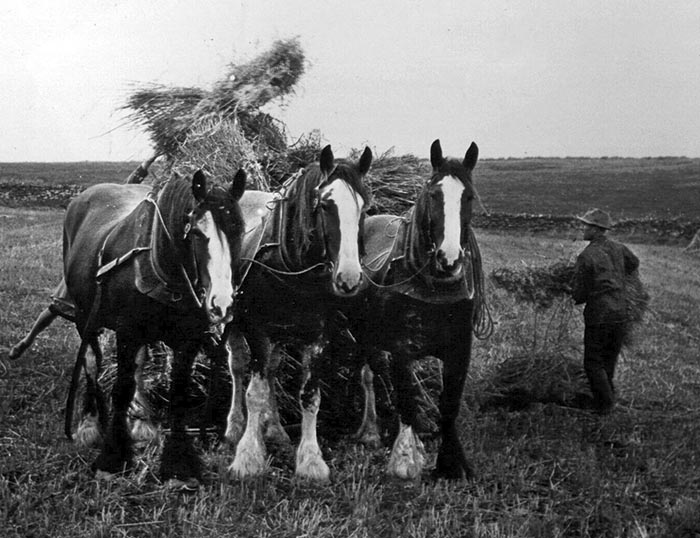
Working horses on Orkney. Photograph: Smith Archive /Alamy Stock Photo
Strange Horses
.
A sense of elusive, mythical reality beneath the surface of things, sometimes hidden and at other times manifest, pervades Muir’s work. A powerful recurrent symbol in his poetry is that of the horse, the creature that once pulled the plough on his father’s farm. It embodies both the rural life he had known and a timeless realm in which humanity lives in harmony with creation. This dual resonance is found in one of his earliest published poems, ‘Horses’, written in the early 1920s:
Those lumbering horses in the steady plough,
On the bare field – I wonder, why, just now,
They seemed terrible, so wild and strange,
Like magic power on the stony grange.[5]
The word ‘strange’ is a favourite of Muir, almost always with a positive connotation of something mysterious and significant, but not yet fully understood. The figure of the horse appears again many years later, in a poem with almost the same title: ‘The Horses’. It was written in 1946, soon after the end of the Second World War, and has become probably his most famous and anthologised poem. It was inspired by the calamity that technological progress had brought to mankind in the war, as well as the growing threat of another – nuclear – war. The poem imagines a shattered world: a catastrophic war has destroyed modern civilisation, silenced machines and left scattered survivors farming and labouring by hand. It begins with the lines:
Barely a twelvemonth after
The seven days war that put the world to sleep,
Late in the evening the strange horses came.[6]
Once again he uses the word strange to describe these mysterious arrivals. The people, at first wary, take the horses into their lives, using them to plough fields and haul loads, and in doing so regain a sense of rhythm, purpose, and connection with nature. The horses are
Stubborn and shy, as if they had been sent
By an old command to find our whereabouts
And that long-lost archaic companionship.
The last lines of the poem refer explicitly to the recovery of Eden:
Among them were some half a dozen colts,
Dropped in some wilderness of the broken world,
Yet new as if they had come from their own Eden.
Since then they have pulled our plows and borne our loads,
But that free servitude still can pierce our hearts.
Our life is changed; their coming our beginning.
This poem was written almost fifty years after Muir’s uprooting from his island home. The world of technology and ceaseless progress has led to its own destruction. The return of the horses offers the possibility of renewal and redemption through older, more harmonious ways of living.
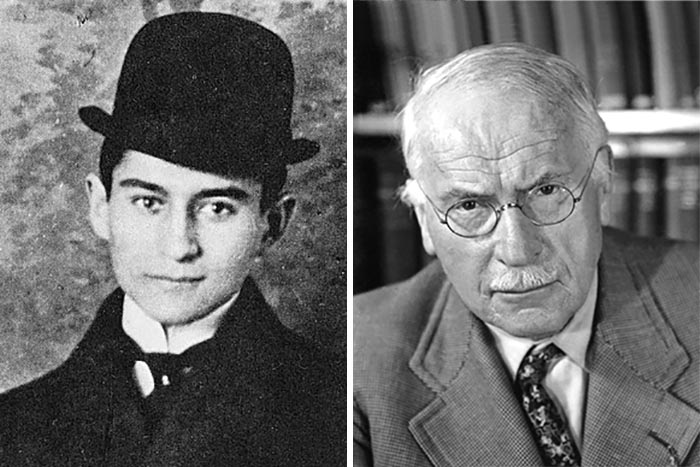
European Influences. Left: Franz Kafka (1883–1924), whose works Edwin and Willa translated into English. Right: Carl Jung (1875–1961), who was a life-long influence on Muir. Photograph: Interfoto / Personalities/Alamy Stock
Loss of Faith / The First World War
.
Alongside the loss of home and family, Muir also lost the religious faith of his childhood, rooted in the austere Calvinism of the Scottish Kirk. He came to believe that this tradition had exerted a damaging influence on the Scottish psyche, fostering guilt, repression and estrangement from both the self and the natural world. To him it appeared a sterile and joyless doctrine, one that betrayed the creative possibilities of the human spirit. His language in this respect was uncompromising, as we see in the poem ‘The Incarnate One’:
The windless northern surge, the sea-gull’s scream,
And Calvin’s Kirk crowning the barren brae.
I think of Giotto the Tuscan shepherd’s dream,
Christ, man and creature in their inner day.
How could our race betray
The Image, and the Incarnate One unmake
Who chose this form and fashion for our sake?
The Word made flesh here is made word again
A word made word in flourish and arrogant crook.
See there King Calvin with his iron pen,
And God three angry letters in a book,
And there the logical hook
On which the Mystery is impaled and bent
Into an ideological argument.[7]
The term ‘ideological’ is telling. Muir had witnessed the grip that sterile ideologies of both right and left had exerted across Europe after the First World War. For him, ideology represented an arid abstract system imposed upon the world, detached from lived experience and the truth of the human heart. It stood in sharp contrast to the enduring validity of myth. The reference to Giotto, the medieval Italian artist whose frescoes adorn the Basilica of St Francis in Assisi, points to another form of Christianity, one in which ‘Christ, man and creature’ exist ‘in their inner day’. It was a version of the faith to which Muir would one day be able to give his assent.
Although Muir endured a private hell after his family’s deaths, he was spared the trenches of the First World War, having been declared medically unfit because of weak lungs. Largely self-educated, he read widely in philosophy, literature and psychology, absorbing the thought of Nietzsche, Freud and Jung. It is also noteworthy that even in wartime Britain he felt a strong attraction to the German-speaking world, which would shape his life between the wars.
While he lamented the passing of a traditional way of life, he also embraced new forms of expression and investigation, including psychoanalysis, to which he attached great significance throughout his life. In 1918 he published We Moderns, [8] a collection of essays engaging deeply with European ideas and aligning him with European modernism, closer in spirit to Eliot and Joyce than to the nationalist Scottish literary revival associated with Hugh MacDiarmid, with which he was never in sympathy. Indeed, he would at times point out the distinct Nordic heritage of the Orkney (and Shetland) islands, with none of the Celtic origins of the mainland. An Orkneyman was a Scandinavian and not a Celt.
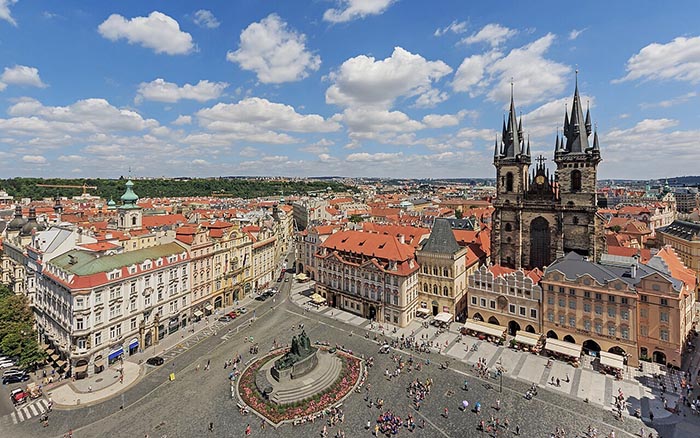
Prague, where Edwin and Willa lived in 1921–23 and 1946–49. Photograph: A. Savin via Wikimedia Commons
European Wanderings
.
The next year (1919), he married Willa Anderson, a classics graduate of St Andrews, whose strength of character and rigorous intelligence was a perfect match for his sensitive and poetic spirit. Their marriage proved to be both stabilising and liberating.
During the 1920s and early 1930s the Muirs lived in Prague, Dresden, Salzburg and Rome, immersing themselves in European intellectual life against the background of the rise of fascism and political repression. In Prague they encountered the work of Franz Kafka, which he and Willa later translated into English, helping to introduce Kafka to the English-speaking world. Muir recognised in him a kindred spirit: a writer of exile and estrangement whose allegorical narratives captured the spiritual anxieties of modern Europe. He believed that Kafka was a writer with a religious temperament who was unable to believe in God. Where they differed was that Muir gradually moved towards faith, without ever relinquishing his awareness of the suffering and alienation that constrict the human soul.
An image that recurs in Muir’s poetry is that of a maze or labyrinth. It seems to reflect his wanderings through modern Europe, in the grip of an ideological conflict which would eventually break out into war and from which there seemed to be no escape. More personally, it is an image of the anxious inner state from which he sought to free himself. The maze thus became, for him, a symbol of the predicament of modern man, adrift in a world that had lost its centre. It first appears in his poem ‘The Escape’, published in 1943:
Escaping from the enemy’s hand
Into the enemy’s vast domain,
I sought by many a devious path,
Having got in, to get out again.
The endless trap lay everywhere,
And all the roads ran in a maze,
Hither and thither, like a web
To catch the careless days.[9]
The rise of fascism deepened his conviction that secular modernity was spiritually barren. He began to see the loss of myth as catastrophic, the loss of transcendence as culturally fatal, and the modern self as dangerously unmoored. Yet in his own life, the years of his marriage and wanderings in Europe had brought a gradual healing of deep trauma. In the poem ‘The Labyrinth’, published after the War, the image of the maze reappears, but with a new emphasis: emergence into light. As so often in his work, the landscape is dreamlike and symbolic, a place where truth and illusion coexist:
———ever since I came out
To the world, the still fields swift with flowers, the trees
All bright with blossom, the little green hills, the sea,
The sky and all in movement under it,
Shepherds and flocks and birds and the young and old.
That was the real world; I have touched it once,
And now shall know it always. But the lie,
The maze, the wild-wood waste of falsehood, roads
That run and run and never reach an end,
Embowered in error – I’d be prisoned there
But that my soul has birdwings to fly free.[10]
The poem records a moment of liberation and reconciliation. It also returns to the island world evoked in the poem ‘Childhood’. This vision seems to have coincided with a return to religious faith. In 1939, while living in St Andrews, Muir underwent a profound spiritual experience and thereafter considered himself a Christian. This conversion did not eliminate his awareness of darkness and conflict within the human soul or within history itself. Rather, it provided a framework through which he could order his inner life and sustain the sense, however fragile, of restored wholeness.
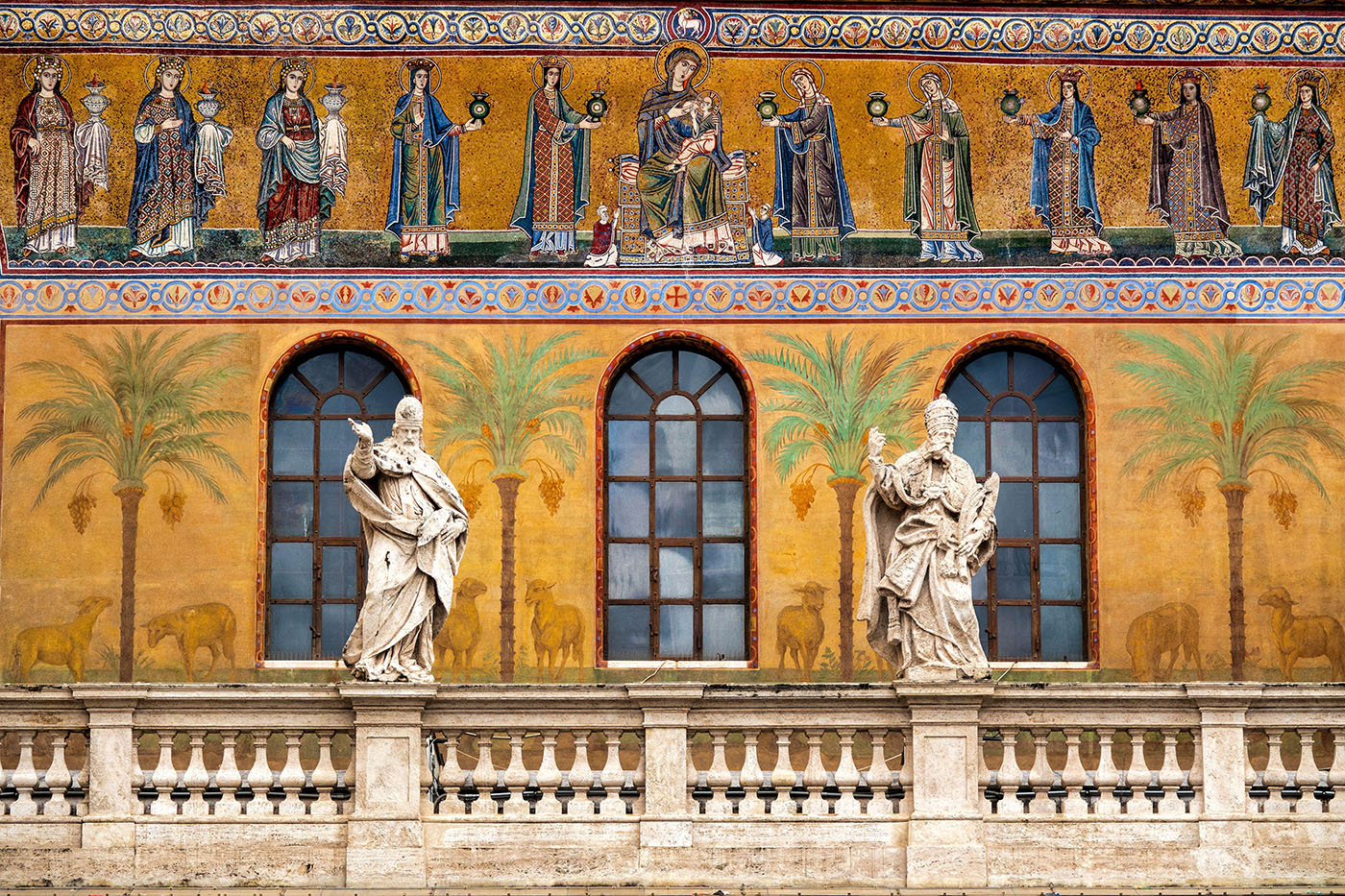
‘For Muir, Catholic Italy presented a Christianity that was sensuous and celebratory’. Facade of the Church of Santa Maria in Trastevere, Rome, Italy. Photograph: Fabrizio Troiani / Alamy Stock Photo
Move your computer mouse of image to enlarge
Transformation
.
If we ask ourselves what it was that brought about the internal change that culminated in this return to faith, we are inevitably interrogating the secret places of a human soul. Yet it is certain that sharing his life with Willa played a vital role in his transformation. Her strength and love had sustained him through their years abroad. Towards the end of his life he paid tribute to her in a moving poem, ‘The Confirmation’ (the title itself has a sacramental aspect), in which he writes of their now mature and tested relationship with grateful acknowledgement. Again, he uses the image of emerging from a maze:
Yes, yours, my love, is the right human face.
I in my mind had waited for this long,
Seeing the false and searching for the true,
Then found you as a traveller finds a place
Of welcome suddenly amid the wrong
Valleys and rocks and twisting roads. But you,
What shall I call you? A fountain in a waste,
A well of water in a country dry,
Or anything that’s honest and good, an eye
That makes the whole world seem bright.[11]
In 1945 Muir became director of the British Council in Prague, where his rejection of Marxism was confirmed as he witnessed the Stalinist takeover of Czechoslovakia. Once again, he experienced a culture stifled by authoritarian dogma, now one of the left. He felt particularly the moral anguish of a society confronted by a materialist ideology that denied the integrity of the individual soul.
From Prague, the Muirs moved to Rome, where he encountered a very different world, one in which religious meaning seemed to permeate the whole texture of daily life. In contrast to the austere Calvinism of his youth, suspicious of images and inclined to strip worship to its bare essentials, Catholic Italy presented a Christianity that was sensuous and celebratory. Churches filled with paintings and sculptures, saints gazing from street corners, bells sounding across the city and the rhythm of festivals and processions all suggested that the sacred was not confined to doctrine but lived within the world itself. For Muir, Christianity in Italy seemed to belong to the visible world, whereas in Scotland it had seemed to belong almost entirely to another. To him, Rome was a living expression of the Incarnation itself: a culture in which the divine and the human were not sharply divided but intimately joined.
An illuminating comparison can be made between Muir and the other great twentieth-century Orcadian poet George Mackay Brown (1921–1996). Unlike Muir, Mackay Brown spent almost his entire life in Orkney, in the town of Stromness, and never experienced the sense of banishment and exile that so marked Muir. Nor did he engage with philosophical and political ideas in the same way. Mackay Brown’s poetry is more concerned with the detailed observation of daily life within a small, closely defined community, though he was equally aware of its fragility and the unceasing play of darkness and light. Mackay Brown converted to Roman Catholicism in 1961, and shares with Muir the conviction that suffering and loss find their place within a larger spiritual order.
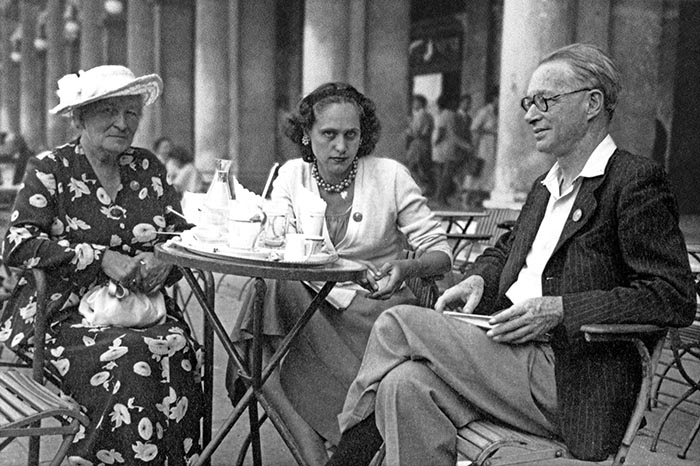
Left to right: Willa Muir, Natasha Spender and Edwin Muir at the PEN Conference in Venice, sitting outside Caffe Florian in Piazza San Marco, 1949. Photograph: Stephen Spender / Bridgeman Images
One Foot in Eden
.
One of the clearest poetic expressions of Muir’s renewed vision appears in ‘The Transfiguration’ (1949), written shortly after his return from Italy. Inspired in part by dreams experienced during Jungian analysis (an influence evident throughout his life), the poem evokes a moment of spiritual restoration:
So from the ground we felt that virtue branch
Through all our veins till we were whole, our wrists
As fresh and pure as water from a well,
Our hands made new to handle holy things,
The source of all our seeing rinsed and cleansed
Till earth and light and water entering there
Gave back to us the clear unfallen world.[12]
The post-war years marked the height of Muir’s poetic achievement. His style became spare yet resonant, shaped by a new sense of acceptance and wisdom. Recasting his personal history in allegorical form, he drew on archetypes from religion and mythology to explore suffering, exile and redemption. These poems embody what he called the ‘mythical sense of time’: the attempt to place contemporary experience within an enduring pattern of meaning.
By the end of his life, he had come to accept the place of suffering and evil in the world, recognising that they give rise to the compassion and charity that might otherwise have no place in the economy of creation. This hard-won insight is memorably expressed in one of his finest poems, ‘One Foot in Eden’ (1956), published shortly before his death and worth quoting in full:
One foot in Eden still, I stand
And look across the other land.
The world’s great day is growing late,
Yet strange these fields that we have planted
So long with crops of love and hate.
Time’s handiworks by time are haunted,
And nothing now can separate
The corn and tares compactly grown.
Evil and good stand thick around
In fields of charity and sin
Where we shall lead our harvest in.
Yet still from Eden springs the root
As clean as on the starting day.
Time takes the foliage and the fruit
And burns the archetypal leaf
To shapes of terror and of grief
Scattered along the winter way.
But famished field and blackened tree
Bear flowers in Eden never known.
Blossoms of grief and charity
Bloom in these darkened fields alone.
What had Eden ever to say
Of hope and faith and pity and love
Until was buried all its day
And memory found its treasure trove?
Strange blessings never in Paradise
Fall from these beclouded skies.[13]
The return to Eden is never complete. His late vision does not abolish exile but transfigures it. Eden itself is reinterpreted: no longer simply a lost innocence, but a reality approached through suffering and compassion. This understanding can speak equally to those who do not share his explicit Christian faith.
There is a beautiful recording of Muir himself reading this poem (see video right or below). It reveals that, even after decades of wandering, he retained an unmistakable Orkney accent, quite distinct from that of mainland Scotland. It is an enduring connection with the homeland from which he had been exiled as a boy. Perhaps it also suggests that, however deep our losses and dislocations, somewhere in the hidden core of our being, even if we do not know it, we are always at home.
Video. Duration 1:33
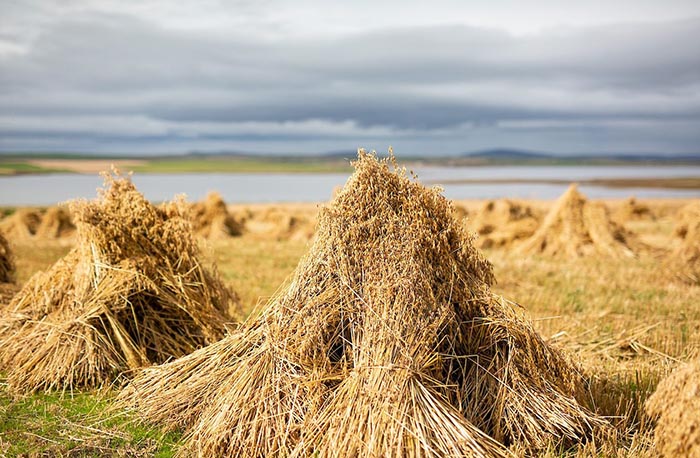
Photograph: Orkney Handcrafted Furniture [/]
Video: The Vision of Edwin Muir. Duration 26:33
Andrew Watson is a writer and translator presently living in the UK.
Image Sources (click to open)
Banner: Orkney Islands, view of the Bay of Firth from Cuween Hill. Photograph: Harald Schmidt / iStock.
Other Sources (click to open)
[1] EDWIN MUIR, ‘The Transfiguration’ from Edwin Muir Collected Poems, (Faber and Faber, 1984), p. 199.
[2] ‘The Betrayal’, Collected Poems, p. 21.
[3] ‘Childhood’, Collected Poems, p. 21.
[4] EDWIN MUIR, An Autobiography (Hogarth Press, 1954) p. 14.
[5] ‘Horses’, Collected Poems, p. 19–20.
[6] ‘The Horses’, Collected Poems, p. 246–247.
[7] ‘The Incarnate One’, Collected Poems, p. 228.
[8] EDWIN MUIR [as Edward Moore]. We Moderns: Enigmas and Guesses (George Allen & Unwin, 1918).
[9] ‘The Escape’, Collected Poems, p. 126.
[10] ‘The Labyrinth’, Collected Poems, p. 163.
[11] ‘The Confirmation’, Collected Poems, p. 118.
[12] ‘The Transfiguration’, Collected Poems, p. 198.
[13] ‘One Foot in Eden’, Collected Poems, p. 227.
The text of this article has a Creative Commons Licence BY-NC-ND 4.0 [/]. We are not able to give permission for reproduction of the illustrations; details of their sources are given in the captions.
FOLLOW AND LIKE US
@Beshara_Mag








——————————————
——————————————
——————————————
Video. Duration 1:33
FOLLOW AND LIKE US
@Beshara_Mag
If you enjoyed reading this article
Please leave a comment below.
Please also consider making a donation to support the work of Beshara Magazine. The magazine relies entirely on voluntary support. Donations received through this website go towards editorial expenses, eg. image rights, travel expenses, and website maintenance and development costs.
READ MORE IN BESHARA MAGAZINE
Personal Integrity in the Poetry of C.P. Cavafy
Andrew Watson pays homage to Greece’s most famous modern poet, whose message of quiet fidelity to one’s own values still has great resonance today
Book Review: Conversations with Dostoevsky
Andrew Watson engages with an innovative new book by George Pattison which explores Dostoevsky’s relevance in the contemporary world
George William Russell: A Forgotten Irish Mystic
Gabriel Rosenstock gives a poetic response to twelve visionary paintings by the ‘myriad-minded’ writer and polymath
Robert Lax: A Life Slowly Lived
The contemplative practice of a remarkable 20th-century poet/mystic — by Robert Hirschfield
READERS’ COMMENTS
A lovely and healing article. Thank you. I particularly like his reference to the wheat and tares compounded – I am only now starting to understand what Jesus was getting at. Pulling up the tares, or trying to, is not the answer. We have to live in light and shade and be grateful for their gifts.
How beautiful! Thank you, Andrew, for researching and writing this article. I had known nothing about Edwin Muir until just now when finishing to read this, and listen to his own voice, and that of his beloved wife. Profound and stirring stuff! Orkney to me is a place of earthly paradise too, and for this reason also to read Muir’s poetry was a special joy.
Thank you for this thoughtful piece. Muir’s journey from trauma to meaning is deeply moving and clearly presented.