
News & Views
The Kogi: More on Munekan Masha and Other Projects
Luci Attala talks to Jane Clark and Richard Gault about the recent visit of the Kogi Ambassador, José Manuel, to the UK, and the latest developments in her work with these remarkable Indigenous people
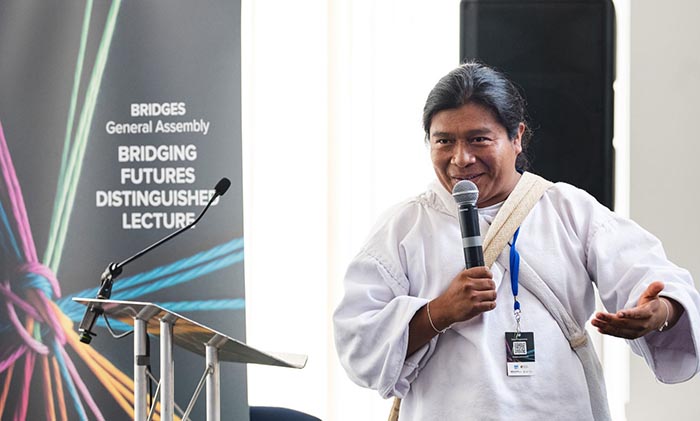
José Manuel, the Kogi’s designated ambassador, addressing a large international audience at a UNESCO General Assembly Meeting in Swansea for the launch of Munekan Masha. Photograph: Luci Attala
For three decades now, Beshara Magazine has been following the work of the Kogi Indians in Northeast Colombia. These extraordinary Indigenous people are descendants of the great Tairona civilisation who flourished for more than 1400 years in pre-Columbian America, but chose not to fight when the Spanish Conquistadors colonised their lands in the 17th century. Instead, they retreated to the mountains, where they lived for 400 years in almost complete isolation, caring for the land according to their ancient wisdom. But in 1990, they came out of isolation to speak about the ecological devastation that they were witnessing in their territory, sending a message to what they call ‘their younger brother’ about the way we are treating the earth.
What ensued was a film made for the BBC by the documentary film maker Alan Ereira entitled The Heart of the World,[1] which had a global impact. This was followed by the establishment of the Tairona Heritage Trust to support the Kogi’s work, and in particular to enable them to buy back lost territory. In the last thirty years there have been further films,[2] a book [3] and increasing recognition of the Kogi and their importance in preserving the Indigenous knowledge which was once prevalent throughout South America. The Kogi on their part have continued to develop new means of communication with the outside world, and in the face of continuing ecological damage, have felt it necessary to reveal more and more about the deep knowledge and rituals through which they execute their sacred task of looking after the world.
We spoke to Alan in 2023 about these developments and, in particular, about their Munekan Masha regeneration project, a UNESCO-MOST BRIDGES endorsed initiative that has the aim of forging a relationship between Indigenous knowledge and Western science. The Kogi have an extraordinary track record in restoration, and in particular on bringing back the flow of water to areas where rivers and lakes have dried up. In a recent project in the Guachaca River valley, for instance, they achieved in 20 years what many ecologists would have expected to take ten times as long. But to date, there has been no scientific validation of the methods they use. Munekan Masha is designed to remedy this by recruiting a group of Western scientists to observe the Kogi in action and monitor the regeneration of an area in the Kogi’s territory in the Sierra Nevada de Santa Marta which has been severely damaged by over-exploitation.
We have decided, as a magazine, to adopt this project and undertake yearly updates on its progress. Last year we spoke to Luci Attala, the present Chair of the Tairona Heritage Trust, about the progress that had been made, and found that due to funding difficulties, the project was still in its very early stages. But just a few weeks ago, we touched base with her again and were delighted to hear that substantial progress has been made. A piece of land has been purchased, and a family has been settled there to look after it, which was always intended to be the first stage. The scope of the project has been set out, a team has been recruited and preparations are underway for the first field trip in 2026.
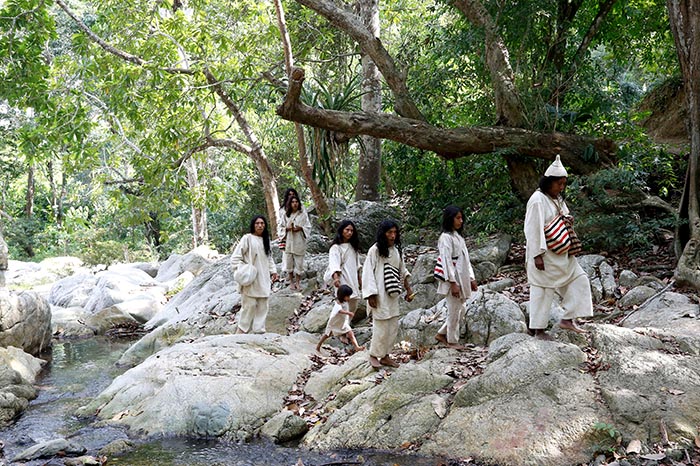
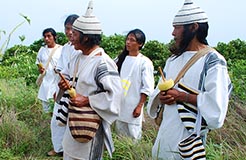
Kogis in Columbia, Sierra Nevada de Santa Marta. Photograph: SAMPERS Erik / Hemis.fr /Alamy Stock Photo
Western and Indigenous Science Meet
.
 We begin by asking Luci about the people she has gathered together for the project. She tells us that about twenty people are now involved. “As far as scientists go, we have a botanist who has expertise in the Caribbean, and an ethnobotanist whose area of study is how people use and engage with plants. He is the Director of the Department of Systematic and Evolutionary Botany in Zurich, although he is Spanish, and he is married to a Colombian woman who’s an ecologist. She’s on the project, too. We also have a biodiversity expert whose speciality is regeneration, specifically biodiversity regeneration. In addition, we have an artistic filmmaker from Germany, a selection of anthropologists, a project manager and 12 Kogi. One of these is a cartographer – he calls himself ‘a coordinator of the earth’ – and there are a couple of mamas, who, as you know, are the spiritual leaders of the community.”
So have they actually started work? “Not formally. The scientists are going to Santa Marta to do a baseline study in late February/early March next year. This is the earliest this can happen because between December and mid-February the Kogi aren’t available. They go up into the Sierra and nobody does any work. The plan is that the group will then visit every four months over a period of three years, and then I want another year for sitting together and writing it up – doing analysis, consolidation, creating the outputs, etc. Recently, I’ve established a relationship with the botanical gardens in Cartagena, which is about five hours drive away, who have said they will be very happy to take some of the samples and specimens. This will be helpful, as they know the area very well and understand the flora and fauna in a way that the scientists from Switzerland may not.”
So, will three years be long enough to really assess such a project? Surely ecological regeneration happens over much longer periods of time? Luci’s response is that ten years is probably what it will take realistically, and hopefully, the first three years will just be a pilot. “One of the great difficulties with this project has been the funding. When it was first proposed, it was fully funded, but then the money was withdrawn. I’ve since resubmitted applications a few more times with no success. So I’ve had to do some head-scratching and rethinking.
“Previously, I’d imagined that we needed all of the money on the table before we could even begin, but as that just isn’t happening, I’m learning from the Kogi and taking on board their philosophy that the Mother will guide us and that we have to work with what we’ve got. This summer we had an extended visit from the Kogi’s ambassador, José Manuel, which I will talk about in a minute. After meeting him at various events, people contacted me and said: How can I help? So, I decided that it would probably be better to raise enough money for one field trip at a time – just to get everybody out there to begin the work. But at the same time, I am also in the process of negotiating with the university about submitting a revised application that focuses a little bit more on the educational part of the research.”
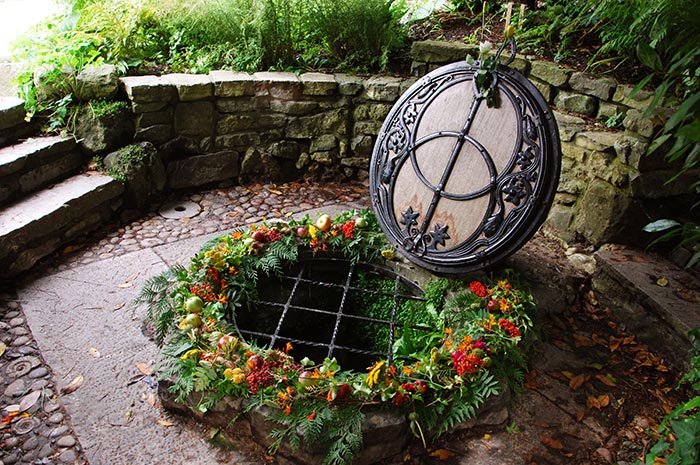
The Red Spring, also known as the Chalice Well, at Glastonbury in Somerset, which archaeological evidence suggests has been in almost constant use for at least two thousand years. It has never failed, even during drought. Since 1959, it has been managed by the Chalice Well Trust. Photograph: eddie linssen /Alamy Stock Photo
Communication and Caring
.
A central feature of the project is establishing communication between people who have very different worldviews. How are the scientists going to understand what the Kogi are trying to say, and from the other side, how are the Kogi going to comprehend the sort of questions that the scientists are asking? Luci explains that the method they have come up with is a form of immersed dialogue, which is going to be recorded. “The scientists will be following the Kogi in their diagnostic and remedial work, and tracking and monitoring the changes in the environment. They will then spend a concentrated amount of time in dialogue, and the job of the anthropologists will be to follow what is happening when these two groups come together and bring them into unity. I expect that we will have to come back to discussions again and again and again, until by year four, we should have a clearer understanding of how environmental science and indigenous science can work together and benefit from each other. Then our job will be to try and create outputs and disseminate the findings in a way that the world can hear.”
So it’s not just unidirectional – us finding out about Kogi teachings and then trying to be more like them? “No, it’s about unity and dialogue – almost reconciliation – so that we come to understand each other better. Hopefully by the end, we will both have learnt and changed our ways. The Kogi are quite clear that they have things to learn from the scientists. They want to teach the scientists their ways because they want them to be included in environmental science – to be taught as science. But they also acknowledge that it’s not for them to take over and to say that their way is the only and the right one, but rather to find a way to unite so that environmental science is sort of woven through with indigenous thinking.”
One of the very obvious differences in the way that the Kogi work is that they use a lot of rituals, invocations and ceremonies. It is hard to imagine scientists doing these, and even if they did, would it work if they were just repeating the words without understanding their meaning or the intention behind them? Luci agrees that this is a crucial point, and in addressing it, she draws upon her own personal experience. “I’m not myself a spiritual sort of person. I’ve had that well and truly knocked out of me by academia. So when I first witnessed the way the Kogi work – when I was at the springs in Glastonbury this summer with José Manuel, for instance, and saw the way he interacted with the water – my first response was to be a bit cynical. But by the end of my time with José Manuel, I felt as if a crusty layer of me had peeled off and I had some real realisations about the things that were getting in the way of me taking on board a different approach. I suspect that other crusty academics like me will have a similar response because, if you are going to participate in a project like this, you have to be open to change.
“But having said that, nobody’s expecting that by the end of this, the scientists will be going around replicating Kogi rituals. I think what is important is the underlying philosophy of the Kogi, which is all about caring. How to act out our care for the world. We talked about this before, and more and more I feel that this is what is lost from a lot of academia – a real sense of values and ethics. We need to put caring back into conservation and restoration. So it’s not just about new techniques or methods, but if there are techniques to learn, that they are approached as forms of caring. If we can get this idea over, we’ll have done an enormous job, I think. I feel that many of us have lost the ability to care for things as Indigenous people do. How do we care for the land? How do we care for the water? Is it just a matter of not polluting it, or is there something else? Can we go deeper?”
We wonder how the project is being received within academia. Are other academics open to it? “Actually, I believe that quite a lot of scientists, certainly the ones I’m meeting these days, are coming to recognise that much of the way the environment has been approached has been damaging – rooted in extractive thinking – as much as it has been beneficial. There have been enormous advancements, but they always come with other problems. It’s like side effects from taking medication; okay, it’s going to sort your heart out, but you’re never going to be able to go to the toilet again!”
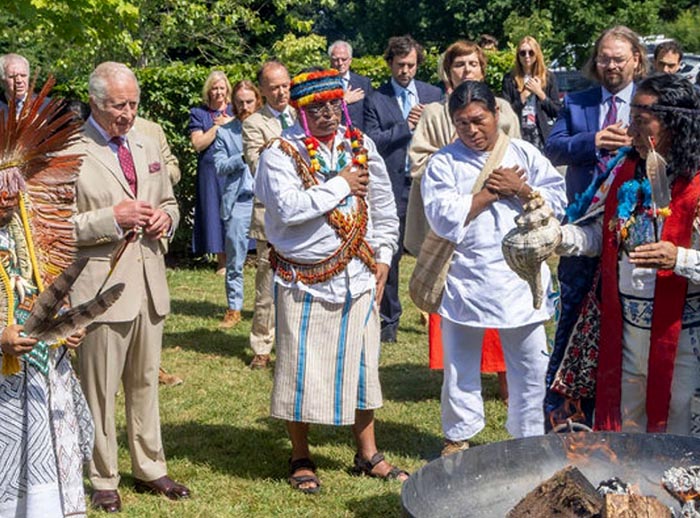
José Manuel at Highgrove House in Gloucestershire at the first ‘Harmony Summit’ alongside King Charles III and other Indigenous leaders. Photograph: Luci Attala
José Manuel: Visiting Sacred Sites in the UK
.
Munekan Masha is not the only activity that is happening under the umbrella of the Tairona Heritage Trust. For instance, in the summer of 2025, the Kogi’s designated ambassador, José Manuel, made an extended visit to the UK. The formal purpose of his trip was to attend a UNESCO General Assembly Meeting in Swansea, where he addressed a large international audience about Munekan Masha. But he came over a little earlier than intended because of an invitation from King Charles to a meeting of Indigenous leaders at Highgrove House in Gloucestershire (for more on this, click here [/]) José Manuel was a last-minute replacement because the original invitee, the Kogi Minister of Health (whose portfolio, Luci explains, is to look after the land, as it is upon that that the health of the people depends) was denied a visa to enter the UK. As well as meeting Indigenous leaders from all over the world, José Manuel had a few minutes of private audience with the King and presented him with a copy of Shikwakala, the extraordinary book which the Kogi have produced outlining the hidden energetic structure of their land.
José Manuel’s own priority, however, was to visit some of the sacred places of water in the UK, so Luci arranged for him to visit the springs in Glastonbury, where they had a private viewing with the Guardian of the Spring. Luci was clearly deeply moved by the way José Manuel interacted with the water. “There are three springs at Glastonbury – black, white and red. At each of them, José Manuel did some rituals and communed with the water. He was very excited that the water was very well looked after, and had been for so long in that area. It seemed to be incredibly meaningful to him.”
They also visited the stone circle at Stanton Drew, a set of 27 standing stones dating back to about 2,500 BCE, which José Manuel recognised as being ‘true Indigenous stones’ with an energy rare in the UK. And Blick Mead, an important site of ancient settlement (now on private land) about a mile from Stonehenge, where many archaeological discoveries have been made; it is thought that human habitation there goes back to 8,000 BCE. Luci describes how José Manual spent a long time contemplating the water there. “I asked him what he had learnt, and he said, ‘This is a place where conflicts have been resolved. That’s why there’s so much archaeological evidence, because people know that the mother of this water helps with reconciling conflict, and they have come here through time to do that.’ Then he said, ‘I think probably that’s what Stonehenge is for as well’. So, I contacted the woman who had shown us around, and she got in touch with some of the archaeologists who are trying to understand the significance of Blick Mead. They got back to us and said, ‘That’s remarkable. We were just starting to think in those terms about it’.”
The series of visits culminated in Wales, where, in collaboration with the Tribes Movement, José Manuel performed a ritual uniting the waters of Wales and those of Colombia. The importance of the sea has been very much highlighted by David Attenborough’s recent TV series Ocean [/], in which, alongside a rather depressing vision of the way we are treating our oceans, there are many messages of hope. One of these concerns the few marine reserves that have been established; these have been enormously successful, surprising people by the speed at which the sea heals itself. And more than this: it seems that there is a spillover effect so that the areas around the marine reserves are also healing very quickly. So we ask Luci whether the Kogi, whose land extends to lengths of coastline, are also working on marine regeneration.
“Yes, absolutely. There are some nice examples of the work that they’ve done in the mangrove swamps around the coast and in other locations, healing the waters in the fullest sense of the word. I think I spoke with you in our conversation last year about the connections that they see between areas of land, so that if one gets its identity back, it’s more likely that the next area will be more receptive to getting its identity back as well. What you were saying about the Attenborough film is very much in line with their understanding of how healing works – that things are connected and support each other in the regeneration process.”

Gonawindua Theatre Project
.
Another project in which José Manual has played a central role is the development of a theatre/dance performance which conveys the Kogi’s understanding of the world in a non-verbal way. This has involved working with a group of young Kogi and a collaboration with Teatro Cenit, a Colombian theatre company. The piece has already been performed in South America – in Bogota – and a film of the event was shown to a packed audience at St Ethelburga’s Centre for Reconciliation and Peace during José Manuel’s visit. Plans are now underway for a European/UK tour in 2027, but whether it happens depends, again, on whether the Trust manages to raise sufficient funds. Click here [/] to see a trailer of the proposed performance.
One of the outcomes of José Manuel’s work on the film has been an increasing awareness of the need to educate the younger generation of Kogi in their own tradition. As the Kogi become more integrated into Colombian society, children are required to attend state schools and to learn Spanish, and this is introducing new elements into their education. As Luci explains, “José Manuel worked very closely with the mamas on Gonawindua, and as a result of that, he realised that the youth performers in the play don’t understand their culture in the way that one would hope, as a result of going to conventional schools. So there’s a growing gap between the mamas and the youth, and he wants to bring them back together so that the young people can understand this part of their heritage better. Because of this, I’ve also now sewn an educational component into the Munekan Masha project alongside the scientific aspect.” One result of this new emphasis upon the participation of the next generation is a charming short film in English, Home Among the Clouds, made by a young Kogi, which we present below.
We thank Luci for talking to us about the progress that is being made in bringing out the wisdom of the Kogi for the benefit of the world. We look forward to hearing more in our next update in 2026, when Munekan Masha will have moved onto the next stage of regeneration.
More information about the Munekan Masha project and José Manuel’s visit to the UK can be found on the Tairona Trust website [/]. If you would like to donate to the project, click on the button below
Sources (click to open)
[1] Heart of the World: The Elder Brother’s Warning. BBC, 1990. Available on You Tube: https://www.youtube.com/watch?v=YJNpMxhO4Ic&t=18s
[2] Aluna: An Ecological Warning. Click here to see the movie and background information: https://www.alunathemovie.com/
[3] ALAN EREIRA, The Heart of the World (Jonathan Cape, 1990).
The text of this article has a Creative Commons Licence BY-NC-ND 4.0 [/]. We are not able to give permission for reproduction of the illustrations; details of their sources are given in the captions.
read more in beshara magazine
More News & Views
Book Review: ‘spinning pinwheels’
Gabriel Rosenstock rediscovers kokoro (heart) in a new book by the distinguished Indian poet K. Ramesh
Book Review: ‘Is A River Alive?’ by Robert Macfarlane
Peter Huitson reviews a book which explores the living presence of diverse rivers around the world and their power to heal and transform
Introducing… ‘Many Beautiful Things’
Steve Scott presents a film on the extraordinary life and work of the Victorian artist and missionary, who set up a dialogue with the Sufi brotherhoods of Algeria
The Voice in the Circuitry
Peter Huitson collaborates with T.B. Schenck to explore the possibility of divine influence in AI
Book Review: ‘Winter Light’ by Douglas Penick
Peter Huitson reviews a book which celebrates creativity and deepening perspectives in old age
Don’t Take It Easy
Richard Gault is inspired by Michael Easter’s book The Comfort Crisis and explores the idea of ‘misogi’ during a 600-mile walk across Scotland
FOLLOW AND LIKE US
@Beshara_Mag








——————————————
——————————————
——————————————
If you enjoyed reading this article
Please leave a comment below.
Please also consider making a donation to support the work of Beshara Magazine. The magazine relies entirely on voluntary support. Donations received through this website go towards editorial expenses, eg. image rights, travel expenses, and website maintenance and development costs.
FOLLOW AND LIKE US
@Beshara_Mag
READERS’ COMMENTS
0 Comments