
Well-Being & Ecology _|_ Issue 29, 2025
Social Ecology: An Alternative Perspective on Human Nature and the Environmental Crisis
Professor Jim Morley argues that we need to rediscover ourselves as naturally affiliative, cooperative and empathetic

Social Ecology: An Alternative Perspective on Human Nature and the Environmental Crisis
Professor Jim Morley argues that we need to rediscover ourselves as naturally affiliative, cooperative and empathetic
Jim Morley is a psychotherapist and a professor of clinical psychology at Ramapo College of New Jersey, USA. His main area of research is phenomenology and its application to psychological research, particularly in areas such as meditation and religious experience. In this article he argues that the root cause of our ecological problems is a misunderstanding about human nature. We have a negative image of ourselves as aggressive and competitive, and consequently establish social structures based on domination, which we then project onto nature. Whereas the evidence from both anthropology and the biological sciences is that we are the most affiliative and cooperative of species. He talked to us – Jane Clark and Peter Huitson – from his office in New Jersey about our need to rediscover a more positive self-image and the importance of creativity in reconnecting us with the natural world.

Jane: Can we start by asking you to say something about social ecology: what it means and what its origins are.
Jim: The term ‘social ecology’ was coined by an American philosopher named Murray Bookchin. Its importance is that it is the only social theory that is seriously addressing the environmental crisis. The rest of them still don’t seem to fully get it. So I think it is terribly important and extremely timely to be talking about it.
The idea is that we have to begin with how we structure our society if we are ever going to be at peace with nature. We see a mirror of what we are in our own souls in our social relations with one another, and we then project that onto the world. If we have a pathological relationship with ourselves and with one another, we will project that onto nature, and this is what we are seeing in the destruction of nature and the ecological collapse that we’ve created.
Jane: Can we start by asking you to say something about social ecology: what it means and what its origins are.
Jim: The term ‘social ecology’ was coined by an American philosopher named Murray Bookchin. Its importance is that it is the only social theory that is seriously addressing the environmental crisis. The rest of them still don’t seem to fully get it. So I think it is terribly important and extremely timely to be talking about it.
The idea is that we have to begin with how we structure our society if we are ever going to be at peace with nature. We see a mirror of what we are in our own souls in our social relations with one another, and we then project that onto the world. If we have a pathological relationship with ourselves and with one another, we will project that onto nature, and this is what we are seeing in the destruction of nature and the ecological collapse that we’ve created.
Bookchin was a star of the New Left in the 1960s. The leftists at that time rejected capitalism, but they were not comfortable anymore with what the Soviet Union had done to the ideas of Marx, and they were looking for an alternative that was not caught up with that kind of state authoritarianism. Bookchin was raised as a Marxist in the Lower East Side of New York, but then he discovered Kropotkin, Bakunin and Tolstoy and a load of other radical thinkers who were very much at odds with Marx. His particular contribution was that he applied these ideas to the environmental movement. He wrote the first book on the environmental crisis, Our Synthetic Environment,[1] which came out just a month before Rachel Carson’s Silent Spring in 1962.[2] It was more statistical and less literary than Carson, and it didn’t get the same attention, although it was just as substantial and made a very similar case.
Jane: Basically, you’re saying that the root of all the problems that we’re facing is that we have the wrong idea about who we are – what human nature is?
Jim: Yes. A lot of environmentalism these days is about changing consumer behaviour, coming up with new non-toxic detergents and dressing certain ways, and so on. These are all good things to do, but they’re not going anywhere if we don’t get to the basic fundamental category error that runs the whole show. And that category error is that we see ourselves as negative and in need of being controlled. We therefore feel that we need to dominate and police ourselves, and we project that domination onto nature. That’s the essential issue. Anything other than that is missing the real point. The basic position of social ecology is that we need to find liberatory ways of coexisting with one another, and in turn have a liberatory coexistence with nature.
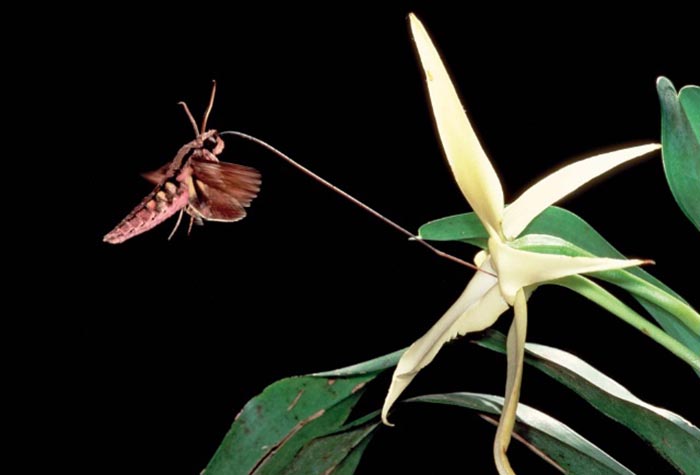
Darwin’s Orchid and the Hawk Moth are a classic example of co-evolution and cooperation.. The epiphytic orchid, native to Madagascar, has a very long nectar spur, inaccessible to most insects. Darwin examined it in the 1860s and predicted the existence of an insect with a proboscis long enough to reach the nectar. The Hawk Moth was discovered 40 years later. Source: Minden Pictures / SuperStock
A Different Understanding of Evolution
.
Jane: An important element in the notion that we need to dominate nature, at least as we understand it today, has come from the theory of evolution, and Darwin’s idea of ‘survival of the fittest’. This has been widely understood to mean the strongest, the most able to dominate. But I have heard you say that this is a misunderstanding, and it is not at all what Darwin meant.
Jim: When Darwin said ‘fittest’, he meant ‘fitting in’. He didn’t mean Arnold Schwarzenegger working out in the gym – the alpha male who’s super fit and strong and powerful and scary. ‘Adaptation’ is the watchword in evolution. Darwin discovered that the species that adapts best is the one whose members live long enough to reach sexual maturation and reproduce the most. It’s all about affiliation with one’s environment, and using resources, including one another, to make that happen. And if you look at the process of evolution, it is clear that the most complex species – and here we’re talking about humans – are basically affiliative. The evidence is overwhelming.
I want to be very careful here, because there clearly is predation in nature, but it’s not what we think it is – by which I mean, how we think of it in moral terms. There is violence and hostility and aggression in nature, I wouldn’t deny that, but for the most part, it happens when organisms are under threat.
I’m a phenomenologist, and I think there are limits to what naturalism [/] can teach us. Naturalism doesn’t help us with the meaning and purpose of relations, but it’s important information nonetheless. Yet even from a strictly natural science perspective, we don’t seem to have the eyes to see what biological research is saying to us. We don’t know how to interpret the results because we’re still trapped in the framework of the social context that trapped the social Darwinists.
Jane: And this was?
Jim: Well, in the mid-19th century, when evolution was discovered, traditional organised religion was falling apart. Among the intelligentsia in Europe, religion had lost its authority, and naturalism was taking over intellectually. Darwin himself was in bed for ten years with depression after he came back from his voyages on the Beagle because he was afraid that his ideas were going to destroy morality and there would be mass chaos because no one would believe in God anymore. He thought that if people no longer believed in God, there would just be chaos – that civilisation would collapse. He only finally published The Origin of Species because Wallace had scooped him.
The upper classes were terrified that without God, without the divine right of kings and so on, how were they going to stay in charge? So what did they do? They took the convenient idea of survival of the fittest and converted it to survival of the strongest and the smartest. So instead of the divine right of kings – the idea that the king and/or the authorities of the power on top were put there by God – the people in charge were put there by nature. This created an excuse for economic domination and everything else that comes with that. It was their way of still maintaining the dominating hierarchical structure of European society while also giving up God.
What it did was set loose a lawless belief in the right of the upper classes, which, of course, went along with colonialism and all that. A lot has happened between then and now, but in a way, this view is still alive and well. I am sure that all these billionaires who are currently running things believe in their natural right to power – that they are there as a natural force of evolution.
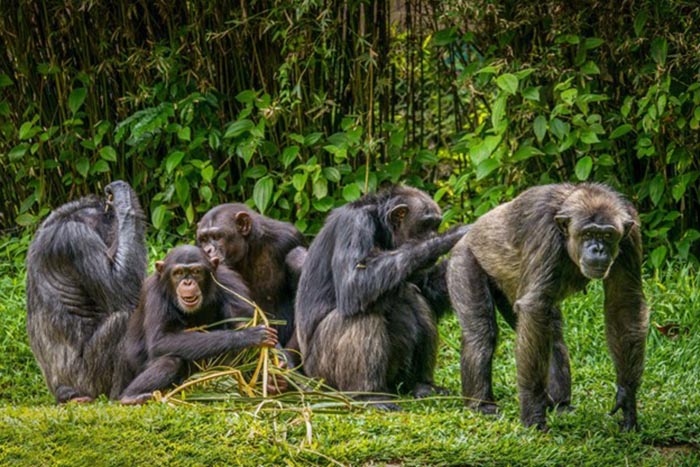
Grooming in chimpanzee communities is a form of social bonding. Photograph: Cheryl Ramalho [/] /Alamy Stock Photo
The Message of Biology
.
Peter: Can you give us an example of how we fail to see the message that biological research is telling us?
Jim: Well, perhaps the most famous example is the work of Peter Kropotkin.[3] He began his life as a geographer, and in the late 19th century spent a lot of time in Siberia and Northeast Asia, where he had the chance to study the behaviour of animals in extreme conditions where it was very hard to survive. He agreed with the theory of evolution, but he felt that Darwin had missed an important point in seeing the engine of evolution solely as competition. His observation was that cooperation and sociability were equally important, and he termed the phrase ‘mutual aid’ to express the principle. This idea of ‘mutualism’ – that there is not only cooperation between members of the same species but between species – is now widely acknowledged as symbiosis in every evolutionary textbook in biology. But still, people put aggression first, despite the fact that the evidence is against it.
A good specific example is the case of alpha male apes in the ape colonies in wild Africa. The early anthropologists went there and saw these alpha male apes dominating the group by beating up all the younger apes so they could have sexual access to the females, spreading their genes by fighting off all the other males, and only letting the females have their sperm. They saw in it a reflection of our own social structures – the strong leader with a harem of women, etc.
Well, some decades later, some women anthropologists went in and they saw things a little differently. They just had a different framework. What they observed was that the beta males – the so-called beta males, note the imposition of the hierarchy in the very name – meaning the ones that weren’t bossing everyone around, that weren’t the aggressive types, were the ones that were always socialising with the females. They were grooming them all the time – you know that grooming is a big part of ape culture, it’s a form of social bonding – removing the lice and the ticks and things from their hair.
So when the females first went into oestrus, who had first access to mating? It was the beta males. The alpha males were away defending the perimeter, fighting with the other alpha males, and most of them died very young from infections because they fought so much. When they returned, they pushed away the beta males and mated, but most of the females were already inseminated by that time.[4]
These findings were followed up with genetic studies, and what do we find? That it is indeed the beta males – the ones that are the most social and most intimate, the ones that you might call ‘the nice guys’ – whose genes get passed on more often than we previously thought. So the nice guys often finish first.
Jane: I edited a paper many years ago, which was a feminist critique of anthropology, showing how the early anthropologists also completely overlooked the role of women. When they talked about hunter-gatherers, they put great emphasis on the hunting, which was done by men, and they neglected to give credit to the gathering, which was what the women were doing. But when these female anthropologists looked more closely, they found that gathering was at least as significant a source of food as hunting, and that it entailed a lot of skill and knowledge – which plants were edible, how to cook them, when they could be gathered, etc.[5]
Jim: Yes, if you get into the right framework – if you get phenomenological about it and suspend all your presuppositions, what you see is that the females were doing the much more relevant work.
And by the way, nothing’s more important than raising babies, who are the next generation. It is interesting how everybody in developed countries now has a terrible time raising families because the whole system is against the family. What matters is economics. But in our ancestral, tribal world, the most important thing was children. That was what was of value. Sometimes I reflect on this and think: Wow! What happened? The economy is all run around money, and people don’t have kids because they’re putting it off until they’re economically secure enough. It’s a fascinating shift in values.
Someone whose work I very much admire, and who I believe would very much support everything I am saying, is the psychologist Darcia Narvaez [/]. She has done a lot of research into indigenous societies and what they can teach us. Her conclusion is that our default evolutionary mode is not the family – at least not the nuclear family – but the extended kinship network. The tribe, so to speak. She calls it ‘the evolved nest’. Modernity has gone amock because we’ve left our natural evolutionary default mode, which is the cooperative, integrative, intimate relations of the tribe, for this other thing that we call modernity – this abstract world where we’re all detached and trained from day one to go against our nature. We are taught to be aggressive and competitive and self-centred, which is not our real nature. And lo and behold, the rise of psychiatry and psychotherapy.
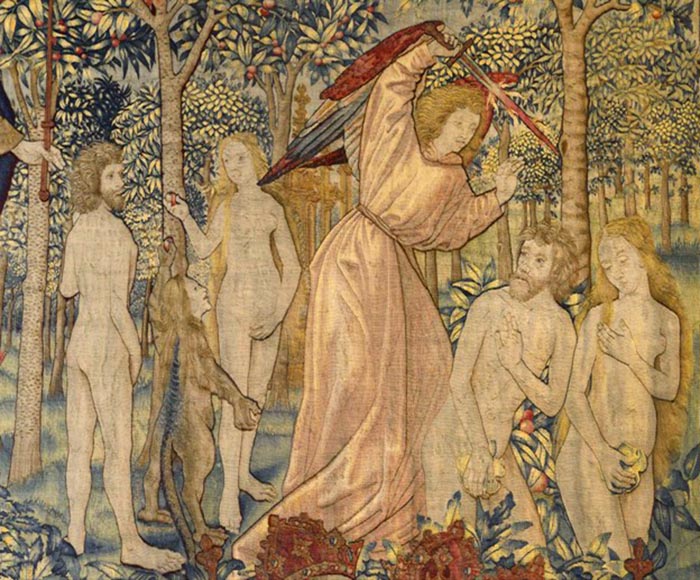
Adam and Eve expelled from the Garden of Eden. Tapestry from the prestigious collection of the National Museum Palace of the Grand Dukes of Lithuania. Photograph: Boisvieux Christophe [/] hemis.fr / Alamy [/] Stock Photo
The Paradox of Consciousness
.
Jane: Before we explore this aspect of things further, can we go back to the issue of our self-image? You say that the ecological crisis comes down to the fundamental fact that our self-image is that we’re separate from each other and from nature.
Jim: Yes. So along with the presupposition of the normalcy of domination and the inevitability and necessity of domination, is also the presupposition that we are individual egos, individual selves. That’s a good thing in a way, and we don’t want to lose it, because it was kind of an achievement. But that’s not all that we are, or even what we actually are. We are relational beings. I think we developed our sense of self or ego as a kind of prosthetic. It’s like a, a tool, a necessary delusion, so to speak. But it’s gotten out of hand now because we have forgotten what it’s founded in. The individual self is founded in relationships, and we’ve disconnected from that. And again, lo and behold, the rise of psychotherapy and psychopathology.
The spiritual traditions, and all the rituals and procedures and relationships and community that we used to have, were our way of coping with this incredibly difficult condition that we are as human beings, which is to be conscious and yet still part of the natural world.
Jane: You have talked about this in terms of the metaphor developed in the Old Testament in the story of Adam and Eve being thrown out of the Garden of Eden. On the one hand, they woke up with what you call ‘the godlike gift of consciousness’, but by the same token, they found themselves isolated and separate from the rest of creation. I would see this as an intrinsic paradox of consciousness – that it’s necessary for us to see ‘other’, to create ‘other’, in order for knowledge to take place. But as you say, it’s gone too far. We’ve forgotten, if you like, the other side of the situation – the unifying side. That consciousness is both a projection outwards and a unification inwards.
Jim: There’s so much to decode from the Garden of Eden myth. You know, it was a Babylonian myth way before it found its Hebraic form. I think it crops up in Gilgamesh, but what everyone forgets is that there were two trees. There was the tree of knowledge, which Adam and Eve eat from, and there’s the tree of life, which they don’t get to eat from because the angels come in with flaming swords to kick them out of the garden before they can. They cast them out and say: you are condemned to suffer in the fields, and women are condemned to have pain in childbirth. Again, all profound metaphors.
So they ate from the tree of knowledge and became conscious, but they didn’t eat from the tree of life and become gods. This means that we became conscious like gods, but we still remain animals – part of nature but disconnected from it because our consciousness means that we are no longer connected with the animals we were. That’s the message that Genesis is telling us – that consciousness is the cause of human suffering. It’s also simultaneously the wonderful gift that makes us godlike, that gives us the power of decision making, and time travel through imagination, and creativity, and also profound, existential and authentic love, which is not something found in the natural world.
All these wonderful aesthetic possibilities are there for us, but there is also a dark side. It’s like the Buddha’s first two noble truths. The first noble truth is that we desire endlessly, and we also have consciousness that makes us desire endlessly because we can see all the possibilities. But consciousness also is the power to hoodwink ourselves, to fool and deceive ourselves. So these two noble truths provide a beautiful diagnosis for the problem of consciousness. The more conscious we become, the more we want, because we see all these possibilities and through our imagination, our desire gets intensified. At the same time, consciousness is the power to deceive ourselves, always. And my personal observation is that the smarter you are, the more self-deceptive you can be and the more of a dark shadow you can cast.
Jane: Part of this dark shadow is the fact that people are afraid of nature. They are dominated by fear, and that leads them to want to control it and subdue it.
Jim: One thing about consciousness is that we’re scared of the freedom that comes with it. The freedom it gives is terrifying, and we’re aware of its destructive possibilities. As for our fear of nature; the United States has a particular history with this. The conquest of the frontier and the pillage of the Native Americans was mixed up with it; the settlers saw nature as evil and thought that it needed to be conquered and dominated. That’s the real story of the settling of the West.
But this is all over European culture as well. The need to kill all the wolves, to kill all the bears so that we know we’re safe. We see nature as scary – the big bad wolf, the dark forest and all the fairy tales of goblins and faeries; these are all ways in which we have projected the fear of our own negativity and made that nature. Nature is the boogeyman; the boogeyman is nature.
Modernity has just brought all this to a head. Now we have the technology to actually destroy the nest, and we’ve soiled it. We have been aware of this since the 1960s, but we haven’t done anything about it. Nothing has happened. We’re still using plastic for everything. There’s no political will to change this, because we’re all settled in with the presupposition of the inevitability of domination.
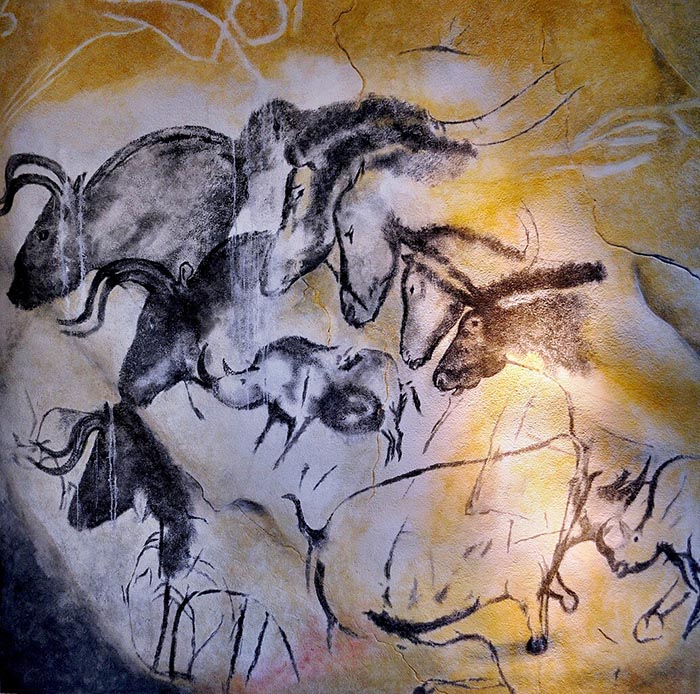
The Chauvet Caves in Southern France , discovered in 1994, contain some of the oldest examples of human paintings dating back 36,000 years. Photograph: Thomas T [/] via Wikimedia Commons
The Importance of Self-expression
.
Jane: Looking at how we might get out of this dire situation; you have mentioned that in the past, although what you say has always been the case, there have also been social structures and rituals – performances and activities – that have brought us back to our origins and reinforced the affiliative and cooperative side of things. You talk particularly about the importance of self-expression for human beings, and how this is now being squeezed out of the lives of many people in the modern world. Do you relate this to the fact that we are now entering into a human crisis as well as an ecological crisis, with mental health issues reaching the scale of an epidemic?
Jim: Yes. It seems that we’re doing to the creative arts what we’re doing to nature. We’re snuffing them out in our schools and universities in favour of what are called STEM subjects (Science, Technology, Engineering and Math). I’m not against STEM as such; I believe in the importance of science and technology and recognise that it will be part of the solution. But the point about artistic creativity is that it connects. It reconnects us with creation, makes us participate in creation. So does sex. Sexuality is participating in the cosmic act of creation. It’s fascinating how all the top-down religions denigrate sexuality, and even in the 21st century, we’re still dealing with the effects of that.
Basically, human creative expression is the way out of our dilemma. In a way, it’s how we have always coped with our condition. Psychotherapy cannot replace the need for creative activity. It’s fascinating to find that good psychotherapists have the same personality profile as artists. I think that this is because, basically, psychological healing is always an act of faith and trust; it is a creative act where you recreate yourself in some way. To go into this would require a whole other interview, but in our present context, I would just say that creativity and healing are essential. As that is snuffed out of our existence in the attempt to make us into homo economicus, we are really suffering. And the more we suffer, the darker we get, and the more dangerous we become towards nature. So this is a chain that needs to be broken.
Peter: You give a very wide range to creativity; you don’t see it just as fine art, but to include any kind of craftsmanship. I can very much relate to this; I spent 30 years in the computer industry and by the end was burnt out. When I stopped, I started making handmade furniture as a kind of healing. Is that the sort of thing that you are talking about – encouraging creativity, whichever form it takes?
Jim: Yes, very much. As a furniture worker, you know about the sensuousness of wood – the feel of it and the swirl of the grains, and so on. When you’re cutting wood, you’re participating in nature, and it’s a beautiful blend of human technology with nature. They’re not contradicting each other.
We tend to think of creativity as Picasso in an attic, but actually, everything we do can be creative; if you’re a computer scientist, and if you’re left alone to think about what you’re doing, you’ll see there’s lots of potential for creativity. Or you could be doing gardening or even science; Francisco Varela [/], the biologist and neuroscientist, used to say that he felt that doing experiments was a kind of craft. It’s the attitude you take that makes it creative. So by creativity, I don’t mean the arts per se. What I mean is an aesthetic approach to all things.
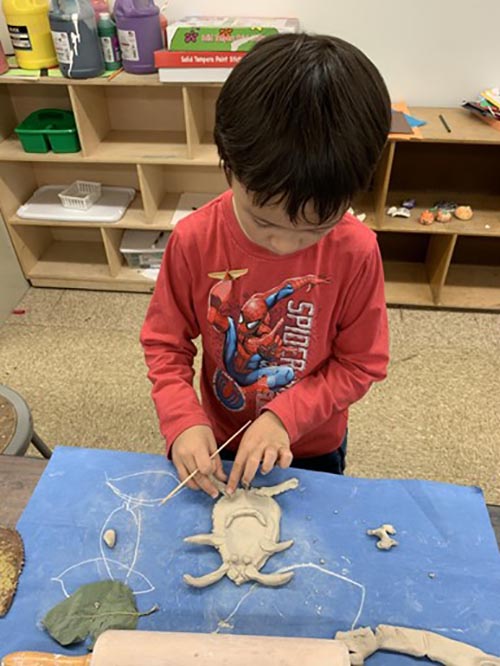
Child at the Touchstone Centre in New York, whose aim is to foster the creativity of children in terms of poetry and artistic expression . Photograph: https://www.facebook.com/TouchstoneCenter/
Experiential Education
.
Jane: So where do you think we go from here? We can see we’ve got the wrong idea about ourselves, and this is leading to the destruction of the world in which we live. Now we’re at crisis point, both in terms of our attitude towards nature and towards human beings. How do we change?
Jim: I think it’s got to be a matter of education. Our education systems are very competitive, and as we’ve already said, the evidence is that competition is not our real nature, or at least not its only component. Affiliation is our nature. And empathy. We haven’t talked about empathy yet, but we’re all empathic. We’re born inherently empathetic and this is part of our creativity.
There’s a very famous study done in the 1990s by two psychologists, George Land and Beth Jarman,[6] who were commissioned by NASA to research into people’s capacity for divergent thinking and creativity. They found that there are certain patterns in the way people think that indicate a high degree of such capacity and developed a test for them. They applied this test to kindergarten kids and found that 98% of them scored at genius level. This was a surprisingly high number, so they started testing the same group of children as they grew up. Three years later, there were less genius-level scores, and then, after eight years of school, only 12% of the kids still tested with these genius capacities. I’m summarising with the word ‘genius’. I don’t mean genius in the IQ sense, but rather in terms of being able to act creatively and see multiple angles, to be imaginative and open-minded.
This shows that there is something wrong with our education system. It stupefies us, and the emphasis upon competition instils fear. The terror of being poor. The terror of not being popular – that’s a big one, which is just crippling American kids. It’s reached a point now where we’re not just destroying nature, but it’s very obvious that our youth are also being destroyed. Twenty-five percent, thirty percent, up to half of them, are crippled with anxiety and depression. And if they have an epigenetic proclivity towards depression or anxiety because of their ancestry or family history, well, they’re in big trouble.
Peter: What kind of changes would you like to see?
Jim: I like the ideas of John Dewey, the American philosophical psychologist, who invented something called experiential education, which only the Scandinavians – especially the Finns – are taking seriously. Dewey says that we teach our children in a very authoritarian way. We teach them to be obedient and compliant. But he thinks that the classroom should be one big experiential workshop where the kids decide what they want to learn, and the teachers are there to be a coach and assist them.
So, for example, in Finland, when kids come to fourth grade, the teacher says: what would you like to do this year? The whole class says: we want to make a car. The teacher says: OK. They go to a junkyard. They find an old car. They bring it into the classroom, and they spend the whole year taking it apart and putting it back together again and making it run. And the kids learn everything they need about physics, about motors, about counting and mathematics, all in the process of an experiential project. Finland scores sky high in every single aspect of educational success.
Jane: Comes on top of the leagues all the time.
Jim: So we know what to do. Dewey gets it right. In Finland, there’s no homework. There’s no punishment. And the kids are only in class for five hours a day. The rest of the time is unsupervised. And that’s another important key here. We need to have childhoods. We need to return to what I like to call ‘free range childhood’. Childhood is so controlled now in the modern world that these kids don’t have a chance.
And the second, larger answer to your question is that we need a rethinking of economic priorities. Instead of profit, we need to think in terms of the health and development of the next generation. Every economy must be oriented towards the well-being of the next generation. I don’t think that’s pie in the sky. I think it’s just absolute biological necessity, and I find it amazing that I have to point out that concern for the next generation must be the primary objective of all economic systems.
Jane: Well, that works both in human terms and in terms of ecology. Because if you think about the well-being of future children, then you’re naturally going to think about the well-being of the world, aren’t you?
Jim: Absolutely. And when you nurture kids to become what they really are, then they are love machines. We need to rediscover that we are beings of love. We really are. Maybe love is too dramatic a word. We could say maybe that we’re affiliative. We are most ourselves when we are bonding and socialising and intimate not just with ourselves but also with nature.
And this is the tie-in with mysticism. Mysticism has always known this. The mystics see a world that is animated with holiness and recognise that we’re a part of that. The sacred is inherent to the world; it’s never separate from it. They’ve known this all along. But we’ve been force-fed this toxic understanding of ourselves that we can’t get out of. The most dangerous thing we can do is think ill of ourselves.
Jane: Jim, thank you so much for a fascinating conversation. You have given us much food for thought and brought a valuable new perspective on some of the most pressing issues we are facing in the contemporary world.
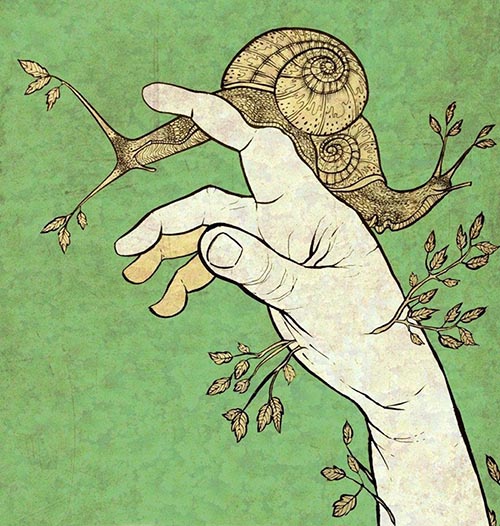
Book cover design of Murray Bookchin’s The Ecology of Freedom: The Emergence and Dissolution of Hierarchy (Cheshire Books, 1982)
Image Sources (click to open)
Banner: Crowds at The Green Man Festival in Brecon, Wales, an independent music, science and arts festival hosting up to 25,000 people every year. Mountain Stage, 2018. Photograph: Stewpots90 [/] via Wikimedia Commons
Inset: Jim Morley
Other Sources (click to open)
[1] MURRAY BOOKCHIN, Our Synthetic Environment (Alfred A. Knoff, 1962).
[2] RACHEL CARSON, Silent Spring (Houghton Mifflin, 1962).
[3] PETER KROPOTKIN, Mutual Aid: A Factor of Evolution (Heinemann, 1902) Project Gutenberg e-text, Project LibriVox audiobook.
[4] DUBUC, MUNIZ, Heistermann et al. ‘testing the priority-of-access model in a seasonally breeding primate species’. Behav Ecol Sociobiol 65, 1615–1627 (2011). https://doi.org/10.1007/s00265-011-1172-8/.
[5] https://link.springer.com/article/10.1007/s00265-011-1172-8#citeas. Another very recent study is described in Beyond the alpha male: Primate studies challenge male-dominance norms, click here [LINK https://phys.org/news/2025-07-alpha-male-primate-dominance-norms.html#google_vignette.
[6] LYNNE HANKINSON NELSON, ‘On What We Say and Why it Matters: A Feminist Perspective on Metaphysics and Science’ in New Metaphysical Foundations of Modern Science edited by Willis Harma.n and Jane Clark (Institute of Noetic Sciences, 1994)
[7] See 21 Days: https://twentyonetoys.com/blogs/teaching-21st-century-skills/creative-genius-divergent-thinking?srsltid=AfmBOop9Yk4E0nFit8t2qJGdfy82Om2N_oNqsMBwGXVcdW0Eo3Hjg5k-.
The text of this article has a Creative Commons Licence BY-NC-ND 4.0 [/]. We are not able to give permission for reproduction of the illustrations; details of their sources are given in the captions.
FOLLOW AND LIKE US
@Beshara_Mag








——————————————
——————————————
——————————————
FOLLOW AND LIKE US
@Beshara_Mag
If you enjoyed reading this article
Please leave a comment below.
Please also consider making a donation to support the work of Beshara Magazine. The magazine relies entirely on voluntary support. Donations received through this website go towards editorial expenses, eg. image rights, travel expenses, and website maintenance and development costs.
READ MORE IN BESHARA MAGAZINE

Listening to the World
Eminent biochemist Professor Pauline Rudd talks about communication, participation and cooperation in nature
A Biology of Wonder
An interview with scientist Andreas Weber, whose radical ideas are transforming our understanding of nature

A Celebration of Nature
Artist and gardener Laura Blackwood talks to Elizabeth Roberts and Kawther Luay about the importance of connecting with the natural world
A Thing of Beauty…
Graham Falvey contemplates the 36,000 year-old paintings in The Chauvet Caves in the Ardèche, Southern France
READERS’ COMMENTS
À lovely and very positive conversation. Thank you. I particularly appreciated the discussion about education – I have 5 grandchildren all in the early stages of having their genii removed. I sincerely hope not. They have good parents.
Thank you for the article, Jim Morley. I liked how you connected education with reconnecting to nature, and showed that solutions start from our human understanding, not just from technology.