
Well-Being & Ecology _|_ Issue 31, 2026
Finding Harmony: A King’s Vision
Finding Harmony: A King’s Vision
Broadcaster Ian Skelly, co-author of the book Harmony, talks about a new film which explores the environmental philosophy and practical achievements of King Charles III
On 6 February this year, a new film about King Charles III’s philosophy of ‘harmony’ was launched by Amazon Prime in 240 territories across the world, based on the 2010 book written when he was the Prince of Wales to encapsulate his vision of our proper relationship with nature – arguing that ‘we are part of it, not “a part” of it’. The film documents his long-standing commitment to a range of issues, most famously the environment, and shows some of the practical outcomes of his work in areas like organic farming, conservation, town planning and the preservation of heritage, not only in the UK but in India, Afghanistan and South America. In this article, Ian Skelly, one of the co-authors of the original Harmony book, talks to Jane Clark and Peter Huitson about the underlying philosophy of ‘harmony’ and how it can help us move towards a more sustainable and harmonious future.
Over the last 50 years, since he gave his first speech as a 21-year-old in 1969, HRH King Charles III has consistently expressed concern about our current approach to the natural world and our treatment of the environment. In a series of highly controversial speeches, often ridiculed in the press, he has talked about pollution, climate change and loss of biodiversity as well as alternative approaches such as organic farming and sustainable development. He has also taken on topics such as city planning and modern architecture, mostly famously with his ‘monstrous carbuncle’ speech of 1989, criticising the proposed extension to the National Gallery in London.
In 2010, he brought out a book in which he placed his various concerns within a wider philosophical framework, arguing that the fundamental problem lies in the way we see the world – in particular, that we perceive nature as something separate and disconnected from us rather than understanding that we are part of it. He called the book Harmony,[1] and in it he set out a series of alternative approaches based on its approach. Now an Amazon film, Finding Harmony, released worldwide on 6 February, explores the practical impact the King’s work has had over the last 50 years both through the his own projects and those of other people around the world who have been inspired by the harmony perspective.
Over the last 50 years, since he gave his first speech as a 21-year-old in 1969, HRH King Charles III has consistently expressed concern about our current approach to the natural world and our treatment of the environment. In a series of highly controversial speeches, often ridiculed in the press, he has talked about pollution, climate change and loss of biodiversity as well as alternative approaches such as organic farming and sustainable development. He has also taken on topics such as city planning and modern architecture, mostly famously with his ‘monstrous carbuncle’ speech of 1989, criticising the proposed extension to the National Gallery in London.
In 2010, he brought out a book in which he placed his various concerns within a wider philosophical framework, arguing that the fundamental problem lies in the way we see the world – in particular, that we perceive nature as something separate and disconnected from us rather than understanding that we are part of it. He called the book Harmony,[1] and in it he set out a series of alternative approaches based on its approach. Now an Amazon film, Finding Harmony, released worldwide on 6 February, explores the practical impact the King’s work has had over the last 50 years both through the his own projects and those of other people around the world who have been inspired by the harmony perspective.
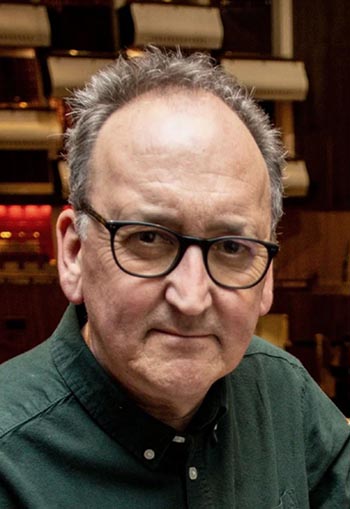
The broadcaster Ian Skelly was one of the co-authors of the original book, and a major contributor to the film. He is also Chairman of the Temenos Academy, an educational organisation devoted to preserving the wisdom and beauty of the world’s spiritual traditions, of which the King is a long-standing patron. We began by asking him whether he could explain, in a few words, the ideas behind Harmony.
Ian: Well it’s always a bit hard to fully explain the concept. The King himself, when he was Prince of Wales, found it extremely difficult to explain it in the early days. In a way, this is why we wrote the book, Harmony, to help articulate the details of the philosophy. I’ve noticed in the intervening years that he has become noticeably more fluent about these ideas and has managed to find the phrases that properly sum up what he is trying to demonstrate in all these different disciplines.
In a nutshell I would say it is an attempt to explain that, for a range of historic and cultural reasons, humanity has become less and less aware of the cyclical and integrated, interconnected way in which nature’s life-support systems operate. The King as Prince of Wales wanted to demonstrate that we have increasingly adopted a particular dangerous, disconnected attitude towards the world we live in. We see nature as something separate from us when, in fact, we are very much a part of it – although he would go further. Saying ‘we are a part of it’ still suggests that Nature is made up of parts, when the truth is we are Nature. There is no separation. What we do to it, we do to ourselves, physically and spiritually.
He could see that exploiting nature as if it is made up of different parts, believing that we can manipulate one part of it as if it exists in its own silo to produce more, risks all manner of dangerous, unintended consequences which are now having a very serious, adverse impact on our own physical and mental health as well as increasingly devastating damage on the very systems we depend upon for our survival.
Jane: One of the problems you faced in the early days was that you were very much pioneers in expressing some of the concepts which we now take for granted. He was talking about climate change, for example, in the 1970s, years before it became widely accepted by the mainstream, and even before there was a lot of hard evidence for it.
Ian: Yes, but I would go further than saying it was just about climate change – although he was obviously very concerned about that and could see what was coming down the track. There was actually some evidence for it at the time. The British Antarctic Survey, for example, had been looking at these extraordinarily long shafts of ice that they drilled out of the ground which showed the quantities of CO2 over millions of years. And you could see how in the last 200 years it’s gone through the roof. Prince Charles saw a lot of this research, but people just weren’t accepting it at that point. That was a great source of frustration for him.
But what has always struck me is that his outlook is much more comprehensive. It’s not just about what climate change is doing to the natural world. As I say, ultimately, it’s what our entire attitude has done to ourselves. He has defined the problem as ‘modernism’, which is a rather loaded word, and in the times when he was criticising architecture, that was taken as a critique of a certain kind of design. But his notion of modernism is much more profound; it is an attempt to define what has happened, probably from about 200 years ago, since we adopted a mindset that is focused purely and simply on progress, on convenience, on achieving ease.
Obviously better standards of life, modern medicine, living longer without pain, all those sorts of things are great, and he is all for them. But the way that is being achieved is at the cost of a spiritual sense of ourselves, and also at the cost of the world. When you look, for example, at his concerns about architecture, when he spoke out he wasn’t so much concerned with the look of big buildings – although actually, he was rather concerned about that as well! The deep driven concern he had was what that sort of architecture and moreover, a certain attitude towards urban planning, was going to do to people.
Nowadays we see lots of research that says that the more contact we have with the living world, the better that is for our well-being. But the general direction of travel of the modernistic mindset at the end of the 20th century was to drive us away from contact with the living Earth. We were sticking people in high rise tower blocks with absolutely no contact with the natural world, or indeed, without any sense of community. He was there at the very start, well before we had any warning about the psychological impact of all this upon people.

‘Geometry is the grammar of harmony’. Starfish showing its underlying fived-fold symmetry. Image: Finding Harmony, courtesy of Prime Video & The King’s Foundation
Architecture, Art & Design
.
Jane: It really comes over in the film that he was a man before his time, and world is now catching up with him – including on this matter of urban planning, where his insights are now widely accepted. I understand that the government has formally adopted some of his ideas in the planning of their new cities – they will have much more green space, traditional low-rise architecture, beautiful public spaces etc. [/]. We see in the film how he has created models of what these principles look like when they are applied in the towns that he himself helped build in Poundbury in Dorset and Nansledan in Cornwall.
Ian: What he’s tried to demonstrate – and it’s not always been understood, I think – is that if you look at a traditional towns and villages, they’re all based upon circles and spirals that define walkable distances. So if you were to fly over Milan or indeed north London, you’d see a series of different little villages effectively, which are like a beehive. But if you fly over Milton Keynes or Los Angeles, you don’t see that shape because those places were built for the car and they cut off rather than affect integration. So now it seems that the government has started to understand that.
It’s also understood that people benefit from places that are beautiful. And this is part of the spiritual aspect of all of this. If you sever yourself from your sense of the sacred – your sense of beauty in the natural world – that has a big psychological effect.
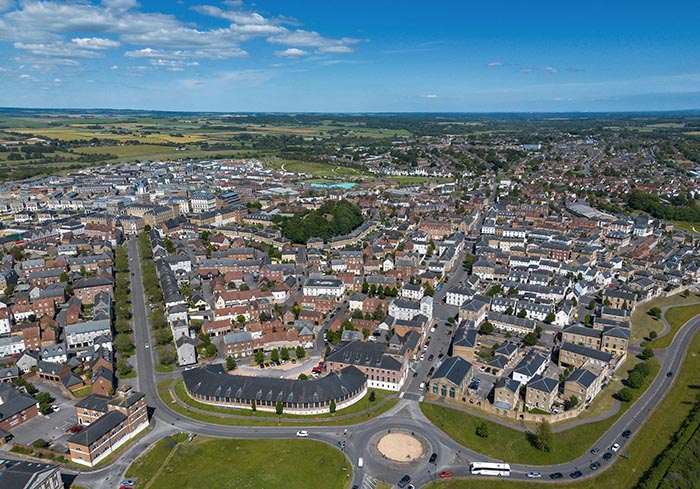
Aerial view of Poundsbury in Dorset, a town developed in the Duchy of Cornwall on the principles of human-friendly urban planning. Photograph: Graham Hunt / Alamy Stock Photo
Jane: One aspect of his work in this respect which is perhaps not so well-known is his support for traditional crafts, and the arts, which bring beauty into the environment. We see in the film how at his centre at Dumfries House in Scotland he trains local people in the skills of woodworking and stone carving, and other heritage skills.
Ian: Yes, and there is also the King’s School of Traditional Arts in London, which was basically founded to try and keep alive the wonderful arts and crafts of many world traditions. These have been kept alive by the Islamic tradition in particular, as you know.
Jane: Yes, we did an article a few years ago in commemoration of Keith Critchlow who was the Director of the Prince’s School and really established the teaching of sacred geometry in the UK. I was very interested to see geometry being described as ‘the grammar of harmony’ in the film by the present Director, Khaled Azzam.
Ian: We also see in the film one of the more recent projects the Prince, now King, helped to set up – The Turquoise Mountain Foundation in Kabul, which is run by a remarkable woman called Shoshana Stewart. During the Afghan war in 2006, he became increasingly concerned about the way that the highly sophisticated crafts and understanding of Afghan traditions were being lost. So he set up this foundation, which to this day, despite what has since happened in Afghanistan, still trains women in particular in all sorts of skills. And the basic reason that he wants that foundation to thrive and prosper is not just to enable all these traditional skills and crafts to be remembered and understood and handed on, but it was also a way of these women getting healthcare.
Jane: I looked up the website of The Turquoise Foundation, and found out that since 2006, they have trained over 11,500 artisans, restored more than 170 historic buildings, provided primary healthcare to over 250,000 patients, and education and cultural heritage programmes to over 4,500 children. This is a fantastic achievement for what is actually only one small part of the work he has done.
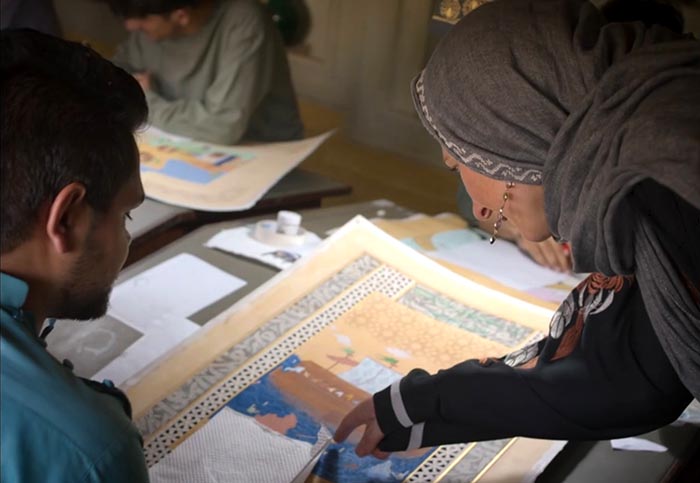
Shoshana Stewart, Director of The Turquoise Mountain Foundation in Kabul, which was set up to preserve Afghan traditions and skills. Image: from Finding Harmony, courtesy of Prime Video & The King’s Foundation.
Changing Our Perspective
.
Peter: I was interested in what you just said about the problem being our basic mindset. And I wondered how the King sees his role is in helping us change this, because this is obviously crucial to the way we move forward.
Ian: Well, if there’s one thing which was at the very heart of both the book and the film, it is that we think we are suffering an ecological crisis or an environmental crisis, but at the heart of it, we’re actually suffering a crisis of perception. And that’s an inner problem. We see the world around us as being separate from us because we live in an age of disconnection. So what we really need to fix is the crisis in our perception, as everything else follows from that. And that comes back to the point about the sacred and why that’s so important. Who are we? What are we? Where are we in this universe? What is reality? What part does our imagination play? And what is the role of ‘the true, the good and the beautiful’, as Plato put it?
All this is at the very heart of his argument, and it’s always been a regret of mine that people haven’t quite noticed this because he’s well known for championing the environment and a certain approach to architecture, but essentially what he’s always been most interested in and concerned about is the relationship between the individual and community. We live in a predominantly individualistic society, but he’s not interested in the individual as such. He’s interested in the individual within community.
And I think of all his charitable operations, The Prince’s Trust, now, the King’s Trust, is the best demonstration of that. He’s always been concerned about unlocking everybody’s potential, in particular those people who sit on the periphery of society, those individuals who’ve been forgotten or dismissed as not worth anything. He brings those people into the centre to unlock their capacity. And that comes from an understanding of what we are and what we’re capable of.
Peter: And of course, education must also be tremendously important.
Ian: Yes, there’s a wonderful sequence in the film about a man called Richard Dunne who came to a talk I gave about Harmony when it was first published. He was a head teacher at a primary school, a state primary school, and he was so moved by what the book was demonstrating that he went back to his state primary school and completely changed the curriculum to create one based on the principles of harmony. He had children studying maths, geometry and art in such a way that it was all integrated and based upon connecting with nature. He now runs the Harmony Project [/] and he’s working all over the world, getting education systems to adopt these ideas.
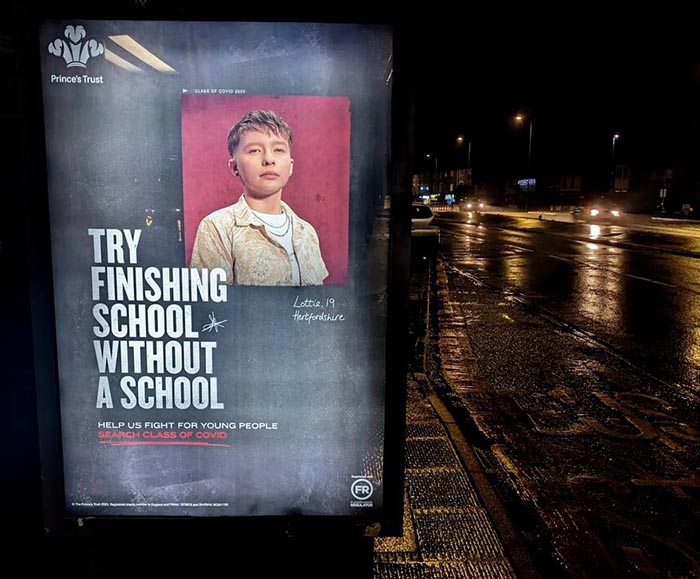
The King’s Trust, formerly Prince’s Trust, was founded in 1976 to help disadvantaged young people in the UK gain skills, confidence, and opportunities for work and education. This poster was displayed at a bus stop in Wales as part of the campaign ‘Class of COVID’. Photograph: Jaggery / Geograph [/]
Spirituality and Religion
.
Jane: When thinking about changing perceptions, central to this is our relationship to religion, or perhaps better to say, the spiritual traditions, because it is within them that we find these principles of harmony and oneness very clearly articulated. I know that the King is very interested in all the different traditions, not just in Christianity.
Ian: Well, I don’t really need to tell you, Jane, that the Sufis famously talk about there being many lamps, but it’s all one light. I know for a fact that that is very much the King’s attitude to the religious traditions. He was brought up in and fully subscribes to the Christian faith, but that doesn’t mean to say that he has no time for any of the other traditions, because they’re all equally valid. They’re all rooted in the same principles, really.
My experience is that he is a very a deeply spiritual person. He has drawn a lot of value from the Orthodox tradition. He used to go to Mount Athos every year and sit in a very plain cell and spend a lot of time meditating. He’s also well known for his support of the Judaic tradition and the Islamic tradition. He has a universal view of faith. He was, I think, misquoted all those years ago as saying that he didn’t want to be the defender of the faith, but he wanted to be a defender of faiths. But that’s not what he actually said. He said, ‘I want to be defender of faith’ – meaning, the faith which is universal to all of the traditions and comes out of the same light.
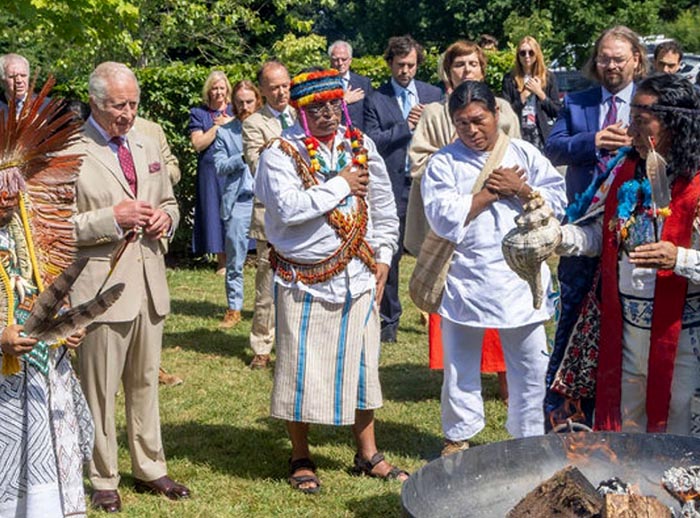
The first ‘Harmony Summit’ bringing together Indigenous leaders from around the world, convened on 2025 by HRH King Charles III at Highgrove House. Photograph: Luci Attala
Jane: He has also recently been engaging with in the Indigenous traditions of the world, and over the summer convened a meeting at Highgrove of a group of Indigenous elders – in fact, we see something of that gathering in the film.
Ian: Yes, he’s very interested in the traditions of the First Peoples because they demonstrate that at the kernel of each of the very large world traditions, you find the same principles. If you go deep into Christianity, if you go deep into Islam, if you go deep into the Hindu tradition and so on, you come to the same principles which dictate the attitude of the Aboriginals of Australia or the First Nations of Canada. Crucially, what those peoples still cling on to, although it’s terribly difficult for them in a modern world, is that they do not see themselves as disconnected from the natural world. They see nature as being a conscious, living whole and that there’s more than just the physical at work. Ultimately there is this deep consciousness, the ground of being, which they recognise and articulate very powerfully.
Jane: Do you think he is happy for his views on this matter to be generally known?
Ian: Oh yes. He is one of the few people I know in public life who is prepared to talk about the sacred and its importance. I think it’s absolutely at the heart of what he is, and he’s never fought shy of talking about it.
During the making of the film, I had to go to endless meetings with the American producers, and they would ask me: Where did all this come from? Why did he do all this? So I explained what moved him when he was growing up, and one of them said: It’s almost as if it was intuitive. And I said; Well, yes it was, but you don’t understand what intuition is. It’s a faculty that we have which is as active and as aware as our minds are. But the problem with this crisis of perception is that we have denigrated that side of ourselves and only concerned ourselves with our rational side.
What we really call for in the book is a balancing up – an internal balancing up, where we let our intuition also guide us. It might seem like a good idea rationally to pump loads of chemical fertilizers onto a crop so that it grows very big, but our intuition is saying; Whoa, hang on a moment. What about all the things you’re killing? What about the runoff into the rivers? What’s it going to do to the streams and the seas and so on and so forth? Our intuition is telling us that’s not a good idea, but we ignore it and instead just go with our rational side.
So I think it’s very important to point out that when we talk about the sacred or our sense of the sacred, what we’re listening to is the faculty we call intuition. This is something that the Western mindset since the enlightenment has denigrated and ignored. But you still find it in the traditions of the First Peoples; their intuition is still very, very alert indeed.
Jane: So we could call this an innate sense of rightness or of wholeness. Beauty perhaps covers it if you know what beauty really is?
Ian: It’s almost like tuning into life itself, you know, which is the power that’s driving nature along. A living presence.
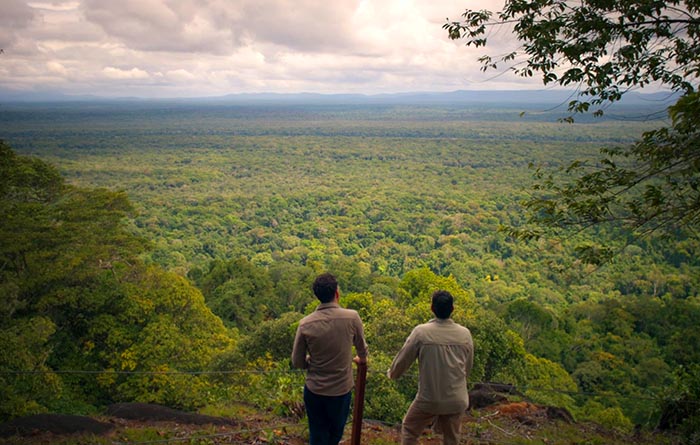
Researchers from the King’s Foundation overlooking the largest and most biodiverse rainforest in the world in Guyana, preserved with support from the Prince’s Rainforest project and the Norwegian government. Image: from Finding Harmony, courtesy of Prime Video & The King’s Foundation
Environmental Change
.
Peter: The King has done work in many areas, but the place where he has made the most impact is on environmental issues. This has been a central concern since he first became a public figure, and the film gives a very good account of the way his ideas have developed, starting with his transformation of the gardens at Highgrove House to be organic and sustainable to the setting up of an organic farm – the Duchy of Cornwall – which has grown into an enormously successful business. These ideas were ridiculed in the press in the 1970s, but they have all become mainstream now.
Ian: I remember the Prince of Wales being laughed at by newspapers like the Guardian for installing in Buckingham Palace something they called ‘a strange machine’. Well, that strange machine turned out to be a bottle bank, which we now have on virtually every street corner! The thing he was most famously ridiculed for, of course, was saying in an interview ‘I talk to my plants’, which led to him being portrayed as a kind of lunatic. But if you look at that interview, that’s a just a little side remark he makes at the end; the main thing he was saying is that we need to plant more trees. This was 40 years ago, when no one else was really thinking about this, but suddenly in the 21st century, this has become a mainstream idea.
The very last sequence of the film, I think, is the most powerful one for me. It describes how a young Indian man from Rajasthan, Manvedra Singh, came to Dumfries House in Scotland to see how all these ideas of sustainability and organic farming were being demonstrated in the various courses that are run up there by the King’s Foundation. He then went back to Rajasthan, where large areas have been ravaged by chemical farming and reduced to desert, and over the course of just a few years restored about 500 acres into a forest.
The point that he got from visiting Dumfries House was that if you just build little reservoirs in the desert to collect water when it rains, it very quickly evaporates. So it’s not a particularly efficient way of saving water. However, if you plant trees, then their deep roots hold the moisture for much longer. And as land retains more water, other plant forms and animals come along and continue the restoration by enriching the soil with their manure and such like. Through this simple action, he has created an incredible paradise which is now farmland with cattle roaming all over it, people living in communities within the forest, and so on.
Jane: We also see something of a project in Guyana, where he helped broker a deal with the Norwegian Government to preserve the rainforest, which is now the largest and most biodiverse in the world, covering an area about the size of Great Britain. One of the King’s Foundation researchers says in the film that it is ‘the largest water pump on earth’, whose impact goes far beyond the borders of Guyana itself.
Ian: The destruction of the rainforests was something that we talked about a lot in the original Harmony book. We had destroyed a third of them when it was written 16 years ago, and the impact that was having on farming as far away as the Midwest of America was already being felt – because, of course, rain forests make rain. Guyana was very inspired by this. The president, Irfaan Ali, was there last week at Windsor Castle for the film premier and told us that they have managed to save about 95% of their rain forests. And the only reason they’ve been able to do that is because of the then Prince of Wales’s Rainforest Project, which managed to raise colossal amounts of money and then in 2007 handed over the entire responsibility for its use to the Norwegian government, which, along with the government of Guyana, started to fund projects that made it more profitable to keep the forests than to chop them down.
Peter: One of the features of this project as it is shown in the film is that it not just about the environment, but really implements the principles of harmony. So it’s also about helping the people to improve their standard of living and building a different kind of economy which is sustainable and innovative.
Ian: Yes, that’s another thing which we were talking about in 2010. Some of the predictions we made in the book have turned out to be a bit conservative, but they weren’t conservative at the time, which just shows how a lot of things have moved on. What’s encouraging to me is that now people in industry are talking about circular economies as if it’s something they’ve known about for years, and people have proved that the whole idea of recycling rather than just burning up resources is the way to go.
What the examples of Rajasthan and Guyana show is that if you put nature at the heart of the equation – which is basically the premise of Harmony; look to nature to be your guide – all the answers are there already, or most of them are. We just have to fix our minds and get over this idea that we must pursue ever more progress, ever more ease and convenience. But the solutions are there, and are now being demonstrated around the world, which moves me deeply, and it certainly moves him.
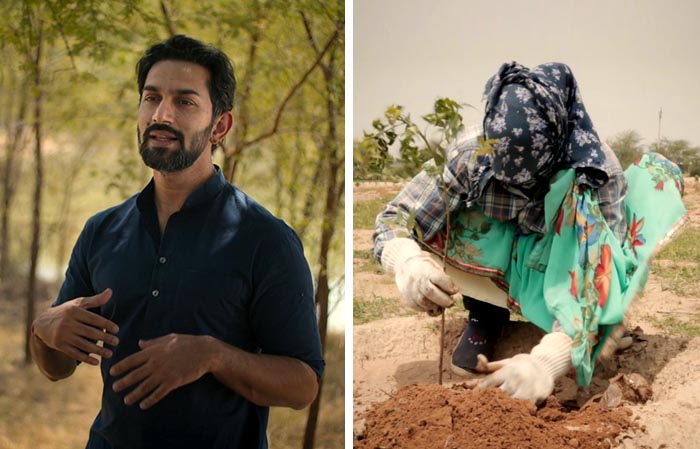
Manvedra Singh whose Dhun Project, inspired by a course run by the King’s Foundation at Dumfries House, has restored 500 acres of desert in Rajasthan into a forest by planting 270,000 trees. Image: from Finding Harmony, courtesy of Prime Video & The King’s Foundation
The Future
.
Jane: Watching the film, I was very struck not just by the fact that he has stuck to his guns all these years despite all the negative press and opposition, but also by the way he has used his position in a really positive way. He is in a very privileged situation, in one way, but in another it is very restricted in that he cannot take sides politically; he can’t go off and just work on a farm or in a rain forest, or whatever one might imagine he would have done if he wasn’t destined to be king. But he has worked with what he was given. One cannot help comparing him, particularly at this moment in time, with his brother, who was given a position of comparable privilege but used it rather differently.
Ian: The great thing about the man himself is that he spent his time as Prince of Wales getting to know everybody. So when he became king, I remember being asked: ‘What will he bring to this role?’ And I said: ‘Well, he knows everyone and consults everyone all of the time.’ He probably meets in the space of a week more people than you and I would meet in a year, and somehow, in very short conversations, manages to get the essence of something out of people. He has not just stood up on his own and pontificated about these things. He’s thought very deeply about them and has consulted a very wide range of people over the past 40, 50 years.
And of course, being who he is, he has access to some of the most remarkable people in the world, so as Prince of Wales, the one thing he could do was to convene people – often people with competing views. Northern Ireland is a classic example. I don’t really want to go into that, but I’ve seen evidence in other places as well where he’s bridged the divide, brought people in, consulted both sides before he does something.
Peter: The word that comes to mind is that although he hasn’t got direct power, he’s like a very powerful catalyst for moving things in a direction towards his vision.
Ian: Yes. And very good at spotting those people who are the seeds that will grow into the tree. He can’t necessarily make things happen, but he can light the touch paper and then. in a very badgering way, can make sure that it happens. He has always been very active in his encouragement of the initiatives that he helps to set up and is constantly in touch with the people on the ground. His input is more limited now than it was because of his role as King, but I’d say that behind the scenes there is still that passionate man there who is very concerned about these issues, which are not political issues – they are things which have a universal benefit.
Jane: So the film is now out and I understand it’s being released in 240 countries simultaneously…
Ian: Yes. Although I don’t think that there are 240 countries in the world; what the TV people talk about is ‘territories’. I don’t know what that actually means, but it’s basically a global release.
Jane: So what do you hope that it will achieve?
Ian: Well, I think it’s a very positive film. It obviously charts a lot of negative things – the way we’ve destroyed the natural world, and particularly in food and farming processes and so on. This has been done for all the right reasons, but we’re now living with the consequences. But ultimately, it’s a very positive film.
My hope is that it does what perhaps the book couldn’t do because lots of people aren’t keen on reading books these days. I really hope that it hits the younger generation, who are much more engaged and concerned about these issues than I think older generations are. I would hope that if the film could be shown in every secondary school in this country and in America – to older teenagers, rather than younger ones who wouldn’t quite get the whole thing – that it would inspire at least 10% of them to do something. To show that it’s possible to turn what could be a disaster around. We’ve got a long way to go, but we’ve also come a long way from the days when a bottle bank was seen as a ‘strange machine’. So a film like this maybe might just push things in a better direction.
Jane: Ian, thank you for talking to us. It is a very inspiring film – and a very visually beautiful one as well – so we hope that it gets the reception it deserves and does, indeed, push things in a better direction.
Finding Harmony is now available to watch on Amazon Prime:
Finding Harmony official trailer. Duration: 2:10
Image Sources (click to open)
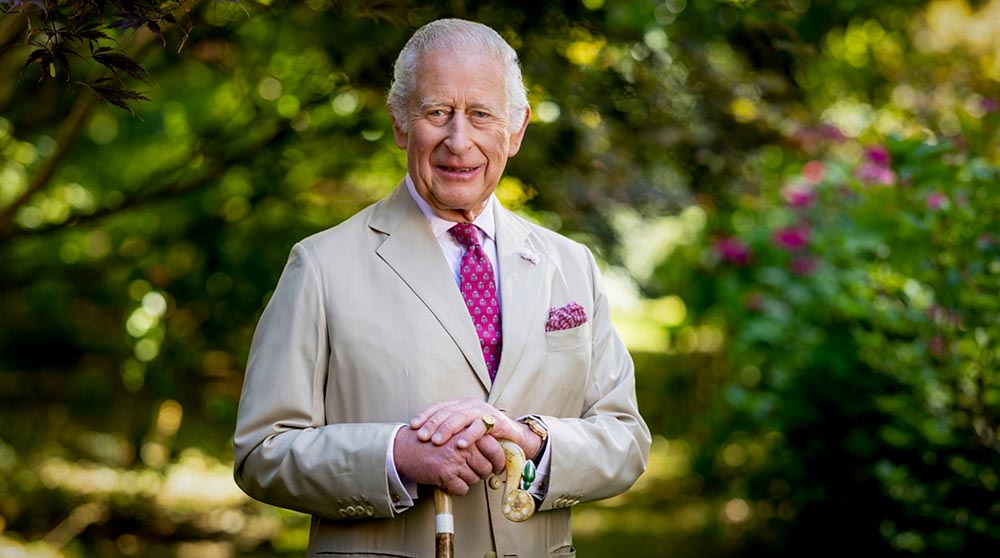
Banner: HRH King Charles III. Photograph courtesy of Prime Video & The King’s Foundation.
Other Sources (click to open)
[1] His Majesty KING CHARLES III (when HRH The Prince of Wales), TONY JUNIPER and IAN SKELLY, Harmony: The King’s Vision for Our World. (William Collins, 2010, reissued in paperback 3 March 2026).
The text of this article has a Creative Commons Licence BY-NC-ND 4.0 [/]. We are not able to give permission for reproduction of the illustrations; details of their sources are given in the captions.
FOLLOW AND LIKE US
@Beshara_Mag








——————————————
——————————————
——————————————
FOLLOW AND LIKE US
@Beshara_Mag
If you enjoyed reading this article
Please leave a comment below.
Please also consider making a donation to support the work of Beshara Magazine. The magazine relies entirely on voluntary support. Donations received through this website go towards editorial expenses, eg. image rights, travel expenses, and website maintenance and development costs.
READ MORE IN BESHARA MAGAZINE
Keith Critchlow: A Life Well Lived
Richard Twinch pays tribute to the teacher and sacred geometer who died on April 8th 2020

Doughnut Economics
Kate Raworth’s new book asks: how we can reconcile the needs of humanity with the needs of the planet?
Review: The Great Re-Think
Richard Gault reviews the latest book by Colin Tudge, which lays out a new vision for agriculture and farming based upon principles of unity and compassion
Bringing the Land Back to Life
Alan Ereira talks about the wisdom of the Kogi Indians and an important new UNESCO project in the Sierra Nevada de Santa Marta in Colombia
READERS’ COMMENTS
I watched the film documentary. A really excellent teaching/learning experience for me. I didn’t know this is what King Charles’s career is about. And of course, the subject of Harmony. We have forgotten harmony in our scientific-technological world. And we have forgotten what a life of contemplation could be about. We threw away both harmony and contemplation to get hi-tech. To get the internet. On and on.
And as important, King Charles, in just the past few days is the first and only head of state who is accepting accountability for the results of the American Epstein debacle. He is walking his talk! Blessings, and my deepest respect to you all in the UK for taking a stand about what’s happening in America. And through the King! Perhaps this is the best use of royalty. Maybe royalty at its best could be like a board of directors in a large corporation. It stands above the day to day leadership operation for things like ethics, values, morals, tradition and the like.
In Healing!
Richard Simonelli
Fenton, Missouri USA
The film is such a fun and inspiring way for young people to learn about sustainability.