
News & Views
Is A River Alive? by Robert Macfarlane
Peter Huitson reviews a book which explores the living presence of diverse rivers around the world and their power to heal and transform
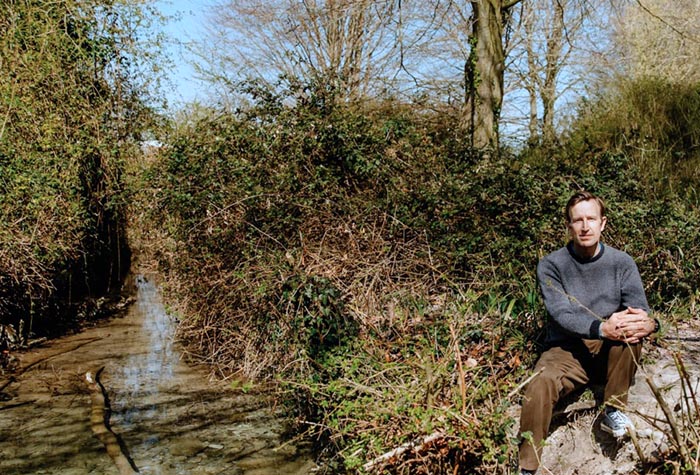
Robert MacFarlane. Photograph: Peter Flude [/]
I was captivated and inspired by this book, which is a lyrical and beautifully written paean to the spirits of rivers. It does much more than simply seek an answer to the question posed by its title. Indeed, an affirmative answer to this is anticipated in the opening pages, when Macfarlane recounts his nine-year-old son’s response to what he is writing about. The boy simply says: ‘That’s going to be a short book then, Dad, because the answer is yes’.
The actual theme, as Macfarlane puts it at the start of the Introduction, is ‘a journey into an idea that changes the world’. He investigates and tests the implications of the notion that rivers are living beings through exploration of three very different rivers on three continents, and in the process is drawn into transforming encounters with the energy of life itself.
The book has three sections. Each takes the form of Macfarlane’s account of a river journey he made in the company of fellow environmental enthusiasts. The first is a trek along the Río Los Cedros (River of the Cedars) in Ecuador, which he traces back to its source in the eponymous cloud forest. The second is an exploration of three rivers in Southeast India whose clear headwaters play host to teeming hordes of birds – ‘an avian Venice’ – but as they flow toward the industrial city of Chennai, they become poisoned by chemicals and effluent. The final journey consists of a challenging passage by kayak down the furious and majestic lower reaches of the only river in Quebec that has not been dammed for power generation – the Mutehekau Shipu, known in English as ‘The Magpie’.
These foreign explorations are punctuated by Macfarlane’s reflections on visits to the chalk springs in Nine Wells Wood in Great Shelford, just over a mile away from his home near Cambridge. These, he notes, form one of the rarest water environments on earth. He follows the changing fortune of the springs as they recover from near-death by drought to a sacralised abundance as the rains return.
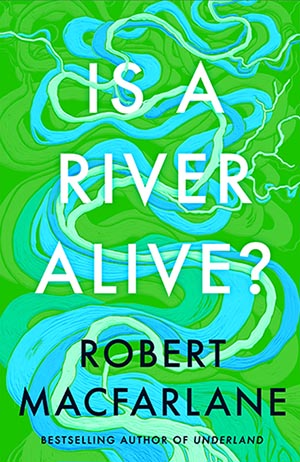 This logical exposition does not do justice to the book. Covers of books can be unreliable guides to their contents. But not in this case. The jacket image, created by Macfarlane’s long-time friend and collaborator Stanley Donwood, consists of a meandering and shape-shifting blue and grey swirl inset into a vibrant green background. It symbolises a river’s propensity to explore new and surprising pathways through a vivid, teeming-with-life green earth. The text mirrors this as it unfolds and draws you along in flowing and diverting ways in a manner that is reminiscent of a symphony in three movements:
1. An immersion in joyful and lively young-river energy under the abundant forest canopy that heals and revitalises
2. A descent from clear life-giving waters through the shadowed vale of death, comforted and guided by the hopeful light of young angels
3. A wild and majestic descent to the temple of the mountain king and resurrection blessed by eternal overwhelming power
These are separated by intermezzi, which feel like whispering airs on the flute, giving voice to the changing fortunes of the chalk spring.
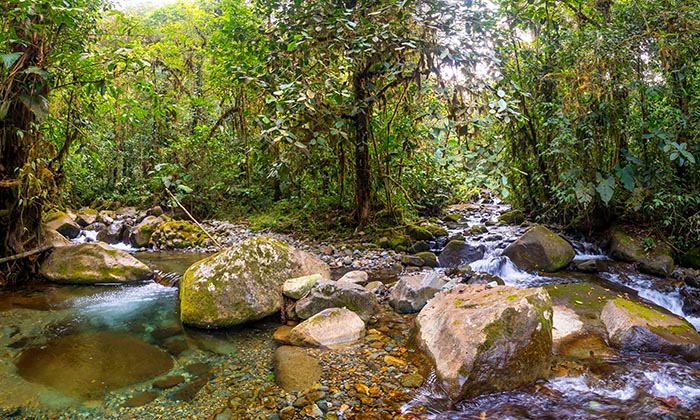
Cloudforest in the Los Cedros Reserve, western Ecuador. Photograph: Morley Read /A lamy Stock Photo. Inset below: Giuliana Furci, mycologist and lead scientist on the Los Cedros expedition. Photograph: Wikimedia Commons
Ecuador: Recovery of Joy in the Cloud Forest
.
While he celebrates and welcomes legal decisions which protect rivers, Macfarlane does not dwell on the mechanisms by which they, and other natural beings, could be protected – by, for example, giving them personhood. His wider intention is to move beyond seeing trees, hills or rivers only as ‘natural resources’ and experience what it is like to meet them as fellow beings. A key theme that emerges is the ability of the natural world, when approached in this way, to engender both renewal and transformation.
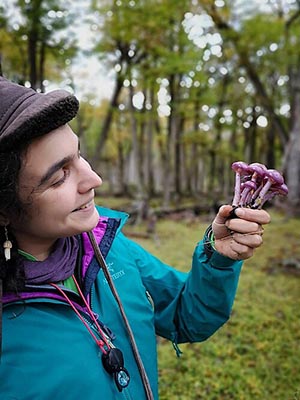 In each section, he is drawn to a particular person who opens up for him aspects of this mysterious and life-enriching power. In Ecuador, it is Giuliana Furci. She is the lead scientist on the expedition to Los Cedros, a mycologist who has written field guides to the fungi of South America. She is sensitive to the presence of fungi in a way that is uncanny and inexplicable. She speaks of hearing them ‘as a fuzz in the matrix’ or picking up a particular vibration and tone in the background energy field – very different to those broadcast by plants. At the same time she is clear that there is a dialogue – ‘they know I’m there’. This amazing talent has enabled her to locate many mushrooms previously unknown to modern mycology.
On the first night in the Los Cedros cloud forest, sitting around the campfire with the rest of the team, Macfarlane notices Giuliana quietly crying in the shadows. She is still grieving the sudden death of her father. But at the same time she is relieved and uplifted by the vital and vibrant energy of the river and forest that have been, against all the odds, saved from destruction by mining.
The next day they trek further into the heart of the forest:
This drifting mist infiltrates the full volume of the forest, wandering … into every available niche …[and] in time rolls and drips as water to the forest floor. … river and cloud-forest cannot be separated because each authors the other. [p. 54]
Step on steep step, the trail winds up. The mist and forest thicken around us until we each move in a grey-green socket of softness. [p.65}
The following morning, walking beneath the canopy bathed in a clear blue sky and cut through with rafters of golden sunlight, Macfarlane is invigorated as the song of river becomes ever more present. It leaps like a silver fish; it is shot through with ingots of golden sunlight, and quartz crystals sparkle in the sand between stones. He is struck by its spontaneous and playful energy. Later, when they reach the biggest waterfall on the river, he leans back into the turbulent veil of water and closes his eyes to feel the spirit of the water on his scalp and skin. He is tuning into the aura of the river, letting it change and enliven his being.
Contemplating what it means to say that a river is alive, he realises that humans and rivers are not alive in the same way. Rivers (and other natural beings) have their own distinctive quality of aliveness which is beyond our habitual range of consciousness.
As the trek proceeds, Giuliana recovers her power to find and tune into the aura of mushrooms. Sitting round the campfire, she explains how scared and broken she was when she arrived in Ecuador. She feared that death had robbed her of her ability, but being in the presence of the forest and river had ‘be-wildered her soul again’. In a moving statement of mutuality, she says, ‘I was ready to greet the Psilocybes when they were ready to greet me.’ [p. 106]
Her transformation has helped Macfarlane coagulate a new relationship with life and nature. He has realised that life – its presence and energy – is more spacious, has a much broader bandwidth than he had previously known. Giuliana has shown him that it is possible for humans to attune to the vibrations emanating from the natural world, and his own heart has been quickened by being immersed in this vibrant presence. He is entering an I–Thou relationship with nature.
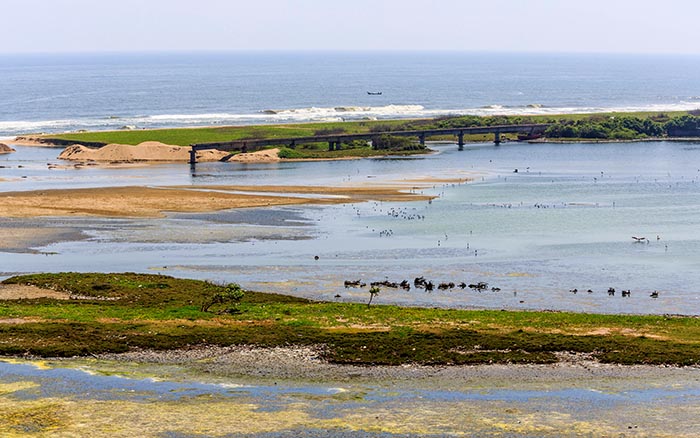
Polluted estuary and islands of the Adyar River and seashore, Chennai, Southern India. Photograph: Alamy Stock Photo. Insert below: Yuvan Aves, young activist, writer, and ‘angel’ of the rivers during a shorewalk for the public at the Urur Kuppam beach. Photo via Sanctuary Nature Foundation [/]
India: Angels in the Vale of Death
.
Macfarlane’s exploration of the rivers of southern India – rivers that become ghosts of themselves, whose clear headwaters are poisoned and their vibrant life snuffed out by the monstrous industrial effluents from the city of Chennai – is the most painful and troubling section of the book. Yet, the apparent sterility is leavened by hope, in the form of young activists, whom he calls angels, ‘who watch over the lives of the rivers where they survive and who seek to revive those who are dying’ [p. 125].
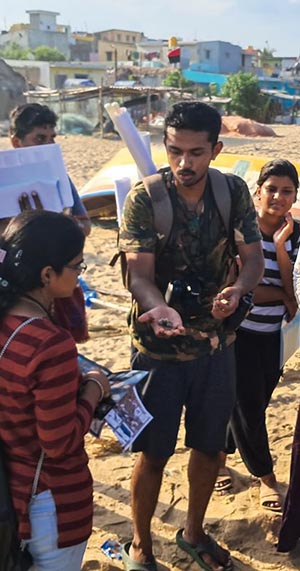 Macfarlane’s guide is Yuvan Aves, a remarkable young man who has been transformed from a traumatised and abused teenager to a ‘young man committed to healing others, from humans to snakes to rivers’ [p. 133]. Like a caterpillar, he entered a chrysalis to undergo his transformation. His cocoon was the Pathashaala School, whose pedagogical spirit was inspired by Jiddu Krishnamurti, for whom closeness to nature was an ethos.
Yuvan has learnt to wait, watch and witness and sit completely still. He left the school as a naturalist self-taught through patient observation. Macfarlane perceives the fruits of his education:
Rivers run through Yuvan too. Water is what he both thinks and thinks with: it is the substance that both defines his landscapes and his ductile, fast flowing mind. Faced with the slow violence visited upon the rivers of his city, Yuvan reimagines how water might be. Faced with conditions in which the life-giving powers of rivers have been forgotten or erased, he works to re-animate new-old ways of seeing and listening to them. [p. 131]
Macfarlane is beginning to think of aliveness not so much as a property of a river but as a universal quality to which water and rivers can give unique expression.
The challenges in the area are immense. The river pollution is so bad that city authorities deny it by simply erasing the worst affected from the environmental map. Macfarlane is swamped with pessimism on being shown the extent of the monstrous effluent-spewing and river-poisoning industrial complex. And yet the young activists are not daunted: as Yuvan says: ‘Barrenness is almost always a state of mind, only rarely a state of the land’ [p. 154]. And there are small victories – areas of wetland cleaned up and preserved so that traditional fisherfolk can survive.
The other advocate in the activists’ quest for renewal is the tenacity of the life energy that still permeates the city. Its manifestations are interwoven into its very fabric: the mongoose that takes to the sewers to breed; the millipedes and fellow detritivores that turn the shit of life into something valuable; the snakes that slip into drains and crevices; the swallows, the bee eaters, golden plovers and dragonflies, the hordes of fiddler crabs.
There are also the Olive Ridley Sea turtles. At the end of his trip, Macfarlane joins the nightly Turtle Patrol that walks Chennai’s sandy beach to protect the mothers from harm and ensure the safety of the eggs. This means finding nests beneath the sand where a turtle has buried her eggs and transporting them to freshly dug nests in a cordoned off area of the beach called the hatchery where they will be safe from feral dogs.
As the patrol walks the sands looking for turtle tracks, Macfarlane asks one of the volunteers ‘Why do you do this?’ ‘For life’, he answers simply [p. 180]. Later, on his hands and knees digging a new egg nest in the sand, Macfarlane reflects on the inspiration he has absorbed from the good dreams that Yuval and his colleagues are trying to realise. He remembers Yuvan’s observation:
A small ‘self’ suffers and causes suffering, … a love of the living world lets single identities and selfhoods expand and encompass other beings, entities and whole landscapes, such that the self becomes a spacious thing. [p.184]
As he continues to scoop out sand with his hands to make the nest, he begins to cry. It is as though his heart has become spacious and tender enough to accommodate the paradoxical mystery of the ocean of life – its irresistible longing to manifest in full awareness of its profound vulnerability.
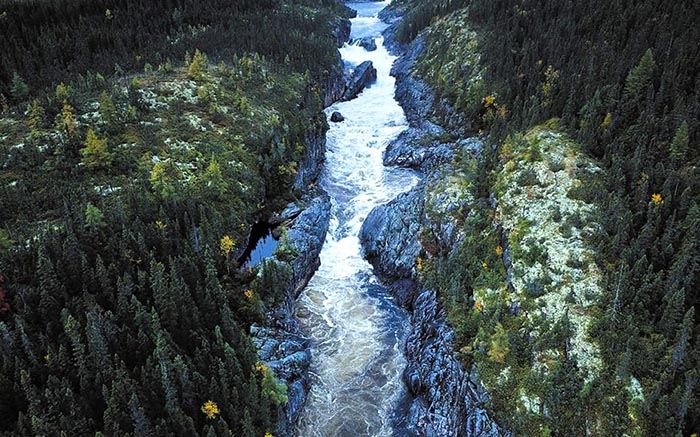
Quatrième Chute (Fourth Waterfall) on the Mutehekau Shipu – also known as the Magpie River – in Quebec. Photograph: Christian Fluery [/]
Canada: Resurrection in the Temple of the Mountain King
.
The mood of the book becomes more urgent, insistent and powerful as we move to Canada, where Macfarlane and his friend Wayne take a journey down the primal majesty of the Magpie. They are guided for ten days by kayak through the tumultuous rapids with quixotic names such as Porcupine, Snow-White and Marmite en route to the Gulf of St Lawrence.
From the beginning, we understand that this transit will be a climax in Macfarlane’s journey and will be transformative. This is confirmed by what he is told by Innu Rita Mestikosho, an activist, healer and poet. From reading her poetry, he has understood that:
Throughout her work […] she is speaking with – being flowed through by – natural forces greater than her individual self; [… there is] a sense that the idea of the individual as an island or singular unit is irrelevant even deceitful. […] Often in her poems the rivers, the land and their beings speak … Streams whisper, the sky utters and rivers murmur. [p. 222]
When they meet, she speaks as though inspired by the presiding spirit of the river and from that perspective says, ‘Don’t think too much with your head.’ Instead, she enjoins him when on the river to think as the river, to become like her, to wake up not so much his consciousness but his heart. To feel the river’s spirit flowing through his being and give her a voice.
Macfarlane accepts her counsel and realises that it corresponds with his longing to open his heart while having no idea how to put it into practice. As Macfarlane and Wayne part, she gives them a final piece of advice: each day make an offering of a pinch of tobacco to both the earth and the river. This, she says, will awaken a mysterious presence that inhabits this remote northern land, who will transform them.
They descend day after day through the lakes, the rapids and falls powered by the storm-swollen Magpie until they approach the Gorge – the climactic cataract which the river has cut through almost-planet-old-rock, and which roars like a vast crowd of huge white bears with their long white hair shattering abroad in the wind. Macfarlane realises that his sense of himself is changing:
Days on the water have produced on me the intensifying feeling of somehow growing together with the river: not thinking with it but being thought by it. [A] physical sense of merging, almost of capture […] Rivers are running through me: I’ve been flowed through and onwards. [pp. 289–290]
That evening, he and Wayne walk to the very lip of the Gorge and step across an invisible barrier into another state of being. The Gorge becomes a huge mouth and the water pouring out appears like an enormous white-green tongue which speaks in a language beyond language and sings the song of songs. The river is communicating not to his head but to his heart. In that moment he finds the current, follows the flow and his heart is permeated by the essence or aura of the river-being – which feels like an endlessly transforming vision of something beyond bears and angels. In this great opening outward of mind and imagination, he is, as he puts it, ‘rivered’. He has been raised up to a higher realm of being where his heart is united with the flow of life’s wild and majestic power.
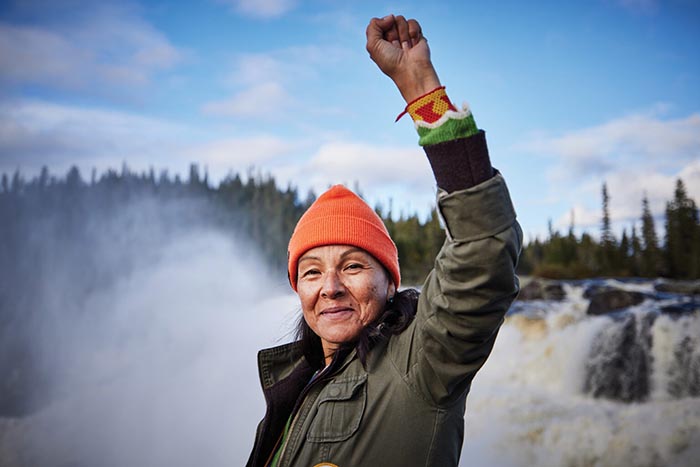
Rita Mestokosho, Innu activist, poet and educator, at the Third Falls of Mutehekau Shipo. Photograph Christian Fluery [/]
Listening to the river
.
Macfarlane does of course include discussion the legal decisions which currently protect the unfettered flow of two of the rivers he explores – the Constitutional Court of Quito’s determination to put the strong voice of life first in refusing the mining companies permission to destroy Los Cedros cloud forest, and the recognition of the Mutehekau Shipu in Quebec as a living-rights being which should flow unhindered by dams. And, through the in memoriam dedication, he honours Josef de Coux (1951–2024), who spent forty years self-exiled from the outside world, living as an anchorite in the heart of Los Cedros, devoting his energies to a heroic defence of its unravaged existence.
The legal rights of natural beings is an increasingly debated issue in the contemporary world and is seen by many activists as an effective means of protecting the environment. Macfarlane poses a pertinent question just before he goes into the Gorge:
The crux that needs solving [… is] not ‘who speaks for the river?’ but ‘What does the river say?’ These are two distinct questions. And whilst it is relatively trivial to answer the first of them, it’s a philosophically immense task to answer the second. [p. 292]
This is clearly a fundamental issue. We cannot be certain, but it would seem highly probable that the Rio Los Cedros does not want to be destroyed by mining; that the rivers in Chennai do not want to be poisoned and polluted; and that the Magpie does not want to be tamed and imprisoned by dams.
But other cases are more difficult. What does a river feel about the reintroduction of beavers that will change its flow patterns? What is a river’s view about putting in concrete culverting to prevent flooding? Do the rivers in the fens, currently constrained in straight line dykes, want to re-establish a meandering course?
We can turn to awakened individuals like Giuliana, Rita or Yuval or indigenous communities like the Kogi, who can listen to what the rivers are saying and translate this as best they can into human terms. Where this is not practical, we could intuit imaginatively as fellow living beings what the river wants – say, to come into the light, have some freedom to determine its course, etc. And we will of course need to balance the desires of the river (to flow freely, to spill its banks) with the interests of other stakeholders, such as the adjacent human and natural communities (their needs to be kept safe, for land to be watered).
But where a river remains undisturbed and poses little danger, it may be useful to keep in mind an adapted version of St John of the Cross’s maxim for Spiritual Direction:
The guardian of the river’s whole concern should be to see whether he can recognise how Nature is carrying the spirit of the river and if he cannot, leave her alone and not disturb her. [3.46] [1]
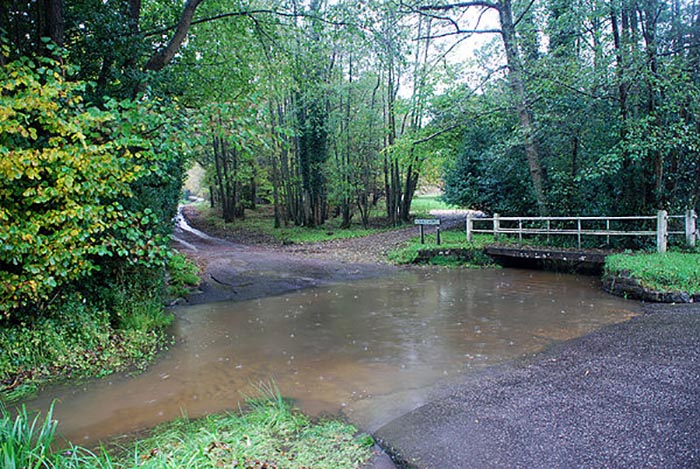
Newbridge Ford in the Ashdown Forest. Photograph: John Walton
Reflections
.
As I read this book, I was reminded of Hazrat Inayat Khan’s reflection on the nature of man’s heart:
The heart of man can be likened to water. Either it is frozen and then it is snow, or it is water and then it is liquid. When it is frozen it has turned into a crystal; when it is liquid it is in running order, and it is natural for water to be running…
The water of the river is sweet. It is sweet because it is attracted to the sea, it is longing to reach the sea. The river represents the loving quality, a quality that is seeking for the object it loves. A heart that loves God and His perfection is likened to the river that seeks the sea.[2]
Another mystic who was in touch with the living spirit in nature was William Blake. As Mark Vernon puts it in his recent book Awake!:
The crux of Blake’s belief is that everything which exists has its own power and presence. […] He saw […] nature revealed as countless independent though thoroughly interrelated creatures. [p. 171] [3]
These two examples suffice to assure us that what Macfarlane discovers for himself and observes in the expansive capabilities of Giuliana, Yuval and Rita follow a deep current within mystical tradition.
In an interview, he was asked what he would like readers to take away from his book. He replied: ‘I want readers to imagine rivers as having lives, having deaths and even having rights – and to see what flows from that.’ [4] Reading this, I recall a line he quotes from Rita’s poetry:
We all have a river who calls to us. [p. 222]
I pause ̶ and in the silence I hear the insistent small voice of a stream from my childhood …
Sometimes on summer Saturdays my parents took me and my two younger sisters in our little yellow van to Ashdown Forest in the Sussex Weald. To me this was a magical land – it seemed as wild and mysterious as any jungle in Ecuador. In the late afternoon we would go to a place that still feels sacred. We parked on a green verge beside a by-road – where a small, unnamed stream emerges from the trees and undergrowth, slips under a squat white footbridge, slides silently across a lane and after its short passage in the open disappears again. I can feel myself transported there: a small boy – standing tall, my soles planted on the stream bed, cool clear water smoothly washing my toes and feet. I am being refreshed by and infused with the distilled spirit of the Forest.
Macfarlane too is sensitive to the subtle currents of spirit that underpin and guide the unfolding of our lives. In the Epilogue, he fondly imagines his three children making a pilgrimage to Nine Wells Springs many years hence, after he has died. As they make offerings to the freshly born stream, he envisions all life forms as flakes of being that ‘move together, drawn by undercurrents we cannot see. Death and love and life, all mingled in the flow.’ [p. 301]
Is A River Alive? was published in London by Hamish Hamilton (London) in 2025
Sources (click to open)
[1] ST JOHN OF THE CROSS, Living Flame in Centered on love : the poems of Saint John of the Cross translated by Marjorie Flower, (Holy Name Press, 1983).
[2] HAZRAT IMRAN KHAN, Volume XIV The Smiling Forehead (Part I, Chapter II) available at VOLUME XIV – Part I – 2 [/].
[3] MARK VERNON, Alive! William Blake and the Power of Imagination (C Hurst & Co Publishers Ltd, 2025).
[4] JONATHON WATTS, Robert Macfarlane: ‘Sometimes I felt as if the river was writing me’ | Rivers | The Guardian [/], 17/5/25.
read more in beshara magazine
More News & Views
Book Review: ‘spinning pinwheels’
Gabriel Rosenstock rediscovers kokoro (heart) in a new book by the distinguished Indian poet K. Ramesh
The Kogi: More on Munekan Masha
Luci Attala talks about the recent visit of the Kogi Ambassador, José Manuel, to the UK, and the latest developments in her work with these remarkable Indigenous people
Introducing… ‘Many Beautiful Things’
Steve Scott presents a film on the extraordinary life and work of the Victorian artist and missionary, who set up a dialogue with the Sufi brotherhoods of Algeria
The Voice in the Circuitry
Peter Huitson collaborates with T.B. Schenck to explore the possibility of divine influence in AI
Book Review: ‘Winter Light’ by Douglas Penick
Peter Huitson reviews a book which celebrates creativity and deepening perspectives in old age
Don’t Take It Easy
Richard Gault is inspired by Michael Easter’s book The Comfort Crisis and explores the idea of ‘misogi’ during a 600-mile walk across Scotland
FOLLOW AND LIKE US
@Beshara_Mag








——————————————
——————————————
——————————————
If you enjoyed reading this article
Please leave a comment below.
Please also consider making a donation to support the work of Beshara Magazine. The magazine relies entirely on voluntary support. Donations received through this website go towards editorial expenses, eg. image rights, travel expenses, and website maintenance and development costs.
FOLLOW AND LIKE US
@Beshara_Mag
READERS’ COMMENTS
0 Comments