
Readers’ Writings
August 2025
Two poems by Iljas Baker
Past and Presence in the Suleymaniye Mosque, Istanbul:
A Haibun.
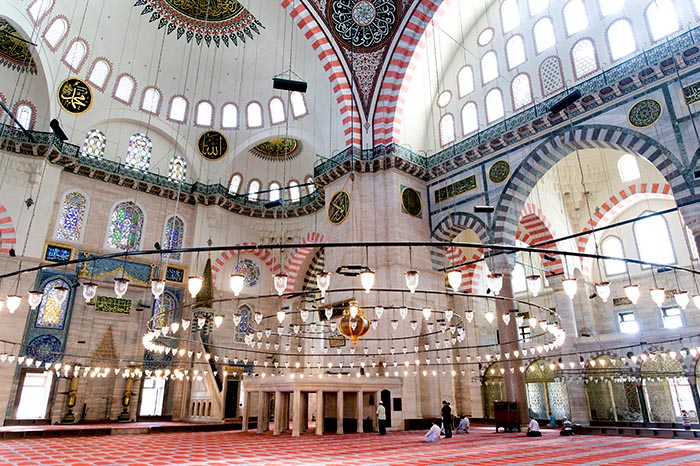
Suleyman I, more commonly known as Suleyman the Magnificent or Suleyman the Lawgiver, commissioned the Suleymaniye mosque in the sixteenth century intending that it should surpass the majesty of the Hagia Sophia, a Christian Basilica built by the Byzantines ten centuries earlier. He had political intentions too. Its location on a hill made it visible from the Golden Horn and was a sign of Ottoman imperial power to the outside world. The view remains, but the empire began to decline early in the seventeenth century and ended in 1922.
Such mundane thoughts now receding, I entered the mosque’s white marble courtyard with its enclosed decorated central fountain which originally provided the believers with drinking water and water for ablutions but has not been used for centuries. Being the beginning of February, it was cold enough for snow to fall in Istanbul and I felt the cold acutely. Nevertheless, I made my way to the open-air ablution area between the side entrances to the main prayer space, facing the mihrab. The large stones directly beneath the cold-water ablution taps are noticeably worn away in parts as a result of centuries of ablution water falling on them. I happily watched my own ablution water fall there, then made my way into the mosque for the prayer, like the millions of believers before me.
for centuries we’ve
—come here to purify ourselves
——before surrendering to the Real
The inside of the mosque is a vast almost empty space. The sense of spaciousness and the feeling of lightness are reinforced by the architect Sinan’s success in incorporating into the walls the marble pillars which hold up the vast central dome and the light coming from over 200 windows, with those on the mihrab wall made of stained glass. The dome’s central cupola is painted predominantly in gold and beneath it there are 32 windows which contribute to the sense that the dome is floating and which help to illuminate the interior. The gold colour is repeated throughout the mosque’s interior and the white is repeated on the red and white arches and on the white marble of some of the interior walls. The sense of physical unity, spaciousness and beauty make it easier to perform the ritual prayer with khushu (the presence of the heart). But only perfect presence will enable it to ascend towards ‘the Throne’.
in that vast space
—the heart truly present
——might taste heaven
A haibun is a Japanese literary form that combines prose and haiku. The prose typically records an event or experience, and the haiku typically illuminates the prose.
The Surprising Words Spoken by Shams-i-Tabrizi
can you unlearn
—————everything?
can you like the sun
accept that the moon must
—————take over
—————sometime?
receive this from me
when you have reached
the invisible border
—————feel the life
—————within your life
follow where it goes
and you will meet
—————the living Mohammed
when you are
—————utterly speechless
he will show you
—————God’s secrets
and let you sip from
—————Al Kawthar
Al Kawthar refers to the abundance of good (spiritual and material) bestowed on the Prophet Muhammad, including the Revelation. It is also said by some commentators to refer to a river in Paradise granted to the Prophet. Travellers on the path can also, to some extent, experience spiritual and material blessings (guidance, protection, inspiration, livelihood etc) bestowed by God. In the Quran, the term is mentioned only in Chapter 108.
Iljas Baker is Scottish and lives in Nonthaburi, Thailand. His poetry collection Peace Be Upon Us was published by Lote Tree Press, Cambridge, UK at the end of 2022. His poems have appeared widely in poetry anthologies and journals and are always about essential things.
Image: The interior of the Suleymaniye Mosque, Istanbul. Photograph: Alex Segre/Alamy Stock Photo
FOLLOW AND LIKE US
@Beshara_Mag








——————————————
——————————————
——————————————
FOLLOW AND LIKE US
@Beshara_Mag
If you enjoyed reading this article
Please leave a comment below.
Please also consider making a donation to support the work of Beshara Magazine. The magazine relies entirely on voluntary support. Donations received through this website go towards editorial expenses, eg. image rights, travel expenses, and website maintenance and development costs.
READERS’ COMMENTS
0 Comments