
News & Views
Introducing… Many Beautiful Things: The Life and Vision of Lilias Trotter
Steve Scott presents a film on the extraordinary life and work of the Victorian artist and missionary, who set up a dialogue with the Sufi brotherhoods of Algeria
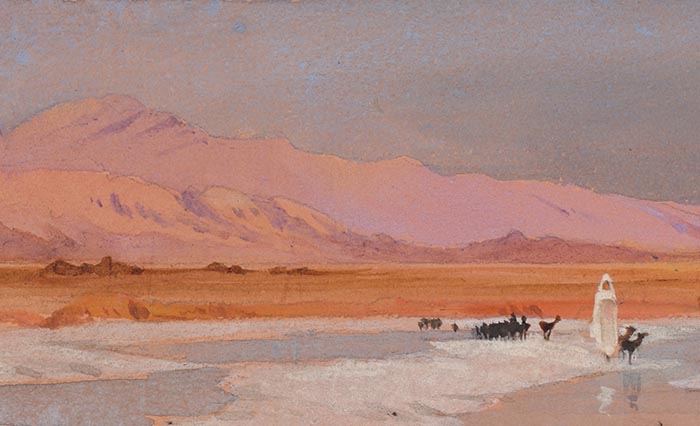
Lilias Trotter Goatmen at Sunset, used with permission of Lilias Trotter Legacy and Arab World Minsteries of Pioneers
Lilias Trotter (1853–1928) grew up in a well-to-do family in London and was a beneficiary of the privileges that go with such a life. She was privately educated by governesses, and she and her family enjoyed travelling in Europe. Her love of beauty was noted early on by those who knew her. It is reported that she burst into tears when she first saw the Alps. It was on another family trip, this time to Venice, that her artistic temperament and gifts were brought to the attention of a fellow tourist: the art critic John Ruskin. Lilias’s mother approached Mr Ruskin at breakfast with her daughter’s sketchbook in hand. As a result of that encounter, Ruskin became Lilias’s mentor, intent on making her a major artist; in fact, he believed that she could become the greatest living painter of her time.
But there were other threads and patterns in Lilias’s life. She lost her father to illness as a young girl of twelve. That cast a deep shadow, even then inclining her towards a more reflective and spiritual view of life. This reflective spirituality began to flower even more when the young adult Lilias began attending some of the ‘Deeper Life’ Christian conferences taking place at the time. As a result of this spiritual awakening, Lilias found herself drawn to the plight of the marginalised and impoverished women on the streets of London. Along with her own innovative efforts, she worked with organisations and ministries attempting to address their situation.
It was Ruskin who first began to sense that these threads and patterns were going to have a negative impact on Lilias’s artistic career. He was right. When Lilias felt compelled to go to Algeria as a missionary, this involved laying aside all thoughts of a career in painting. She was not deterred when a missions agency would not directly work with her because of a ‘pre-existing health condition’. She and two friends simply sold off what they owned and used the proceeds to travel to Algeria and begin a lifetime’s work among the Algerian Muslims – starting with learning the language and culture. The little ‘Algiers band’ of workers that formed around their efforts worked alongside established mission groups in addressing a variety of spiritual and social issues. Lilias found her own entrance into the Muslim community by working with the women and children. She also found a continuing outlet for her artistic gifts, adding drawings and watercolours to the letters she sent her supporters and illustrating the little books on spirituality she wrote during times of convalescence.
She continued to be drawn by beauty – this time the beauty of the landscape and the people she moved among. She also sensed the sincerity and depth of spiritual longing in her new companions and conversation partners, the Sufi masters she met in the Algerian desert, who, against all custom, admitted her to their brotherhood. Towards the end of her life, she wrote them a book: The Way of the Sevenfold Secret, wishing to build a bridge between the Jesus of John’s Gospel and the spirituality of the Sufi tradition.
Her remarkable life has been celebrated in this film, Many Beautiful Things, which presents many beautiful examples of her painting as well as extracts from her spiritual journals and letters. It is available on YouTube (see below) and Amazon Prime [/].
I wrote this poem inspired by Lilias’s life and art.
A Long Obedience
A blur of wings, a bird departs in flight.
A broken song, its slowly fading strain
delicate as the line that you might place
against the texture of a paper’s grain
as you begin a child’s face filled with light
or light that plays where fallen petals throng.
From a lake you have learned to be still.
Untroubled surface…that will pause, reflect
on changes that a passing breeze unfolds.
All these your eye will measure and collect
and learn to loosely hold inside until
the images reveal their deeper purpose
or unseal the patterns in the dance
of those who gather grain from open flowers
then scatter as they travel, with no thought
of how their work enriches future hours.
This grand design, sought with intelligence
and nurtured in a long obedience.
Video: Many Beautiful Things | Full Movie | The Life and Vision of Lilias Trotter; duration 1:10:22
You can learn much more about Lilias, her art and life at liliastrotter.com.
You can also go to the Ashmolean Museum Website [/] search ‘Lilias Trotter’ and see some of the sketchbook pages that intrigued John Ruskin. These are under lock and key ‘by request only’ for those that walk in through the door!
And lastly, here is a link to my own poetry and music project inspired by Lilias’s book for her Sufi friends. Click here [/].
The text of this article has a Creative Commons Licence BY-NC-ND 4.0 [/]. We are not able to give permission for reproduction of the illustrations; details of their sources are given in the captions.
More News & Views
Book Review: ‘spinning pinwheels’
Gabriel Rosenstock rediscovers kokoro (heart) in a new book by the distinguished Indian poet K. Ramesh
The Kogi: More on Munekan Masha
Luci Attala talks about the recent visit of the Kogi Ambassador, José Manuel, to the UK, and the latest developments in her work with these remarkable Indigenous people
Book Review: ‘Is A River Alive?’ by Robert Macfarlane
Peter Huitson reviews a book which explores the living presence of diverse rivers around the world and their power to heal and transform
The Voice in the Circuitry
Peter Huitson collaborates with T.B. Schenck to explore the possibility of divine influence in AI
Book Review: ‘Winter Light’ by Douglas Penick
Peter Huitson reviews a book which celebrates creativity and deepening perspectives in old age
Don’t Take It Easy
Richard Gault is inspired by Michael Easter’s book The Comfort Crisis and explores the idea of ‘misogi’ during a 600-mile walk across Scotland
FOLLOW AND LIKE US
@Beshara_Mag








——————————————
——————————————
——————————————
If you enjoyed reading this article
Please leave a comment below.
Please also consider making a donation to support the work of Beshara Magazine. The magazine relies entirely on voluntary support. Donations received through this website go towards editorial expenses, eg. image rights, travel expenses, and website maintenance and development costs.
READERS’ COMMENTS
1 Comment
Submit a Comment
FOLLOW AND LIKE US
@Beshara_Mag
What a beautiful film! What a beautiful soul it portrays – thank you!