
Arts & Literature _|_ Issue 30, 2025
Jethro Buck: Painting the Beyond
The renowned artist talks about the inspiration for his work in Indian miniature painting and the way these traditional techniques can bring us into a sense a deeper connection with the natural world
Jethro Buck: Painting the Beyond
The renowned artist talks about the inspiration for his work in Indian miniature painting and the way these traditional techniques can bring us into a sense a deeper connection with the natural world
Jethro Buck is a UK-based painter who has a special interest in Indian miniature painting, in particular applying traditional techniques to explore the natural world and celebrate its life and beauty. Educated at Falmouth College of Arts and the King’s Foundation School of Traditional Arts, he also spent several months in Jaipur studying with master painter, Ajay Sharma. In 2014 he received the Ciclitira prize for outstanding work, presented by HRH Prince Charles, and his subsequent work, presented at a series of sell-out solo exhibitions, is highly prized. He spoke to Jane Clark at the Crane Kalman Gallery, London, in November during his most recent exhibition, Nocturnes, about his evolution as a painter, how the Indian tradition differs from Western understanding of art, and how it can bring us into a deeper sense of our interconnectedness with Nature.
Jane: Can we begin by asking you about your background. How did you come to the create the art that you are creating now?
Jethro: Well, my dad, Michael Buck, is an artist, and from a young age he taught me how to see and to notice things. He would say things like: ‘Look at the way the light hits that tree.’ I thought this was normal, and it was only later that I realised that I had been brought up to always look at the world through a painter’s eye.
So when I Ieft school I went to Falmouth College of Arts, which was a great three years of my life. The nature of the art degree there was quite self-directed and more conceptually based than being grounded in any sort of traditional crafts as such. But I loved Falmouth and the wild seascapes there, and I had a great tutor, Lisa Wright, who really pushed me to devjbelop my art.
Jane: Can we begin by asking you about your background. How did you come to the create the art that you are doing now?
Jethro: Well, my dad, Michael Buck, is an artist, and from a young age he taught me how to see and to notice things. He would say things like: ‘Look at the way the light hits that tree.’ I thought this was normal, and it was only later that I realised that I had been brought up to always look at the world through a painter’s eye.
So when I Ieft school I went to Falmouth College of Arts, which was a great three years of my life. The nature of the art degree there was quite self-directed and more conceptually based than being grounded in any sort of traditional crafts as such. But I loved Falmouth and the wild seascapes there, and I had a great tutor, Lisa Wright, who really pushed me to develop my art.
After that I worked in a school as a technician in Oxford, and one Christmas I went to India for a holiday to visit a friend who was teaching out there. I was in Rajasthan, on a moped, going through Udaipur, and through an archway I saw some people doing miniature painting. I just thought it was absolutely incredible to see this ancient craft that was still being practised. Even though what they were producing was copies of copies for the tourist market, it was still based on ancient stories that went back beyond antiquity, and it felt alive somehow. They were grinding up pigments and mixing them, and using squirrel-hair brushes, which are tiny brushes which are taken from the palm squirrel, which is also called the Indian squirrel. You dip their tail in water and it goes into a clump with one single hair at the tip. You get an extraordinary level of detail with it.
I watched them for ages and I bought a couple of works. I was really drawn to it. So I went back the next day, and they kind of laughed at me and said: right, we’d better put you to work. They gave me a pestle and mortar to grind up the pigments, and then they very kindly gave me a squirrel-hair brush. At the time, this was back in 2011, I was preparing for an exhibition in Oxford at the North Wall in Summertown. I’d been doing quite expressive work up until then and my pitch to the gallery was that I was going to respond to the seasons – four seasons, big paintings. But it turned out to be a bipolar show, because when I came back from India I wanted to use this tiny brush that I’d been given and I tried to paint miniatures, memories of my trip. So I had all this big work on one side, and miniatures on the other. But it went very well. All the miniature stuff sold and people were intrigued by it. So I thought, I need to learn this properly.
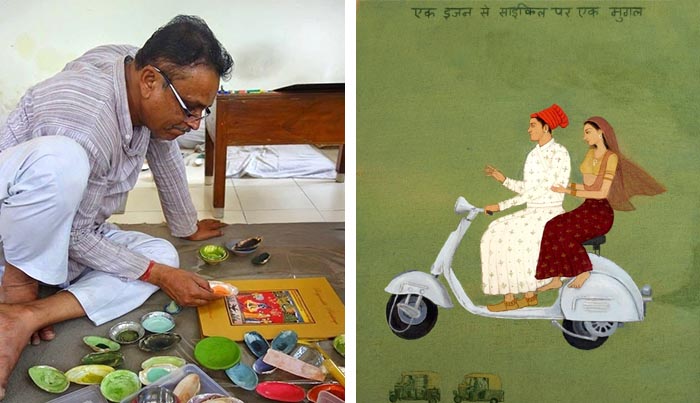
Left: Ajay Sharma in his studio in Jaipur. Right: Jethro Buck, Mughal on a Vespa, 2012 (Oil on Linen, 80 x 56 cm)
Training in an Ancient Art
.
Jane: So you went back to India to train with one of the surviving master painters?
Jethro: Yes. I applied for a grant from the Indian National Trust for Art and Cultural Heritage, which I got. But they said: it’s up to you to find someone to learn from. So then I spent a lot of time just sending out emails here and there. I got nowhere for ages, then I came across a woman called Olivia Fraser, who is a great artist herself. She’s the wife of the historian William Dalrymple. She was running these things called Wonderful Workshops [/] teaching miniature painting in Jaipur, so I emailed her and said: Rather than just do a workshop, I want to get an apprenticeship. She replied: Well, you need to contact this guy Ajay Sharma [/].
So I emailed Ajay and sent him a long CV, but I didn’t get a reply for a long time. At that point I started to get cold feet, because I had quit my job when I got the grant but I still did not have anyone to teach me. Ajay did eventually send me a response, but it just said yes, please, thank you. It was very indefinite. So I bit the bullet and just went out there and knocked on his door and said: Hi, I’m Jethro. We spent some time talking to each other, and then he gave me some Khariya (Kaolinite ), which is the white rock that they have around Jaipur – a kind of clay, basically, which you mix with the paint – and said: well, if you want to learn miniature painting, you need to mix this with your finger in a bowl and it needs to be this very specific consistency.
After that, I was just mixing white, which is the ground paint for everything, from nine to five every day. It was kind of crazy, but I accepted that that was the process of it, the patience required. I guess he was seeing whether I was serious. Once I got to know him a bit better, a couple of weeks later, I said: ‘Actually, I can’t believe you made me just mix paint with my finger all day’. And he said: ‘When I was 17 and just beginning, I did that for six months, mixing everyone’s paints’. So I asked: ‘Is it really necessary, then, to learn like this and not even pick up a brush for six months?’ And he said after a very long pause, with a laugh: ‘No!’ He was just kind of playing with me!
But the serious point is that learning these techniques is a lengthy process. If you want to do it in the traditional way you make your own paints, you make your own brushes, you make the paper, everything.
Jane: So the techniques have been handed down from master to student for hundreds of years?
Jethro: Essentially, they have remained largely unchanged since the time of the Moghuls in 17th/18th century. I guess that is what drew me to it all initially, because we don’t really have that kind of tradition in the West. We have things like icon painting and stained-glass window making, but with the miniature painting it feels as if there is more of a direct line back to the original masters.
In recent times the art lost some of its patronage in India and, as I said, it survived by producing copies of copies for a tourist market. But for some time now in Pakistan the National College of Art, the NCA, in Lahore has been running a BA course in miniature painting. It’s really quite innovative, making miniature painting relevant to the modern day, and it’s very popular. There is now the beginning of a resurgence in India as well. It has been alive as a tradition all along; it’s just that its patronage fell away for a while, but now there are lots of contemporary galleries starting to exhibit miniatures with a contemporary twist.
Jane: Are people still painting in the traditional way, using the original dyes for instance?
Jethro: A few are. As well as my own teacher, Ajay, there are a handful of others who are using colours derived from stones – lapis lazuli, malachite green, cinnabar reds. There are also the dye colours, indigo, madder and the earth colours like ochre. I think most people perhaps use ochres, but lots of people now use poster paint, so the quality has definitely gone down, I’d say.
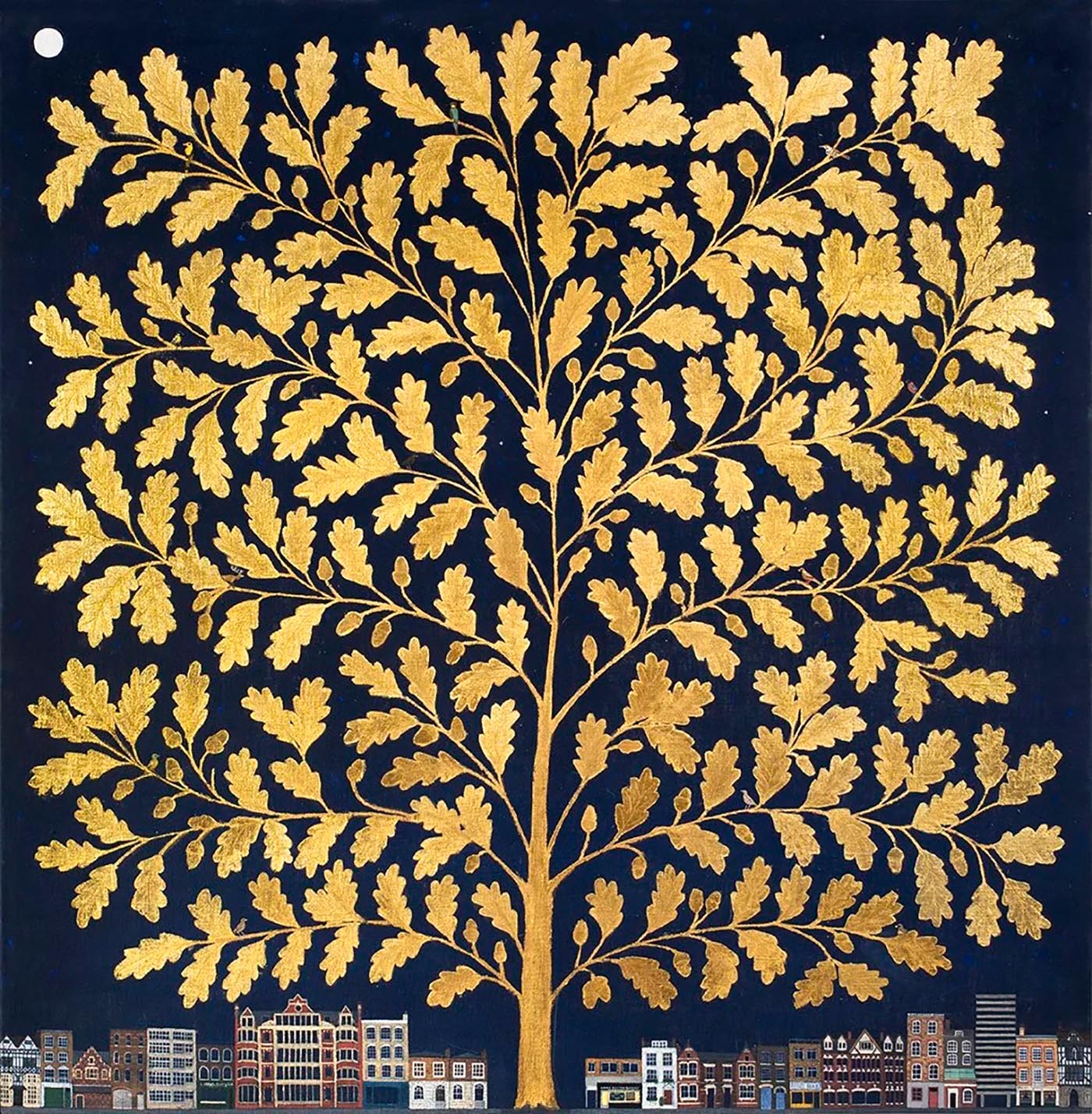
Jethro Buck, London’s Oak, 2019 (Tempera and 22.75 ct gold leaf on dyed linen, 121.9 x 109.7cm)
Move your computer mouse over image to enlarge
Painting the Archetypes
.
Jane: So after India, you continued your studies in London?
Jethro: Yes, I spent three months with Ajay and his wife Vinita, who is also a wonderful artist, and it was an incredible time that informed me of all these amazing ancient techniques. Then while there, I applied for an MA at the Prince’s School of Traditional Arts in London, now the King’s School, and spent the next two years there. I’ve been painting ever since – doing jobs in between but now, luckily, more or less full-time.
Jane: I believe that the School has quite a strong tradition of Persian miniature painting as well as Indian?
Jethro: The education at the School was fantastic because we spent a week on different kinds of sacred traditional art from around the world. So we learnt about Russian icon painting, Islamic geometry, Iznik tiles, and yes, Persian miniatures. We also learnt about Indian miniatures with a tutor called Desmond Lazaro. I learnt a lot from him. He’d done a similar thing to me, though a few decades before, when he’d gone, I think it was to Jaipur as well, and done an apprenticeship in Pichhvai painting, which uses similar techniques to miniatures but on larger cloths. He’d spent nine years there and has written an amazing book about the processes of it all.[1]
He was a great tutor to have. He taught us all to get in tune with the brush by doing some warm-up spirals, which are a symbolic way of coming into your own centre. You start on the outside and gradually come in. You’re mastering the brush, but you’re also trying to master your emotions and calm down and let the worldly hullabaloo outside settle You come into yourself and just focus. I still try and do that every time I start to paint; I do a few spirals and think of Desmond (see video right or below).
Video: Jethro paints a centring spiral. Duration: 0.39
Jane: Are these kinds of centring practices built into the Indian miniature tradition as well?
Jethro: He learnt this exercise from his own teacher, so yes, it’s all basically visionary work, especially the Pahari school [/] which is one of the schools from the Hindu kingdoms. Western art tends to be all about what we see ‘out there’, but this kind of painting is very much about finding the archetypes. Things are not just observed as they are in the West, where the focus is on what this tree looked like at this time, from this angle, when the sun was at this height– at least it has been since the Renaissance. This approach brings time and place and individualism to the figures, and they have shadows. Whereas in miniature painting and a lot of more ancient art, there are no shadows. Everything exists in the entirety of itself, and it is illuminated. The figures are alive in the painting, and they are therefore timeless and more symbolic, perhaps also more poetic.
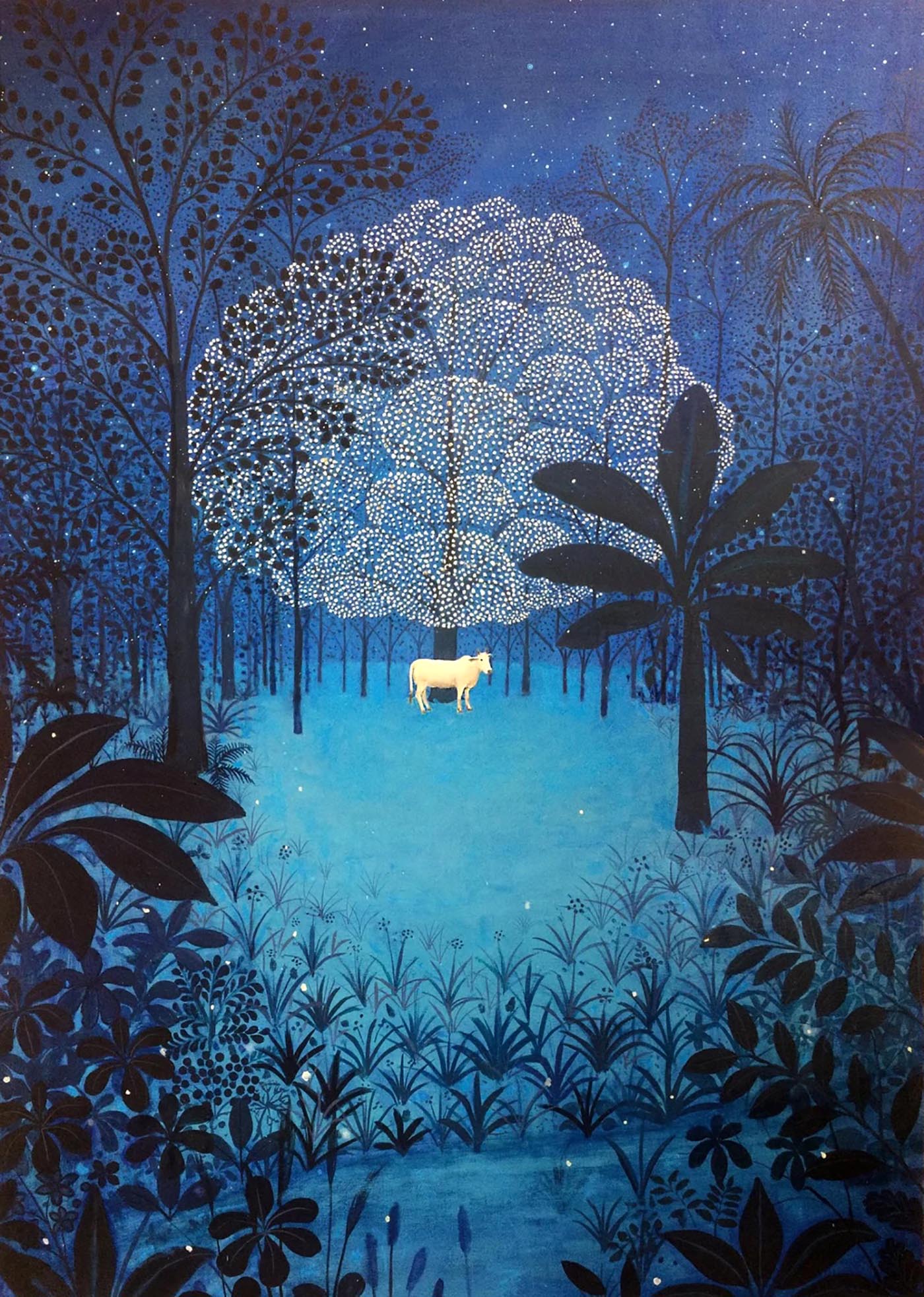
Jethro Buck, The Night of the Glowing Sembar, 2018 (Oil on Linen,140 x100cm)
Move your computer mouse over image to enlarge
Painting Nature
.
Jane: The Pahari School is very much devoted to portraying scenes from the great Indian epics like the Mahabharata and the Ramayana, but your focus is much more upon the depiction of nature.
Jethro: I just love the way nature is depicted in a lot of these paintings. It’s similar to maybe more medieval or early Renaissance work where rather than just painting nature, you become nature and the painting grows itself by following a process. It’s not just retinal like an aesthetic experience, but it grows from learning how to do it. When I was painting leaves, my teacher would say: ‘When you do the leaf and when you do the shading, you do one between two, one between two. Every successive leaf goes between the previous two. Just follow that rule while thinking tree-ness as you do it, and you will find that the tree will grow itself.’ It’s kind of a beautiful process and it’s less of a struggle than our way of doing things. There are certain principles you just apply – without it becoming too formulaic and repetitive – and then the process becomes naturalistic. It’s not realistic, it’s naturalistic, meaning that it becomes more in tune with nature rather than just focussing on what nature looks like.
Jane: It’s fundamentally a very different approach than, say, someone like Monet painting a haystack and trying to capture its essence by painting it at a series of different times. In fact, it’s almost the opposite of that.
Jethro: Yes, it’s trying to say: What is this thing always? What’s the seed of a mango tree? What are the genetics of it? If we put a mango seed in the ground, it will turn into a mango tree. In the same way, once you know how to you paint mango trees in this tradition, they will grow. Each one will be a slightly different – different artists do it in slightly different ways – but there’s a way to do it. It’s like a blueprint. In some senses, it is a language – a visual language that you learn cumulatively, like an alphabet and all the marks you make are calligraphic.
You have to master the brush, and in order to master the brush, you have to master yourself. So it takes ages to learn miniature painting properly. I haven’t really learnt it fully, to be honest, because I have not spent long enough doing it and I’ve still got my Western eyes. I paint things how they look. But even for a short time I was studying, it was a kind of self-development.
I was helping with a workshop recently, and somebody showed me some AI-generated miniature work, which at first I was fascinated by. It looked like a miniature painting that had been printed out. But although it looked like a miniature painting, it wasn’t. Obviously, it didn’t have the textures of hand-ground pigments, but more than that, the fact that it was an amalgamation of data that had been printed out made it feel horribly surfacy. It left a cold, empty feeling in me because I knew that no one had gone through any process to learn how to produce it. For me, art is a process of discovery of the world and myself, and it just feels a shame that AI can just quickly make something that looks like something, but it isn’t it. It’s not deep.
Jane: Even with Western paintings, there is huge difference between seeing reproductions of a painting and standing in front of the original. The state of the person is present in the painting in some indefinable way.
Jethro: Yes, definitely. This can especially be the case with the natural pigments. There’s a guy called David Cranswick who taught me all about the alchemy of the process of making paint and the journey that you need to go on in order to make a pigment. What is important is the journey, not just the destination. So when you’re making paint from a rock that’s come from the earth, you’re in conversation with it and you’re connected to that material. It’s akin to going on a pilgrimage and walking the whole way, rather than just getting on a plane and landing at a destination. If you just do that, you haven’t been through any of the processes of turning that blob into something.

Jethro Buck, Night Birds (Flying Over the Fire), 2025 (oil on canvas, 100 x 130 cms)
Painting the Beyond
.
Jane: In the work you are doing now, though, you are not just painting Indian miniatures in the traditional way. You are also painting as a Western person, coming at it from a different angle.
Jethro: Yes my current output is a result of all my inputs and experiences. Before going to India I was painting quite expressive large oil paintings, which is a completely different way of working and thinking to miniature painting, but the two ways both now inform my current work. The desire to learn miniature painting started off as a visual fascination, and yes, there was a part of me that wanted to learn as quickly as possible in order to then use the techniques for my own practice. It wasn’t until I began the journey that I realised that the value lies not in the eventual application but simply in the transformational process of studying itself.
My tutor Paul Merchant at the King’s School once said during a geometry class: ‘You don’t do geometry. Geometry does you’. The same could perhaps be said of learning miniaure paintng. I’ve become more and more interested in the philosophy behind the painting and so recently I’ve been studying the Hindu and Indian spiritual traditions alongside my art. So the path of miniature painting has led me to Vedantic ways of thinking, and this has given me a whole new lens through which to look at the world.
Jane: Can you say what sort of lens that is?
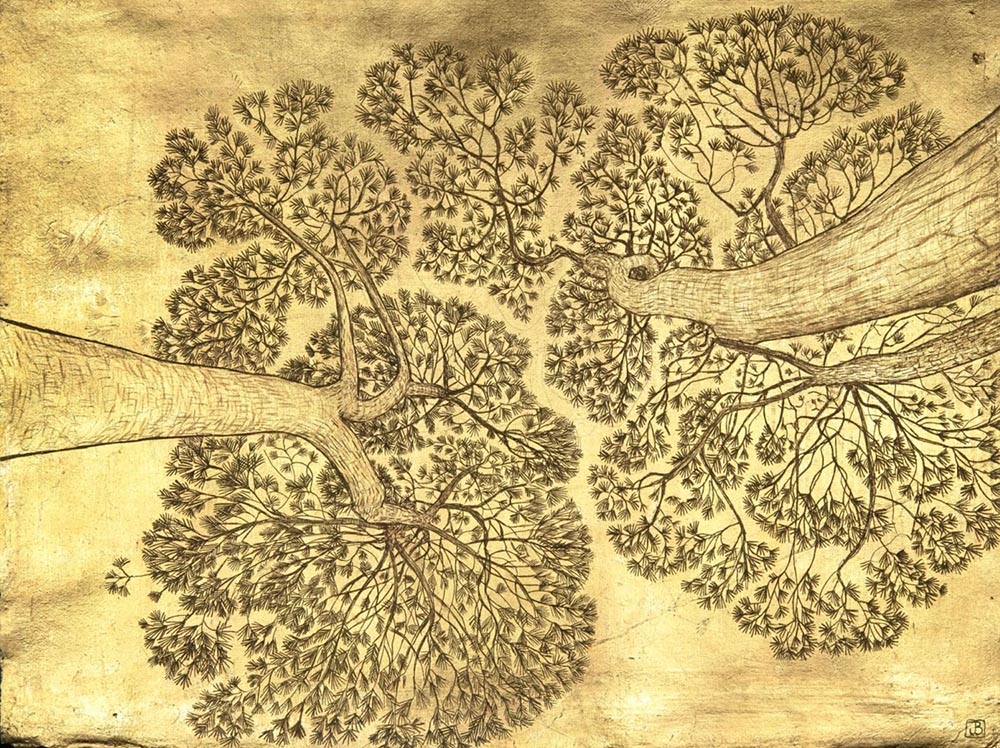
Jethro: Well, I don’t tend to talk about this very much, because I still feel like I’m on a journey to discover what it was all about. But in 2020, when I was studying in Spain, I had what can only be called a mystical experience in the woods, looking up at trees. I was looking up at the branches and they were vibrating and everything went completely gold. Everything felt gold. It was a strange experience, but ever since then, I’ve been fascinated by the question: what was that? Through Vedanta, I am realising that this kind of thing is what people are talking about, but it’s achieved through a much more systematic and disciplined practice, and the philosophy gives you tools to bring it back to the everyday.
One consequence is that I have been brought to contemplate the deeper reasons why I’m making this art. The way I think of art is summed up in the Alan Watts quote: ‘You are an aperture through which the universe is exploring itself.’ I feel that when I’m doing a painting, when I’m in that zone, I just forget myself for a moment. It feels similar to being in the woods and experiencing complete interconnectedness with it all.
I used to share a studio with another artist who said to me one day: ‘There is no art without ego’. That’s maybe true with modern art, including my own. But I remember thinking at the time: Well, that’s not what I feel when I go around the Alhambra. I guess they don’t call miniature painting ‘art’ as such; it’s more craftsmanship, and what I’ve discovered through doing the craft is the opposite of self-expression. You try and dissolve the ego through the doing, and let the craft talk for a bit. So I suppose I would say that for me, the process is of trying to connect back to nature through painting.
Jane: In the past few years, you’ve done several paintings which are almost precisely a depiction of your experience in Spain. There is one very lovely one in the present exhibition, for instance, which you have called The Luminosity of Being.
Jethro: Yes. For me, the gold represents that experience of oneness beyond the trees. And the trees – well, I keep coming back to the tree as a symbol, because it’s a great image for interconnectedness between nature and us and everything else in the world. The trees are all reaching up to that mysterious force beyond, which in Spain I saw as a golden light. So I’ve just left the centre gold, indicating the heart of everything, which is also the unknown.
I say that the trees are pointing towards this, but when you’re really in the zone, it’s not even pointing towards but, as I was saying about painting the leaves, it’s coming from it. Or at least feels more like that. In this particular painting I use a technique I have developed myself: I paint a dark background and gild it, and then the image is scratched through.
Jane: You use gold to indicate that which is beyond, but in your most recent exhibition, which had the title ‘Nocturnes’, you also use darkness.
Jethro: Yes. The unknowable. Several of the paintings are about the time beyond or around dusk, when the world and the busyness of the day is falling away and you’re left with just that nighttime glow and the blue light. I guess the dark sky is, again, that unknowable infinite space. You can see the cosmos through it.
Jane: Some of your paintings are like miniatures in their form – the way the trees are depicted, for instance – but they are actually very large. In this exhibition, there is one which is more than nine feet in height. So is there some meaning in the transition from the small to the large?
Jethro: Well, I’ve always liked either tiny paintngs or big paintings, although they work in very different ways. Traditionally miniature paintings were not meant to be hung on the wall. They were for holding in the hand whilst a story was being told and immersing yourself in the world that was depicted. Rather than glancing at the whole image in one go, the eye would move across a miniature in a way which was more like reading a map.
So small paintings occupy the realm of the imagination more, whilst big paintings sit in actual real architectural space more. A big thing on the wall can occupy your whole field of vision, so it can be intimate in a different way by bringing the subject matter closer to you.
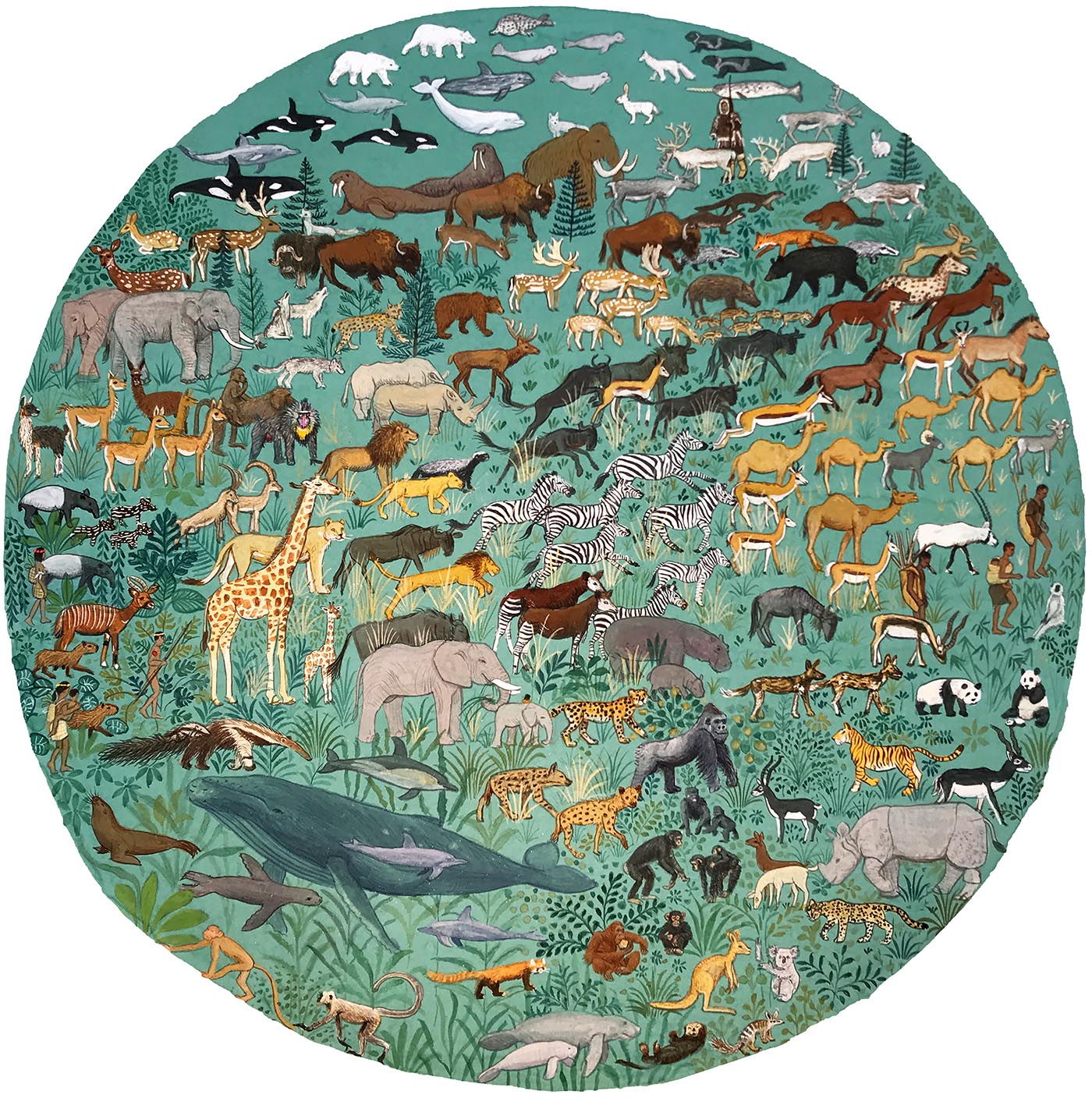
Jethro Buck, Mammals Past, 2019 (Gouache and natural pigments on hemp paper, 40×40)
Move your computer mouse over image to enlarge
Painting Animals
.
Jane: Another important strand of your work concerns animals and biodiversity. You’ve been working with the Environmental Justice Foundation [/] who are trying to protect the natural world, and a print of your painting Mammals Past is sold to support their work.
Jethro: This came about because one day I watched one of the David Attenborough documentaries, and the opening line was: If we were to weigh the biomass of all mammals, then only 4% are actually wild. About a third are humans, about a third are cattle and the rest are various types of livestock – sheep, pigs, camels, etc. (see here [/]). It’s quite shocking. So I made some pie charts to kind of bring home the point, one of which has that quite depressing tiny sliver of wild animals. Then I imagined the past, when we would just have been one of many mammals and we wouldn’t have taken up so much of the biomass. Then I did another in which I attempted to think of a positive future where we readdress the balance somehow.
Jane: In the print that is for sale in support of the Foundation there are just four tiny human beings in the midst of all the animals, which is how it must have been in the early days of humanity. Indian miniature painting, of course, has a strand of quite naturalistic painting of birds and animals.
Jethro: Yes, the Mughal emperor Jahangir commissioned a lot of paintings of animals. The artist Ustad Mansur was the best, who had bestowed upon him the honorific Nadir al-Asr, ‘Wonder of the Age’. And then later came the ‘company school’ paintings, when the British from the British East India company commissioned Indian artists to paint the flora and fauna of India. That was a coming together of Western thinking and Indian thinking, and I quite like that cross-pollination and the visual effects.
Although actually, I prefer the older Indian depictions of nature, even though in Mammals Past I’ve used quite a lot of photographic references and such like, so it looks less archetypal and more like realistic individual specimens from a scientific viewpoint. The more I look at miniature painting, the more I come to appreciate the older ways of thinking, where there is a bit more of a poetic representation of say, a bird. In Western and scientific studies, there is a sense of dissecting an animal and cutting it open – cutting a wing off, for instance, to figure out how it works. Whereas in traditional Indian painting, you’d always paint a bird with a tree because a forest isn’t a forest without birds.
In my recent exhibition, I did a painting called Animalia, which is a spectrum of animals in terms of rainbow colours, coming up with what I suppose you would call an artist’s taxonomy. Many of these life-forms are now endangered. So the painting is a celebration of all these miraculous ways that life has been formed and how we can reconnect with it – how we can keep these wild spaces and regenerate them. I love painting birds particularly because – well, it’s a good excuse to get the saturated colours out, and there are so many fascinating, incredible, colourful birds out there. And also of course they’re flying into the sky, so they are always symbolic of upward and looking up, leading the eye up to the canopy, which is leading us to things beyond. Heavenly creatures.
Jane: Thinking about to our relationship as human beings to the natural world, I have been intrigued by your painting Genesis, where you depict the creation of the world as it is described in the Bible – beginning with the void out of which everything emerges and ending with the formation of the human being. But instead of painting figures, you have represented humanity by the entirety of the painting. Can you say more about your intention in doing that?
Jethro: I thought painting humans at the top of the painting would look too simplistically hierarchical. I don’t think we are superior to other animals but we do seem to be more complicated. A fractal of the created painting inside the created painting seemed more appropriate to symbolise humanity and the creative impulse.
We humans seem to be the only species (amongst the other 8.7million others on Earth) that has the capacity to contemplate our own existence. We tell stories about it. We make art about it. This painting invites the viewer to potentially participate in a rare occurance in the universe: a moment when consciousness becomes conscious of its own consciousness. Maybe this is what art is all about?
We have the capacity to love the world on one hand but on the other hand we also have the unique capacity to destroy whole ecosystems, unlike other animals that seem to simply exist harmoniously with in them. We have choice.
So I think the art we make and the stories we tell are important. Art is culture’s way of describing itself to itself. I want to make art that nurtures the side of us that loves nature and hopefully inspires us to create systems that allow us to live more in balance with the miraculous wonder of it all.
Jane: Jethro, thank you for talking to us about your art and the very different perspective that the Indian tradition embodies. We are fascinated to see how your work will evolve in the future, and wish you all the best.
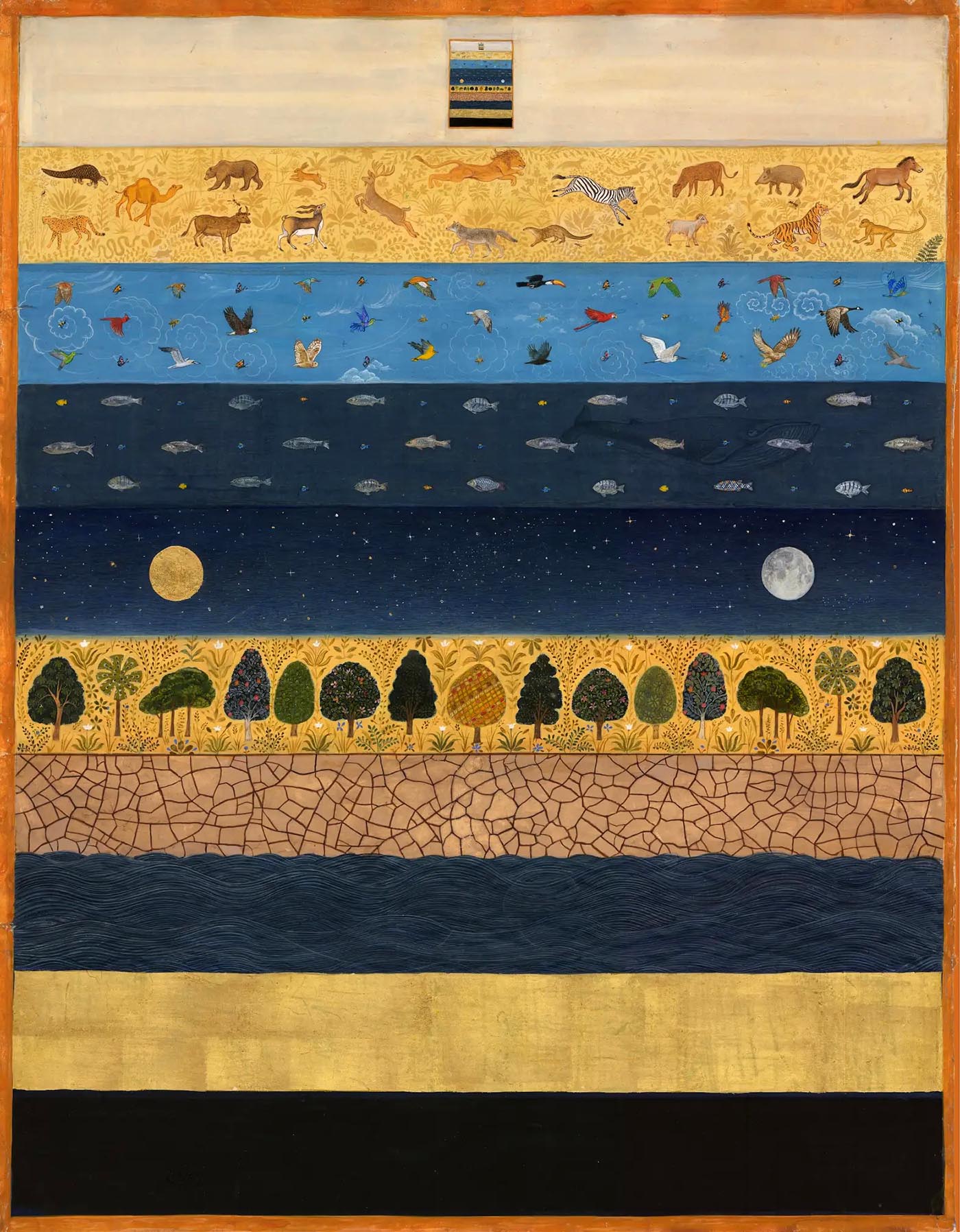
Jethro Buck, Genesis, 2015 (Pigment paint on Hemp paper, 90 x 60cm)
Move your computer mouse over image to enlarge
Image Sources (click to open)
Banner: The Luminosity of Being, 2025. Gold Leaf on Paper, 32 x 40 cm.
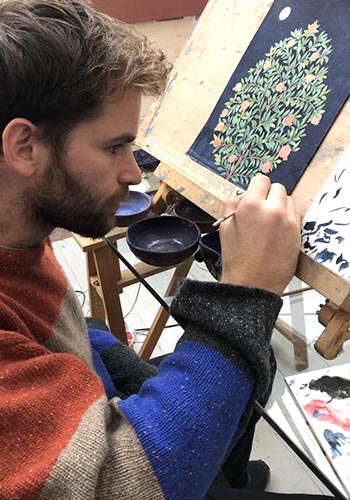
Inset: Jethro painting The Pomegranate Tree.
All images courtesy of Jethro Buck.
Other Sources (click to open)
[1] DESMOND LAZARO, Materials, Methods & Symbolism in the Pichhvai Painting Tradition of Rajasthan, (Mapin, 2005).
The text of this article has a Creative Commons Licence BY-NC-ND 4.0 [/]. We are not able to give permission for reproduction of the illustrations; details of their sources are given in the captions.
FOLLOW AND LIKE US
@Beshara_Mag








——————————————
——————————————
——————————————
Video: Jethro paints a centring spiral. Duration: 0.39
FOLLOW AND LIKE US
@Beshara_Mag
If you enjoyed reading this article
Please leave a comment below.
Please also consider making a donation to support the work of Beshara Magazine. The magazine relies entirely on voluntary support. Donations received through this website go towards editorial expenses, eg. image rights, travel expenses, and website maintenance and development costs.
READ MORE IN BESHARA MAGAZINE
Connecting with the Unseen World
Kira Perov, wife and long-term collaborator of the video artist Bill Viola, talks to Jane Carroll about the ideas and experiences which inspire their work
The Grandeur of the Night Sky
Hannah Dalgleish invites us to rekindle our ancient relationship with the night at a time when light pollution is becoming a global disruption
Keith Critchlow: A Life Well Lived
Richard Twinch pays tribute to the teacher and sacred geometer who died on April 8th 2020
Calligraphy – A Sacred Tradition
Distinguished calligrapher Ann Hechle talks about her lifelong quest to understand the underlying unity of the world
READERS’ COMMENTS
Wonderful article such a joy to see such beautiful work
Fabulous. Inspiring. I particularly liked the first and final images. However, I disagree with his words ‘I don’t think we are superior to other animals but we do seem to be more complicated.’ The difference is more than one of degree.
Very interesting and lovely. Thank you Beshara and all the best to Jethro. I too look forward to seeing how his work evolves.
Wonderful to hear about Jethro’s work and approach, and such inspiring paintings. Those night birds…the mammals…a transformative vision of the natural world.
Thank you for this informative article.