
Arts & Literature _|_ Issue 32, 2026
The Whole Earth is One Family
An interview with the Indian poet-author and diplomat Abhay K.
The Whole Earth is One Family
An interview with the Indian poet-author and diplomat Abhay K.
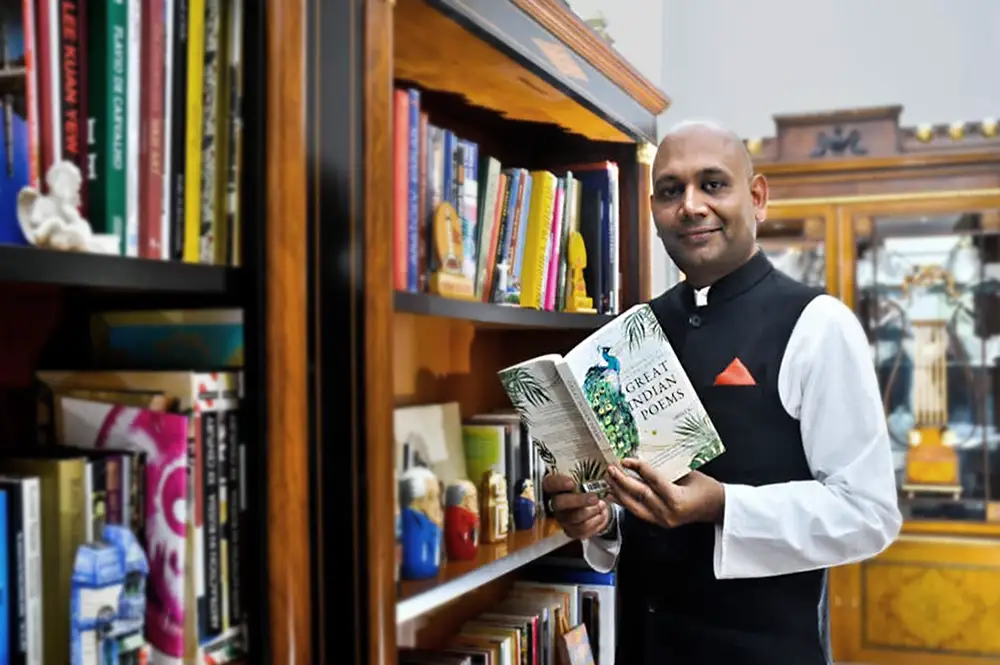
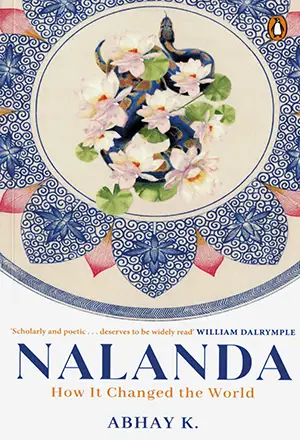
The Indian writer and translator Abhay K. is extraordinarily wide-ranging in his literary output. A distinguished poet with 13 published volumes of poetry to his name, he is the editor of several compilations of Indian literature (The Bloomsbury Anthology of Great Indian Poems, [1] The Book of Bihari Literature [2]), a translator of Indian classical literature (Fool Bahadur,[3] Hanuman Chalisa [4]), and the author of a best-selling history of India’s great ancient centre of knowledge, Nalanda.[5] He is best known perhaps for his poem Earth Anthem, which is widely sung during annual Earth Day Celebrations and has been translated into more than 160 languages. He is also a career diplomat who has served in Nepal, Moscow, Brazil, Madagascar and Comoros. He is currently the Indian Ambassador to Azerbaijan, and talked to Jane Clark and Uzma Chaudhry from Baku about the importance of remembering history, the way that cultures cross-fertilise and his belief that we are all part of one family – vasudhaiva kutumbakam.
Jane: Abhay, one of the problems we had when thinking about what to talk about in this interview is the huge scope of your work. You’ve written about the cultural history of India in your book about the great ancient centre of knowledge at Nalanda in East India. You’ve published several anthologies of Indian poetry and a compilation of Bihari literature. You’ve translated classical works of the Indian spiritual tradition into English, and you’ve published 13 volumes of poetry. You’re also a painter, and in fact, we first came to know you because we used one of your paintings of shunyata in an article in the Magazine.
So looking at this diverse body of work, we feel that there are two main themes which underlie everything you do. One of them is the continuing relevance of the ancient traditions of India to contemporary times. And the other is an understanding of the way different cultures interact and bounce off each other. And these two might very well, I think, boil down to one theme, as it’s always been a feature of Indian culture that it is – or I suppose we could say it was traditionally, because I think things are changing now – essentially a multicultural environment in which many different influences are synthesised.
Jane: Abhay, one of the problems we had when thinking about what to talk about in this interview is the huge scope of your work. You’ve written about the cultural history of India in your book about the great ancient centre of knowledge at Nalanda in East India. You’ve published several anthologies of Indian poetry and a compilation of Bihari literature. You’ve translated classical works of the Indian spiritual tradition into English, and you’ve published 13 volumes of poetry. You’re also a painter, and in fact, we first came to know you because we used one of your paintings of shunyata in an article in the Magazine.
So looking at this diverse body of work, we feel that there are two main themes which underlie everything you do. One of them is the continuing relevance of the ancient traditions of India to contemporary times. And the other is an understanding of the way different cultures interact and bounce off each other. And these two might very well, I think, boil down to one theme, as it’s always been a feature of Indian culture that it is – or I suppose we could say it was traditionally, because I think things are changing now – essentially a multicultural environment in which many different influences are synthesised.
So to begin with the first: why do you think that the ancient traditions continue to have importance today? Why, for instance, does what happened in Nalanda 1500 years ago still matter to us?
Abhay: Well, history is never history. The past is never past. This is something which I think we often try to forget. History repeats itself, and that’s why we need to know it. If we do not, we are prone to repeating it. Therefore, it’s very important to know what happened in the past. I come from Bihar, which is where Nalanda is, and I’m afraid that we did forget what it stood for and what its contributions were, and in doing so we lost a great heritage of knowledge. So the book I wrote on it is not just history, but it tells us how Nalanda changed the world in a concrete way. I try to figure out what were its contributions in shaping our modern world.
Jane: So what would you say these were?
Abhay: Nalanda was not just a great university; it was the place where the very idea of a university was born. It began as a Buddhist vihara in the third century BCE, during the time of Emperor Ashoka, and over a period of 800 years it gathered a critical mass of people who were thinkers and intellectuals. By the fifth century CE, it had become a full-fledged university. So at Nalanda, we see the idea of the university evolving, meaning that it was a place where everything was universal.
The admission process was universal in the sense that not only the children of kings and queens could go to a place of education but anybody could enter. There was someone at the entrance who engaged students desirous of being admitted in debate and discussion. If they were able to engage with him, they were let in – though the success rate was only 20% according to the historical records. So at Nalanda we saw, for the first time, democratisation of the admission process.
The second thing which happened at Nalanda was the universalisation of knowledge in the sense that everything was taught. It was not just Buddhist philosophy but also mathematics, astronomy, medicine – everything which was known to humankind was taught there. And the third universalisation was that the students and teachers could come from anywhere in the world. It was not restricted to a particular geography. At its peak, Nalanda had more than 10,000 students, and they did not only come from South Asia. They came from across the known world – from Sumatra, China, Korea, Turkey, Bactria, Central Asia and so on. So we have these three universals that established Nalanda as a university.
Jane: Another innovation that you mention is that Nalanda set the pattern for the physical form of universities, which is still, in fact, followed to the present day.
Abhay: Yes, it had what we call a courtyard plan. There is evidence of courtyards earlier in the modern period, meaning from the 3rd century BCE. You find them in Buddhist monasteries, but they were made of rock – cut into the rock face. What happens at Nalanda is the standardisation of the plan, where there is a courtyard of a certain shape and cells around it for the resident monks to live in. This architecture helps evolve a knowledge community where you have students staying in the cells and coming into the courtyard where lectures happen.
That courtyard plan was standardised at Nalanda, then it travelled to Central Asia where you see it, for instance, in the madrassas of the Islamic world. Of course, as they evolve they bring in local traditions, but the same basic form is kept. Then from Central Asia, they travelled to North Africa and from there to Europe. The first universities only appeared in Europe in the 12th century, and if you look at the architecture of the medieval colleges of Oxford and Cambridge, you will see that they are based on that same courtyard plan.
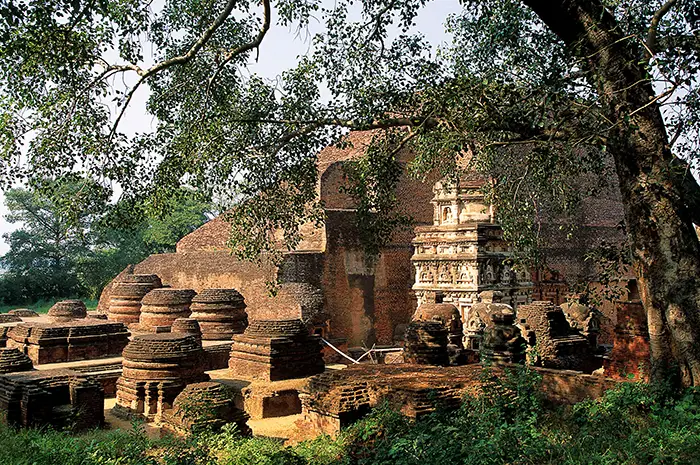
Remains of the great university of Nalandar in Bihar. Photograph: GOTIN Michel / hemis.fr / Alamy Stock
The Value of Debate
.
Jane: Looking at the principles behind Nalanda: the ideal was that knowledge was studied for its own sake rather than for getting a job or economic advantage. You’ve criticised modern-day education in the light of what you found out about it as being too utilitarian.
Abhay: That’s true. The goal of a monk in the fifth century CE, for example, was not to get a job, but to seek enlightenment, to seek knowledge, to seek an answer to the question: what’s the nature of reality? This is a fundamental difference from what we have in our universities today. Isn’t it more beautiful that the idea of a university is the pursuit of knowledge for knowledge’s sake?
Our universities today have become business centres where students are taking out loans to study for three or five years and then afterwards have to find jobs to repay them. So what kind of knowledge are we generating? So I think today we have lost that initial noble idea of pursuit of knowledge for itself, which gave us the foundation for science and technology.
Jane: The other thing that has interested us is your discovery that Nalanda established, perhaps for the first time, the principle of debate as a vehicle for learning. The idea of testing faith through reason and sorting out difficulties.
Abhay: Yes. Nalanda has made many contributions to world thought in science and mathematics – for example, the zero was invented at Nalanda and what we know as algorithms today, which drive artificial intelligence, actually began with Aryabhata there in the fifth century CE. But to my mind, its greatest contributions are not in science, although these things were truly transformative. Even greater is this fundamental belief in the value of debate and discussion and resolving conflicts without resorting to violence.
You know, when a Chinese traveller visited Nalanda in the seventh century CE, he wrote that in 700 years there had not been a single instance of a dispute having been resolved through violence. He was amazed at how the university had held to its tradition of debate and discussion.
Uzma: You talk in your book about the philosophy of Nagārjūna (150–250CE), the Madhyamaka or the ‘middle way’, which was very much associated with Nalanda. You also make quite a specific point that this was a place where intellectual and philosophical differences were celebrated. So I’m really curious about what you think it takes to create this environment in our contemporary times. What do you consider the etiquette of debating with one another, being able to sit with multiple truths and one ultimate truth at the same time? And why do you think this is important to attempt?
Abhay: Yes, it was an important feature of the education that monks had freedom of thought, expression and belief, and it was even the case, as you say, that philosophical differences were seen as a cause for celebration. The monasteries provided an atmosphere of freedom and tolerance where any dispute could be settled through debate using the recursive argument method. This marked the first step in the process of scientific inquiry, laying the foundation of science in the first millennium CE.
This is something which we can certainly learn from the first millennium as we are stepping into the third. Today, if there are major differences of opinion or belief, students are often expelled or asked to go back to their countries. There is so much intolerance and students cannot speak their minds. So I think this is something which we need to learn from the great Nalanda tradition and remember that the idea of university began with the principle that everybody is free to have their own beliefs.
How can we do this? Well, I think it’s fundamentally a matter of faith that if we sit together and debate and discuss, we will be able to resolve our differences. It might take longer, but we have to have the belief that there is another way – that we cannot use violence.
Jane: In your working life, you are a diplomat. So you are yourself presumably involved in conflict resolution, which is at the heart of diplomacy, is it not? And so can you say how this principle forged at Nalanda feeds into your diplomatic work?
Abhay: The essential job of a diplomat is to communicate and communicate clearly. Being a diplomat is a very special profession because you have to see the interests of both parties and meet somewhere in the middle – at the common point where the interests of both parties meet. There is a kind of golden negotiation point. So, I think that all diplomats are, in a way, followers of Nagārjūna’s Madhyamaka.
Video: Earth Anthem by Abhay K., sung by Kavita Krishnamurti and Bindu Subramaniam. Duration: 2:07
The Whole Earth is a Family
.
Jane: The other aspect of your work is the ease with which you move between different cultures and your awareness of the way the different traditions intertwine. For instance, your book Celestial,[7] which you describe as ‘a love poem to the universe’, consists of a hundred rhyming couplets, each one to a different constellation. You tell us that it was originally inspired by the poem Locksley Hall by Alfred Lord Tennyson, which was itself, I find, inspired by a translation of the Mu’qallāt – a series of seven pre-Islamic poems – by Sir William Jones [/], which was published in London in 1782.[8]
Then you have illustrated the book with drawings of the constellations by the 10th century Arabic astronomer al-Sufi, which is kept in the Bodleian Library here in Oxford, and which was based on the Greek cosmology of Ptolemy. So the book kind of embodies in itself the free flow of ideas across religious and political boundaries.
Abhay: Yes. And also, I should mention that I wrote the verses in Celestial while I was in Madagascar and looking at the sky every night.
Uzma: Your most famous poem is Earth Anthem, which has been used by the United Nations and is sung on Earth Day every year because it is such a celebration of multiculturalism.
Abhay: Yes. In that poem, I say: We are humans, Earth is our home, and all the people and all the nations, one for all and all for one. I feel at home everywhere in the world primarily because I see the whole planet as our home and humanity as our family. In the ancient Indian tradition, there is this beautiful saying: Vasudhaiva kutumbakam – the whole earth is one family, meaning not just human beings but in a sense that includes all other species – animate and inanimate, for example, oceans and continents, and so on.
This expresses my encompassing view. Therefore, I can move very easily from one culture to another, and that’s why I can see this interdependence or these interconnections, which have always existed in the world. For example, T.S. Eliot’s famous poem The Waste Land ends with a quote from a Sanskrit shlok.
Datta, dayadhvam, damyata. / Shantih shantih shantih.
Give, have compassion, exercise self-restraint. / Peace, peace, peace.
So we have this intertextuality because people borrow from each other all the time. Most of my books are actually dialogues. For example, my latest book is called The Alphabets of Africa,[6] where I have a dialogue with great African writers, for example, Chinua Achebe, the author of Things Fall Apart,[9] and the Kenyan novelist Ngūgī wa Thiong’o, among others. In my book The Alphabets of Latin America,[10] I have a dialogue with the Mexican writer Octavio Paz and Pablo Neruda and so on. Neruda was inspired by Rabindranath Tagore, and I think Tagore had a huge impact on him.
Jane: Having been to India myself, it seems to me that this is a particular characteristic of the culture – that it has the ability to absorb different influences almost without judging them.
Abhay: And not only absorb, but also to be absorbed by other cultures. For example, if you see Indians abroad, you will see them as the people who are most open to mixing. They are not the ones who are holding on to their own cultures or their own beliefs.
Jane: I think that you exemplify this very much; in each of the places you have been posted, you have written a collection of poems which respond to its particular culture and, as you have just explained, set up a dialogue with its literature. We have mentioned the ‘Alphabets’ of Africa and Latin America, but there is also, for example, a collection devoted to Moscow called Enigmatic Love,[11] and one devoted to Madagascar.[12]
Abhay: Yes, I found my latest book, The Alphabets of Africa,[6] particularly interesting to write because very little gets written about Africa, and within the continent itself there are so many different narratives. In the book, I try to explore it through space and time, from the deep history of Africa to present times, and to let the characters speak for themselves. This allows me to do more than a prose or history book could do. So Chinua Achebe comes to life and tells his story, or Ramses the Great complains about Shelley’s poem Ozymandias, refuting his ephemerality. It ends with the lines:
I am eternal, indifferent to time’s ticking clock
my monumental edifices, gigantic and tender
come now, behold my beauty and splendour
don’t despair, listen to my immortal voice
across the vast stretches of sand and rejoice.[13]
Uzma: One of the things I very much enjoy in your work is that you bring a lot of humour into it. I found that reading Fool Bahadur [3] – a Magahi novel that you have translated – as well. It’s a style of storytelling that you don’t find in English very often – a light humour that makes the story really authentic.
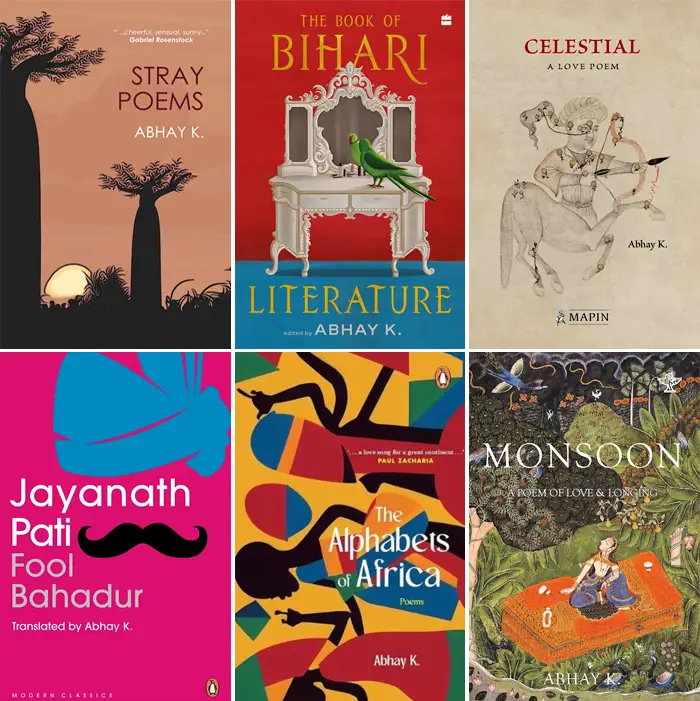
A sample of Abhay’s many published books. For a complete list, see his website: www.abhayk.com
Education and Background
.
Jane: Speaking of Fool Bahadur,[3] can you say something about your upbringing and how you’ve come to this universalist point of view? Bihar is your homeland, is it not?
Abhay: Yes, well, Bihar is a very special place. It was the capital of India for 1500 years, from fifth century BCE until the 12th century CE, so much of India’s history is actually Bihar’s history. It is perhaps most famous as the birthplace of Buddhism. It was where the Buddha grew up, and Bodhgaya, the great Buddhist pilgrimage site, is still in the state. But there are also many great writers like Chanakya, [/] and Vatsyayana, who wrote Kama Sutra, came from there, as well as Aryabhata [/], the person who gave us zero.
I grew up in a very ancient place called Rajgir, which is very close to the ruins of Nalanda, which are just about ten kilometres away. Rajgir is a special place in itself; it was the first capital of Magadh, which gave birth to the Mauryan Empire, and is near to Bodh Gaya, the place where the Buddha is said to have gained enlightenment. Rajgir is also an important place for the Jains. Many philosophers lived there.
I was born in Chhabilapur, near Rajgir. My father was a teacher – he taught in a primary school – my mother was a housewife. Actually, my first book, River Valley to Silicon Valley (2007) [14] was a memoir of my early years and three generations of my family. I did not grow up studying in an English medium school. Of course, I learned English in school, but I only really started learning it seriously when I was in college in Patna, which is the present capital of Bihar. After Patna, I went to Delhi, where I did my first and second degrees before joining the diplomatic service – ṭhe Indian Foreign Service. This has taken me to many different world capitals. I have served in Moscow and in Saint Petersburg. I lived in Nepal for three and a half years, then in Brazil and in Madagascar before taking up my present post.
Jane: We have spoken about the universalist perspective that permeates your writing, but you have also been concerned with bringing out the particular culture of your home state. You have edited The Book of Bihari Literature,[2] which brings this very rich literary heritage to an English-speaking audience for the first time and also translated Fool Bahadur,[3] which has been one of your most popular books.
Abhay: At home, my mother spoke Magahi, which is the local Bihari language, and my father spoke Hindi, which is like a pan-North Indian language. I had no idea, when I was growing up, that Magahi is something special. It was only when I was in Madagascar editing The Book of Bihari Literature, [2] which includes all sorts of works of Bihari literature – poems and prose – spanning over 3000 years and in several languages, that I realised that Magahi has its own literature. As you say, I ended up translating Fool Bahadur,[3] which was the first novel written in the language about 100 years ago. It’s the story of a lawyer in British India. Penguin has published it as a modern classic, and, you know, it feels as if the story was written yesterday; it feels so fresh. But I could only translate this treasure because of my mother, because she spoke to me in Magahi.
Uzma: I am curious about your mother, who you say was a housewife, as often there is a sort of cultural strength in having a mother who stays at home and preserves aspects of the local traditions within her home and in her own etiquette.
Abhay: Yes, this was very much the case. The Magahi language, for example, has been preserved by people who stayed back, so to speak, and who have remained rooted in their traditional culture – most of them women like my mother. Being in touch with the rest of the world, and with the changes that are happening around, is fine, but there are some people who resist this and they are the preservers of this kind of knowledge.
Jane: The loss of languages and the cultural heritage they embody is a very big issue these days, and it is very pertinent to India. According to the United Nations, there are 197 Indian languages that are considered endangered, although I note that Magahi is not one of them. Is this one of your motivations for the many translations and compilations you have either undertaken yourself or published?
Abhay: I think there is a quest by all of us to be recognised globally. We all desire that everybody should get to know about our language and our great works of art, whether they be poetry or prose, novel, short story or a poem. That’s what is driving the many translations which are appearing today, especially into English, which has become a kind of informal universal language. And the value of translations is increasingly being recognised; for instance, they are now eligible for a Booker Prize, which wasn’t the case up until recently.
This is how world literature is born, because world literature is nothing but translations. When local literature gets translated, and it is really good, it becomes part of world literature. And oddly, this can have a very positive effect upon the original culture, as often the people themselves did not value what they had. It took me years to find a book in Magahi, for example, but now that I have translated it, lots of people are interested in reading the novel written in its original language.
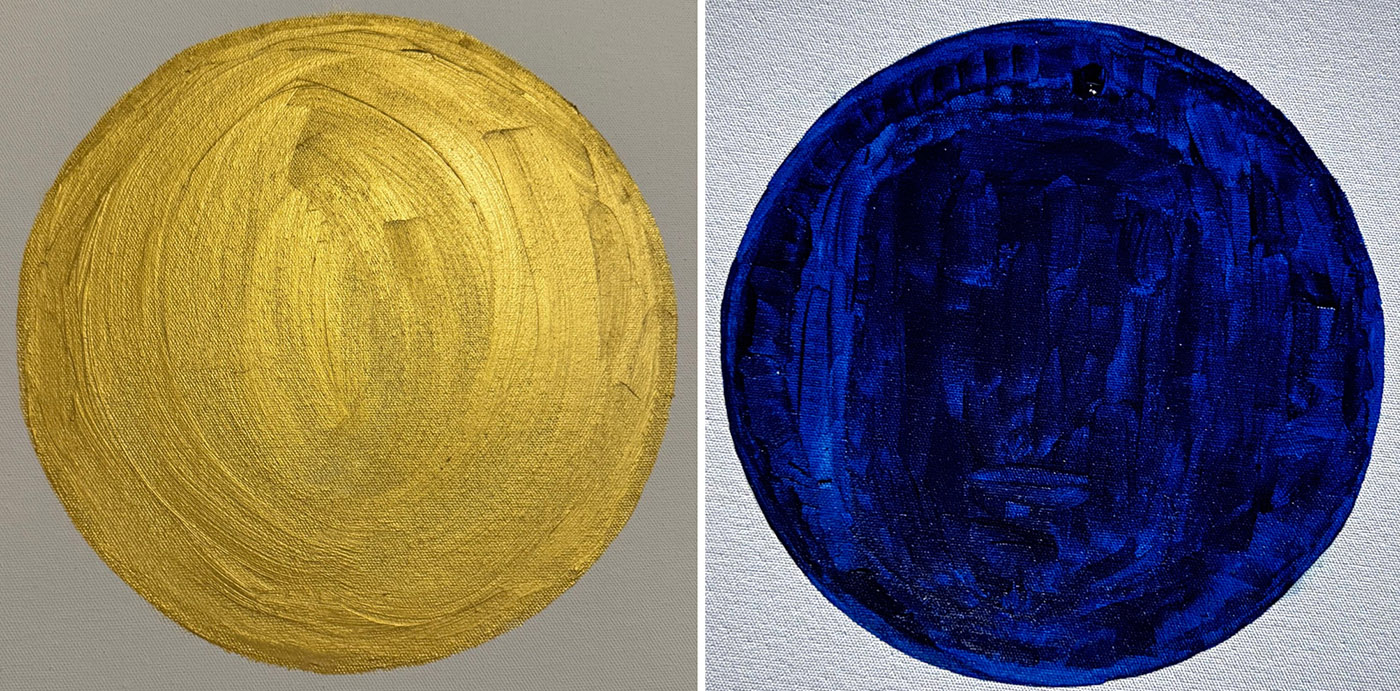
Shunyata
.
Uzma: So before we end our conversation, can we talk a little about your artistic work? You’ve had several exhibitions of your paintings, most recently at the Bihar Museum in Patna. Could you share a little bit about how you see the relationship between your writing and your painting, and what it is that you enjoy from the artistic process?
Abhay: Well, I started painting while I was in Russia, in Moscow and then in St Petersburg. I came across a lot of artists there, and one day, I just picked up a paintbrush and started painting on the back of some used chocolate boxes. One idea which I always had was about planetary consciousness – that we are one planet – and about putting the planet first. So I think that has always been the theme of my paintings. I borrowed the techniques from the Suprematists – in the sense that Suprematism [/] uses geometric forms and minimalism to tell the reality of things. The best-known figure in the movement, for instance, was Kazimir Malevich, whose most famous work was Black Square.
I did several exhibitions while I was in Russia, in Moscow and Saint Petersburg. And then later on, while I was writing Nalanda, I came across the idea of shunyata, which is a philosophy of Nagārjūna – it comes from the Heart Sutra. It indicates the essential emptiness or nothingness of all things. So I thought about how I might depict shunyata through painting, although I didn’t know how to do it. So I started painting – I just started making circles – and form started appearing on its own. It came as a surprise, just as a line comes to you in a poem as a surprise. So I continued sort of highlighting those forms which started appearing in these paintings. I did lots of those and eventually had that exhibition at the Bihar Museum. (To hear Abhay talk about this exhibition when it was exhibited at Alliance Française in New Delhi, see video below.)
Shunyata – paintings by Abhay K.
Move your computer mouse over the image to enlarge
Video: Abhay K. unveils ‘Shunyata’: A mesmerizing artistic journey into Buddhist philosophy. Duration: 4:32
Earth Anthem
by Abhay K.
Our cosmic oasis, cosmic blue pearl
the most beautiful planet in the universe
all the continents and all the oceans
united we stand as flora and fauna
united we stand as species of one earth
diverse cultures, beliefs and ways
we are humans, Earth is our home
all the people and all the nations
all for one, one for all
united we unfurl the blue marble flag
You can see the full range of Abhay’s work on this website: www.abhayk.com
Image Sources (click to open)
Banner: Abhay K., courtesy of the author
Other Sources (click to open)
[1] ABHAY K., (Editor) The Bloomsbury Anthology of Great Indian Poems (New Delhi: Bloomsbury India, 2020).
[2] ABHAY K,. (Editor) The Book of Bihari Literature (Editor) (New Delhi: HarperCollins, 2022).
[3] JAYANATH PATI, Fool Bahadur, translated by Abhay K. (New Delhi: Penguin Random House, 2024).
[4] TULSIDAS, Hanuman Chalisa, translated by Abhay K. (New Delhi: Bloomsbury India, 2025).
[5] ABHAY K., Nalanda: How it Changed the World (New Delhi: Penguin Random House, 2025).
[6] ABHAY K., The Alphabets of Africa (New Delhi: Penguin Random House, 2026).
[7] ABHAY K., Celestial (New Delhi: Mapin, 2023).
[8] SIR WILLIAM JONES, Poeseos Asiaticae Commentariorum Libri Sex, cum Specimine Variarum Lectionum (London: W. Bulmer, 1774).
[9] CHINUA ACHEBE, Things Fall Apart (London: Heinemann, 1958).
[10] ABHAY K., The Alphabets of Latin America (New Delhi: Penguin Random House, 2026).
[11] ABHAY K., Enigmatic Love: Love poems from Moscow (New Delhi: Bookwell, 2009).
[12] ABHAY K., The Magic of Madagascar (Bilingual edition in French and English) (Paris: L’Harmattan, 2021).
[13] ABHAY K., The Alphabets of Africa.
[14] ABHAY K., River Valley to Silicon Valley (New Delhi: Bookwell, 2007).
The text of this article has a Creative Commons Licence BY-NC-ND 4.0 [/]. We are not able to give permission for reproduction of the illustrations; details of their sources are given in the captions.
FOLLOW AND LIKE US
@Beshara_Mag








——————————————
——————————————
——————————————
FOLLOW AND LIKE US
@Beshara_Mag
If you enjoyed reading this article
Please leave a comment below.
Please also consider making a donation to support the work of Beshara Magazine. The magazine relies entirely on voluntary support. Donations received through this website go towards editorial expenses, eg. image rights, travel expenses, and website maintenance and development costs.
READ MORE IN BESHARA MAGAZINE
World Literature Decentered
Ian Almond talks with Jane Clark about a more inclusive approach to comparative literature, and the cultural traditions of Turkey, Mexico and Bengal
A West-Eastern Divan for Our Time
Robin Thomson describes a project that has brought together poets from around the world to honour Goethe’s ground-breaking tribute to the Hāfiz
Book Review: spinning pinwheels
Gabriel Rosenstock rediscovers kokoro (heart) in a new book by the distinguished Indian poet K. Ramesh
READERS’ COMMENTS
0 Comments