
Metaphysics & Spirituality _|_ Issue 32, 2026
Jung in the 21st Century
A conversation with Mark Vernon about the heritage and continuing influence of the famous psychotherapist
Jung in the 21st Century
A conversation with Mark Vernon about the heritage and continuing influence of the famous psychotherapist
Carl Jung (1875–1961) has been a seminal figure for our contemporary culture, and many of his insights – the collective unconscious, synchronicity, the notion of the archetypes and individuation – have entered into common currency. More than a hundred years after his first books appeared, how are his ideas holding up? Mark Vernon is a practising psychotherapist, broadcaster and student of the perennial wisdoms who has published books on Dante,[1] William Blake [2] and Owen Barfield.[3] In April this year, he gave a nine-part lecture series for the Pari Centre entitled ‘The Armchair Guide to Jung and God’, in which he revisited Jung’s legacy in the light of current developments in science and spiritual understanding. In this conversation, he talks to Jane Clark and Peter Huitson about some of his conclusions, touching upon the phenomenon of synchronicity, the revelations of The Red Book and the meaning of UFOs along the way.
Jane: Jung’s central point – made over and over again in his many books – was that people in the modern West have lost contact with their own souls, meaning that they have lost touch with the unifying, life-giving currents of the spirit. This has led to a state of alienation, depression and anxiety at a personal level, and at a social level it has manifested in behaviours such as rampant consumerism and the embrace of fascism and such like.
It seems to me that whatever one might think about his specific therapeutic techniques, this analysis was spot on. And even though lots of people have taken up his ideas, and science in particular has moved on – it is no longer the very hard-nosed materialist discipline it was – the things that he saw at the beginning of the 20th century about anxiety and alienation are even more prevalent now than they were in his time. We are currently in the midst of what many people see as a mental health crisis in Europe and the USA.
Jane: Jung’s central point – made over and over again in his many books – was that people in the modern West have lost contact with their own souls, meaning that they have lost touch with the unifying, life-giving currents of the spirit. This has led to a state of alienation, depression and anxiety at a personal level, and at a social level it has manifested in behaviours such as rampant consumerism and the embrace of fascism and such like.
It seems to me that whatever one might think about his specific therapeutic techniques, this analysis was spot on. And even though lots of people have taken up his ideas, and science in particular has moved on – it is no longer the very hard-nosed materialist discipline it was – the things that he saw at the beginning of the 20th century about anxiety and alienation are even more prevalent now than they were in his time. We are currently in the midst of what many people see as a mental health crisis in Europe and the USA.
Mark: The ideas of the psychoanalysts have clearly been very, very successful. They really have become part and parcel of how we understand ourselves now. But I think there is an ambivalence in Jung himself – a tension between being what he called an ‘empirical psychologist’ and a spiritual leader – and this is the reason why his ideas have not really reached out into the broader culture as much as they might have. He wanted to present psychology as an empirical science, so he tried to find evidence and coherence so that the things he describes might qualify it as a science. He often said that his task as an empirical psychologist was just to comment on what he saw when he was working with people one-on-one. But that leads him to a kind of uncertainty about the status of what he’s describing – I mean the ontological status.
So is it, for example, that God is just what he would call an imago, a feature of the human psyche? Or is the human psyche in some kind of relation to an objective deity – something that is more than just the human psyche, maybe even more than the psyche of the world itself? And I think the trouble with that ambivalence is that if psychology, or the psychological therapeutic process, is not itself seen as a reflection of a wider vitality, then it serves just to cut us off even more – to turn, as it were, in on ourselves. So I think that is a major tension in Jung which is a real factor when we consider his legacy.
Jane: You are referring to the tendency in modern Western societies to relegate things like religious belief – spirituality, the finding of meaning and such like – to the private realm. We don’t see these as being in the public sphere, in the same way as Christianity used to be when it was a generally-shared belief and so had a social presence, but they are restricted to the inner, private world of the individual.
Mark: Well, in a way things are in the public realm. I mean, we live in a world where the imagination, for example, is absolutely everywhere. You can barely look at a single surface these days without at least some sense of it being designed, whether for utility or for beauty. The trouble is that there’s very little coherence, or at least any coherence other than that provided by, say, consumptive impulses or utilitarian purposes. There isn’t a vision of unity that comes from what would traditionally be associated with the divine or God such that all that we do is seen to be in the service of a wider vision. Instead, there’s this privatisation, to reflect your use of the word. Everything is presented in relation to our private pursuits rather than some kind of wider reality that makes our lives meaningful.
Jane: But in your lecture series you indicated that Jung did develop some sort of a metaphysic. For instance, he challenged the Descartian view that the inner world and the outer world were completely separate and different, non-interacting realms; he posited the idea of the unus mundi, which is the underlying unity, the reality, which unites the interior and the exterior, and saw the archetypes as what you described as ‘the organising principles of this one substance’. He also put forward the idea of the collective unconscious, which challenges the idea that we are all stuck in our own isolated sphere of consciousness, and of synchronicity, which is a very direct demonstration that what happens in the interior is also reflected in the exterior. Is that not sufficient to count as a metaphysical vision?
Mark: Again, I think it goes part of the way, but not the whole. With synchronicity, I think he got very drawn into trying to prove that individual synchronicities occur. So in the life of an individual person, he wanted to show that they may receive images, for example in dreams, that they couldn’t possibly have witnessed in their lives, and he believed that those images came from a collective unconscious that would manifest, say, in older religious traditions or in alchemical texts. There’s something valid in this kind of quest for evidence. But the trouble is that what he meant by synchronicities are exceptional experiences. They come to us in exceptional moments, which is what gives them great meaning for the person because they say: Gosh, how did that happen? That’s unexpected! They are out of the ordinary, and scientifically, that makes them statistically negligible because by definition, they’re not the norm.
Jane: In the most famous case that Jung describes – where a patient was describing a dream in which she had been given a scarab beetle, and scarab-like beetle flew into the room – was certainly like that. Its very unexpectedness was what allowed her to a break through to a deeper level of understanding.
Mark: Yes. But, having said all that, I think it is possible to go through Jung’s work and put together an implicit metaphysics that isn’t always fully expressed. This is what Bernardo Kastrup has done in his book Decoding Jung’s Metaphysics,[4] where he makes the case that Jung is a kind of objective idealist. Not everyone would agree with Bernardo’s conclusions. I personally find them quite compelling, and I think what is implied is that Jung wanted to create for the modern world a model which would have been similar to the one we had in, say, the medieval world of Western Europe – what C.S. Lewis called ‘the discarded image’.[5]

The golden scarab beetle, Khepri, was regarded as a god in ancient Egyptian religion, representing the rising or morning sun, and by extension, transformation and the creation or renewal of life. Jung’s most famous example of synchroncity was an incident with a patient involving a such a beetle. Photograph: jvphoto /Alamy Stock Photo
A Sympathetic Universe
.
Peter: So what would you see as the difference between this model and the concepts that are prevalent now?
Mark: In this view, the fundamental connection between everything that exists is not actually material cause and effect. This does not mean that material cause and effect are not there, but as a mode of connection they are just one facet, or a small subset, of a wider way of connecting which was called ‘sympathy’. This was a much fuller kind of connection, and people would have experienced the world as a network of ‘sympathies’ that run through all things. It is because of this that beauty, for instance, is both a delight to the mind and a guide to the mathematician.
Actually, people are experiencing these sympathetic connections all the time, but I think that the only way really to make that robust metaphysically rather than just experientially requires some kind of theism, or monism, if it’s going to be part and parcel of a single vision. And Jung is always a bit ambivalent about that because of his ambivalence, particularly, about Christianity. He’s extraordinarily rich to read, and very, very suggestive all the time if you’re, say, a psychotherapist working with individuals. But quite how it translates into a worldview that might be shared by a culture is a more difficult question.
Peter: You say that he was ambivalent about religion, but towards the end of his life, in 1959, when he was asked by John Freeman in the famous BBC interview, whether he believed in God, he replied: ‘I don’t believe that God exists, I know it.’ [6] So I’m wondering if his position gradually changed throughout his life.
Mark: I think he did get more comfortable towards the end of his life speaking openly about what might be called, for example, the supernatural, meaning experiences that people have that can’t be accounted for by the natural sciences. And actually, that acceptance was present throughout his life; his PhD was on the supernatural as it was encountered by his niece, who was a medium. So he was always interested in that sort of thing.
But it was how he talked in public that really mattered. So when you hear him say, ‘I don’t believe, I know,’ it begs the question of what that knowing was. Because it could be that he was just saying that I know that the imago, the god imago, is a powerful dynamic in people’s psyche. He didn’t need to believe that, as he had witnessed it so many times in his practice. Whether or not he’s saying he knows the God of Abraham, Isaac and Jacob, or was acknowledging the divine as Pascal put it, I think is another question.
Jane: I think this is an interesting point. When people like ourselves, who have a strong metaphysical grounding – such as I have acquired from reading the work of Ibn ʿArabi, or you have from your study of Greek philosophy and Dante – read Jung, we see a great many parallels. The idea of the unus mundi, for instance, which it is easy to correlate with Ibn ‘Arabi’s ‘unity of being’. So we can jump to conclusions about what he really believed. But what you’re saying is that what he himself produced is not strong enough or coherent enough to form the kind of metaphysic – a culturally acceptable metaphysic – that we need in the modern world.
Mark: Yes. For instance, the theology that follows from what Jung investigates and puts forward is much disputed. There are many Christian individuals who have written on Jung’s ideas and say that it’s very supportive of a Christian view of things. There are others who think that Christianity is the problem and maintain that Jung is saying something completely different; he’s saying that we need to go into the shadow of Christianity and it is there that the life of the culture will be found. These are very, very different conclusions. So people may agree with the analysis that a living relationship with the soul is the trouble we face in the modern world, but they can nonetheless go into very, very different directions about what follows on from that.
Peter: In his autobiography, Memories, Dreams, and Reflections,[7] he talks about love as being the quintessence of divinity itself. He says: ‘I’ve again and again been faced with the mystery of love and never been able to explain what it is. For we are in the deepest sense victims and instruments of cosmogonic cosmic love.’ [8]
Mark: I think that that kind of expression is completely genuine, and it’s part of what you might call the perennial philosophy that many different traditions would acknowledge. But nonetheless, it can still culturally take you in very different directions. Love, you might say, is how we might experience the divine. But quite what that says about God and God’s self is another question.
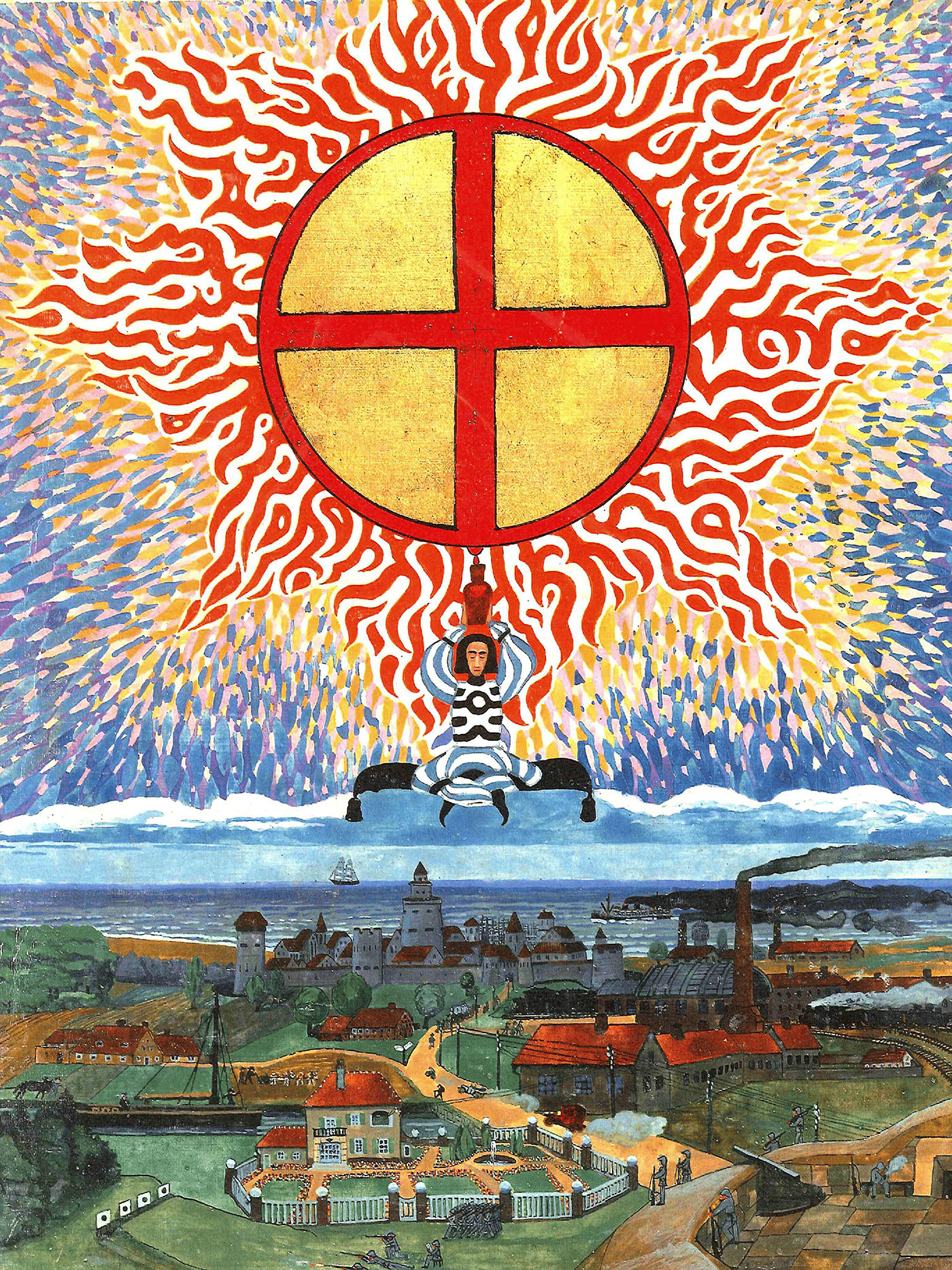
A page (125) from Jung’s Liber Novis (The Red Book), depicting the city of Basel in medieval times. From the Rubin Museum of Art, New York. Image: Album /Alamy Stock Photo
Move your computer mouse over the imagege to enlarge
Exploring the Unconscious: The Red Book
.
Jane: One of the main factors which has led to a reassessment of Jung’s position on these matters is the publication of the Liber Novis, commonly referred to a The Red Book, in 2009.[9] This is a record of his own experiences in the period immediately after his break-up with Freud, between 1913 and 1919, when he undertook an intense experimental encounter with his own unconscious. How would you see the impact of its publication?
Mark: I think it’s had a massive impact on people who are interested in Jung. It is a very intriguing and powerful document in terms of both imagery and words. On the one hand, it’s been very influential on what you might call the academic study of Jung – looking at his influences and tracing the development of his work and so on. Because he says that everything that he wrote after about 1919 followed from this confrontation with the unconscious, and The Red Book is the most developed personal manifestation of that confrontation, although he actually worked on it for years after 1919.
It’s also a very inspiring text. It’s one of those texts that when you read it, it kind of awakens a dynamic within you. Synchronicities abound in it; imagery abounds in it; different what you might call complexes or part personalities of the psyche abound in it. So to read it is to at least be intrigued about what’s going on inside your own world, if not to start having experiences which in some way parallel the experiences that Jung describes. It’s a very alchemical book – you might say ‘psychoactive’.
Peter: It was not published during Jung’s lifetime, and in fact he is on record as saying that he did not want it published at all.
Mark: Yes, I myself feel a bit ambivalent about it, because I think the fact that Jung himself did not want it published matters. There’s always a risk that it becomes a bit like a sacred text that people endlessly try to interpret as if that’s where they’re going to find meaning. Whereas really what we need to find is our own Red Book. This may involve writing, it may involve imagery, or it may be something completely different. But the point is to find some kind of locus for working out our relationship with all these archetypal forces and dynamics.
A culture or society needs its own Red Book as well. Again, I don’t mean a literal replication of what Jung did, but places and the ways in which it too works out these deep dynamics and archetypal encounters. We need the equivalent of the great cathedrals or the religious music or the rituals, the festivities, the patterns of the year, that was the dispensation in the Christian world – and of course in other parts of the world, we have a similar complex of places and rituals and festivals which are a living mode of working out what Jung is working out in The Red Book.
Jane: Again, we are talking about going beyond the merely private world so that these things are expressed or explored at a communal level.
Mark: Yes – although we’ve still got some aspects of it. A medieval cathedral will still inspire people when they visit it today. But it inspires them with a kind of nostalgic feeling, rather than being a living part and parcel of people’s engagement with the cosmos, as it presumably was for people that visited the cathedrals when they were first built.
Jane: I very much appreciate Jung’s insight that when we lose these modes of communal ritual and engagement which bring us into contact with living archetypes – when the things which used to be infused with energy and vigour kind of die on us – we turn to other modes of engagement which still have some life in them, even though they are essentially unable to bear the weight of our desire. So one of the examples is our focus on romantic love, which has come to carry a burden of expectation that should really be shouldered by the much stronger force of the spirit. I myself really love a good rom-com, but I notice that these days there are literally hundreds and hundreds of them on the streaming platforms; as a culture, we are obsessed with them.
Mark: That’s a very good example of how the problems of being human don’t go away; it’s a question of what a culture has to offer us as support in working through them. You can see things like rom-coms as an attempt to fill a vacuum as the old ways of engagement have died, and people strive to find practices that they can relate to. Jung himself would probably say that psychotherapy isn’t exactly in the same ballpark as the rom-com, but it could be seen as an example of the same kind of process. It can help people as individuals, but only up to a point. And that point is where the individual psyche connects with the wider interiority of the cosmos.
Peter: So this brings us back to our first point; that psychotherapy has become quite widespread in modern culture but doesn’t seem to impact the problems that the culture itself faces.
Mark: Yes. You also get a glimpse of the limitations of counselling when people are now sometimes prescribed an art course or gardening, or they go on a pilgrimage, and they find that that helps. So this is engaging with a kind of wider interiority, but the risk is that those methods then get psychologised in order to justify the money being spent upon them. So art might come to be thought of as a way to process your own behaviours rather than as a portal through which you make contact with a wider life. So we’re on a kind of edge, I think, with some of these things as well.
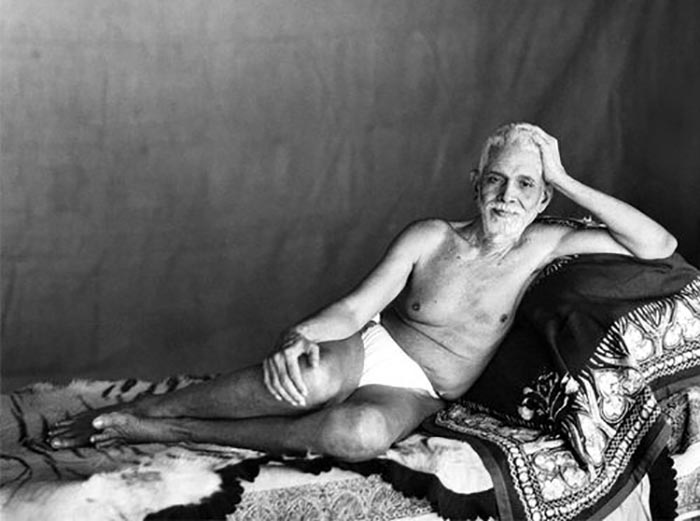
South Indian mystic Ramana Maharshi (1879 –1950) Photograph: Wikimedia Commons
Triangulating with Perennial Wisdom
.
Jane: We started off thinking about the relevance of Jung today and how important his work has been. But actually we’re discussing the limits of psychotherapy itself as it is practised in our culture. So is there any way that Jung’s vision could help us to move forward out of this situation?
Mark: Well, Jungians have a variety of responses to your question. And I think it’s important to say, first of all, that there is recognition of the situation in certain sectors of the community. James Hillman, for instance, coauthored a book in the 1990s called We’ve Had 100 Years of Psychotherapy – And the World’s Getting Worse.[10]
Jane: As I remember, his point was that therapy is basically helping people cope with an insane socio-economic system, and his solution is a political one – we need to change society as well as the individual.
Mark: For myself, I think that one way to respond to Jung is to embrace the darkness – that it’s only by going through the darkness that real life might be refound. It’s a kind of hero’s journey if you like.
But I think other Jungians say that we might turn to something which may be more familiar to your readers, which is the reality of the imaginal. That we can turn to this intermediary realm, rather as Jung himself did in his Red Book, and use his techniques of active imagination in order to engage with it more seriously – particularly with the images that come from the imaginal. You might say that this is a more positive way forward.
These people might go further and link all this to a wider metaphysics, maybe borrowing from Neoplatonism, which the imaginal can be made to fit with because the imaginal realm can be seen as a kind of emanation from the divine unity. This response means that we don’t need to remake our metaphysical understanding of things; we just need to rediscover it. Then Jung becomes a key facilitator of that rediscovery rather than an instigator of a new metaphysic.
Jane: That’s certainly a way of seeing things. But I understand that Jung himself thought that for modern Western people, mere access to the perennial traditions was not sufficient – that we need something else, even though he himself was very engaged in things like alchemy and making mandalas, etc. and saw their purpose and value. For instance, his reaction when he was in India and invited to meet the great mystic and teacher Ramana Maharshi [/] was to decline. It interests me to know why he thought this. But I aIso see that what he said is experientially true. Many of us who have been very deeply involved in studying the perennial traditions have also gone through some sort of psychotherapy or engaged in secular practices aimed at developing our self-awareness as well.
Mark: Well, me too, obviously. I mean, I sit in my treatment room with an image of Ramana Maharshi on the wall. I suppose that the way I relate to what you are saying is that what Ramana stood for and brought so palpably into people’s awareness needs to be somehow triangulated with my context now in the Christian world – though you might want to qualify that as a post-Christian world, or whatever; a Western world at least. And from those two things coming together, a new thing might emerge, a third thing.
It’s not that we, as it were, leave the West – as if we could just go to India and forget all that came before. Even the really devoted Western followers of Ramana, like Major Chadwick, who ended up living the rest of their lives on the ashram in Tamil Nadu, were still referring to Christianity and Easter and the crucifixion, etc. And Ramana said that to them as well – that this kind of triangulation can perhaps inspire a revivification of these things.
The way that Ramana’s teaching often comes into the West is to reflect on the ‘I’, on the nature of what it means to say ‘I am’. I’ve gained a lot from that kind of practice, but it also feels too much like a turn inward into myself. That’s because of the power that notions of the individual and individuality have in the modern Western world. This brings with it many, many good things – don’t think that I am entirely dismissing it – but it’s also entangled with the psychologisation of the individual, as if the individual psyche is a kind of world unto itself.
Jane: So how do you deal with that?
Mark: Well, the practice which has become personally important to me is a form of apophatic contemplation. Practically, it means that I use the medieval text, The Cloud of Unknowing, to shape my meditative practice. Essentially, it involves putting everything that you think you know, everything that’s happening to you, everything that’s coming through your mind imaginalisticly or whatever, into what the author calls ‘the cloud of unknowing’ and then sitting with what he calls ‘a naked intent’ towards the cloud. Everything goes into the cloud of forgetting, and then you sit in front of it, and for reasons I can’t fully articulate, it feels revivifying. It’s not, I think, the same as entering into the darkness because the darkness too would go into the cloud of forgetting, but it means that I have at least a regular period where I am turning towards the limits or the edges of what the culture knows.
Returning like this to the Cloud of Unknowing text feels like it has this impulse to move out of myself and find the interiority in other things, which is the divine interiority that’s in me as well. So it might seem quite unnuanced, but there’s something about the practice which is a ‘going out’ rather than a ‘turning in’. And somehow I feel that that really matters to me.
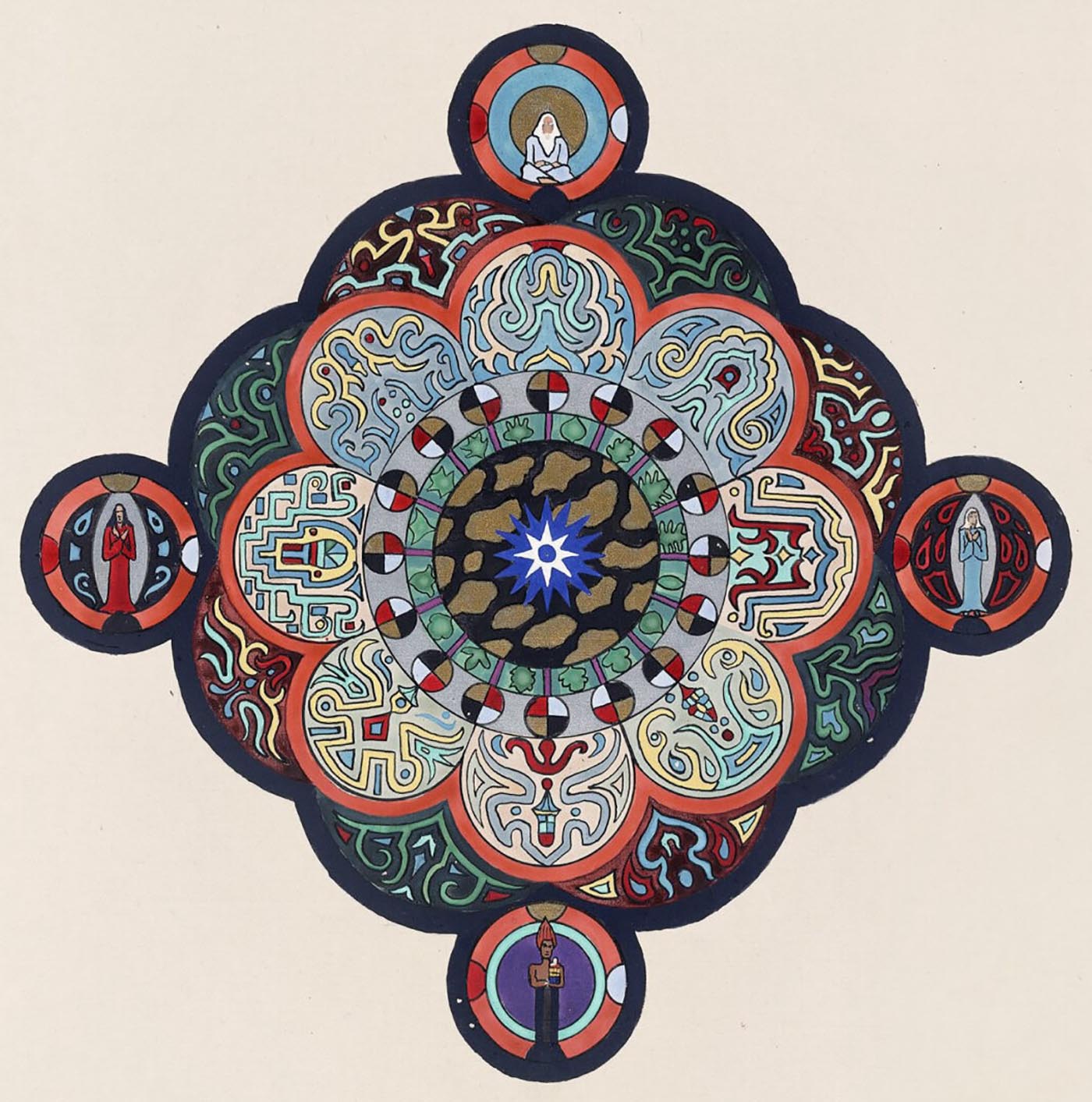
Mandala from The Red Book, p. 105, drawn by a patient. Jung described it as follows: ‘In the centre, the white light, shining in the firmament; in the first circle, protoplasmic life-seeds; in the second, rotating cosmic principles which contain the four primary colors; in the third and fourth, creative forces working inward and outward. At the cardinal points, the masculine and feminine souls, both again divided into light and dark’
Move your computer mouse over the imagege to enlarge
Finding the Centre
.
Peter: I think this kind of practice is very much about stepping into what I would call ‘the mystery’. But it’s also a receptive practice, as you’re opening yourself up to receiving the living archetypes – the cosmic currents of life which energise and enliven us.
Mark: It is interesting to mention the archetypes here, because I think this is an important area of Jung’s thought which needs to be understood in context. I feel that what we need now is to go beyond an interest in what you might call ‘penultimate things’ – I’m using here the distinction that Paul Tillich made between ‘ultimate’ and ‘penultimate’. It feels like a lot of psychology, a lot of modern culture, is very fascinated with penultimate things – meaning, things which are finite. The archetypes are one of those, showing us how various facets of inner life show up in external forms and in imaginal material and so on. These things clearly matter. It’s what makes for a life. But we also need ways of being concerned with ultimate things. In a classical theistic frame, these would be called the ineffable divine, the God that can’t be named – different traditions have different ways of putting it.
For this reason, I’m very interested in the way that Jung talked about mandalas. There was a period when he did a mandala every day. You know what a mandala is? It’s a pattern with a fourfold symmetry which is used in lots of Eastern traditions as a tool for contemplation. It was the detail that really preoccupied Jung at first, but then he reached a point where he suddenly realised that all that does not really matter as much as the centre. So in later life it was the centre of the mandala that drew him. I feel that being drawn to the centre, not just all the details of the patterning, is what we need as well, culturally.
Peter: Isn’t that what Jung discovered in his famous Liverpool dream? He had this at a very difficult time of his life, when everything seemed very dark and opaque. In it, he goes to Liverpool – he relates the ‘liver’ to the symbol of life, the pool of life – and wades through a load of grimy mess before he finds himself in the centre of the pool, where there is a wonderfully beautiful red magnolia tree. And he realises that he’s come to the centre and there’s no further to go. He drew a mandala of the experience in the Red Book and talked about it as a ‘vision of unearthly beauty’.[11] He was with other people in the dream, but none of them could see what he saw; they just saw the bad weather and the darkness.
Mark: Yes. So the question: ‘How our culture can see through to the centre?’ would be another way of putting the great challenge that we are facing now. How do we access the mystery that lies at the heart of everything?
Jane: Jung himself discussed this, I believe. He talked about the fact that we have difficulty in our culture dealing with what he called ‘the numinous’ – things which are mysterious or beyond our comprehension. We tend to shove these out of our minds rather than regarding them as opportunities for development.
Mark: Yes. Though in a way, I feel that we live in a culture that actually rather loves mystery. Look at the prevalence of horror movies or the public interest in the wonder of space flight that has been revived again this year. The dark side of the moon is obviously a very resonant sort of notion. But it’s almost like we don’t know quite what to do with it. The interest in the supernatural that informs horror movies tends to just be the psyche playing games with itself – giving ourselves a fright. It’s a fantasy rather than the imagination proper.
As for space flight, there’s a very telling thing that happens with astronauts when they come back from their trip. For many of the Apollo astronauts, it ruined their lives. There were 24 or so of them, and well over half of them went on to have serious problems; they became alcoholics, or they had various kinds of scandals. One way of understanding that is that you can have an experience of mystery that you don’t know what to do with. So seeing Earth rise over the lunar landscape might be so overwhelming that it haunts you rather than leads you anywhere. People have tried to say things about their feelings as they look back from space; oh, it’s a view of a united humanity and of the fragility of planet Earth and so on. Which of course it is. But I think that there is often a moral response – that we should do something about that, care for planet Earth or whatever – which clearly matters, but it’s not a soulful response.
So maybe this difficulty with mystery, even though it’s all around us, could be another prompt for development. And of course some of the Apollo astronauts found ways of dong this. Edgar Mitchell for instance went on to found the Institute of Noetic Sciences [/] specifically to explore phenomena which lie outside the remit of our current science.
Peter: All the spiritual traditions have the idea that we need to make ourselves capable of receiving the vision of God. In Christianity we talk of God as being a light so bright we can’t bear it. So I wonder if this is a capability that has been lost and needs to be refound?
Mark: Yes, I agree. In The Divine Comedy, Dante has experiences which can be correlated with what these days we call ‘overview effects’, where in the high heavens with Beatrice he looks back down and sees the Earth – ‘the puny threshing field’, he calls it. But what Dante has had is the great training with Beatrice, who represents wisdom, to have the capacity to witness that. And in fact, Beatrice warns him that he mustn’t look too soon. The myth that she refers to is when Semele asked to see Zeus and turned to dust. So this idea that you can see God too soon is definitely present.
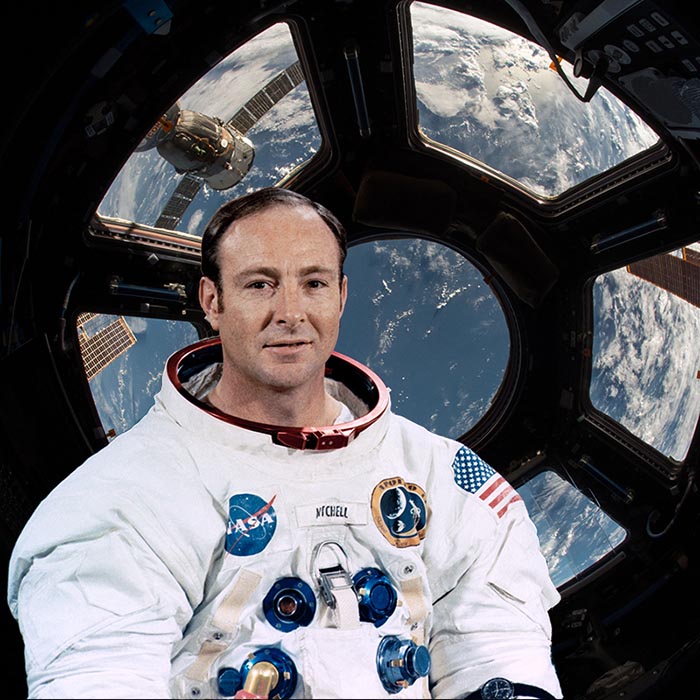
Edgar Mitchell, American NASA astronaut who, in 1971 as a member of the Apollo 14 mission, became the sixth person to walk on the moon. In 1973, he founded the Institute of Noetic Sciences (IONS) with the aim of exploring the boundaries of science, ‘inner space’ and consiousness. Photograph: Institute of Noetic Sciences [/]
Facing the Unknown
.
Jane: Talking of mysteries: I was fascinated to learn that right at the end of his life – he lived into the 1960s – Jung wrote about the phenomenon of UFOs.[12] This is another topic which has gained momentum in the last 60 years; we’ve just had the release of Spielberg’s Disclosure Day, for instance.
Mark: What he says is really worth pondering. He didn’t think that UFOs are extraterrestrials coming to visit us. Nor did he think that they are archetypes appearing in technological form, which is sometimes how he is interpreted. This is the idea that whereas our ancestors might have seen angels in the sky because of living in an enchanted world, we see technology in the sky because of living in a technological world. Rather, Jung argues that these kinds of mysterious appearances are a sign of transition – that they represent a breakdown of a worldview or a tear in assumptions about reality. So they are indicators of something new being born as well as something old breaking down.
I find that very fascinating, because while we’ve been saying ‘100 years of psychotherapy and things are only getting worse’, at the same time, I do believe that there’s something always striving to be born. I’m a theist and a Christian, so for me there’s always something in the divine presence that’s striving to be born. So trying to be open and receptive to what that might be, matters even more than getting troubled by what is going wrong.
I think the reason why UFOs can be useful is that they discombobulate us. We can’t put them into one box or the other. It doesn’t quite stack up to say that they’re extraterrestrials visiting us, nor does it quite stack up to say they’re products of the collective unconscious, projected onto the skies. It is that impossibility of understanding them that I think Jung was on to as well. It’s about being taken to an edge from which something new might become perceivable.
Jane: So where do you think we are now with Jung and his legacy?
Mark: I would say that on the one hand, as a working psychotherapist, Jung gives me lots of techniques and resources to bring to bear on the person that I am working with. I suppose that is a sort of toolbox kind of approach. He is immensely valuable in this respect.
But in terms of wider issues, I would say that we are left not with a finished project but with further work to do. I feel that much of what we need in our contemporary situation is not provided by Jung himself, but the work we have to do is deeply enriched by his own investigations and example; his confrontation with his own unconscious, his interest in the perennial traditions, his insistence on facing the unknown and mysterious. These are all things which can continue to inspire us today.
Jane: Mark, thank you for talking to us. It has been a fascinating discussion that I am sure our readers will want to continue in their own lives.

‘Pool of Life’; a mural created by Smug in 2022 on a wall in Liverpool to commemorate Jung’s ‘Liverpool dream’. Photograph: The Liverpool Echo
Image Sources (click to open)
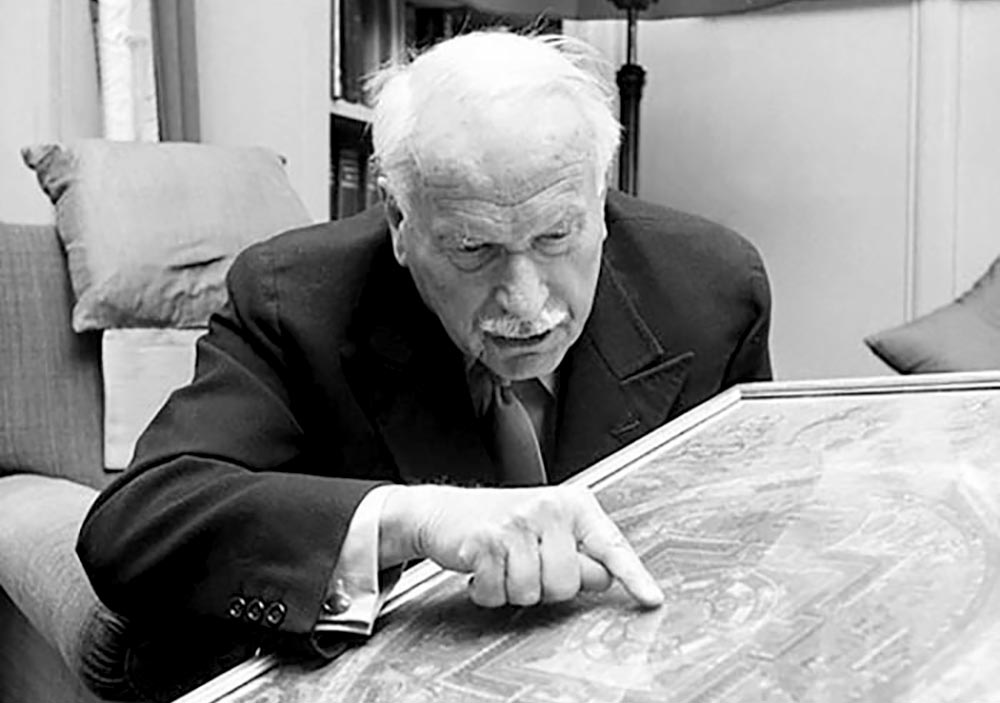
Banner: C.G. Jung pointing to the centre of a Tibetan mandala. Photograph: source unknown.
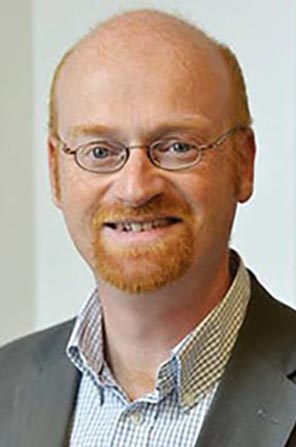
Inset: Mark Vernon, courtesy of himself.
Other Sources (click to open)
[1] MARK VERNON, Dante’s Divine Comedy: A Guide for the Spiritual Journey (Angelico Press, 2021).
[2] MARK VERNON, Awake! William Blake and the Power of Imagination (C. Hurst and Co Publishers Ltd, 2025).
[3] MARK VERNON, A Secret History of Christianity (Christian Alternative Books, 2019).
[4] BERNARDO KASTRUP, Decoding Jung’s Metaphysics: The Archetypal Semantics of an Experiential Universe (Iff Books, 2021).
[5] C.S. LEWIS, The Discarded Image: An Introduction to Medieval and Renaissance Literature (Cambridge University Press, 1964).
[6] CARL GUSTAV JUNG: Face to Face – The John Freeman Interview (BBC, 1959). See https://www.youtube.com/watch?v=ks9NR9KZeog.
[7] CARL GUSTAV JUNG, Memories. Dreams and Reflections (Fontana Press, 1995).
[8] Ibid, p. 387.
[9] CARL GUSTAV JUNG, Liber Novis (The Red Book) (Philemon Foundation and W. W Norton & Co, 2009).
[10] JAMES HILLMAN & MICHAEL VENTURA, We’ve Had 100 Years of Psychotherapy – And the World’s Getting Worse (HarperSanFrancisco, 1993).
[11] For a description of the dream, see Memories, Dreams, Reflections, pp.223-4. For Jung’s commentary, see Red Book (Liber Novus), p.217.
[12] CARL GUSTAV JUNG, Flying Saucers: A Modern Myth of Things Seen in the Skies (Routledge and Kegan Paul,1959).
The text of this article has a Creative Commons Licence BY-NC-ND 4.0 [/]. We are not able to give permission for reproduction of the illustrations; details of their sources are given in the captions.
FOLLOW AND LIKE US
@Beshara_Mag








——————————————
——————————————
——————————————
FOLLOW AND LIKE US
@Beshara_Mag
If you enjoyed reading this article
Please leave a comment below.
Please also consider making a donation to support the work of Beshara Magazine. The magazine relies entirely on voluntary support. Donations received through this website go towards editorial expenses, eg. image rights, travel expenses, and website maintenance and development costs.
READ MORE IN BESHARA MAGAZINE
The Image Bears Witness to Your State
Psychotherapist Sir Nick Pearson talks about his unique approach to healing based on an understanding of imagination drawn from the Sufi tradition

Mind over Matter
Scientist and philosopher Bernardo Kastrup discusses his critique of the materialist paradigm and argues that consciousness is the underlying reality of the universe

A Thing of Beauty…
Jane Clark contemplates the view of Earth from the moon, first captured in the famous photograph ‘Earthrise’

Podcast: Mark Vernon on William Blake
The philosopher, podcaster and psychoanalyist talks about his latest book Awake! William Blake and the Power of Imagination
READERS’ COMMENTS
A thoroughly enjoyable and illuminating read. The UFO element was particularly helpful – I and my 12 year old daughter (and a neighbour) saw a UFO many years ago. I’ve never had a satisfactory explanation of it until now. A technological’angel’ as a portent of change seems to be exactly what it was.