
News & Views
An Island to Myself by Michael N. McGregor
Robert Hirshfield talks to the author of a new book which explores the place of solitude in an active life
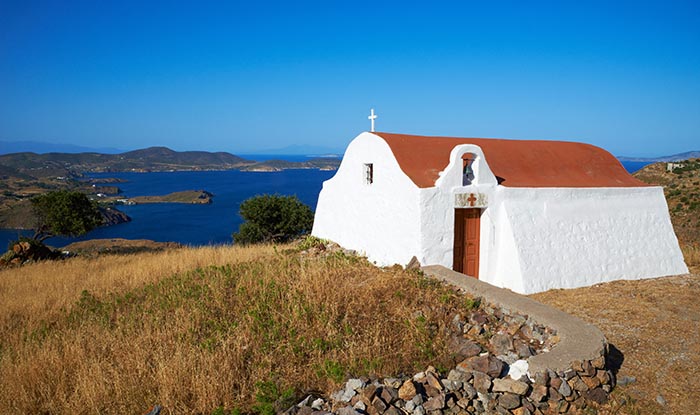
The Greek Island of Patmos, where McGregor spent periods of solitude in his twenties and sixties. Photograph: Tuul / Alamy Stock Photo
Solitude doesn’t give me meaning so much as help me see where my life has meaning and where it doesn’t. [p. 129]
I go over that line maybe three or four times, as if afraid it may otherwise disappear for good. There are many lines like that in Michael McGregor’s latest book. He has the knack, at once inspiring and deflating to an old writer like myself (I am 86, he is 68), of getting at what is most essential and quietly moving on. A talent he may have honed over his many years as a tour guide in Europe.
I met McGregor once at Poets House, in New York, right before the pandemic. He was there to talk about Robert Lax, experimental poet and Christian mystic, who lived the final decades of his life in solitude on the Greek islands of Kalymnos and Patmos, and whom McGregor met quite accidentally on his first trip to Patmos. A convert to Catholicism, Lax was the subject of McGregor’s award-winning biography, Pure Act,[1] for which he is best known.
Reconnecting with McGregor on Zoom, I see basically the same man I saw six years ago, amiable and sturdy, resembling perhaps a former athlete time has treated kindly. A flawed impression. Right before his final journey to Patmos in 2024 (Island is bracketed by the author’s two journeys to Patmos, the first at age 26, the last at 64), McGregor was stricken with Bell’s palsy that he initially feared was a stroke. He thought: ‘This is it. Everyone who lives to my age knows that a day will come when your life will change’ [p. 125]. Tests indicated it was not a stroke after all, and he was able to travel to Patmos. He was also fearful about a heart condition, atrial fibrillation, that can bring on arrhythmia.
As far back as childhood, as far back as the big refrigerator box in his house in Seattle, he remembers being drawn to being alone. The box was his first hermitage. ‘I loved just to sit in it, to be able to think and feel without interruption.’ Nodding, I was reminded of the bushes outside my residential building in the Bronx to which I was drawn for the same reason.
Being alone for a while, away from society, with its seductive tyranny of computers and smartphones, is just part of how McGregor defines solitude. ‘Those are the things that impact our lives without our being conscious of it. Solitude is becoming conscious of being by yourself, and becoming conscious of knowing yourself.’
‘When people think of solitude with regards to aging,’ I say, ‘what they have in mind is a lonely detachment.’
He responds: ‘Loneliness can be helpful in developing an understanding of solitude. Loneliness is very much about thinking of ourselves. Solitude is very much about going beyond ourselves. You can use solitude in a proactive way that gets you thinking about other people, about what values you hold. If we are not connected, we can’t see life’s deeper possibilities.’
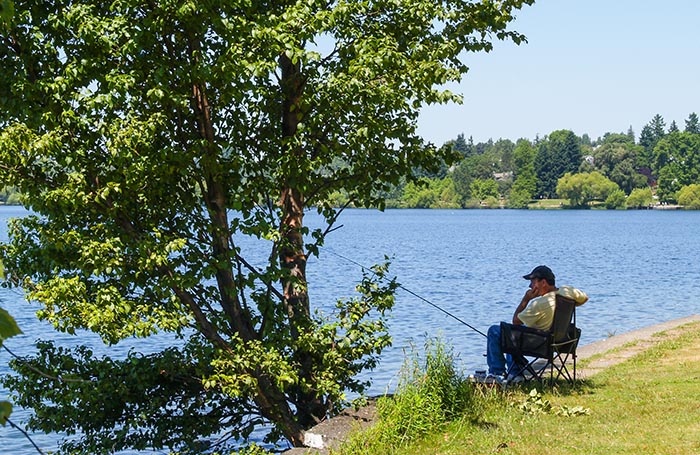
Fisherman at Green Lake, Seattle, where McGregor grew up and had his first tastes of solitude in nature. Photograph: BrianScantlebury / Shutterstock
Solitude, Nature and Travel
.
On his first trip to Patmos, motivated more by the desire to experience self-reliance amid its remoteness than by anything spiritually transformative, McGregor encountered on his walks an old woman with a black shawl and a crippled back, and two boys, each with a goat. The woman was gently trying to stop the boys from pulling at the rope attached to the neck of one of the goats. McGregor stopped to take in her kindness, getting a glimpse of the island’s scenery of compassion. He was learning how to slow down and look for meaning.
On his second trip, Lax, who had become friend and mentor, was long dead. McGregor had been granted permission to live in the poet’s windswept house atop a steep hill. With astonishing frankness, he dismantles the notion of a spiritually idyllic setting. His first dream in the Lax house is pocked with sexual images, his second with thieves.
‘What did the old man see?’ I ask him, ‘that the young man didn’t.’
‘I think the biggest thing the old man saw was that what he had been seeking was around him all along. He didn’t have to go with any kind of agenda.’
I myself have an on-again, off-again relationship with solitude. I see its importance more than I live its truth. I may be quieter now than ever, but it strikes me how little it takes for my mind to turn into a slot machine of self-centred thoughts and urges.
Intimate with the difficulties that keep him from solitude (laziness, social interactions, work obligations), McGregor is practical, yet deep, in his advice to others: ‘It seems obvious to me that in our very busy, very noisy world, just giving yourself a break from that would have to be beneficial. Beyond that, to live a life is to experience the unknown. I think solitude allows you to exist in that unknowing state, to realise a true vision of who you are and what it means to be alive.’
Travel, for both of us, has been a key portal into the unknown. For a long time, I carried within me the ringing silence of the Peruvian altiplano. A crystalline vastness that told you that you had entered into the realm of the mysterious, the sacred, the empty, as there were then few tourists to speak of.
For McGregor, even before his years of travel in Europe, he found the world of nature outside his house. ‘Growing up, I lived near Green Lake (in Seattle). I would go out early on weekday mornings by myself, and had the profound experience of connecting with this natural environment, even if it was created by human hands. In the back of my book, in acknowledgment, I thank all the planners of parks.’
It is a credit that amuses him. He holds his seriousness lightly. He writes in Island that ‘lovers of the wilderness’ may scoff at his confusing a city park for nature, but ‘nature doesn’t care what those people say.’ [p. 85]
He recommends travel to beginners seeking solitude. ‘Travel takes you outside of yourself, into a different culture. It makes you think about things as you never thought about them before, including the relationship with yourself.’ But he cautions: ‘A lot of times people go on a tour, or travel superficially, where the whole idea is to have sensory input all the time. Solitude is a place where you travel by yourself without the need for constant stimuli. You have to say, “I am going to this place and just see what happens.”’
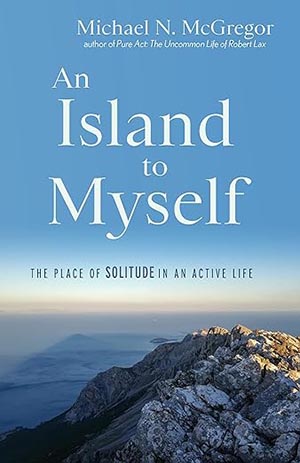 An Island to Myself was published by Monkfish Publishing in the USA in May 2025 and in the UK in June 2025.
An Island to Myself was published by Monkfish Publishing in the USA in May 2025 and in the UK in June 2025.
Robert Hirschfield is a New York-based writer and poet. He has spent much of the last five years writing and assembling poems about his mother’s Alzheimer’s. In 2019, Presa Press published a volume of his poems titled, The Road to Canaan. His work has appeared in Parabola, Tricycle, Spirituality & Health, Sojourners, The Moth (Ireland), Tears in The Fence (UK) and other publications.
Sources (click to open)
[1] MICHAEL N. McGREGOR, Pure Act: The Uncommon Life of Robert Lax (Fordham University Press, 2017).
read more in beshara magazine
More News & Views
Book Review: ‘The Anxious Generation’
Fatima Chaudhry reviews a recent book which explores the effect of smartphones on the younger generation and proposes spiritual elevation as a solution
Reflection: Dad’s Transition
Helen Carolan remembers the death of her father, Sean, aged 80, in County Mayo, Ireland, and the traditional wake which followed
In Memory of Gabriel Rosenstock
Peter Huitson remembers the Irish writer and haikuist who contributed several pieces to Beshara Magazine
April 2026
Gabriel Rosenstock
Don Quixote in Search of the Holy Land
All You Need is Love: The Lasting Legacy of the Beatles
Jane Clark reflects on a recent book and two documentaries about the Fab Four which argue that they were seminal in making us the people we are today
Book Review: ‘spinning pinwheels’
Gabriel Rosenstock rediscovers kokoro (heart) in a new book by the distinguished Indian poet K. Ramesh
FOLLOW AND LIKE US
@Beshara_Mag








——————————————
——————————————
——————————————
If you enjoyed reading this article
Please leave a comment below.
Please also consider making a donation to support the work of Beshara Magazine. The magazine relies entirely on voluntary support. Donations received through this website go towards editorial expenses, eg. image rights, travel expenses, and website maintenance and development costs.
FOLLOW AND LIKE US
@Beshara_Mag
READERS’ COMMENTS
0 Comments