
A Thing of Beauty _|_ Issue 30, 2025
A Thing of Beauty… The Nebra Sky Disc
Susan Bachelder is drawn into the eternal beauty of the cosmos through contemplation of its oldest surviving representation
A Thing of Beauty… The Nebra Sky Disc
Susan Bachelder is drawn into the eternal beauty of the cosmos through contemplation of its oldest surviving representation
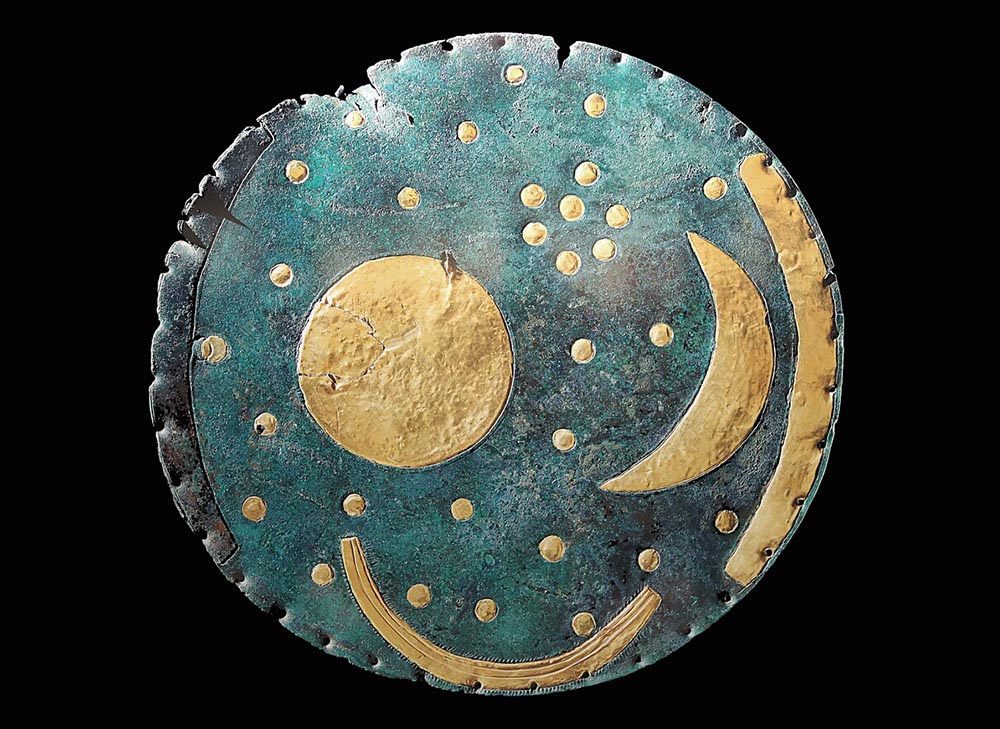
The Nebra Sky Disc is thought to be the earliest concrete representation of the night sky. It was only discovered in 1999, when it was unearthed on a hill near Nebra in Germany by two treasure-hunters illegally using metal detectors. They sold it for profit, but it was eventually acquired by the state and is now on display in the State Museum of Prehistory in Halle, Germany. It has been dated to between 1800 and 1600 BC, making it about 3,600 years old; it is included by UNESCO in its Memory of the World International Register [/]. In this article, Susan Bachelder contemplates our long-standing relationship with the beauty of the cosmos, relating the disc to two other artefacts ancient and modern; an Egyptian papyrus showing the barque of the god Ra on which he traverses the night sky, and the James Webb Space Telescope which is currently exploring hitherto unknown depths of space.
More than a thousand years after the Nebra Sky Disc was forged in bronze and German gold, Socrates sat waiting for Alcibiades to arrive at a dinner party – late, in the high flush of youth, he arrived with the ribbons of races he had won in triumph tied around his thigh (and before his betrayal of Athens and all that it stood for). All at the symposium admired the beauty of his youth, as Socrates related a conversation he had had with the wise woman Diotima.
Diotima was well known to Socrates. In fact she was known to have educated many young men in understanding deeply that when one comes to truly understand love, it will, if one diligently pursues it, ultimately lead to the most profound love of Beauty itself. Many are the paths to love and many spend their lives in search of it, but it was Diotima’s skillful methods in threading together desire and love, which, when well fashioned, could lead us to stand before eternal beauty without desire. The perfect state of love.
Plato’s description of beauty in The Symposium has stood the test of time – for there are certain things we all share, like the profound beauty of the heavens above us, which call us to love; to desire an intimacy with the cosmos in all its mystery and presence; to sail into its embrace. Illustrated in this article are three objects which depict the beauty of the heavens as seen, worshiped and explored over millennia using symbols perennially shared across cultures. Wrought in gold, powered by the sun, these three vessels, separated by time, sail into an eternal night and illuminate its beauty.
The first, the Nebra Sky Disc shows 32 stars, a sun and a crescent moon, all of gold, hammered into a pattern on a bronze disc. Dated at 3,600 years old, it is thought to be the oldest known object showing the Pleiades, a cluster of seven stars positioned here between the sun and moon. Over the course of time, two golden ‘horizons’ were attached on either side of the disc, one now lost, and subsequently a small golden barque was wedged precariously between a few of the stars.
We know now through material analysis that the disc was reworked several times. Gold from different goldmines in the region of Nebra, where the object was found by tomb robbers in 1999, and perhaps even different hands, refashioned the object by adding additional elements. What we do not know, and probably never will, is why. We don’t even know the original intention of the disc let alone what moved others, at unknown later dates, to add more information. And who determined that its fate would ultimately see it ritually buried? Unearthed by thieves thousands of years later, for years the disc was tracked across the globe in an Indiana- Jones-like escapade until finally making its way back to a German museum.
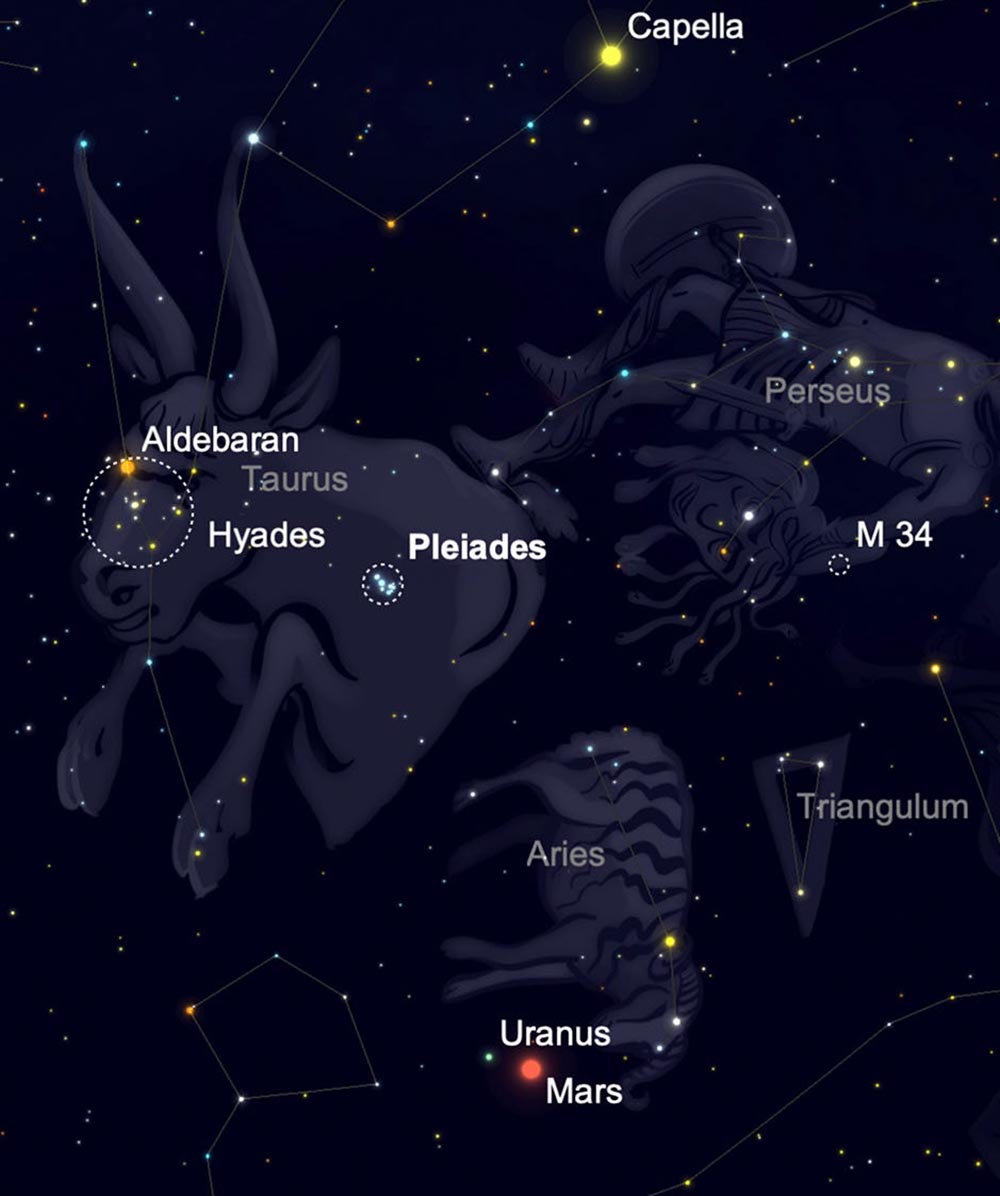
The Pleiades are now known astronomically as M45, a sad dry name for such a storied group of stars. It is one of the most ancient asterisms human beings have noted. Found in Homer, the Old Testament and in the White Tiger constellation of China, it has been called many different names over thousands of years. For sea-faring cultures, the start of the sailing season was at its heliacal rising. Al Thurayya, as it is known in Arabia, announced the start of the heavy rains in pr-Islamic Yemen. It is considered by some to be the star referenced in the Quran’s Surah 53:
By the star when it sets, your companion has not strayed,
and it was and still is found in the third house in Indian and other Asian astrological lunar charts.
The disc places the cluster directly between the sun and moon, which is not where it sits now. But present astronomy can ‘retrofit’ sky charts and we find that 5000 years ago the Pleiades did indeed appear directly on the point of the Vernal Equinox, where the ecliptic and the equator cross and day and night are equal. Therefore, as the disc shows, the cluster sat between the Sun and the Moon for a ‘celestial moment’, until the precession, the gradual shift of the earth’s rotation around its tilted axis, moved it along.
Move your computer mouse over the image to enlarge
The Plaeides are often associated with the Hyades, another cluster constellation proximate to the star Aldebaran, and the two clusters were known as the Golden Gates or the two ‘clashing rocks’ – both gates and rocks being perennial symbols found across time and cultures in fairy tales, religious rituals and myths such as Jason and the Argonauts. The ship Argo was a constellation in antiquity, but was removed from western star charts in the early 18th century.
In western mythology Aldebaran is the red eye of Taurus and its face is the Hyades. But in Arabic astronomy Aldebaran is the red turbaned camel driver, driving the camels of the Hyades. Across Asia, Hyperboria and the Americas, these two clusters have been memorialised in stories and characters far different than our own myth of the Seven Sisters [/], in which the seven stars are seen as the daughters of the Titan Atlas and the nymph Pleione. They are attempting to flee from Orion the hunter, so Pleione’s mother, Gaia, places Taurus the bull in between her daughters and Orion to protect them.
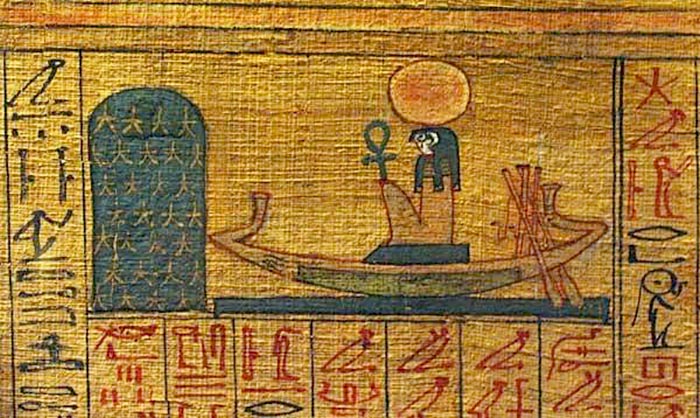
The Barque of Ra traversing the sky. From the Papyrus of Ani, c1250BC, held at the British Museum. Image:
The Barque of Ra
.
The addition of the disc’s ‘horizons’ might have been an attempt to recalibrate the disc and to re-site it for other purposes. For agricultural communities and sailors, the Pleiades can still play a significant role in predicting the rains for crops and herds. But what do we make of the ‘stellar barque’? A journey into the cosmos by a shaman perhaps? Or the final journey of a great chief? Or an attempt to explore the heavens more intimately with Hyperborean Apollo? We do not know its function, nor likely ever will.
We know more about the second ancient image presented here, which shows the solar barque of the Egyptian God Ra and its passage into the Duat (underworld) through a doorway into a starry night. Ra would enter the Duat to challenge the great snake of darkness and chaos, and overcome it every night to rise again in the east. We have far more archaeological and astronomical evidence available now about Egypt than we do about northern cultures. For example, called The Thousands, the Pleiades can be found on an ancient tomb map copied by Sir Flinders Petrie, where it appears near the crossing point of the ecliptic and the equator. So although we are not able at present to weave a story line through this image with more accuracy, the volume of materials available for research gives hope that the connection between golden gates, crushing stones and solar boats will eventually be found.
But can we ever really find the initial creative impetus for these objects? Paul Taylor, the curator of the photographic collection at the Warburg Institute in London, explores in his new book, How Images Mean,[1] how intentionality with an image can slip away as a culture shifts focus, or time moves on, or the earth and the stars themselves shift in their relationships with each other – a phenomenon of which the ancients were aware. In a different context, something can become a potent iconic source for misinformation totally alien to the intention of the original, or meaning can be captured unintentionally in images that had little connective tissue in their alternate iterations.
This could likely be the pattern for the future of the third image presented here, which is that of the James Webb Space Telescope, launched in 2021. This object and its elements carries many sympathies with the first two, but the impetus for its creation is entirely different. And yet in five hundred years, a thousand years, who can say whether the intentions of these three images will be misconstrued or conflated, or interpreted in newer and even more fascinating ways.
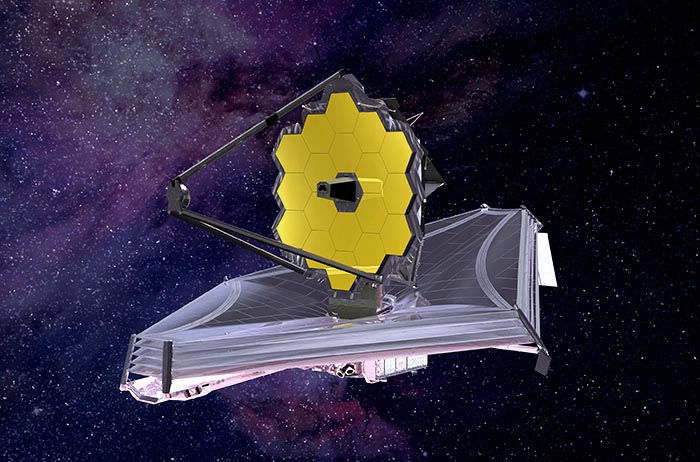
The James Webb Space Telescope – Cold Side. Image: NASA [/]
The Voyage of the Webb
.
In this image, the Webb telescope is ‘visioned’ on its cosmic voyage – a ‘barque’ of five sheets of wafer-thin aluminium veils shielding the telescope from the scorching rays of the sun. The 18 hexagons of gold stationed around the eye of the scope turn its face away from the sun and into the sub-zero temperatures of the darkness, looking, like Ra, into the chaos of space and sending messages back to us here on earth about the wonderful and glorious things that are there for us to experience in the Duat. Do we dare to go there and take our ship, as Jason did, and sail these unknown celestial seas through the narrow gate of the Pleiades and Hyades? Or as the Webb does, sail the halo orbit of Lagrange Point 2 on the opposite side of the sun? This sweet spot, which suspends the telescope in a static position for viewing, is a glory of geometric balancing, masterfully brought to safe harbour by contemporary Jasons.
The Webb captures and reflects back to us the beauty of the ancient cosmos – our beauty before we separated ourselves from our world with a definite article and decided to call it ‘the Cosmos’, a separation from the truth of reality the Greeks never knew. A cosmos that is eternally present. Continually desired, loved and worshiped over countless aeons in 84,000 ways and perhaps more. As expressed in the 99 names of God, and perhaps more. Eternally effulgent. Beauty eternal and unattached to any thing or any time. As Dante says when he reaches the end of his high fantasy in Canto XXXIII of the Divine Comedy and sees that both his will and his desire are now uniformly participating in heavens’ grand design – ‘moved by the Love that moves the sun and the other stars’.
After a 30 year career in international film and advertising, Susan P. Bachelder presently works with the Sozzani Ruhs Foundation of Milan and Paris as English text editor on projects for the Galleria. As a long-standing member of Dark Sky, her personal interests in retirement have been focused on protecting and promoting star gazing in our classic understanding of this art, and she is presently engaged in supporting the development of dark sky parks in Bhutan.
Image Sources (click to open)
Banner: Nebra Disc, 1800–1600 BC, at the State Museum of Prehistory in Halle, Germany. Photograph: Frank Vincentz via Wikmedia Commons.
Other Sources (click to open)
[1] PAUL TAYLOR, How Images Mean: iconography and metaiconography (Paul Holberton Publishing, 2025).
The text of this article has a Creative Commons Licence BY-NC-ND 4.0 [/]. We are not able to give permission for reproduction of the illustrations; details of their sources are given in the captions.
FOLLOW AND LIKE US
@Beshara_Mag








——————————————
——————————————
——————————————
FOLLOW AND LIKE US
@Beshara_Mag
If you enjoyed reading this article
Please leave a comment below.
Please also consider making a donation to support the work of Beshara Magazine. The magazine relies entirely on voluntary support. Donations received through this website go towards editorial expenses, eg. image rights, travel expenses, and website maintenance and development costs.
READ MORE IN BESHARA MAGAZINE

The Grandeur of the Night Sky
Hannah Dalgleish invites us to rekindle our ancient relationship with the night at a time when light pollution is becoming a global disruption

A Thing of Beauty…
Jane Clark contemplates the view of Earth from the moon, first captured in the famous photograph ‘Earthrise’

The Future Prospects for Humanity
Martin Rees, the Astronomer Royal, on the threats to our survival in the 21st century, and the need to take a cosmic perspective
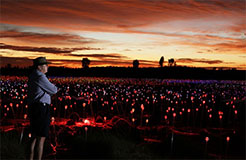
The Field of Light
Bruce Munro’s art installation at Uluru (Ayers Rock)
READERS’ COMMENTS
Indeed beautiful…
Beautiful simplicity along with its inclusions.
Written with great integrity. Thank you.
Complete explanation of all design elements of the disk at: dcwalley.com/sky-disc
Beautifully written, Susan. The Nebra Sky Disc truly connects us to the timeless beauty of the cosmos.