
Science & Technology _|_ Issue 29, 2025
Listening to the World
Eminent biochemist Professor Pauline Rudd talks about communication, participation and cooperation in nature
Listening to the World
Eminent biochemist Professor Pauline Rudd talks about communication, participation and cooperation in nature
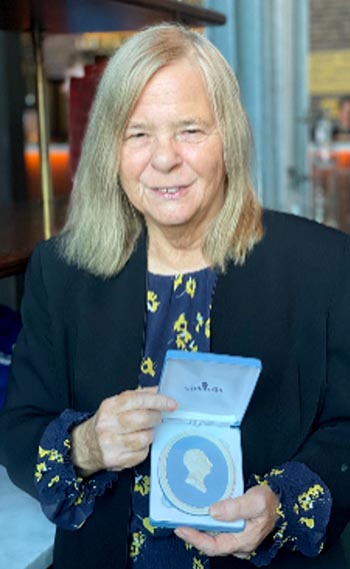
Dr Pauline Rudd has had a long and distinguished career in science. An Emeritus Professor at the University of Dublin, an MDhd from the University of Gothenburg and a member of the Oxford Glycobiology Institute for 23 years, she has received a clutch of awards for her work, including, this year, the prestigious Torbern Bergman Award for Analytical Chemistry. But she has also had a life-long commitment to the Christian contemplative tradition and over the years has given hundreds of talks on science and religion, including the first lecture at the start of the season at the Chautauqua Institution [/] and the final after dinner talk at the State of the World Conference (The Millenium Summit) in 2000 in New York [/]. In this article she talks to Jane Clark and Peter Huitson about the convergence of science and contemplation in her life; her insight into what she calls ‘the gifts of the spirit in other-than-human creatures’, and the need for us to establish an ‘I-thou’ relationship with the natural world.
Jane: Before we approach our main topic of communication in – and with – the natural world, could you give us an idea of your background. You are working scientist but also a very committed Christian and meditator?
Pauline: When I first went to university, I was really torn because I wanted to do science, but at the same time, I was drawn to the religious life. And thirdly, on the first Sunday I was there, I met an ordinand and we fell in love. I wanted to marry him and have a family. At that time, in the early 60s, it was not considered possible to do more than one of these things. My mother said: well, if you have children, you’re not going to have time for anything else. I went to my professor and he said: there’s no hope for you in science if you get married. I went to the convent and the Mother Superior said: well, if you come in here, you’re not going to do science or have children. So make your mind up, girl!
But I thought: how can I deny two parts of myself in order to follow just one path? So I made a vow that I would pursue all three directions in my life and that I would intertwine them like a plait. I had no idea how I was going to do it. But remarkably, that’s what my life’s been about.
Jane: Before we approach our main topic of communication in – and with – the natural world, could you give us an idea of your background. You are working scientist but also a very committed Christian and meditator?
Pauline: When I first went to university, I was really torn because I wanted to do science, but at the same time, I was drawn to the religious life. And thirdly, on the first Sunday I was there, I met an ordinand and we fell in love. I wanted to marry him and have a family. At that time, in the early 60s, it was not considered possible to do more than one of these things. My mother said: well, if you have children, you’re not going to have time for anything else. I went to my professor and he said: there’s no hope for you in science if you get married. I went to the convent and the Mother Superior said: well, if you come in here, you’re not going to do science or have children. So make your mind up, girl!
But I thought: how can I deny two parts of myself in order to follow just one path? So I made a vow that I would pursue all three directions in my life and that I would intertwine them like a plait. I had no idea how I was going to do it. But remarkably, that’s what my life’s been about.
Jane: So you thought about entering into a convent before you took a science degree?
Pauline: Yes. Then, when I was at university, I used to spend some part of every holiday in the Community of St Mary the Virgin in Wantage doing odd jobs. I worked in the home for the elderly, or helped with the garden, or did some cooking or whatever else needed doing. At that time, many of the sisters had been at Oxford – Sister Penelope, for instance, who was mentored by C.S. Lewis and still corresponded with him. They were women of huge intellectual stature, and I loved being with them – and I loved their library. My solution to the problem of how to live three lives at the same time was to become an associate of the convent, as I am still today.
Jane: And your science subject was biology?
Pauline: Chemistry. In fact, I always wanted to do biochemistry, but in those days, biochemistry was a weak option. Before the discovery of DNA, anything biological was somehow perceived as a descriptive activity associated with skills like painting and sketching, not a hard science. So my headmistress advised me to do a ‘pure’ science to start with.
But also, when I was at school, I was crazy about chemistry. I used to go up and down the pharmacies and beg for some potassium permanganate or sulphuric acid, or whatever I wanted, to do my own experiments. Of course, they were very reluctant to give a 14-year-old a bottle of sulphuric acid! But there was one pharmacist who was more generous than the rest, and one day he said to me: You should meet my son. He’s just as crazy as you are. So I went upstairs to the flat above the pharmacy, and there was this guy called Peter making Glucose-1 Phosphate using an enzyme from potatoes.
He was three or four years older than me, and he obviously didn’t want a kid there. So I stood against the wall and said: ‘if I don’t say anything, can I just watch?’ I used to go back day after day. He only had very basic equipment – buckets and washing machines, rubber tubing and a few bottles and corks. He used some ordinary household taps with a tube on the end and a suction arm to create a vacuum. One day, this thing fell apart in his hands, and water was spraying everywhere. He didn’t have enough hands to hold it back together, so for the first time, I was actually useful.
After that, we got on really well together, and with the help of his family, we ended up starting a small company, Wessex Biochemicals, which was probably the first British biotech company. Eventually we were taken over by Sigma Chemical Company (now Sigma Aldrich) and we continued to run the science, acquiring the site in Poole where Sigma are still.
Jane: You founded this when you were still in your teens?
Pauline: Yes. We made rare sugars and sugar phosphates out of natural products, mostly. We worked in the flat over the pharmacy, but then we got a bit too big for that. My father was an architect, so we bought an old laundry and he did the plans to convert it into laboratories. We had both returned from university by then, and we started to build the company quite seriously. After a few years, I had a baby and I took him into the lab as long as he’d sit still in a seat. But when he grew older, they built me a lab at home. I was married to a vicar, so we were in the curate’s house. I worked in an upstairs bedroom using hopefully nontoxic plants, such as sedum spectabile which I grew in the garden, to make all sorts of rare sugars and sugar phosphates.
But then we moved, and by that time we had four children. It wasn’t really realistic to work at home anymore, so I had a 15-year career break to bring the kids up.
Peter: You eventually got back into scientific work at the University of Oxford?
Pauline: Yes. At first, I got a job as a glass washer, because after such a long break I no longer regarded myself as a qualified scientist, and also, it was in general very hard for women to get jobs in academic research at that time and I did not have a PhD. After a year or so, there was an advert for a Grade 1 technician, so I applied for it. The departmental administrator said to me: we don’t understand why you would want to change your job. I mean, you’re the best glass washer we’ve ever had. That’s how scientifically low I stood in people’s esteem!
But fortunately, Raymond Dwek, who had advertised the job, was more insightful than the administrator, so I joined the Glycobiology Institute, and over the next ten years, I worked my way through every single technician’s grade. Eventually, I became a research assistant and ended up as a University Reader. But in 2005, I was forced to leave Oxford because I had reached their official retirement age. I felt that I was only at the beginning of my real career – I had only been awarded my PhD with the Open University in 1995. So when I was offered a position by University College Dublin to take all of our equipment and my whole research team (11 people, their partners, children and dogs!) to build a Glycobiology Research Group in the National Institute for Bioprocessing Research and Training, I took the job. It was very challenging, but it gave all of us a wonderful opportunity to work with many large pharmaceutical companies manufacturing new biological drugs like monoclonal antibodies.
Jane: The last twenty years have been among the most productive of your career. You received an honorary doctorate from the Salgrenska Institute, University of Gothenberg; the Karger award for developing new methods in Analytical Biochemistry; the international Glycoconjugate Medal for contributions to glycobiology, and have now just been awarded the prestigious Torbern Bergman Award [/] for your pioneering work on the analysis of sugars attached to glycoproteins.
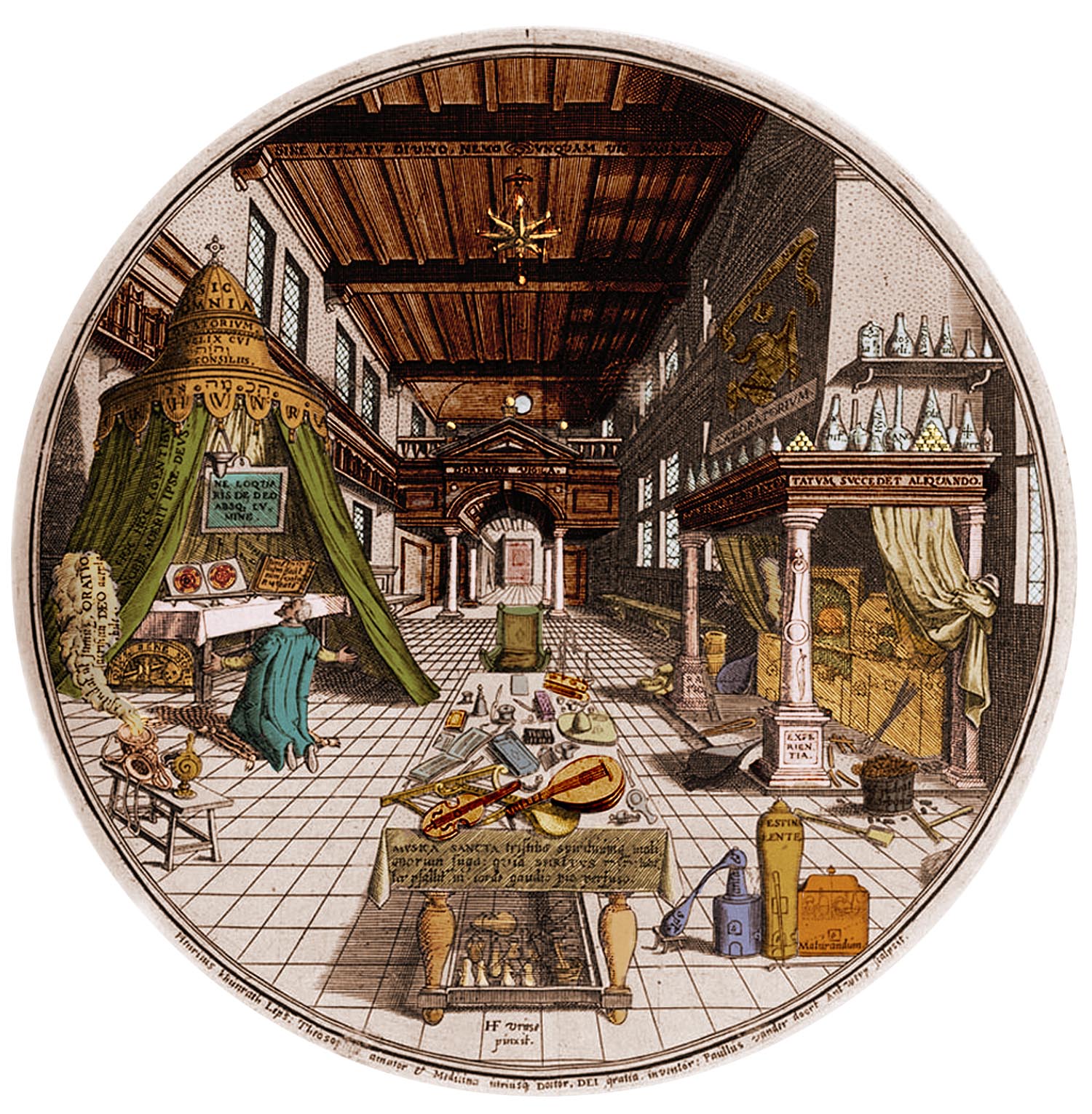
The Alchemist’s Laboratory, credited to architectural painter Hans Vredeman de Vries, showing the workplace of the German philosopher and alchemist Dr. Henricus Khunrath (1560–1605). From Amphitheatrum Sapientiae Aeternae (1595). Drawing: Science History Images [/] / Alamy Stock Photo.
Move computer mouse over image to enlarge
Science and Contemplation
.
Peter: One of the things you’ve talked about is the fact that you’ve never found a contradiction between doing science and your continued deep commitment to the contemplative life.
Pauline: When I was in my mid 20s, I picked up a book on alchemy by Holmyard.[1] It’s a classic textbook, and it completely gripped me. I think what inspired me was the idea that for nature to reveal itself to us, we need to have particular life qualities. In their laboratories, medieval alchemists had their chemical equipment, but they also had musical instruments and paintings and in the middle of it all, they had a prayer desk. There was a sense of integration of every aspect of life, and it made me see that in order to be worthy for nature to reveal itself to us, we have to pursue a particular kind of life; we need to take the dross out of it, basically. So I’ve always seen science and religion as two parts of a big whole. There might sometimes be intellectual challenges in reconciling the two, but in my heart, I know that they’re both part of the holistic world that we live in.
Jane: You’ve also talked about the fact that in the practice of science, you feel that there’s a very strong contemplative aspect?
Pauline: I do think this, and I think that many scientists, although they may not express it in these terms, actually feel the same. But people don’t talk about it very much, because by the time they’ve written up a finding, when they come to publish, it’s no longer relevant. But for me, when I’m tackling a scientific problem, I am using the same practice that we use in contemplative prayer, where the intention is to empty ourselves of any preconceived ideas that we might have.
For example, when I first get a problem that I think is worth pursuing, I start by planning out how to tackle it. And every day, I throw away that piece of paper and do it again, and eventually the first four or five steps become clear. Then I move on to the next set, and the next, etc. It’s an evolving thing. I don’t suddenly wake up one morning and see it all tabulated. And the spiritual life is a bit like that as well. We repeat the first steps and then we get a bit further and then we have to go back and repeat them again; it’s an evolving process.
But the most profound parallel, I think, is when I’ve done all the experiments and I’ve set the instruments running. I’ve gone home and had something to eat, and then come back late in the evening to watch the data come out. It’s usually dark and there’s nobody else around. It’s just the lights of instruments, and I’ve probably only lit the corner that I’m working in. Then the data comes in, and it’s at this point that I need my mind to be free of preconceptions, because it’s very easy to read into the data what we think we’d like to see. So, to me, it’s really important to de-clutter my mind and just let the data speak to me. And this is what we do in contemplative prayer – or at least, we try to. The idea is that our mind is so clear that we can become aware of the deeper things in our psyche or our relationship with God or whatever terms you want to use.
So what I have learned in the contemplative life, I simply apply to my science, and what I learn in my science, I take into my contemplative life.
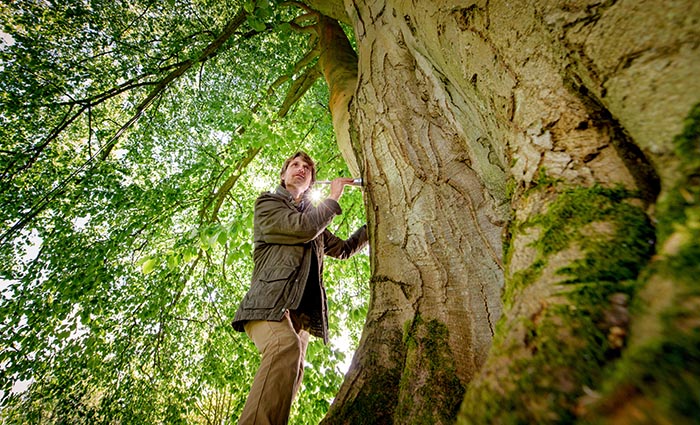
Alex Metcalf, founder of The Tree Listening Project [/] with his unique tree-listening trumpet, at the Wakehurst Estate run by Kew Gardens in UK. Photograph: Jim Holden/Alamy Live News
Living with Nature
.
Jane: You’ve also spent some considerable time in solitude, and your interest in nature – and what nature is trying to communicate to us – has been sparked by what you found during these times of retreat.
Pauline: I’ve always liked to live somewhere where I’m in touch with the natural world – where there’s access to water or something like that. But when I was in Ireland, it was the time of the Covid pandemic. We had strict regulations around travel, and I was isolated in the mountains in the Wicklow National Park, which is very remote. I hardly saw anybody except when I went for a walk; then we’d wave at each other, standing ten feet apart.
But what I did get to know was the wildlife around me in a way that I think would be impossible here in the town. I counted 22 species of birds one year in my garden. There was a fox that came through every night and I used to feed it, and deer. They were so used to me, they’d just bring their fawns in and stand in front of the window and feed them. The blue tits would come and peck on the window when the bird feeder was empty. They all just absorbed me into their lives.
And then I began to really listen. I’d go for a walk and put my ear against a tree trunk. You can hear the sap rise. You can hear the noises inside the tree. I discovered that the same skills that I had been working with in my science and in my contemplative life could be used to interact with the trees or the clouds or whatever. It became a matter of opening myself up and clearing out the chatter in order to make space to hear what the rest of the world was trying to say to me. I recognised that the world around me was trying to include me in their world, but I didn’t have the language to communicate well.
Peter: So that’s how you became interested in communication between different species?
Pauline: Yes. I saw how the trees, if they sensed that I was upset, would in some way enfold me, and the other animals would move apart a little bit to accommodate me as I walked. Every year, I would watch the swifts and swallows coming in from Africa in the spring. There were masses of birds in the garden, and all of them had their own territory. But they always seemed to make way for the next lot of migrants that came in. They just moved around a bit to make space. Most of the time they all lived together pretty harmoniously.
Then I was asked to give a talk to the International Society for Science and Religion (ISSR) [/], and at first I did not want to talk about what I had been discovering. But when I started to explore it further, I thought it was very fruitful. I came down to just thinking about the gifts of the spirit in other-than-human creatures.
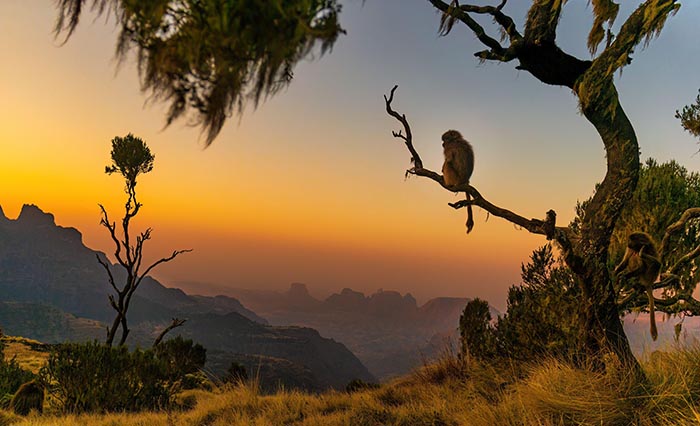
A Gelada Baboon watching the sunset in the Ethiopian highlands. Photograph: Christian Offenberg [/] / Alamy Stock Photo
Entering an I-Thou Relationship
.
Jane: In the talk you gave to the ISSR, you say that the natural world continually calls out to us to enter into an I-thou relationship, which I thought was a lovely way of seeing this matter of communication.
Pauline: ‘I-thou’ is, of course, a phrase coined by Martin Buber [2] – it’s the title of his most famous book. I think this is a very important way of understanding how we view the world.
Jane: Buber talks about us having two modes of relationship: ‘I-it’, which objectifies the external world, and ‘I-thou’, which puts us into a personal relationship with it.
Pauline: Yes. What I want to convey to people is that it is not just a matter of watching nature but knowing that we are part of it. We’re not observing from the outside, but we are an integral part of the natural world. All our genes are very ancient; we share them with all other creatures. 60% of Drosophila genes – the fruit fly – have homologies in humans, you know. And also, if we believe in what the spiritual traditions tell us, we are all made by the same spirit, part of the train that filled the temple in Isaiah’s vision of God. So we have these two hugely important planks of our lives in common with the whole creation.
Nature is far more intelligent than people often think. Elephants raise their trunks to the moon – they’re in awe of the universe around them. Chimps stop to watch the sunset. There are dozens of examples of animals appreciating each other and the natural world, understanding how the seasons work, how to treat disease, and so on. So my plea is that people come to understand what richness there is apart from human beings and their incessant desire to take from creation more than we need. The rest of the world is connected, but somehow we’ve grown apart and severed the link.
Jane: You don’t think that they have given up on us because of our bad behaviour?
Pauline: I know that many animals are really afraid of human beings now, and so they’re programmed to run away or attack us. But certainly, with the wildlife in the mountains in Ireland, there’s no sign of aggression. If you interfere with their nests, the birds will, of course, be aggressive. But if you just behave normally, they’re totally accepting. And other creatures know when human beings are there to help them. In Africa, at animal rescue centres, the animals will come in if they are injured, if they’ve got barbed wire around them, or some other problem they can’t solve. They come of their own accord because they know that people will help them out.
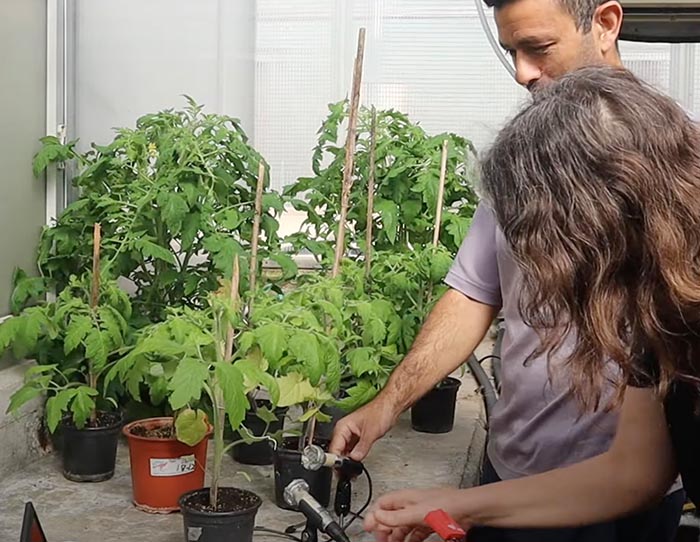
Scientists at Tel Aviv University, Israel, recording the sounds emitted by tomato plants. Image: YouTube [/]
Listening to the World
.
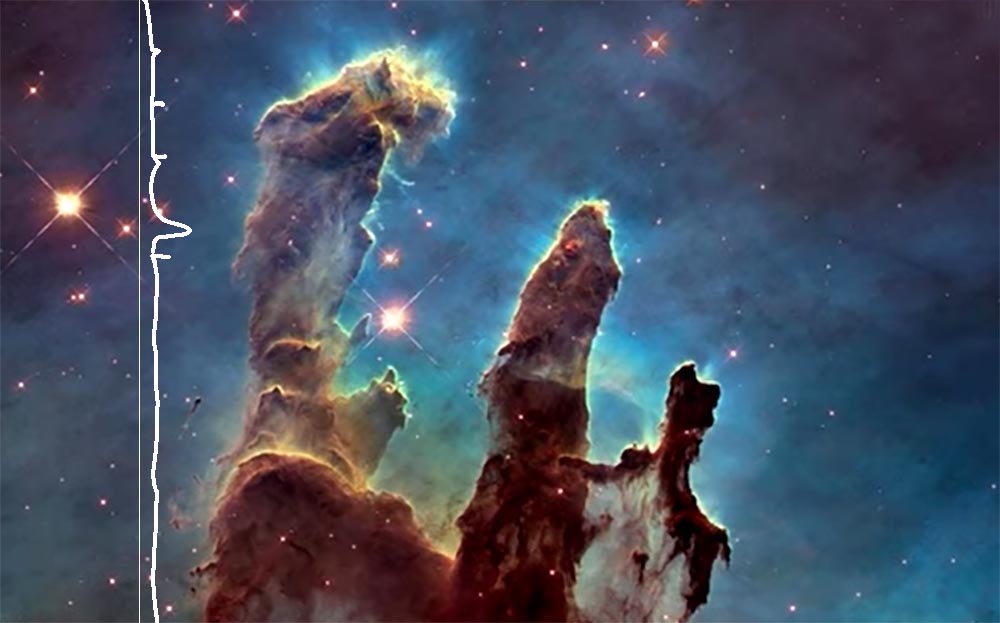
Jane: One of the things you have drawn out is how technology is allowing us now to listen to some of the sounds that things make. We may ’hear’ them intuitively inside ourselves in contemplation, but we now also have this other means of tuning in. For instance, there is a recording made by NASA of the sound made by the ’Pillars of Creation’ Nebula (see video right or below).
Video: The Pillars of Creation, duration 00:39
Pauline: It’s wonderful, isn’t it? This has come from the Hubble Telescope. They take all the electromagnetic waves and the other emissions that are in ranges beyond our normal senses, and convert them into sound so that we can hear them. I just think it’s absolutely beautiful. It reminds me of Psalm 19, which has the lines:
The heavens are telling the glory of God
and the firmament proclaims his handiwork.
One day pours out its song to another
and one night unfolds knowledge to another.
They have neither speech nor language
and their voices are not heard,
Yet their sound has gone out into all lands
and their words to the ends of the world.
It’s the same with the whole of nature. If you put a microphone into a pond, the cacophony of noise that’s going on between the different species is amazing. We could never hear it before, but now we can through the amplification of the sound. Everything is ’speaking’. We know that even electrons can communicate across the universe.
Jane: Learning that things make sounds is one thing, but seeing that as meaningful communication – a kind of speech – is a further step that scientists have only started to take quite recently. It’s only in the last fifty years or so that there has been any real research which verifies it. Do you think that it is now quite widely accepted?
Pauline: Some things, like whale songs, have become quite well-known. They were discovered in the 1960s, and you don’t need much imagination to hear there’s a language there. Now we even know that whales that go up and down the east coast of Australia speak a different language from the ones going down the West coast. And when they meet, they exchange words.
Jane: You describe how scientists at Tel Aviv University have done research into the sounds made by plants, and shown that they make different noises when they are experiencing different kinds of stress. So basically they are sending out distress signals. We don’t hear these because they are in the ultrasonic range which we are not attuned to, but other creatures may (see video right or below).
Video: Global Breakthrough! Plants Emit Sounds, duration 3:34
Pauline: Yes, the problem is that we don’t necessarily hear what things are saying because every species has different receptors and different ways of making sounds or sending out waves or whatever it does. I have a dream that one day we could make a huge mind map and put every species onto it. Then against each one we could put what capacity it has to send out signals – light signals or sound or radio waves or whatever. And on the other side, we would ask, what receptors does this species have? Oh, this one can hear radio waves, so this thing over here, which gives out radio waves, is able to communicate with it and maybe evoke a response.
We would then have this massive, crisscrossing mind map showing all the things that are able to talk to one another. I think it would be amazing to do that. It’s perfectly feasible to begin even now. It’s just complex. So it’s a challenge for the next generation.
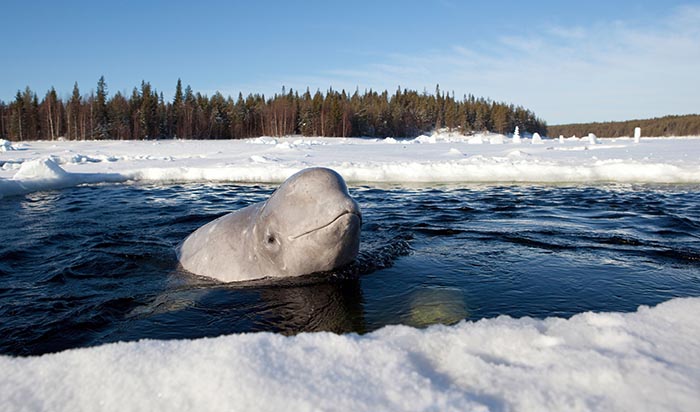
Beluga Whale in the White Sea, Russia. They use their heavy heads to punch holes in the artic ice, allowing other sea creatures such as narwhals and seals to feed. Photograph: WaterFrame [/] / Alamy Stock Photo
Intelligence and Cooperation
.
Peter: So, alongside the fact that everything is ‘speaking’, you talk about how animals and plants show intelligence in all sorts of other ways, particularly in the way they co-operate with each other.
Pauline: I recently went through the Northwest Passage in the Arctic, which is very remote. Humans have no place there; the whole thing runs without any need of us whatsoever. There you can see clearly how these species work together. They have to in order to survive. A really nice example is the beluga whales, which have huge heads half the size of their bodies. They’re like lumps of concrete. So in the winter, they can get underneath the ice and punch holes in it. Behind them come the narwhals – which have very fragile tusks; there’s no way they can penetrate the winter ice – and the seals. So the whales make the holes, and then these other species can feed.
Another very famous example is the relationship between the honey bird and the honey badger and humans in Africa. The bird knows the location of all the bee hives in its territory, but it is unable to break into them to get at the honey. So it leads the badger, who has strong, sharp claws, to them, and then feeds on what it leaves behind. They will also guide people to the honey, which is then shared by all (see video right or below).
Video: The Honey Bird Guide, duration 1:29
There are many different examples of this kind of cooperation. There’s this whole sort of interconnected network of creatures that operate way beyond the areas where humans have an impact. It’s the same with trees; as is now quite well-known, recent research has shown how they are interconnected through networks of mycorrhizal fungi and help and support each other by passing on nutrients or giving warnings if one tree is under attack. Mother trees look after their offspring and the weaker trees. Within our own bodies, our cells communicate and cooperate with each other in order to protect us from infection. Our brains synchronise with other people’s in intense situations such as mothers’ beast-feeding their babies or during communal prayer. We are so interconnected.
Jane: There is also research that shows that non-human species can show high degrees of emotional intelligence.
Pauline: In fact, it is possible that some species are even more emotionally developed than we are. Research, for example, has shown that in orca whales, the areas of the brain devoted to emotion are very much enlarged (for more click here [/]). One of my favourite examples of emotion in animals is a video of an octopus interacting with an underwater robot taken from the BBC documentary The Spy in the Ocean (see video right or below), which also shows just how amazingly intelligent and inventive these creatures are.
Video: Robotic Spy Octopus Lends a Helping Hand, duration 4:00
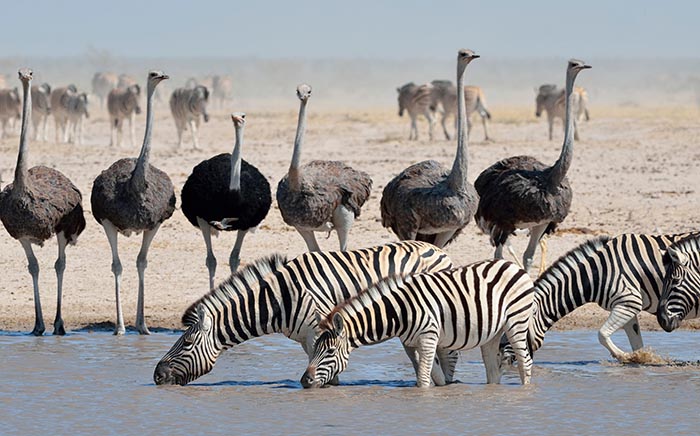
Burchell’s zebras drinking at a waterhole, Etosha National Park, with ostriches standing by. Ostriches have poor eyesight but a highly developed sense of smell, while zebras see well but have poor smell. By grazing together, they offer each other much greater protection. Photograph: J-Francois Ducasse [/] / Alamy Stock Photo
Healing Our Wounded World
.
Peter: You see this kind of understanding as leading to a different attitude, which would allow us to heal what you call ‘our wounded planet’.
Pauline: Definitely. If we take the time to watch the natural world and see how we can fit into it – listen to what it is saying – rather than plunging in with preconceived ideas, then maybe we can find ways of being genuinely useful rather than destructive. These species are very experienced in living in this world, and they’ve got agency themselves. They don’t necessarily need us. So we need to hold off a bit and just allow them to be themselves. People say: let God be God. Don’t try and tell God how to run the world. And the same with creation. Let’s stop telling creation how it should be.
I can see this process even in my garden. It knows how to organise itself. I do a bit of pruning here and there, but mostly it’s stable. It doesn’t need me to keep going around with fertiliser or insect repellents or any of these things, because nature has its own balanced system. Again, I see a parallel with contemplative prayer. We need to be open and not try to dictate what’s happening – just to recognise what there is that we don’t understand and learn from it.
Jane: I think there probably are interventions that we need to make, but very often we’re not making them from the right place. If you’re in your garden in a state of contemplation and it occurs to you that this or that needs cutting back, the action is actually coming from a different place than when you go in with a fixed idea of what the garden should be like. I think that all the indigenous traditions of the world would see their job as helping and aiding like this.
Pauline: Yes. I think that’s a profound way to garden. We now think that agriculture developed because people saw clumps of grass which had heavier seed heads, and they cleared a space around them so they would grow. It wasn’t that they actively planted it or manipulated the genes; they just made space for the clumps to grow. And I think that that’s also a good way of looking at gardening; it’s a matter of clipping this bush back because this little plant here doesn’t have enough light, and so on.
Peter: I wonder if you would relate what you are saying about our attitude towards nature to what Iain McGilchrist says about the two sides of the brain. What you seem to be talking about is what he calls ’right brain’ consciousness, so that in stillness we can actually listen and hear what is being said to us.
Pauline: Absolutely, yes. I think that if you’re a creative scientist, you’re using your right-hand brain all the time. You understand everything in a cloud long before you can articulate it. I can have a picture of what a particular molecule might be doing – well, it’s not really even a picture; it’s as if I am the molecule. I understand how it works. But you can’t do anything with that knowledge because there are no words, no rules. So I need to bring it into the left-hand side of the brain in order to articulate what I intuitively know, and then I can design an experiment to test the idea. The two sides of the brain work together, but it all begins in the right-hand brain.
Jane: McGilchrist would argue, and I would very much agree with him, that as a culture we have fallen into thinking that we will solve everything with the left brain, and we tend to dismiss things like art and poetry as significant ways of seeing the world. One of the results is that science has become very dominant.
Pauline: I think the idea that science will solve everything has been a bit of brainwashing, really. My uncle was a nuclear physicist. After the bombs were dropped in Japan in 1945, Robert Oppenheimer said: Physicists have sinned. This was very sobering, and my uncle was really affected by it. Then the next generation came along, and the chemists gave us plastics and many other wonderful things. But look at what the unintended consequences have been!
And now biologists are concerned because we have invented all these tools for looking into the genome, for example, and we’re aware that we might create similar situations in our own field. So I think it’s really important that we all engage in the discussion about how these amazing insights should be used. We should stop thinking in what has become the default left-brain way and learn to work with both sides of the brain.
Peter: In fact, many of the nature poets have sort of been looking in this direction for much longer than science has. You end your talk to the ISSR with a quote from Wordsworth, from Tintern Abbey, which I feel vividly describes the sense of everything being infused with the same spirit:
And I have felt
A presence that disturbs me with the joy
Of elevated thoughts; a sense sublime
Of something far more deeply interfused,
Whose dwelling is the light of setting suns,
And the round ocean and the living air,
And the blue sky, and in the mind of man:
A motion and a spirit, that impels
All thinking things, all objects of all thought,
And rolls through all things.
Pauline: I think Wordsworth and other nature poets like John Clare – who was somewhat dismissed as a poet in his lifetime – really understood this approach to nature. It is a matter of just being there, being quiet and listening. And creation will speak to us and we will hear.
Jane: Pauline, thank you so much for talking to us about this fascinating subject.
Image Sources (click to open)
Banner: The Pillars or Creation Nebula, also called The Eagle Nebula, showing the sound that it generates. Image: NASA.
Inset: Pauline receiving the Torbern Bergman Award in June 2025. Photograph: Courtesy Pauline Rudd.
Other Sources (click to open)
[1] J. HOLMYARD, Alchemy (Penguin, 1968).
[2] MARTIN BUBER, I-Thou, translated by Ronald Gregor Smith (T. and T. Clark. 1937).
The text of this article has a Creative Commons Licence BY-NC-ND 4.0 [/]. We are not able to give permission for reproduction of the illustrations; details of their sources are given in the captions.
FOLLOW AND LIKE US
@Beshara_Mag








——————————————
——————————————
——————————————
Video: The Pillars of Creation, duration 00:39
Video: Global Breakthrough! Plants Emit Sounds, duration 3:34
Video: The Honey Bird Guide, duration 1:29
Video: Robotic Spy Octopus Lends a Helping Hand, duration 4:00
FOLLOW AND LIKE US
@Beshara_Mag
If you enjoyed reading this article
Please leave a comment below.
Please also consider making a donation to support the work of Beshara Magazine. The magazine relies entirely on voluntary support. Donations received through this website go towards editorial expenses, eg. image rights, travel expenses, and website maintenance and development costs.
READ MORE IN BESHARA MAGAZINE
A Biology of Wonder
An interview with scientist Andreas Weber, whose radical ideas are transforming our understanding of nature
Review: Finding the Mother Tree
David Hyams reviews Suzanne Simard’s book about the intelligence and cooperative behaviour of trees
The Matter with Things
Dr Iain McGilchrist discusses his most recent book which brings together neuroscience, psychology and philosophy into a unified vision
Entangled Life
Dr Merlin Sheldrake talks about the remarkable world of fungi, and what they can tell us about ourselves and the interconnectedness of the world
READERS’ COMMENTS
Another superb interview. Thank you!
What examples does Rudd give to demonstrate communication and cooperation among animals, plants, and other parts of nature?
So valuable is this information to share and be in it,thankyou so much.